
A functional analysis observation form organizes what happened during each condition. It does not, by itself, establish function. Learn what to record, how to compare the form with ABC observation, and how to protect data quality.
Table of Contents
- What Is a Functional Analysis Observation Form?
- What Should Be Defined Before Observation?
- Which Fields Belong on the Form?
- How Is It Different From an ABC Observation Form?
- What Does the Observer Record During Each Condition?
- Why Do Condition Labels Matter?
- How Should You Summarize the Completed Form?
- What Does a Functional Analysis Observation Form Prove?
- How Can Data Quality Be Protected?
- What About Safety and Ethical Limits?
- How Should a BCBA Candidate Study This Topic?
- Key Takeaways
- Sources and Further Reading
- Quick Review Checklist
- Take the Free BCBA Mock Exam
When a BCBA candidate searches for a functional analysis observation form, the real need is usually bigger than a blank sheet. The learner wants to know which events matter, how condition labels relate to an experimental question, and how a completed record supports—not replaces—analysis. A useful form makes the observation easier to conduct consistently without pretending that a grid can make the clinical decision for you.
Functional analysis (FA) and functional behavior assessment (FBA) are related but not interchangeable terms. An FBA is a broader assessment process. A functional analysis systematically arranges conditions and measures behavior to test hypotheses about function. The form should therefore match the design, target behavior, safety plan, and measurement system selected by a qualified professional.
What Is a Functional Analysis Observation Form?
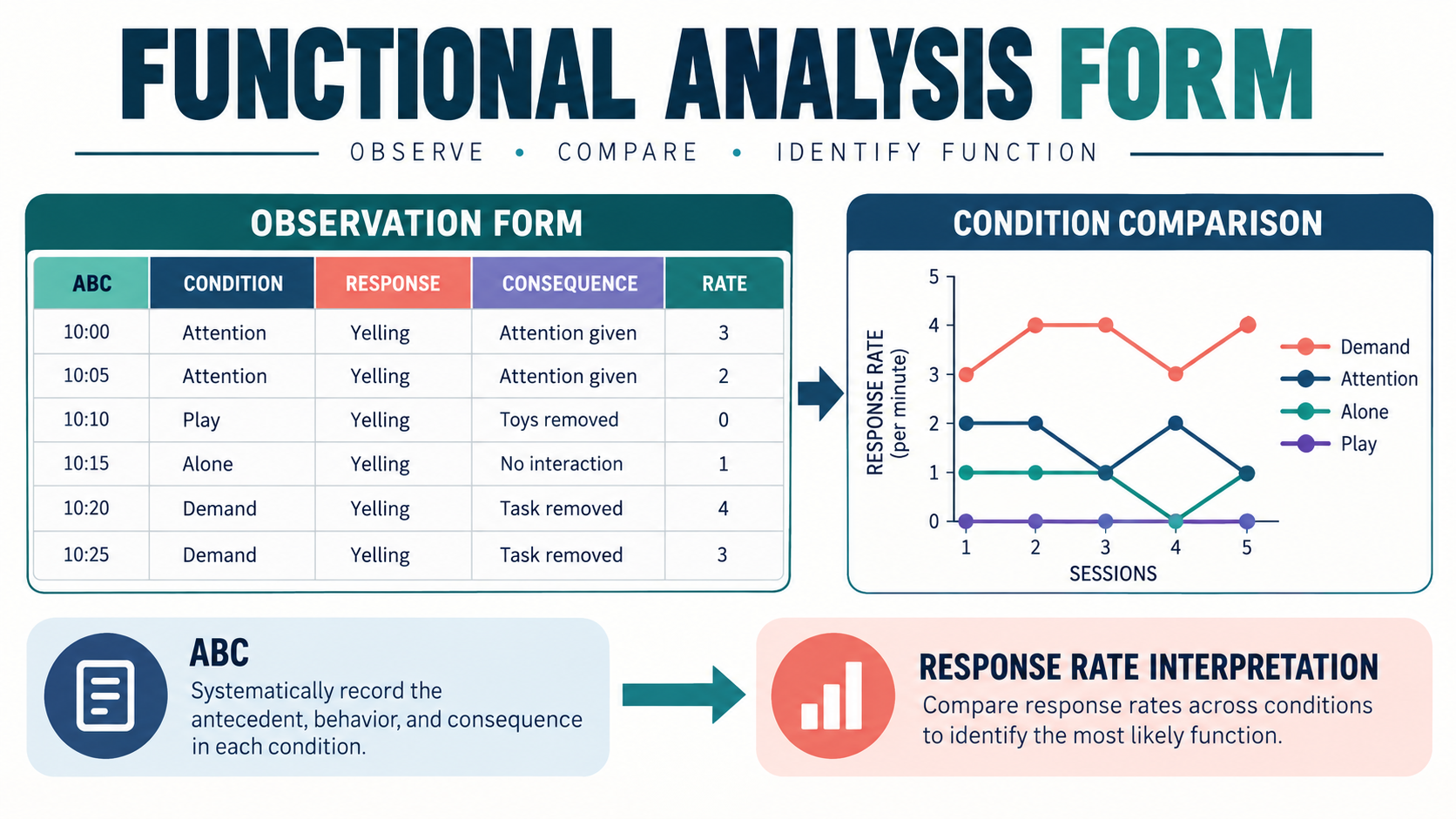
A functional analysis observation form is a structured record for documenting target behavior and relevant events across arranged conditions. Depending on the design, it may include the condition name, session or trial identifier, operational definition, antecedent event, response measure, consequence delivered, latency or duration, notes about deviations, and a summary field.
The form is a measurement aid. It is not a diagnosis, a treatment plan, or a substitute for training. If the observer records only “bad behavior” or “attention given,” the form cannot repair vague definitions. Strong data begin with observable, measurable descriptions and a clear plan for what counts as a response.
What Should Be Defined Before Observation?
Before the first observation, define the target response in a way that two trained observers could use. Include what the behavior looks like, when it starts, when it stops, and what does not count. If multiple topographies are included in a response class, say why they belong together and record enough detail to evaluate that decision.
Also define the measurement. Frequency may fit discrete responses; duration may fit behavior that continues over time; latency may fit the delay between an instruction and a response. A form can include more than one measure, but adding fields without a purpose increases recording burden and error.
Which Fields Belong on the Form?
Exact fields vary by assessment design, but the following categories are commonly useful. The names can be adapted to the setting and to the professional’s approved protocol.
| Form area | What to capture | Quality check |
|---|---|---|
| Target definition | Observable response, start/stop rules, and measurement | Could another trained observer score it consistently? |
| Condition and session | Condition label, date, observer, session/trial, and setting | Can the row be assigned to the correct condition? |
| Immediate events | Relevant antecedent, response, consequence, and timing | Are facts separated from interpretation? |
| Deviation and safety notes | Protocol changes, interruptions, risk events, or missing data | Would a reviewer know why this row is unusual? |
| Summary | Totals, pattern display, and next analysis question | Does the summary preserve the raw record? |
How Is It Different From an ABC Observation Form?
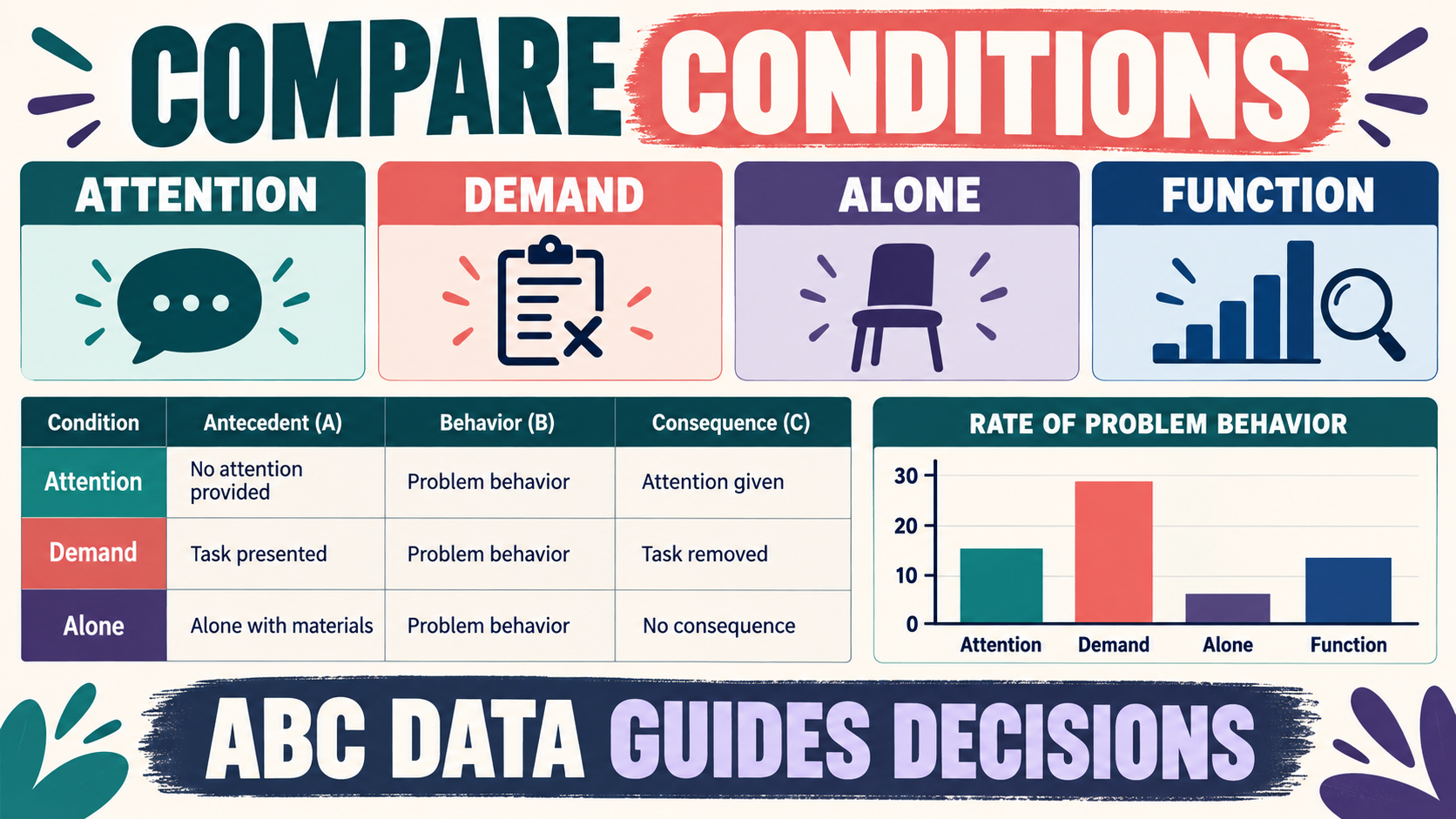
An ABC form is usually used for descriptive observation: the observer records what occurred before the behavior, the behavior itself, and what followed in the natural context. That information can help develop a hypothesis. It does not demonstrate a functional relation because the relevant variables were not necessarily manipulated and compared.
An FA observation form is tied to arranged conditions. The observer needs to know which condition was in effect and whether the programmed antecedent and consequence occurred as planned. The same words—“before,” “behavior,” and “after”—can appear on both forms, but the logic of the design is different.
What Does the Observer Record During Each Condition?
Record the events required by the protocol and the response measure selected for the target. For a frequency measure, the row may capture each response or a trial total. For duration, the start and stop points need to be clear. For latency, record the event that starts the timing and the response that ends it.
Record deviations promptly. If a demand was not delivered, a preferred item was unavailable, an interruption occurred, or the planned consequence was delayed, the note helps the analyst interpret the session. Do not silently “fix” the record later. A clean-looking form that hides protocol deviations is less useful than an honest form with a clear note.
Why Do Condition Labels Matter?
Condition labels make the comparison possible. A label should have one meaning in the protocol, the observer training, the form, and the graph. If two observers use different abbreviations or if the same label is used for different arrangements, the data can be sorted incorrectly and the resulting pattern can be misleading.
Use a key or legend when abbreviations are necessary. Include enough information to distinguish the conditions without turning the form into a long narrative. The form should reduce ambiguity, not create a new decoding task for the analyst.
How Should You Summarize the Completed Form?
Summarize only after checking the raw entries. Count or calculate the selected measure according to the protocol, preserve missing or invalid observations, and note any session that should not be compared with the others. A visual display can make differences across conditions easier to inspect, but a high bar is not automatically proof of a function if the conditions differed in other important ways.
What Does a Functional Analysis Observation Form Prove?
The form records evidence; the design and analysis support the conclusion. A blank form proves nothing. A completed form can still be weak if the target is vague, the conditions were not implemented as planned, the measure was inconsistent, or the data were summarized incorrectly.
On a BCBA exam, look for the difference between a descriptive relation and an experimental demonstration. A question may show that behavior occurred after a demand and was followed by a break. That pattern can support an escape hypothesis, but the answer should not call it proof of function unless the scenario describes an appropriate functional-analysis comparison.
How Can Data Quality Be Protected?
- Train observers with examples, nonexamples, and practice scoring before formal data collection.
- Keep the operational definition and measurement rule visible or readily available.
- Use the same condition labels and response rules across observers.
- Record deviations, interruptions, and safety events rather than hiding them.
- Plan interobserver agreement or another reliability check when appropriate.
- Review a sample of completed forms before relying on a summary graph.
What About Safety and Ethical Limits?
Functional analysis can involve arranging conditions that evoke problem behavior, so it requires qualified design, risk assessment, consent or assent processes as applicable, trained implementers, and a safety plan. A downloadable form cannot authorize a procedure. Do not use an online template to improvise an FA for severe, dangerous, or medically relevant behavior.
Protect privacy on paper and in digital systems. Use the minimum necessary identifying information, store records securely, and follow the applicable professional, organizational, and legal requirements. A form should support respectful service, not turn a person’s difficult moment into decontextualized content.
How Should a BCBA Candidate Study This Topic?
Practice labeling the assessment question first. Is the scenario describing behavior in its natural context, or are conditions arranged and compared? Then identify the target response, measurement, antecedent, consequence, condition, and design logic. Finally, ask what conclusion the data can support and what it cannot support.
That sequence prevents a common error: treating any ABC-looking table as a functional analysis. Review the current BCBA Task List and use practice questions to discriminate among descriptive assessment, experimental functional analysis, measurement, reliability, and treatment selection.
Key Takeaways
- A functional analysis observation form organizes condition-level records; it is not a stand-alone assessment or treatment authorization.
- Define the target response and measurement before collecting data.
- Record condition, immediate events, response measure, deviations, and safety-relevant notes accurately.
- ABC observation can support a hypothesis, while an experimental FA is designed to test functional relations.
- Interpret the form through the assessment design, data quality, individualized context, and qualified supervision.
Want to practice assessment reasoning? Try the free BCBA mock exam and explain why a scenario supports a descriptive hypothesis or an experimental conclusion. Practice can support preparation, but it cannot replace supervised training or guarantee an examination result.
Sources and Further Reading
For examples of observation structures, review the University of Oregon functional-analysis observation form, the Vanderbilt ABC form, the Illinois functional-assessment observation form, and the peer-reviewed discussion of baseline conditions. For exam context, consult the current BACB Task List.
For targeted review, use our functional analysis observation form practice questions to apply the concept in exam-style scenarios.
Quick Review Checklist
Use this final checklist to turn functional analysis observation form into exam-ready reasoning. The goal is not to memorize a label in isolation; it is to identify the relevant evidence and explain why the best answer fits the scenario. Key ideas to review:
- State the central definition or decision point for functional analysis observation form in your own words.
- Identify the detail that makes functional analysis observation form different from its closest related ABA term.
- Separate the observable facts in a scenario from assumptions that are not supported by the facts.
- Write one example and one nonexample so you can recognize the concept in a new setting.
Exam application checks:
- Ask what the question is actually requesting before comparing the answer choices.
- Mark the antecedent, response, consequence, or other evidence that supports the selected answer.
- Look for a distractor that describes a related process but does not answer the specific question.
Final self-check:
- Explain how you would verify the interpretation with clear observations or data.
- Change one detail in the scenario and decide whether your answer should change.
- Give a one-sentence rationale that a supervisor or study partner could evaluate.
Take the Free BCBA Mock Exam
If you want a low-pressure way to check your recall, use the free practice resource below. Take the Free BCBA Mock Exam



