
What is a Functional Behavior Assessment (FBA) Template?
A Functional Behavior Assessment template serves as a structured guide for systematically evaluating problem behaviors. This standardized format ensures practitioners collect comprehensive data to identify the function of behavior before designing interventions.
Table of Contents
- What is a Functional Behavior Assessment (FBA) Template?
- Essential Components of an Effective FBA Template
- FBA Template in Action: Worked Examples
- BCBA Exam Relevance and Common Traps
- Your FBA Template Checklist
- Summary and Next Steps for Mastery
The template organizes assessment components logically, promoting consistency across cases and settings.
Core Purpose and Ethical Foundation
Using a standardized FBA template aligns with the BACB Ethics Code requirements for evidence-based assessment. It ensures practitioners don’t skip critical steps in the assessment process.
The template provides a systematic approach that distinguishes formal assessment from informal observation. This structured methodology helps practitioners meet ethical standards for competent assessment and data-driven decision making.
Essential Components of an Effective FBA Template
Every comprehensive FBA template must include specific sections that guide the assessment process from start to finish.
Operational Definition and Data Collection Plan
The foundation begins with a clear operational definition that describes behavior in observable, measurable terms. This section should specify topography, frequency, duration, and intensity.
Data collection methods must align with the behavior’s characteristics. Common approaches include:
- Frequency recording for discrete, countable behaviors
- Duration recording for behaviors with clear start and end points
- ABC recording for identifying antecedents and consequences
- Interval recording for continuous or high-frequency behaviors
Functional Analysis vs. Descriptive Assessment
Understanding when to use functional analysis versus descriptive assessment is crucial. Functional analysis involves experimental manipulation to test hypotheses, while descriptive methods observe behavior in natural settings.
The template should guide practitioners in selecting the appropriate approach based on risk, resources, and assessment goals. For more on assessment approaches, see our guide on functional analysis vs descriptive assessment.
Synthesizing Data to Form a Hypothesis
This section integrates data from multiple sources to develop testable hypotheses about behavior function. The process involves:
- Reviewing indirect assessment data (interviews, rating scales)
- Analyzing descriptive assessment data (ABC recordings)
- Considering experimental data from functional analysis
- Identifying patterns across setting events and contexts
FBA Template in Action: Worked Examples
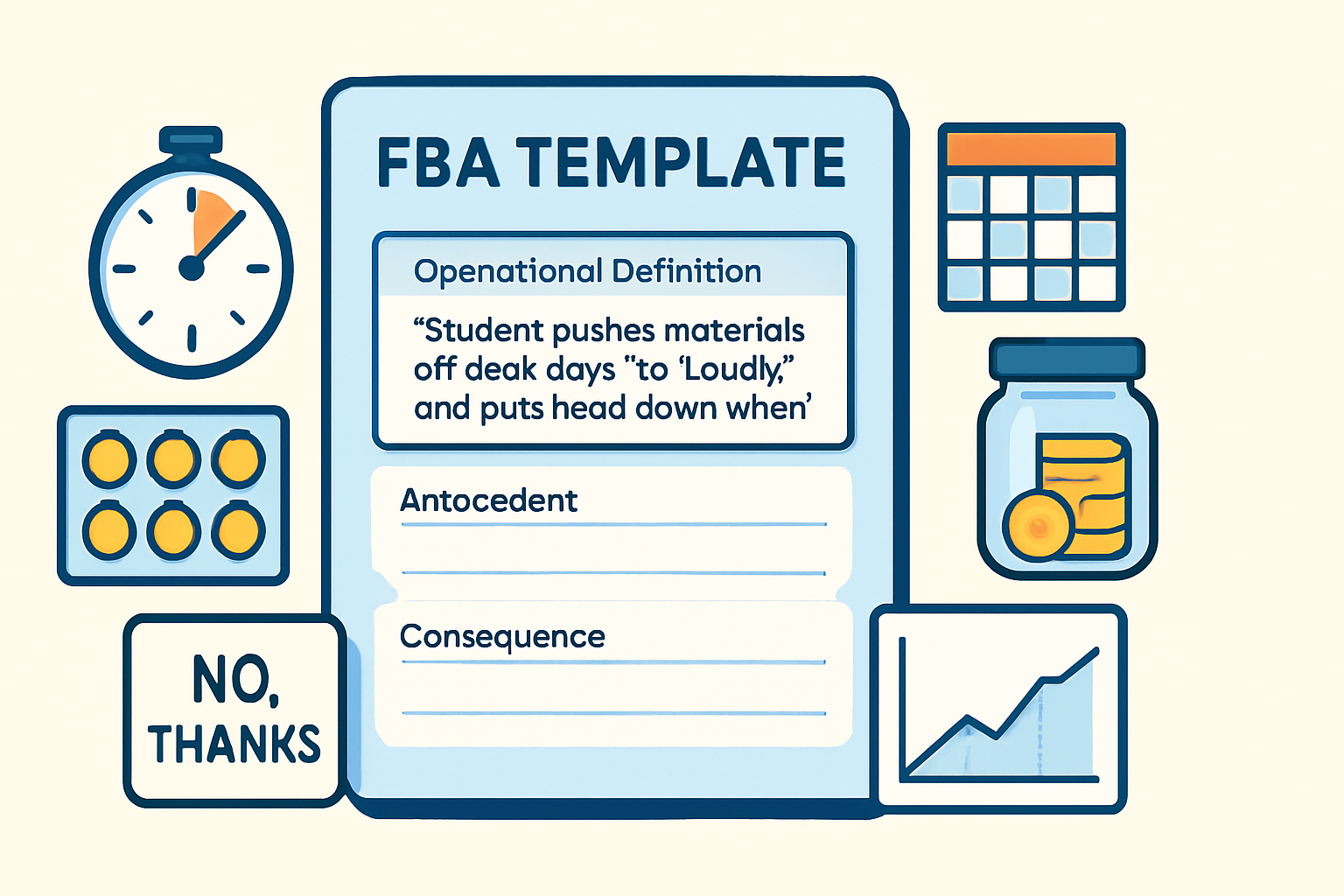
Seeing how to complete an FBA template with real data helps bridge theory and practice.
Example 1: Escape-Maintained Behavior in a Classroom
Consider a student who engages in task refusal during math instruction. The operational definition specifies: “Student pushes materials off desk, says ‘no’ loudly, and puts head down when presented with math worksheets.”
ABC data reveals consistent patterns:
- Antecedent: Teacher presents difficult math worksheet
- Behavior: Student pushes materials, says ‘no’
- Consequence: Teacher removes worksheet, provides easier task
The hypothesized function is negative reinforcement through escape from difficult tasks. This aligns with the four functions of behavior framework discussed in our four functions guide.
Example 2: Attention-Seeking Behavior at Home
A child engages in property destruction when parents are occupied. The operational definition: “Child throws toys against wall with sufficient force to cause damage when parents are on phone.”
Caregiver interviews and ABC data show:
- Antecedent: Parents engaged in conversation, not attending to child
- Behavior: Toy throwing with force
- Consequence: Parents stop conversation, attend to child, provide reprimand
The hypothesized function is positive reinforcement through access to social attention. This demonstrates how social reinforcement can maintain problematic behaviors.
BCBA Exam Relevance and Common Traps
Understanding FBA templates directly relates to multiple areas of the BACB Task List and appears frequently on the BCBA exam.
Linking Template Components to the Task List
Key task list items connected to FBA template knowledge include:
- F-1: Review records and available data
- F-2: Determine the need for behavior-analytic services
- F-3: Identify and prioritize socially significant behavior-change goals
- F-7: Conduct descriptive assessments
- F-8: Conduct functional analysis
- F-9: Interpret assessment results
Exam Traps to Avoid
Common mistakes students make include:
- Confusing behavior topography with function
- Neglecting to consider setting events in analysis
- Selecting inappropriate data collection methods for the behavior
- Failing to prioritize testable hypotheses based on data patterns
- Overlooking multiple functions of the same behavior
For more on ethical assessment practices, review our ethics in ABA practice guide.
Your FBA Template Checklist
Use this checklist to evaluate or create your own FBA templates:
- Include clear operational definitions with measurable criteria
- Specify appropriate data collection methods for each behavior
- Document indirect assessment results (interviews, records)
- Record ABC data across multiple contexts and times
- Consider setting events and contextual variables
- Develop testable hypotheses about behavior function
- Include data synthesis section integrating all sources
- Reference ethical considerations and consent documentation
- Plan for hypothesis testing through intervention
- Connect assessment findings to intervention planning
Summary and Next Steps for Mastery
Mastering the FBA template structure is essential for both clinical practice and exam success. A well-designed template ensures comprehensive assessment that identifies the true function of behavior.
To deepen your understanding, practice completing templates with various case examples. Review the official BACB Ethics Code and Task List 6th Edition for specific requirements.
Consistent practice with data interpretation and hypothesis development will build the skills needed for both the BCBA exam and effective clinical practice. Remember that the template serves as a guide, but clinical judgment and data-based decision making remain paramount.
Next step for BCBA exam prep
Turn this topic into exam-day practice
Use this topic as a focused review, then test it in exam-style conditions with a free mock before deciding whether five full-length mocks are the right next step.
Start the Free BCBA Mock ExamContinue with Five Full-Length Mocks — $99
Review the included materials and access details before ordering. No pass guarantee is implied.



