
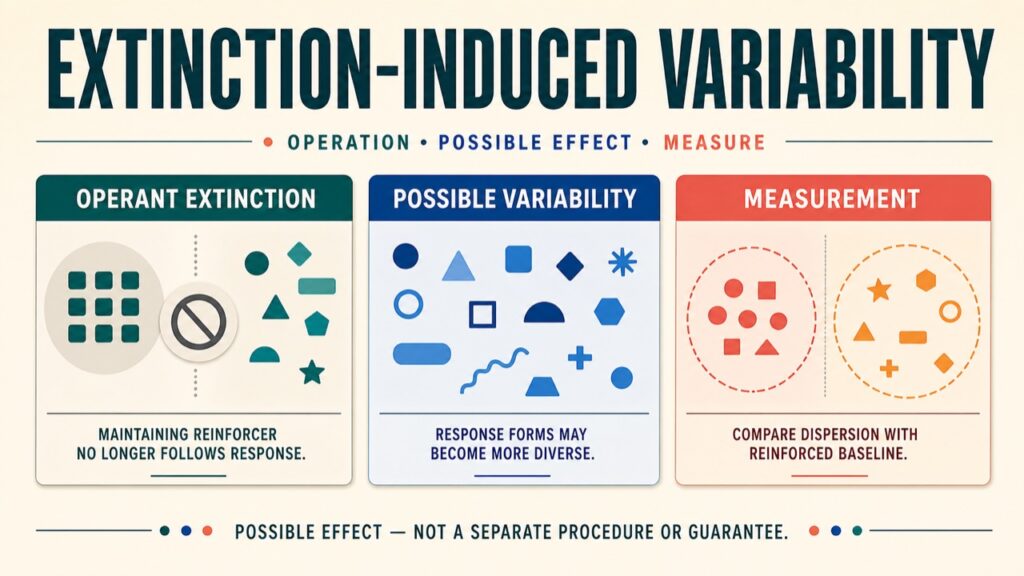
Extinction-induced variability describes an increase in the variation of responding that may be observed when a previously reinforced operant no longer produces its maintaining consequence. A person or organism may vary response topography, location, sequence, duration, force, or another measured dimension. The phenomenon is an effect observed during some extinction conditions; it is not the extinction procedure itself and should not be treated as a predictable recipe for generating novel behavior.
Table of Contents
- Definition: Operation Versus Observed Effect
- Extinction Burst and Variability Are Different Measures
- Extinction-Induced Variability and Reinforced Variability
- Original Examples and Nonexamples
- What Evidence Supports the Interpretation?
- Clinical Relevance Without Turning the Effect Into a Procedure
- Safety, Ethics, and Interpretation Boundaries
- Study Checks
- Free BCBA Mock Exam Practice
- References
This guide separates the extinction operation from response variability, an extinction burst, and differential reinforcement of variability. It also explains what data would support the label, what alternative explanations remain possible, and why applied use requires conservative safety and ethical review.
Definition: Operation Versus Observed Effect
In operant extinction, a response with a reinforcement history no longer produces the reinforcer that maintained it. The definition is functional. Ignoring a response, removing an item, or changing an adult’s behavior is not necessarily extinction unless the relevant reinforcement contingency has actually been discontinued for the defined response class.
Extinction-induced variability refers to a change in the distribution of response forms during that transition. For example, a response previously emitted at a narrow location may appear across a wider range of locations, or a stable sequence may give way to several sequences. The key dependent variable is dispersion or diversity in a specified response dimension, not merely the total number of responses.
The operation and effect must remain separate:
- Operation: discontinue the maintaining consequence for a previously reinforced operant.
- Possible effect: variation increases in one or more measured dimensions.
- Longer-term outcome: response rate, form, or allocation changes across continued observation.
An increase cannot be assumed from the operation. Demonstration requires comparable measurement before and during extinction, a defensible definition of variability, and attention to reinforcement that may still occur in the natural environment.
Extinction Burst and Variability Are Different Measures
An extinction burst is a label commonly used for a temporary increase in some dimension of the previously reinforced behavior after extinction begins. Depending on the study or teaching example, the measured dimension may be frequency, duration, force, latency, or another feature. Extinction-induced variability instead concerns the spread or diversity of response forms.
Imagine a laboratory response occurring at the same position during reinforcement. During extinction, repeating that position more rapidly would support a rate increase but not necessarily greater variability. Responding at several new positions could support greater location variability even if total responding decreases. Both patterns could appear together, but neither label can substitute for the other.
The time course also should be described cautiously. Variation has appeared rapidly in some basic studies, yet histories, response definitions, reinforcement schedules, contexts, and organisms differ. Response variability may rise, remain stable, or be difficult to detect. A short early observation cannot establish that a fixed burst-then-variability-then-decline sequence occurred.
Extinction-Induced Variability and Reinforced Variability
Extinction-induced variability and differential reinforcement of variability use different programmed contingencies.
- Extinction-induced variability: the previously effective reinforcer is discontinued for the defined operant, and variation is measured as a possible induced effect.
- Lag or novelty schedule: reinforcement follows a response or sequence when it differs from a specified number of recent responses.
- Frequency-threshold arrangement: relatively uncommon variants meet the reinforcement criterion, whereas recently frequent variants do not.
- Differential reinforcement: consequences are arranged to strengthen qualifying variants relative to nonqualifying variants.
The teaching distinction is useful, although some experimental analyses note that variability-training procedures combine reinforcement of qualifying variants with nonreinforcement of repetitions. That overlap does not justify calling every varied response an induced extinction effect. Identify the programmed contingency and the measured change before assigning a label.
Original Examples and Nonexamples
Laboratory-style example. During reinforcement, a joystick response is recorded within a narrow movement range and produces a point. When the same response no longer produces points, movements occur across a wider range. If the measurement system shows increased dispersion relative to the reinforced baseline—and no other programmed consequence selects the new forms—the pattern is consistent with extinction-induced response variability.
Sequence example. A computer task previously reinforces one stable four-key sequence. In an extinction phase, no sequence produces the programmed consequence, and several new sequences appear. Increased sequence diversity relative to baseline supports the variability description. The example does not show that every new sequence belongs to the same functional response class outside the task.
Nonexample: reinforced novelty. A program delivers a point when the current sequence differs from the prior three sequences. Variation is explicitly part of the consequence rule, so the arrangement is differential reinforcement of variability.
Nonexample: rate without spread. A response occurs more frequently after the contingency changes, but its location and form remain as narrow as before. The data may fit a rate increase; they do not establish greater topographical variability.
Nonexample: unmeasured natural reinforcement. New response forms receive attention, escape, access, or sensory consequences during the supposed extinction phase. Their emergence cannot be attributed solely to discontinuation of the original programmed reinforcer.
What Evidence Supports the Interpretation?
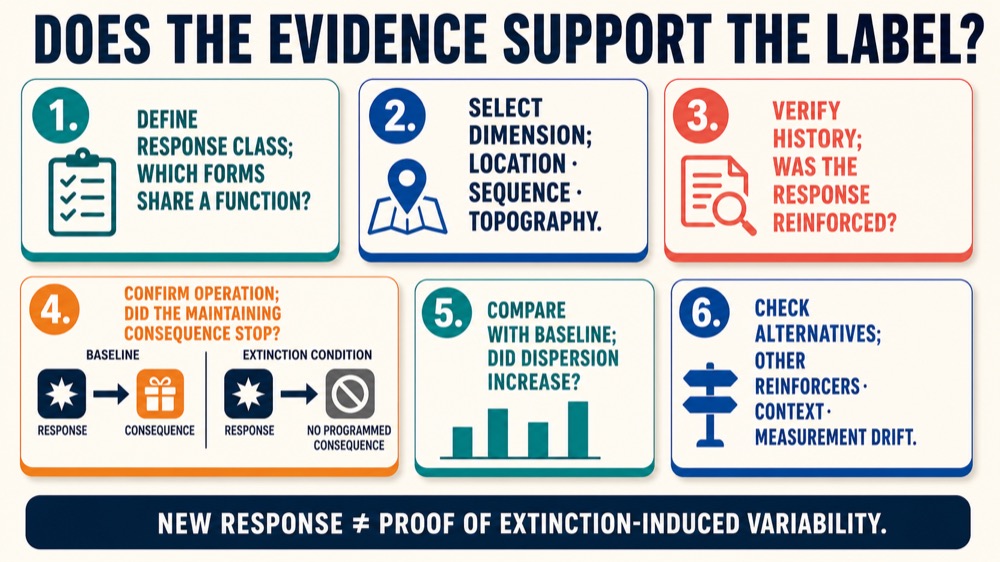
A strong analysis specifies the response class and the exact dimension in which variation is expected. “Trying different things” is too vague. Location can be measured as spatial dispersion; sequences can be summarized by diversity indices; topography can be coded with operational categories; temporal variability can be examined through duration or interresponse-time distributions.
Useful questions include:
- Was the response previously reinforced, and was the maintaining consequence identified with reasonable evidence?
- What changed in the reinforcement contingency during the extinction condition?
- Which response dimension represents variability, and is the measurement reliable?
- Did diversity increase relative to a stable, comparable baseline?
- Were novel forms reinforced by staff, peers, task escape, materials, or automatic consequences?
- Did response rate change independently of diversity?
- Can measurement drift, a context change, instructions, or another intervention explain the pattern?
These questions prevent a common inference error: seeing a new response during a treatment change and labeling it extinction-induced without demonstrating the relevant history, operation, and variation measure.
Clinical Relevance Without Turning the Effect Into a Procedure
A narrow applied literature has examined whether response forms emerging during extinction could inform selection of alternative communication responses. One study, Utility of Extinction-Induced Response Variability for the Selection of Mands, evaluated this possibility under specific assessment and treatment conditions. Its results and limitations do not authorize using extinction broadly to provoke novel communication or to “see what happens.”
In practice, a newly observed form may be adaptive, neutral, unsafe, or part of a previously reinforced hierarchy. Clinicians should not presume that it lacks a reinforcement history or that it should be selected for teaching. Direct assessment of communication ability, effort, preference, accessibility, social validity, and stakeholder priorities remains necessary.
When safer and more direct teaching arrangements can establish an alternative response, generating variability through extinction is not a neutral first choice. Reinforcement-based skill building, antecedent supports, choice, and environmental changes should be evaluated in relation to the person’s goals and context.
Safety, Ethics, and Interpretation Boundaries
Extinction can produce unwanted effects, treatment escalation, or shifts to different behavior. With dangerous, severe, automatically reinforced, or poorly assessed behavior, a generic extinction plan can create substantial risk. This article therefore does not provide implementation instructions, blocking methods, caregiver scripts, consistency rules, or a cross-setting protocol.
Qualified review should address functional assessment, informed consent, assent when applicable, dignity, feasibility, staff competence, protective procedures, less restrictive alternatives, and objective modification or stop criteria. Monitoring should include adverse effects, emotional responding, new topographies, treatment integrity, stakeholder acceptability, and quality of life—not just change in the original target response.
The BACB BCBA Test Content Outline, Sixth Edition distinguishes operant and respondent extinction as operations and processes and includes competencies related to differential reinforcement, unwanted-effect mitigation, procedural integrity, and data-based modification. The outline supports those broad study boundaries; it does not name extinction-induced variability as a promised examination topic or replace the current Ethics Code and individualized clinical judgment.
Study Checks
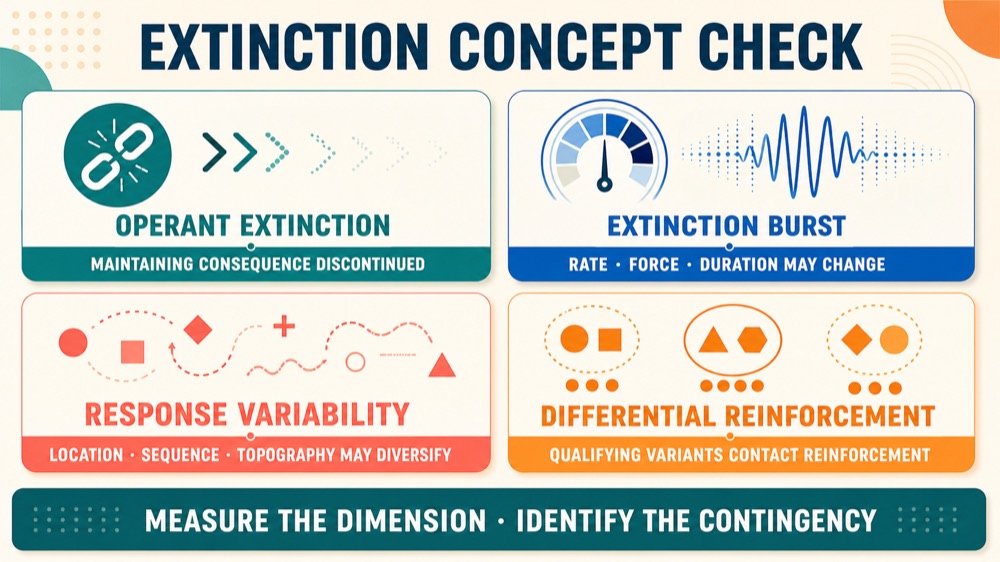
- Can you identify the previously reinforced response and its maintaining consequence?
- Can you state the extinction operation without using the vague phrase “ignore the behavior”?
- Which dimension changed: rate, duration, force, location, sequence, or topographical diversity?
- Does the example show an extinction burst, response variability, both, or neither?
- Was novelty reinforced according to a lag or frequency criterion?
- Could an unplanned consequence explain a new response form?
- What evidence and safeguards would be needed before making an applied interpretation?
For practice, hold the response rate constant while changing diversity, then reverse the arrangement. This makes the distinction between “more responding” and “more varied responding” easier to see.
Free BCBA Mock Exam Practice
Use the Free BCBA Mock Exam to practice distinguishing procedures, processes, and measured effects. It provides feedback and helps identify areas for further study; it does not reproduce or promise any particular certification-exam topic.
References
- Utility of Extinction-Induced Response Variability for the Selection of Mands
- Behavior Analyst Certification Board, BCBA Test Content Outline, Sixth Edition
Next step for BCBA exam prep
Turn this topic into exam-day practice
Use this topic as a focused review, then test it in exam-style conditions with a free mock before deciding whether five full-length mocks are the right next step.
Start the Free BCBA Mock ExamContinue with Five Full-Length Mocks — $99
Review the included materials and access details before ordering. No pass guarantee is implied.



