
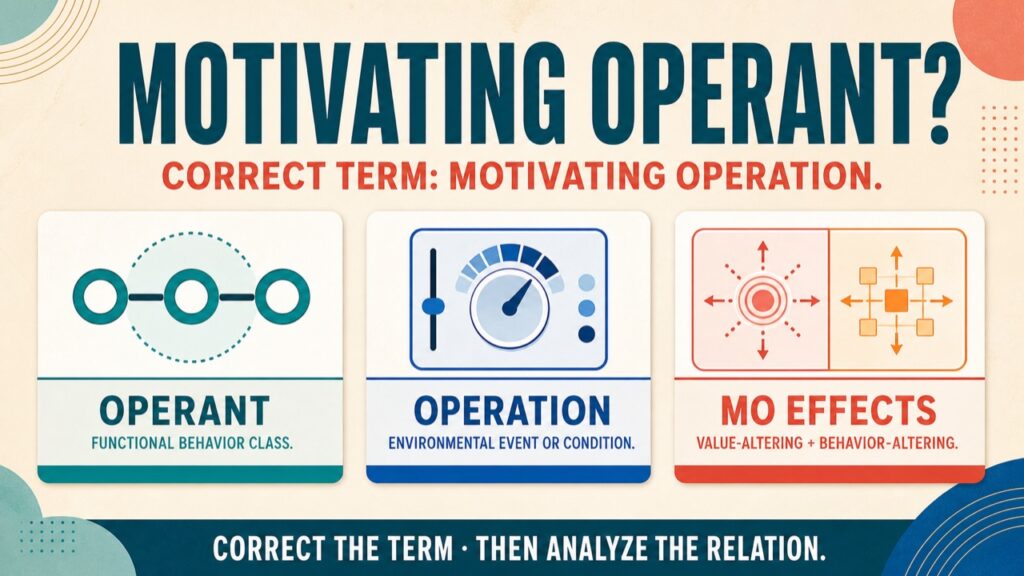
If you searched for “motivating operant,” the standard ABA term you probably need is motivating operation, usually abbreviated MO. The two expressions sound similar, but they name different kinds of things. An operant is behavior defined by its relation to consequences; a motivating operation is an environmental variable that temporarily changes the effectiveness of a consequence and the current frequency of behavior related to that consequence.
Table of Contents
- The Key Correction: Operant and Operation Name Different Relations
- What Makes an Environmental Variable a Motivating Operation?
- The Two Effects: Value Altering and Behavior Altering
- How an Operant Fits Into the MO Relation
- Motivating Operation Versus Discriminative Stimulus
- Evidence, Nonexamples, and Conservative Inference
- Unconditioned and Conditioned Motivating Operations
- A Compact Identification Checklist
- Use the Correct Term in Study and Practice
This terminology correction matters because replacing operation with operant changes the concept, not just the spelling. This guide starts with that boundary, then explains the two effects that define an MO, a compact MO-versus-SD distinction, and an observable water example. Readers who want broader coverage can continue to the site’s full motivating operations guide after mastering the wording.
The Key Correction: Operant and Operation Name Different Relations
An operant is a class of responses defined functionally by a common effect on the environment. A request spoken aloud, a signed request, and selecting a communication icon may belong to one operant class when each response has produced the same type of consequence under relevant conditions. The label concerns behavior and its history with consequences, rather than the response’s appearance or a person’s presumed intention.
A motivating operation, by contrast, is an environmental event or condition. It temporarily changes how effective a stimulus, object, or event is as reinforcement or punishment and changes the current frequency of behavior previously reinforced or punished by that consequence. The word operation therefore points to a variable affecting behavior; it does not rename the behavior itself. That is why careful ABA writing keeps the two terms separate.
- Operant: a functional class of behavior with a relevant consequence history.
- Operation: an environmental event or condition whose effects are analyzed.
- Motivating operation: an operation defined by both a value change and a related current behavior change.
What Makes an Environmental Variable a Motivating Operation?
Calling something an MO requires evidence for two separable functional effects. First, the event has a value-altering effect: it changes the present effectiveness of a particular consequence. Second, it has a behavior-altering effect: it changes the current frequency of behavior that has previously contacted that consequence. A useful analysis names the consequence, the relevant response history, and evidence for both effects instead of relying on a broad label such as “motivation.”
The definition is temporary and relation-specific. A period without water may increase the effectiveness of water as reinforcement and increase water-getting responses that have worked before. After substantial water consumption, the effectiveness of water and the frequency of those responses may decrease. Neither water nor a person carries a fixed MO label. The analyst is describing how a current environmental condition relates to a particular consequence and behavior at that time.
The Two Effects: Value Altering and Behavior Altering
The value-altering side includes an establishing effect and an abolishing effect. An establishing effect increases the current effectiveness of a stimulus, object, or event as reinforcement or punishment. An abolishing effect decreases that effectiveness. These terms describe a measured or reasonably demonstrated functional change. They are not synonyms for pleasant, unpleasant, wanted, or unwanted, and they should not be assigned from appearance alone.
The behavior-altering side includes an evocative effect and an abative effect. An evocative effect increases the current frequency of behavior that has produced the relevant consequence in the past; an abative effect decreases that frequency. The response change must be interpreted alongside the value change. A behavior increase by itself could reflect discriminative control, schedule changes, new prompts, measurement variation, or another environmental variable.
- Establishing effect: the consequence becomes more effective under the present condition.
- Abolishing effect: the consequence becomes less effective under the present condition.
- Evocative effect: previously consequence-related behavior increases in current frequency.
- Abative effect: previously consequence-related behavior decreases in current frequency.
How an Operant Fits Into the MO Relation
The operant and the MO can appear in the same analysis without becoming the same concept. Suppose requesting water has produced water in the past. Requesting is the behavior under analysis, and its consequence history helps define the operant. A period without water may function as an MO by altering water’s effectiveness and the current frequency of requesting. One term identifies the behavior class; the other identifies a current environmental influence on that class.
This distinction prevents a common shortcut: treating “motivated behavior” as a complete functional explanation. An observed response does not reveal the controlling variables by itself. Analysts compare relevant conditions, consequence effectiveness, and response patterns. A precise statement might say that a documented period without water was associated with greater selection of water and more previously reinforced water requests. That description provides testable relations instead of assigning an unseen quality to the person.
Motivating Operation Versus Discriminative Stimulus
A discriminative stimulus, or SD, has a different function. Through a history of differential reinforcement, the SD is correlated with reinforcement being available for a particular response. The MO concerns the current effectiveness of the consequence; the SD concerns the response-consequence relation in the presence of a stimulus. Both variables may influence one episode of behavior, but each requires its own evidence and neither label follows automatically from physical appearance.
Use a working fountain to see the boundary. After a documented period without fluids, water may become more effective as reinforcement, while previously reinforced water-getting behavior increases. Those are candidate MO effects. If approaching and pressing a particular fountain has produced water when that fountain is operational, its visible operating cues may function as an SD for that response. The MO changes water’s effectiveness; the SD reflects when the response has produced water.
A fountain-shaped object is not necessarily an SD, and time without water is not established as an MO from one approach response. A broken fountain may lack the relevant differential reinforcement relation. An approach could also occur because of instructions, imitation, or another history. The site’s detailed MO and SD comparison covers that broader distinction; the central correction here remains operant versus operation.
Evidence, Nonexamples, and Conservative Inference
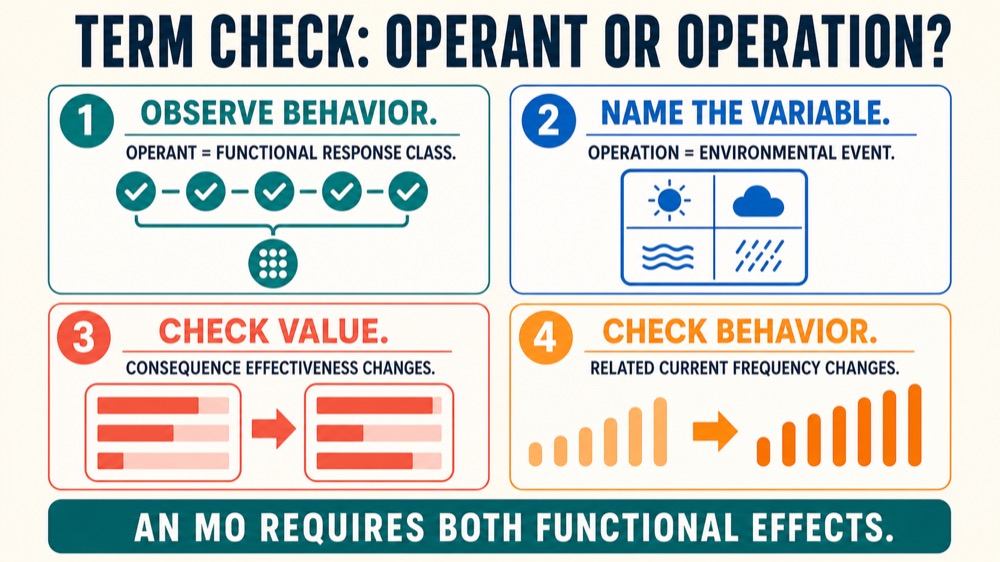
A report such as “I feel thirsty” is behavior that may be relevant to assessment, but the report alone does not demonstrate the two defining MO effects. Likewise, elapsed time since drinking is a plausible environmental measure, not automatic proof of function. Stronger evidence combines the documented condition with a change in the effectiveness of water and a corresponding change in behavior that has previously produced water, ideally across observations or planned comparisons.
Consider a nonexample: a learner selects a water icon once immediately after a teacher points to it. That single response may reflect the prompt rather than an evocative effect, and no value change has been shown. Another nonexample is labeling a water bottle as an MO merely because it is visible. Depending on history, the bottle could have discriminative, reinforcing, eliciting, or other functions; its topography does not settle the analysis.
- Do not infer an MO from a preference statement without evidence of the relevant functional effects.
- Do not infer an MO from one increase or decrease in response frequency.
- Do not classify a stimulus from its form, location, or intended use.
- Do specify the consequence whose effectiveness changed and the behavior with a relevant history.
Unconditioned and Conditioned Motivating Operations
Some motivating operations have value-altering effects that do not depend on the relevant learning history; these are commonly called unconditioned motivating operations. Others acquire their effects through learning and are called conditioned motivating operations. This distinction concerns how the functional relation developed. It does not divide people into motivated and unmotivated groups, and it does not turn the MO into a feeling, preference, personality feature, or diagnosis.
Three conditioned categories may appear in advanced study. A CMO-S acquires effects through pairing with another MO. A CMO-R is a condition whose worsening establishes its own improvement or removal as reinforcement and evokes behavior that has produced that change. A CMO-T changes the effectiveness of another stimulus because that stimulus enables access to an already effective form of reinforcement. Each label depends on demonstrated relations, not a memorized object example.
For instance, when access to a desired powered device is valuable but its secured battery compartment cannot be opened, a suitable screwdriver may temporarily become effective as reinforcement and tool-seeking may increase. This can illustrate a transitive relation if the necessary history and effects are present. The tool’s presence could separately have discriminative functions. Keeping those possible functions distinct is more accurate than declaring that a screwdriver has one permanent behavioral role.
A Compact Identification Checklist
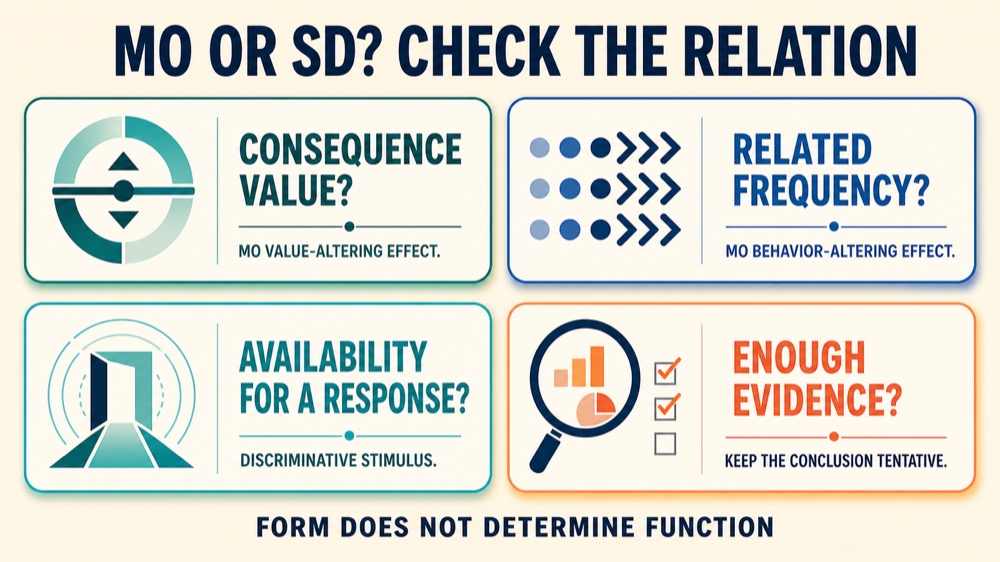
When a scenario uses vague language about motivation, translate it into observable and function-based questions. The checklist below is designed to slow down classification rather than force every event into an MO category. A conclusion should remain tentative when the scenario supplies a plausible variable but no evidence that consequence effectiveness and related response frequency changed together.
- What exact environmental event or condition is being evaluated?
- Which stimulus, object, or event is the relevant consequence?
- What evidence shows an establishing effect or abolishing effect?
- Which behavior has previously produced or contacted that consequence?
- What evidence shows an evocative effect or abative effect on that behavior?
- Could a prompt, instruction, schedule change, or measurement artifact explain the response change?
- Is a separate stimulus correlated with reinforcement availability for a particular response?
- Does the conclusion stay at the level supported by the available observations?
Use the Correct Term in Study and Practice
The durable correction is simple: use operant for the functional behavior class and motivating operation for the environmental variable with value-altering and behavior-altering effects. Then identify establishing or abolishing effects and evocative or abative effects separately. This vocabulary keeps the analysis tied to measurable relations and helps prevent an SD, a prompt, a consequence, or a private report from being mislabeled as the source of behavior.
The BACB BCBA Test Content Outline (6th ed.) includes motivating operations and discriminative stimuli within the knowledge and application framework for behavior analysts. The outline identifies content, while functional examples still require careful analysis. Study the relation described in each scenario rather than matching a familiar object to a memorized label, and use authoritative terminology when explaining why an answer is supported.
To practice applying functional definitions across ABA topics, try the Free BCBA Mock Exam. It provides practice and feedback across a range of concepts; this link does not imply that the practice set contains this exact wording or topic. Use the feedback to identify which distinctions need more review, then return to the relevant source and analyze the variables again.



