
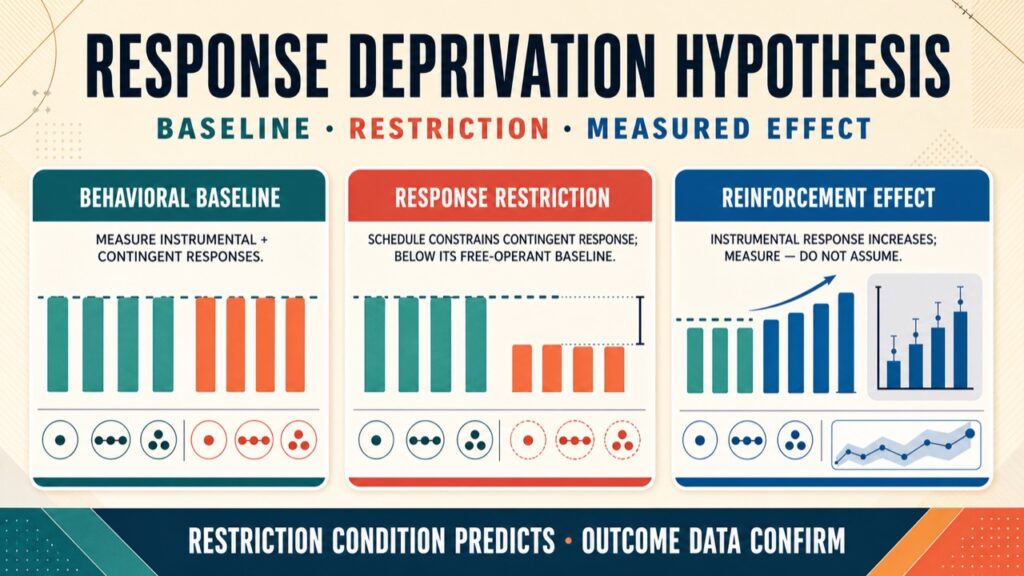
The response deprivation hypothesis ABA literature asks when access to one activity can reinforce another. Its central prediction concerns a response-restriction schedule: if a contingency would hold the contingent activity below its unconstrained behavioral baseline unless the instrumental activity increases, the schedule can produce a reinforcement effect. This is more precise than saying that any preferred or high-rate activity automatically becomes a reinforcer. Baseline response allocation, the schedule ratio, the measured response dimension, and the observed effect all matter.
Table of Contents
- What Is the Response Deprivation Hypothesis?
- RDH, the Premack Principle, and Biological Deprivation
- Original Examples and Nonexamples
- How a Response-Deprivation Arrangement Is Evaluated
- Operation, Effect, and Interpretation Limits
- Ethical and Practical Safeguards
- Study Checks for Response Deprivation
- Free BCBA Mock Exam Practice
- References
This article explains the core relation, distinguishes response deprivation from the Premack principle and biological deprivation, and gives original educational examples. It also outlines how qualified professionals evaluate such an arrangement without presenting a generic treatment protocol.
What Is the Response Deprivation Hypothesis?
The response deprivation hypothesis (RDH) predicts reinforcement from a relation between free-operant behavior and a contingency. Begin with two activities measured when both are reasonably available: an instrumental activity, which a contingency requires, and a contingent activity, which becomes available according to that requirement. Their unconstrained levels form the behavioral baseline.
Next consider the schedule. If following the instrumental-to-contingent ratio while keeping instrumental behavior at baseline would provide less contingent activity than the person freely allocated at baseline, the schedule creates response deprivation. Increasing the instrumental activity is then one way to move contingent activity back toward its baseline level. A reinforcement effect is demonstrated when the required instrumental response increases under the arrangement; it is not established by restriction or preference alone.
Many introductory examples use a high-probability behavior as the contingent activity and a low-probability behavior as the instrumental activity. That pattern is easy to recognize, but the formal RDH prediction rests on restriction relative to baseline and the schedule requirement. A contingent activity does not need a higher baseline probability than the instrumental activity in every valid RDH arrangement. This is one way RDH extends beyond a simple probability-differential rule.
The 2017 peer-reviewed tutorial Predicting the Effects of Interventions: A Tutorial on the Disequilibrium Model derives practical prediction models from RDH and emphasizes baseline measures plus contingency parameters. The article presents a broader disequilibrium approach; readers should not treat a two-activity example as the whole theory.
RDH, the Premack Principle, and Biological Deprivation
These concepts overlap in everyday teaching examples, but their controlling relations differ.
- Premack probability differential: a higher-probability response is arranged contingent on a lower-probability response. The relative baseline probabilities are central to the prediction.
- Response deprivation: the schedule restricts access to the contingent response below its free-operant baseline unless instrumental responding changes. The restriction relation is central.
- Biological deprivation: access to a biologically relevant stimulus, such as food or water, changes across time. This is not required to demonstrate RDH and should not be used as an RDH teaching procedure.
- Preference: a person selects or approaches an option during an assessment. Preference can guide a candidate choice, but it does not by itself demonstrate reinforcement.
The phrase reinforcer value is sometimes used as shorthand for the effect of restriction. A more careful analysis separates the operation from the result. Response restriction describes what the schedule does relative to baseline. An increase in the instrumental response is the observed reinforcement effect. If that increase does not occur, describing the contingent activity as an effective reinforcer for that response and context would be premature.
RDH also is not interchangeable with a motivating operation. Motivating operation is a useful required term for study because it directs attention to momentary changes in consequences and related behavior. The cited disequilibrium tutorial, however, models response allocation through baseline and schedule constraints. Treating every response-deprivation arrangement as merely a stimulus-value change can hide the molar relation the model was designed to describe.
Original Examples and Nonexamples
Video-game example. Suppose free-operant measurement shows that an adult independently spends substantial time gaming and less time completing an optional study set. A proposed contingency links a specified amount of study to gaming access. The relevant RDH question is not simply whether gaming is “preferred.” It is whether the programmed ratio would reduce gaming below its measured baseline if study remained at baseline. If study increases and the planned analysis supports the contingency as the responsible variable, the result is consistent with a response-deprivation reinforcement effect.
Leisure-and-chore example. Imagine that a learner has safe, freely available opportunities for a leisure activity and a low baseline rate of a household task. A professionally reviewed plan makes leisure access contingent on the task. Baseline duration for both activities, the schedule ratio, access outside the contingency, and task performance are measured. The arrangement meets the deprivation condition when the schedule would constrain the leisure response below baseline without increased task responding. Whether the task actually increases remains an empirical question.
Low-rate nonexample. A rarely selected puzzle is made available after writing, but puzzle access was not reduced below its free-operant level and writing does not increase. Calling the puzzle a high-probability behavior or an RDH reinforcer would be unsupported.
Biological-deprivation nonexample. Delaying meals and then using food access after a task changes a biological deprivation condition. It does not illustrate the response-specific baseline and schedule relation needed to teach RDH, and withholding basic needs is not an acceptable shortcut for a study example.
Schedule nonexample. A valued activity is limited during the day, but access is never contingent on the instrumental response. Restriction occurred, yet the instrumental-to-contingent schedule that defines the prediction is absent.
How a Response-Deprivation Arrangement Is Evaluated
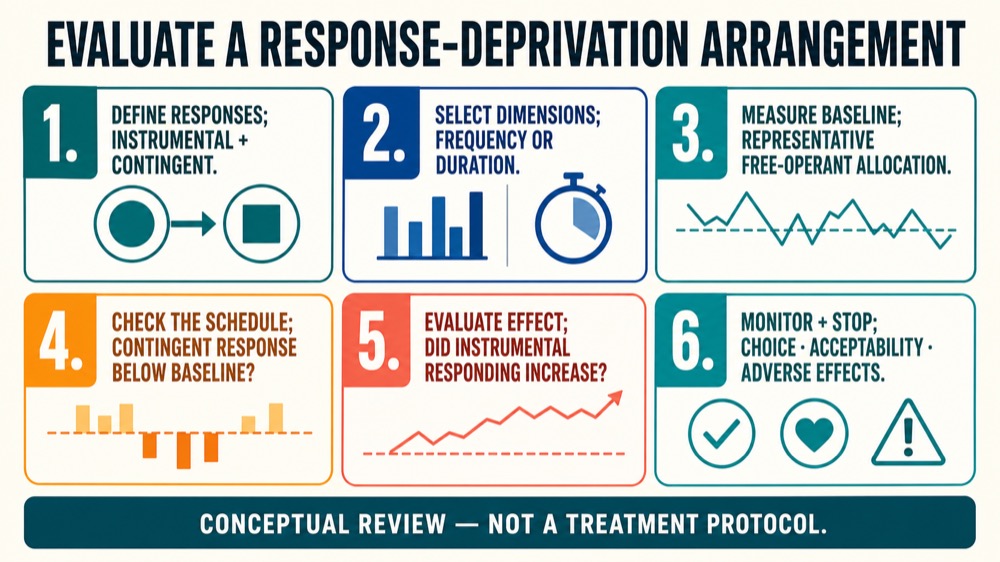
The following is a conceptual review framework, not a stand-alone implementation guide. Applied use requires competence, informed consent, contextual fit, supervision where relevant, and an individualized plan.
- Define both activities. Operationally define the instrumental and contingent responses and select a response dimension, such as frequency or duration, that represents each activity.
- Measure a representative baseline. Observe response allocation when meaningful alternatives are available. A brief or artificial sample can misrepresent the behavioral baseline.
- Check the proposed schedule mathematically. Determine whether the contingency would restrict the contingent response below baseline if instrumental responding remained unchanged. The schedule ratio, not a generic timer, carries the prediction.
- Evaluate safer options and choice. Consider nonrestrictive access, direct skill supports, environmental changes, and other reinforcement arrangements before introducing a restriction component.
- Measure effects broadly. Track the instrumental response, contingent response, total access, engagement, adverse effects, procedural integrity, and stakeholder-reported acceptability.
- Use an appropriate demonstration. A reinforcer assessment or experimental comparison can help distinguish a contingency effect from maturation, instructions, attention, concurrent changes, or measurement error.
A preference assessment and a reinforcer assessment answer different questions. Preference data identify candidates under specified choice conditions. A reinforcer assessment evaluates whether contingent access increases the behavior it follows. RDH contributes a quantitative prediction about the schedule, but outcome data remain necessary.
Operation, Effect, and Interpretation Limits
Conceptual precision improves when three layers remain separate:
- Operation: arrange a contingency between an instrumental and contingent activity.
- Restriction condition: the schedule constrains the contingent response below its free-operant baseline unless allocation changes.
- Observed effect: instrumental responding changes, contingent responding changes, or both.
Meeting the modeled deprivation condition creates a prediction, not certainty. Baseline estimates can be unstable, alternative activities can compete, schedule contact can be weak, and behavior can change for reasons outside the programmed relation. Multiple-response environments are especially important because restricting one activity may redistribute time across several alternatives rather than only the designated instrumental response.
RDH is also a historical foundation for broader disequilibrium models. A short definition is useful for study, but it does not capture every parameter needed to predict the direction or magnitude of behavior change. The peer-reviewed tutorial should be read for its full model, assumptions, and applied cautions rather than cited as proof that a simple “first this, then that” rule will work.
Ethical and Practical Safeguards
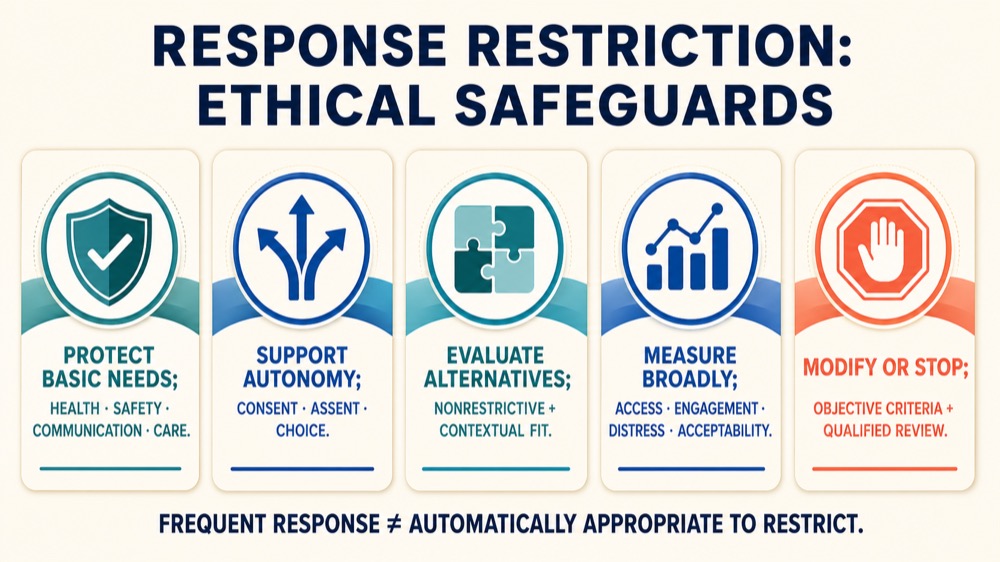
Response restriction can affect autonomy, access, relationships, and quality of life. Basic needs, health and safety behavior, communication, movement needed for regulation, sleep, toileting, hydration, food, medical care, social connection, and access to help should not become bargaining tools. A frequently occurring activity is not automatically appropriate to restrict.
Review should consider client preference, assent when applicable, informed consent, cultural context, risk, feasibility, and less restrictive alternatives. The plan needs objective modification and stop criteria. Monitoring should include distress, avoidance, escalation, loss of valued activity, displacement to other behavior, and the person’s experience—not merely whether the instrumental response rose.
The BACB BCBA Test Content Outline, Sixth Edition identifies relevant competencies in response measurement, motivating operations, reinforcement procedures, assessment-based intervention selection, unwanted-effect mitigation, procedural integrity, and data-based modification. It does not name RDH as a guaranteed examination item and does not replace the Ethics Code, supervision, local requirements, or individualized clinical judgment.
Study Checks for Response Deprivation
- Which activity is instrumental, and which activity is contingent?
- What response dimension was measured for each activity?
- What is the free-operant baseline for both responses?
- Would the schedule restrict the contingent response below baseline if instrumental behavior stayed unchanged?
- Is the scenario using a probability differential, a response-deprivation relation, biological deprivation, or none of these?
- What outcome would demonstrate reinforcement rather than assumed reinforcer value?
- What concurrent alternatives, risks, and stakeholder outcomes also require measurement?
For practice, change one feature in a vignette at a time: baseline allocation, schedule ratio, contingent-response access, biological state, or measured outcome. This prevents surface details such as “screen time after homework” from replacing the actual behavioral relation.
Free BCBA Mock Exam Practice
Use the Free BCBA Mock Exam to practice distinguishing operations, predictions, and observed behavioral effects. The practice resource provides feedback and helps identify areas for further study; it does not reproduce or promise any particular certification-exam topic.
References
- Jacobs et al. (2017), Predicting the Effects of Interventions: A Tutorial on the Disequilibrium Model
- Behavior Analyst Certification Board, BCBA Test Content Outline, Sixth Edition
Next step for BCBA exam prep
Turn this topic into exam-day practice
Use this topic as a focused review, then test it in exam-style conditions with a free mock before deciding whether five full-length mocks are the right next step.
Start the Free BCBA Mock ExamContinue with Five Full-Length Mocks — $99
Review the included materials and access details before ordering. No pass guarantee is implied.



