
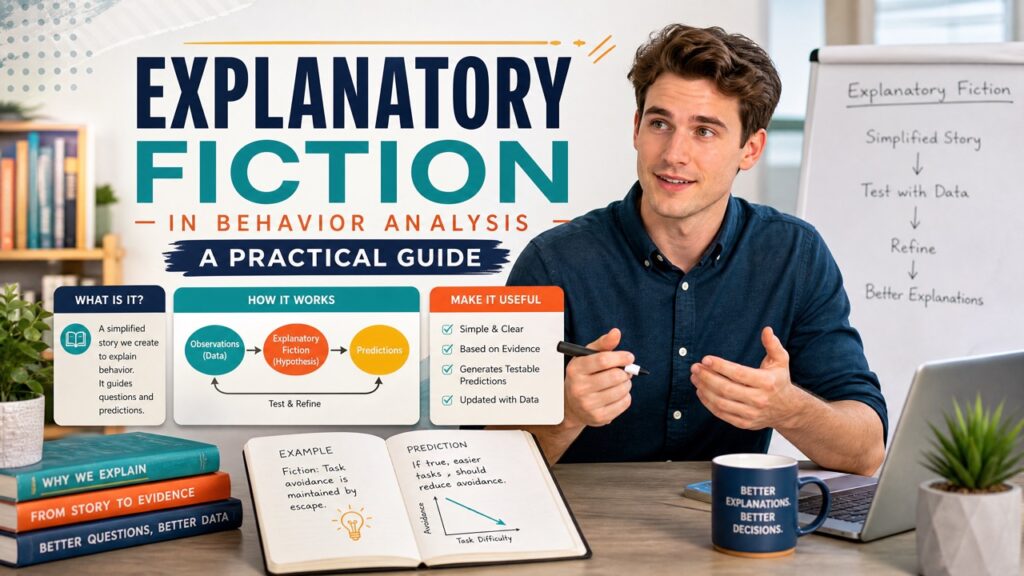
Explanatory fiction in applied behavior analysis (ABA) is a concept that often confuses learners and practitioners alike. It refers to a type of explanation that attributes behavior to an inner cause that is merely a restatement of the behavior itself. For example, saying “he ate because he was hungry” is an explanatory fiction if hunger is inferred solely from the eating, with no independent evidence of hunger. This guide will define explanatory fiction, contrast it with hypothetical constructs, explain why it is problematic, and provide practical examples to help you recognize and avoid it in your work.
Table of Contents
- What Is Explanatory Fiction in ABA?
- Explanatory Fiction vs. Hypothetical Construct
- The Problem with Explanatory Fictions
- Examples and Nonexamples
- How Explanatory Fiction Relates to Mentalism
- Common Traps and Study Tips
- Practical Implications for Applied Behavior Analysis
- Conclusion and Next Steps
- Reference
What Is Explanatory Fiction in ABA?
An explanatory fiction is a mentalistic explanation that attributes behavior to an inner cause that is merely a restatement of the behavior itself. In other words, the “cause” is inferred from the behavior it is meant to explain, and no independent evidence supports the existence of that cause. For example, saying “She cried because she felt sad” is an explanatory fiction if sadness is inferred from crying. The explanation adds no new information about the environmental events that actually control the crying.
Explanatory fiction is a specific type of mentalism. Mentalism is a philosophical position that explains behavior by appealing to internal mental states, such as thoughts, feelings, or traits. Behavior analysts often reject mentalism because it does not lead to a functional understanding of behavior. Instead, they focus on identifying environmental variables that can be manipulated to produce behavior change. When an explanation is an explanatory fiction, it is not testable because the inner cause is defined in terms of the behavior it supposedly explains.
- Definition: A restatement of behavior as its own cause.
- Type: A form of mentalism.
- Key problem: It is not testable and does not identify controlling variables.
- Contrast: It differs from a hypothetical construct, which may have some empirical basis.
Explanatory Fiction vs. Hypothetical Construct
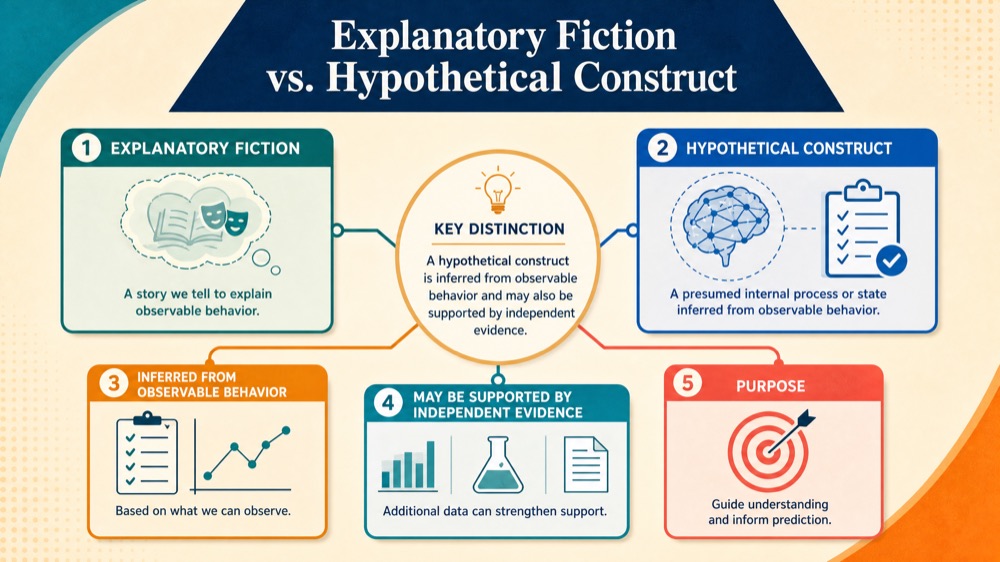
It is important to distinguish explanatory fiction from hypothetical construct. A hypothetical construct is a presumed internal process or state that is inferred from observable behavior but may also be supported by independent evidence. For example, memory is a hypothetical construct; while it cannot be directly observed, researchers can measure performance on memory tasks and manipulate variables that affect those tasks. In contrast, an explanatory fiction has no independent evidence and is not testable.
To illustrate, consider the statement “He hit because he has a bad temper.” Here, “bad temper” is inferred solely from hitting. There is no independent observation of temper, and no way to measure it separately from the behavior. This is an explanatory fiction. However, if aggression is measured by a standardized questionnaire that predicts behavior across settings, it could be a hypothetical construct with some empirical support.
Behavior analysts often prefer to avoid both explanatory fictions and mentalistic explanations. Instead, they seek a behavior-analytic interpretation that identifies the environmental events that reliably precede and follow behavior. For instance, to explain hitting, a behavior analyst would examine the antecedents (e.g., a request to transition) and consequences (e.g., escape from the demand) that maintain the hitting. This allows for a functional analysis and eventual intervention.
The Problem with Explanatory Fictions
Explanatory fictions are problematic for several reasons. First, they do not identify controlling variables. Unlike a functional analysis that reveals the environmental determinants of behavior, an explanatory fiction just gives a name to the behavior pattern. For example, saying “John is lazy” when John does not complete his homework does not tell us why he avoids homework. It does not tell us whether the behavior is maintained by escape, attention, or access to preferred activities.
Second, explanatory fictions can impede effective treatment. If a clinician believes that a child cries because of “sadness,” they may try to comfort the child or teach emotional regulation, without addressing the environmental variables that actually trigger and maintain crying. In contrast, a behavior-analytic approach would assess the situation: perhaps crying occurs when a preferred toy is removed, and historically, crying led to the toy being returned. Then treatment could focus on teaching communication skills and reinforcing appropriate requests.
- Stops exploration: Once an explanatory fiction is accepted, clinicians may stop looking for real environmental causes.
- Hinders assessment: It prevents functional analysis and leads to ineffective interventions.
- Contradicts science: Behavior analysis aims to predict and influence behavior through environmental events, not inner causes.
Consider a common scenario in practice: a child screams during transitions. A label such as “stubborn” does not identify the transition conditions, the observable response, or the consequences that follow it. A behavior-analytic interpretation would note that screaming has historically led to delayed transitions or escape from the transition. By identifying these variables, the behavior analyst can design an intervention, such as giving advance notice or providing a high-probability request sequence.
Examples and Nonexamples
Examples of Explanatory Fictions: Use the points below as a quick study guide.
- She cried because she felt sad. “Sadness” is inferred from crying; there is no independent measure of sadness.
- He hit because he has a bad temper. “Bad temper” is inferred from hitting; it is not testable.
- Homework was not completed. A label such as “lazy” does not identify the task conditions, prompts, consequences, or reinforcement history related to homework completion.
Nonexamples: A nonexample is critical for understanding. Consider: “She cried because the toy was removed, and crying previously led to toy retrieval.” This is not an explanatory fiction because it references environmental events—the removal of the toy and the history of reinforcement. It identifies a plausible function: crying is maintained by the return of the toy. This explanation is testable and potentially useful for intervention.
Another nonexample: “He hit because, in the past, hitting resulted in attention from peers.” This is a behavioral interpretation, not an explanatory fiction, because it cites the environmental consequence (attention) and the history that establishes it.
How Explanatory Fiction Relates to Mentalism
Mentalism is the broader philosophical stance that behavior is caused by internal mental events. Explanatory fiction is one form of mentalism, but A hypothetical construct such as “memory” may be discussed as an unobserved process when independent evidence supports it; that differs from an explanatory fiction that simply restates the behavior. However, behavior analysts often reject mentalism because it shifts attention away from the environment and can lead to circular reasoning.
It is important to note that not every reference to private events is an explanatory fiction. For instance, a behavior analyst might acknowledge that a person has a headache (a private event) and that this may influence behavior, but they would not use the headache as an explanatory fiction. Instead, they would treat the headache as a biological variable or an antecedent that can be observed indirectly.
Behavior analysts are not concerned with the existence of inner events; they are concerned with whether those events can be studied scientifically. Explanatory fictions fail this test because they are not independently verifiable. Therefore, they are often rejected as explanations in applied behavior analysis.
Common Traps and Study Tips
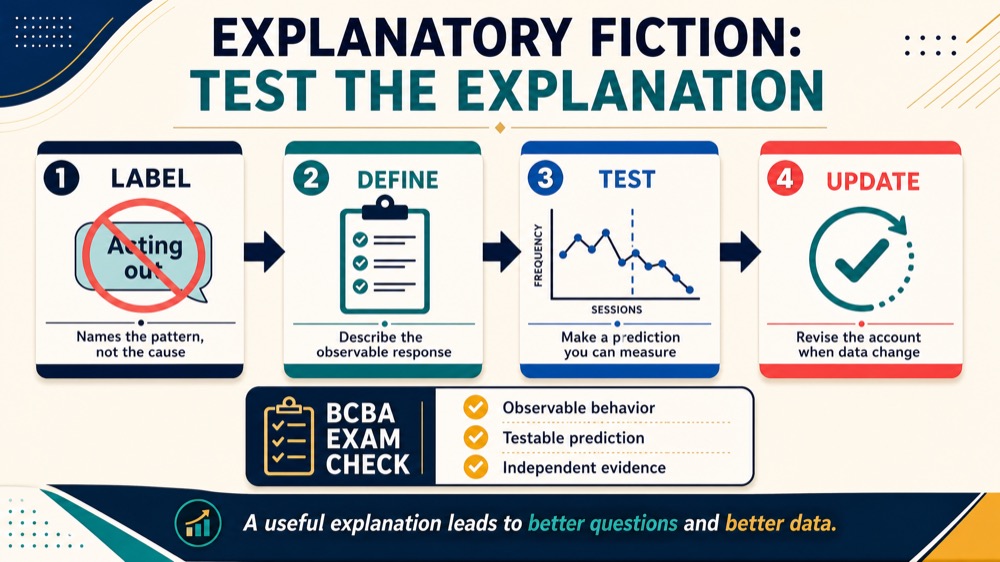
When studying explanatory fiction, learners often fall into several traps. First, they may think that any reference to feelings or thoughts is an explanatory fiction. That is false. The key is whether the inner cause is inferred solely from the behavior it is supposed to explain. Second, they may confuse explanatory fiction with hypothetical constructs. Remember: hypothetical constructs have empirical support, while explanatory fictions do not. Third, they may believe that explanatory fictions are harmless, but they can lead to ineffective treatment.
- Use independent evidence: Ask yourself: Is the inner cause observed or measured separately from the behavior?
- Look for environmental variables: For a behavior-analytic interpretation, identify antecedents and consequences.
- Practice with examples: Create your own examples and test whether they meet the definition.
Here is a checklist to help you evaluate whether an explanation is an explanatory fiction:
- Does the explanation refer to an inner state or trait?
- Is that inner state inferred solely from the behavior it explains?
- Is there any independent way to verify the inner state?
- Are there environmental events that could be identified instead?
- If the inner state has no independent evidence, it is likely an explanatory fiction.
For more practice, consider reviewing our free BCBA mock exam. It offers practice questions and feedback to help you apply these concepts in exam-like scenarios. While it may not include this exact topic, it can help you strengthen your overall conceptual understanding.
Practical Implications for Applied Behavior Analysis
In clinical practice, using explanatory fictions can lead to ineffective treatment. For example, if a behavior analyst says that a client engages in self-injury because of “pain,” without any medical evidence, they may not conduct a functional analysis. This can result in interventions that fail to reduce the behavior because they do not address the environmental variables maintaining it. Instead, a behavior-analytic approach would involve assessing the function of self-injury, perhaps through functional analysis, to identify whether it is maintained by access to tangibles, escape, attention, or automatic reinforcement.
It is also important to recognize that explanatory fictions are not acceptable in clinical practice. The BACB Ethics Code requires behavior analysts to use evidence-based practices and to base their interventions on behavioral principles. Using mentalistic explanations does not align with this requirement. Always strive to identify controlling variables and to use behavior-analytic interpretations that are supported by observations.
In summary, explanatory fiction is a mentalistic explanation that provides a false sense of understanding. It is a common error in behavior analysis, but with practice, you can identify and avoid it. By focusing on environmental variables, you can improve the effectiveness of your interventions and adhere to the principles of applied behavior analysis.
To further your study, consider reviewing the BCBA Test Content Outline (6th ed.) from the BACB website. This outline provides a comprehensive list of topics that may appear on the exam, including philosophical foundations. Although explanatory fiction is not explicitly named, understanding it is crucial for mastering the conceptual analysis of behavior.
Conclusion and Next Steps
Explanatory fiction is a subtle but important concept in behavior analysis. It undermines scientific explanation and can hinder treatment progress. By learning to recognize and avoid explanatory fictions, you will become a more effective behavior analyst. Remember to look for environmental events, use functional analysis, and rely on testable explanations.
If you are preparing for the BCBA exam, reinforce your understanding with practice questions. Our free BCBA mock exam offers realistic practice and feedback to help you identify areas for improvement. Visit https://bcbamockexam.com/free-bcba-mock-exam/ to get started. Good luck with your studies!
Reference
Next step for BCBA exam prep
Turn this topic into exam-day practice
Use this topic as a focused review, then test it in exam-style conditions with a free mock before deciding whether five full-length mocks are the right next step.
Start the Free BCBA Mock Exam
Continue with Five Full-Length Mocks — $99
Review the included materials and access details before ordering. No pass guarantee is implied.



