
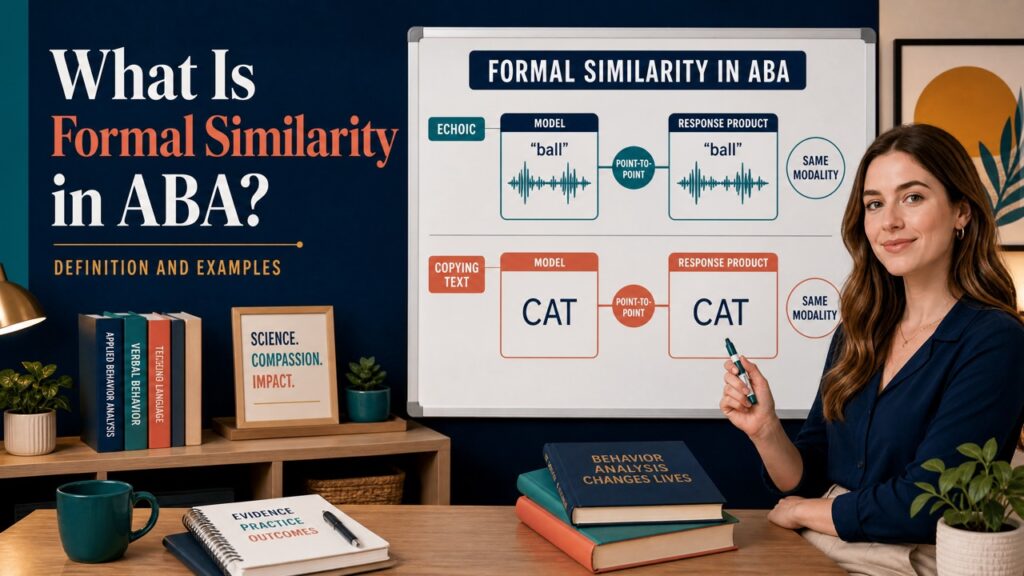
In applied behavior analysis, formal similarity aba refers to a specific relationship between an antecedent stimulus and the response product it evokes. When a response product physically resembles the antecedent stimulus in a way that involves both point-to-point correspondence and the same sensory modality, the behavior is said to have formal similarity with that stimulus. This concept is central to understanding certain verbal operants, especially the echoic and copying text. In this guide, we’ll define formal similarity in ABA, provide clear examples and non-examples, and explain why it matters for assessment and intervention.
Table of Contents
- Definition and Criteria for Formal Similarity
- Examples and Nonexamples
- Distinctions from Related Concepts
- Role of Formal Similarity in Assessment and Intervention
- Limitations and Practical Cautions
- Common Traps and Study Checklist
- Conclusion
Definition and Criteria for Formal Similarity
Formal similarity is defined by two criteria: point-to-point correspondence and same sensory modality. Point-to-point correspondence means that the response product can be divided into parts that correspond to the parts of the antecedent stimulus. For example, when you say “cat,” the sounds “c,” “a,” and “t” correspond to the sounds in the model. Same sensory modality means that the antecedent and the response product are experienced through the same sense—both are auditory (for spoken words) or both are visual (for written words). When both criteria are met, the response has formal similarity with the antecedent.
In contrast, a response lacks formal similarity if it fails either criterion. For instance, reading a written word aloud does not produce a response that has point-to-point correspondence with the visual text in the same modality, because the response is auditory while the antecedent is visual. Also, saying the word “dog” after hearing “cat” would not show point-to-point correspondence because the sounds differ. Thus, formal similarity is a precise technical term, not just a general sense of resemblance.
This distinction is essential for understanding verbal operants. In ABA, verbal operants are classified by their controlling variables, and formal similarity is a defining feature of some operants. Specifically, the echoic is a verbal operant in which a speaker repeats the verbal behavior of another person. The response product (the spoken word) has point-to-point correspondence and is in the same sensory modality as the antecedent (the spoken model). Similarly, copying text involves writing or typing a written model, and the written response has point-to-point correspondence with the visual antecedent, so it also exhibits formal similarity.
However, formal similarity is not required for all verbal operants. For example, a tact is a verbal response under the control of a non-verbal antecedent, such as seeing a dog and saying “dog.” Here, the response (“dog”) does not resemble the dog in any sensory modality, so there is no formal similarity. Likewise, a mand (a request) is controlled by an establishing operation and a motivating variable, and the response does not generally match the antecedent. Intraverbals, such as answering “What is your name?” with your name, also lack formal similarity because the response does not match the verbal stimulus.
Examples and Nonexamples
Example: Echoic: Use the points below as a quick study guide.
- Antecedent: Therapist says “ball” in a clear voice.
- Response: Learner says “ball.”
- Analysis: The spoken response matches the spoken model sound-for-sound (point-to-point correspondence) and is also auditory (same sensory modality). Therefore, there is formal similarity between the model and the response.
Example: Copying Text: Use the points below as a quick study guide.
- Antecedent: A worksheet shows the word “cat” written in black ink.
- Response: Learner writes “cat” on a line below.
- Analysis: The written response has each letter corresponding to the letters of the model (point-to-point correspondence) and both are visual (same sensory modality). Thus, formal similarity is present.
Nonexample: Reading Aloud: A common misconception is that reading a word aloud exhibits formal similarity with the written word. However, the response (spoken “cat”) is auditory, while the antecedent (written word “cat”) is visual. Although there is a correspondence between the letters and sounds, the modalities differ, so formal similarity does not exist. This distinction is critical because it clarifies why echoic and copying text are considered formally similar, but reading is not.
Distinctions from Related Concepts
Formal similarity is often confused with imitation, but they are not the same. Imitation is a behavior that is controlled by an antecedent behavior of another individual, and the imitative behavior formally matches the model. For example, if a therapist claps their hands and the learner claps, that is imitation. Importantly, imitation can involve non-verbal behavior (like motor actions), whereas formal similarity in the context of verbal behavior specifically refers to verbal responses. Additionally, imitation is defined by the matching of the form of the behavior itself, not necessarily the response product. Formal similarity focuses on the response product (e.g., the sound or written word), not the process or the muscle movements involved.
Another related concept is stimulus control, which refers to the extent to which an antecedent stimulus evokes a response. Formal similarity is not the same as stimulus control; a response can be under stimulus control even if there is no formal similarity. For example, a tact is under stimulus control of an object, but there is no formal similarity between the object and the response. Thus, formal similarity is a property of certain stimulus-response relationships, not a mechanism of control.
To illustrate, consider a child who says “cookie” when they see a cookie (a tact). There is no formal similarity because the spoken word does not resemble the cookie. However, the response is under stimulus control of the cookie. Conversely, in an echoic, the response is under the control of the verbal model, and there is formal similarity. Both are examples of stimulus control, but only the echoic involves formal similarity.
Role of Formal Similarity in Assessment and Intervention
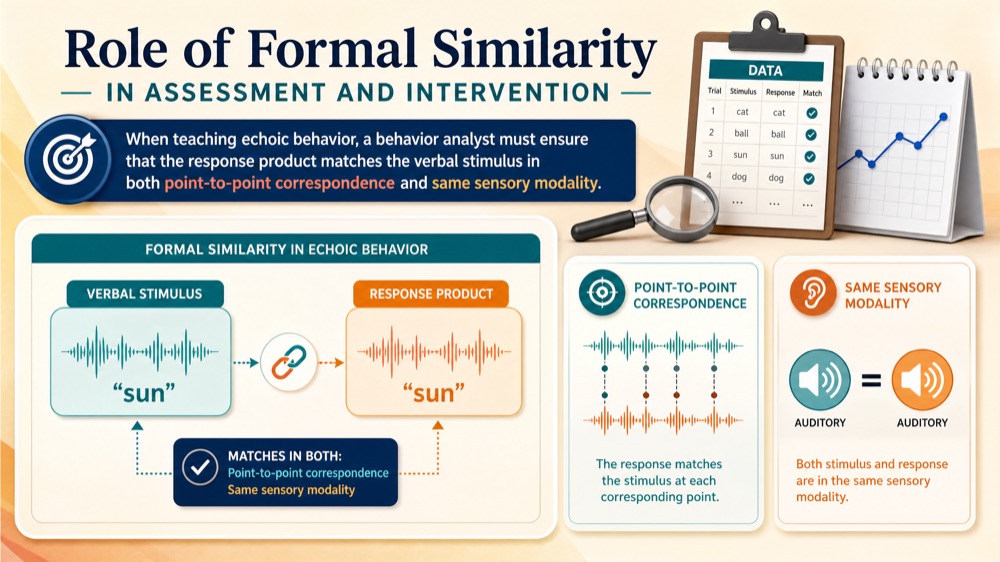
When teaching echoic behavior, a behavior analyst must ensure that the response product matches the verbal stimulus in both point-to-point correspondence and same sensory modality. This means that during intervention, the therapist might present a vocal model and then record whether the learner’s vocalization matches that model. If the learner says “ball” after hearing “ball,” the response is correctly matched. Data collection should focus on the accuracy of the match, not just whether the learner made any sound. Error correction procedures can then be used to improve the correspondence.
Similarly, when teaching copying text, the analyst would present a written model and require the learner to produce a written response that matches the model. The therapist might use a visual check to compare the written product to the model, ensuring each letter is replicated. This is different from teaching a tact, where the response does not need to resemble the antecedent.
In assessment, formal similarity can help determine whether a learner has acquired a particular verbal operant. For example, if a learner can echo “ball” but not tact “ball” in the presence of a ball, the analyst can assess which operant is deficient. The presence or absence of formal similarity helps guide the selection of teaching procedures.
Limitations and Practical Cautions
One important limitation is that formal similarity alone does not determine the controlling variable. A response that has formal similarity with an antecedent may still be under the control of other variables. For instance, a learner might say “ball” after the therapist says “ball” in a context where a ball is present and the learner has a history of gaining access to the ball by saying “ball.” In that case, even though there is formal similarity, the response may be a mand, not an echoic. Therefore, behavior analysts must assess the function of the response through multiple probes, not just rely on the presence of formal similarity.
Another caution is to avoid using “formal similarity” interchangeably with everyday terms like “similarity” or “resemblance.” Formal similarity is a technical term with specific criteria. Always assess both point-to-point correspondence and sensory modality. For example, a learner might say “b” when the model says “d,” which has some resemblance but not point-to-point correspondence because the sounds are different. That response does not have formal similarity.
Additionally, it is a misconception that formal similarity is defined by the behavior analyst’s perception. It is defined by the physical properties of the response product, not by the analyst’s judgment. The response must actually match the antecedent in the specified ways, regardless of whether the analyst sees it as similar.
Finally, formal similarity is not guaranteed to be taught on the BCBA exam, but it is a concept that appears in the BACB BCBA Test Content Outline (6th ed.) under verbal behavior. For a deeper understanding, refer to primary sources like this article on verbal behavior. Always consult the official outline and current ethics code when preparing for certification.
Common Traps and Study Checklist
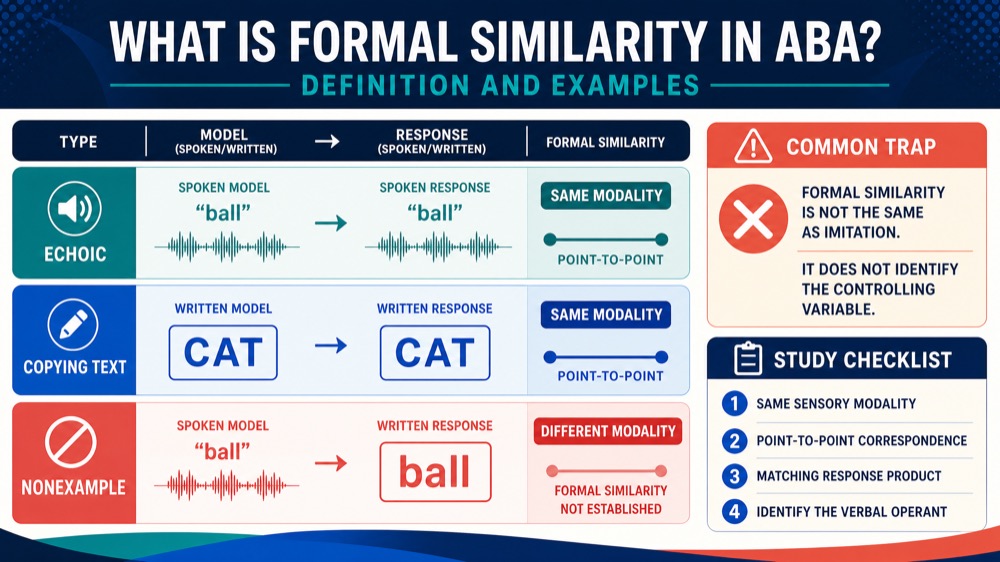
- Trap: Confusing formal similarity with imitation. Fix: Remember imitation can be non-verbal, while formal similarity specifically refers to verbal response products.
- Trap: Thinking formal similarity is required for all verbal operants. Fix: Only echoic and copying text require it; tact, mand, and intraverbal do not.
- Trap: Assuming reading aloud has formal similarity. Fix: Modalities differ (visual vs. auditory), so it does not meet criteria.
- Trap: Overlooking the need to assess both point-to-point correspondence and same sensory modality. Fix: Always check both.
- Trap: Believing formal similarity determines the controlling variable. Fix: Formal similarity is a structural property, not a functional one.
To solidify your understanding, use this checklist:
- Define formal similarity in your own words, including both criteria.
- Provide an example of echoic and an example of copying text.
- Explain why reading aloud is a non-example.
- Contrast formal similarity with imitation and stimulus control.
- Identify which verbal operants require formal similarity.
- Explain how to assess formal similarity in a clinical session.
For more practice, explore our free BCBA mock exam to test your knowledge of verbal behavior and other key concepts. Additionally, check out our stimulus control guide for scenario-based learning.
Conclusion
Formal similarity is a precise concept in applied behavior analysis that describes a specific relationship between an antecedent and a response. It requires point-to-point correspondence and the same sensory modality. This concept is essential for understanding echoics and copying text, and it is not required for other verbal operants. By mastering the definition, examples, and distinctions, you can better analyze verbal behavior and avoid common pitfalls. Use this guide as a reference in your BCBA exam preparation and clinical practice.
Remember, the Free BCBA Mock Exam offers practice and feedback to help you gauge your readiness. It does not contain exact questions from the live exam, but it provides valuable practice opportunities. Good luck with your studies!



