
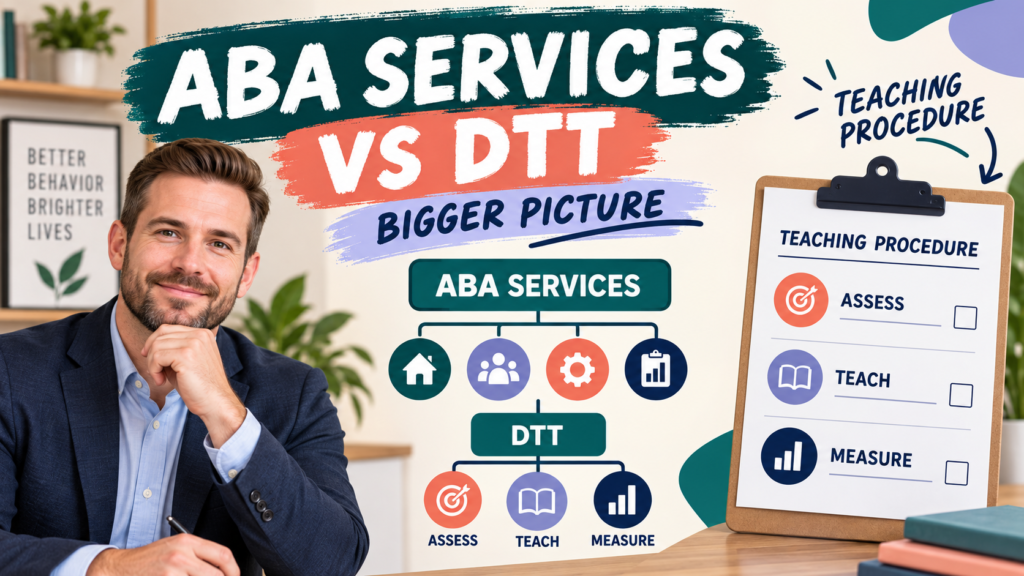
Explain the difference between ABA services and DTT in one sentence: applied behavior analysis is the broader science and service framework, while discrete trial training is one structured teaching procedure that can be used within an ABA program. They are related, but they are not interchangeable labels.
Table of Contents
- Explain the Difference Between ABA Services and DTT
- What Do ABA Services Usually Include?
- What Is Distinctive About DTT?
- How Does DTT Fit Inside ABA Services?
- How Could the Same Skill Be Taught in Different Formats?
- What Should You Ask About an ABA Service Model?
- How Do You Answer an ABA-versus-DTT Exam Question?
- What Mistakes Should You Avoid?
- ABA Services and DTT FAQ
- Sources and Date Check
- Take the Free BCBA Mock Exam
The confusion is understandable because many families and websites use “ABA” to describe a provider’s entire program, while “DTT” may describe the teaching arrangement used during part of a session. A service can include DTT, naturalistic teaching, functional communication training, prompting, shaping, task analysis, caregiver coaching, and other behavior-analytic procedures. The right comparison depends on whether the question is asking about a science, a service model, or a specific teaching format.
Explain the Difference Between ABA Services and DTT
ABA services are a broader, individualized application of behavior-analytic principles. They may include assessment, goal selection, intervention planning, data collection, caregiver or team collaboration, progress review, and decisions about which procedures fit the person and context. “ABA services” describes what a program or professional provides; it does not name one single teaching technique.
Discrete trial training (DTT) is a structured instructional arrangement. A teaching opportunity is separated into a clear antecedent or instruction, a learner response, and a consequence or feedback. Skills are broken into teachable components, repeated opportunities are arranged, and prompting and reinforcement are used according to the teaching plan. DTT can be one component of an ABA program, but it is not the whole field of ABA and it is not synonymous with every ABA service.
So, if a question asks whether DTT and ABA are the same, the best answer is no: DTT is one procedure or teaching format that may be used within broader ABA-based services. That relationship is a category distinction, not a claim that every DTT arrangement is identical or that one format is automatically better for every learner.
What Do ABA Services Usually Include?
The exact package varies by provider, payer, setting, and the person’s goals. For study purposes, think of services as a coordinated cycle rather than a single table-top activity:
- Assessment and definition: identify socially meaningful goals, define behavior observably, and review relevant context and baseline information.
- Intervention planning: select procedures that fit the target, the person’s skills, the environment, and the available supports.
- Teaching and behavior change: use appropriate arrangements such as DTT, naturalistic teaching, prompting and fading, shaping, chaining, reinforcement, or functional communication training.
- Measurement: record responses and relevant context so the team can evaluate progress, implementation, generalization, and possible side effects.
- Collaboration and review: coordinate with caregivers, educators, and other providers as appropriate, then adjust goals or procedures when the data and the person’s priorities call for it.
The current BCBA Test Content Outline organizes exam content around assessment, behavior-change procedures, intervention selection and implementation, measurement, and professional issues. That structure is a useful reminder that a service program involves more than a particular lesson format.
What Is Distinctive About DTT?
DTT makes the teaching opportunity more discrete and observable. The instructor arranges a defined cue, gives the learner an opportunity to respond, and delivers a planned consequence or correction. The target response, prompt level, reinforcement rule, and data definition should be clear enough that the team can tell whether the learner responded independently, after a prompt, incorrectly, or not at all.
DTT can be useful when a skill has a clear response form, when the learner benefits from small repeated teaching opportunities, or when the team needs precise trial-level data. It can also be combined with other arrangements. A learner might practice a discrimination in structured trials and then use that skill during play, conversation, classroom work, or community routines.
A structured format does not remove the need for choice, dignity, meaningful goals, prompt fading, generalization, and individualized decision making. DTT is a tool. Its quality depends on what is taught, how it is taught, how the learner experiences it, and what happens when the structured practice ends.
How Does DTT Fit Inside ABA Services?
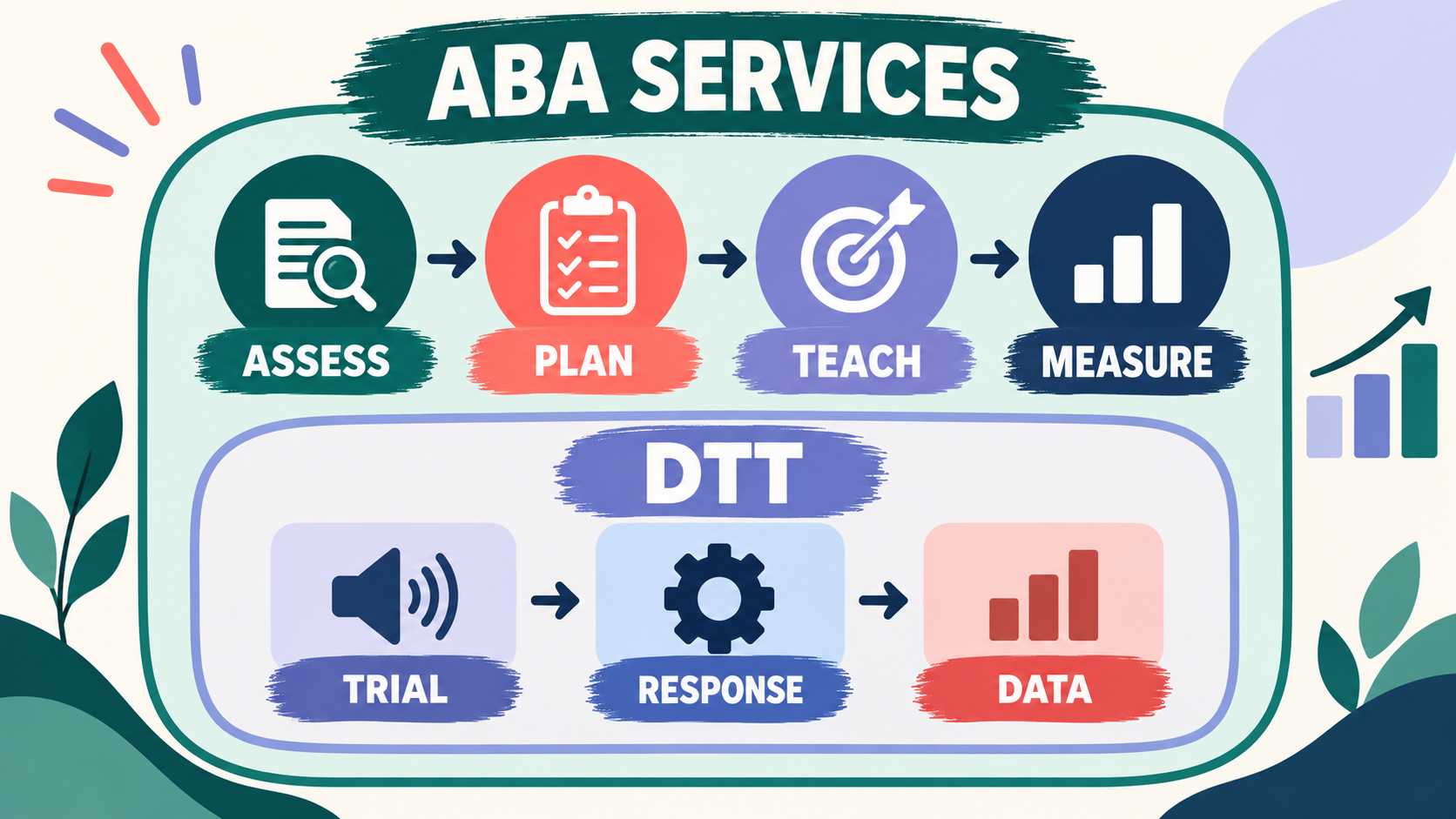
Think of the relationship as a set-within-a-set rather than a competition. ABA services may include an assessment and a coordinated plan; DTT may be one teaching arrangement selected for a particular objective. The same program may use DTT for one skill, naturalistic teaching for another, and functional communication training or caregiver coaching for a different need.
A helpful planning question is not “Do we choose ABA or DTT?” It is “What is the learner’s goal, what conditions support useful learning, and which teaching arrangement gives us interpretable data and meaningful opportunities to use the skill?” The answer may change as the learner acquires a response, becomes more independent, or needs the skill to generalize to new people and settings.
| Feature | ABA services | DTT |
|---|---|---|
| Level of description | A broader science-informed service or program context. | A structured teaching arrangement or procedure. |
| Typical scope | Assessment, goals, intervention, measurement, collaboration, and review. | Repeated teaching opportunities with defined cues, responses, and consequences. |
| Possible setting | Home, school, clinic, workplace, community, or other relevant context. | Often a more arranged instructional setting, although it can be adapted and distributed. |
| Main exam clue | The stem asks about the science, service plan, assessment, or overall intervention. | The stem describes a discrete trial, a structured sequence, or trial-level teaching data. |
How Could the Same Skill Be Taught in Different Formats?
Consider a fictional goal of teaching a learner to request a break. In a structured DTT arrangement, the instructor might present a defined task, arrange the communication opportunity, prompt the request when needed, honor the request, and record the response and prompt level. The trial has a clear beginning, response opportunity, consequence, and data rule.
In a natural routine, the team might arrange a difficult but reasonable activity, watch for the learner’s communication, prompt or model the functional request according to the plan, and honor the request in the natural context. The learning opportunity is less separated from the routine, but the behavior and consequence still need to be defined. Both arrangements can use ABA principles; they answer slightly different teaching and generalization needs.
The example does not mean that a particular request program should be used for a real person without assessment and supervision. It illustrates the vocabulary: ABA describes the science-informed approach and service context, while DTT describes one way to arrange teaching opportunities.
What Should You Ask About an ABA Service Model?
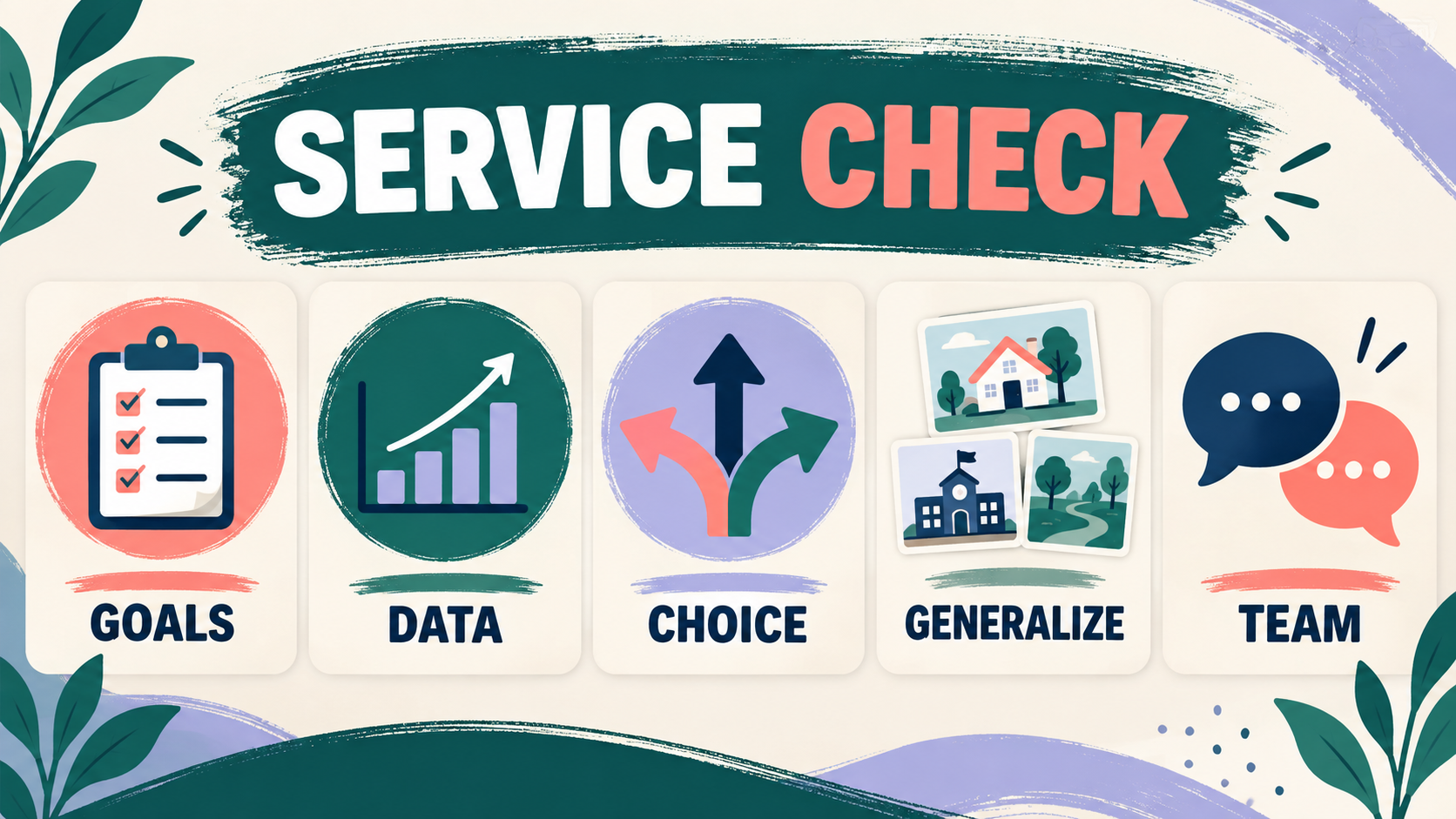
When a provider says “we offer ABA,” the label alone does not tell you how the program works. Useful questions focus on goals, measurement, teaching formats, collaboration, and the learner’s experience:
- What behaviors or skills are the goals, and how will they be defined and measured?
- Which teaching arrangements may be used, and why would the team choose DTT for a particular objective?
- How will the team plan for independence, generalization, maintenance, communication, and choice?
- How will caregivers, teachers, or other supporters receive information and participate when appropriate?
- How will progress, treatment integrity, side effects, and the learner’s priorities affect decisions?
These questions help separate a service description from a method label. They also keep the focus on whether the program produces meaningful, ethical, and usable outcomes rather than whether it uses a fashionable term.
How Do You Answer an ABA-versus-DTT Exam Question?
Use the level of the wording. If the item asks about the broad application of behavioral principles to socially meaningful change, the answer is likely ABA or applied behavior analysis. If it describes a step-by-step teaching sequence with a clear antecedent, response, consequence, prompting, and trial-by-trial recording, DTT may be the specific procedure.
- “Which field or science?” Think applied behavior analysis.
- “Which service includes assessment, goals, data, collaboration, and review?” Think broader ABA services or program planning.
- “Which procedure breaks instruction into discrete repeated opportunities?” Think DTT.
- “Which method occurs in everyday routines and follows the learner’s motivation?” Consider a naturalistic teaching arrangement, not automatically DTT.
- “Which is better for everyone?” Reject the universal claim and look for the option that matches the goal, context, data, and individual fit.
The CDC overview of autism treatment and intervention describes DTT as one ABA teaching style, while the NICHD overview describes DTT as one structured behavioral teaching approach. These public resources support the category distinction, but they do not replace a learner’s individualized assessment or the current BACB materials. For additional comparison practice, the free BCBA mock exam is an independent study aid. It is not an official BACB product and does not replace the current TCO, handbook, supervision, or professional judgment.
What Mistakes Should You Avoid?
Watch for these common errors in study notes and answer choices:
- Calling DTT and ABA synonyms when DTT is one procedure within a broader behavior-analytic framework.
- Assuming ABA services must happen at a table or use only discrete trials.
- Assuming a naturalistic setting means no prompting, measurement, or planned contingencies are present.
- Choosing a teaching format before identifying the goal, response definition, context, and data decision.
- Using “ABA” as a guarantee of quality without asking about assessment, collaboration, implementation, and outcomes.
ABA Services and DTT FAQ
Are ABA services and DTT the same thing?: No. ABA services are broader and may include assessment, intervention planning, data collection, collaboration, and several teaching procedures. DTT is a structured teaching arrangement that may be used within an ABA program. Is DTT part of ABA?: Yes, DTT is commonly described as one ABA-based teaching procedure. It should still be selected and implemented according to the learner’s goals, context, data, and individualized plan.
Does every ABA program use DTT?: No. Programs may use DTT for some targets and naturalistic teaching, functional communication training, shaping, chaining, prompting and fading, or other procedures for other targets. The service label does not determine every teaching arrangement.
Which is better, ABA or DTT?: The question compares different levels of description, so it is not an either-or choice. DTT may be a useful tool for a specific objective, while ABA describes the broader principles and service framework used to select, implement, and evaluate interventions.
Sources and Date Check
This article was reviewed on September 29, 2026 against the BACB sixth-edition Test Content Outline, the current BCBA Handbook, and public educational resources from the CDC, NICHD, and ASHA. Terminology and service requirements can vary; verify current BACB, payer, and provider materials before making a practice or care decision.
Take the Free BCBA Mock Exam
If you want a low-pressure way to check your recall, use the free practice resource below. Take the Free BCBA Mock Exam



