
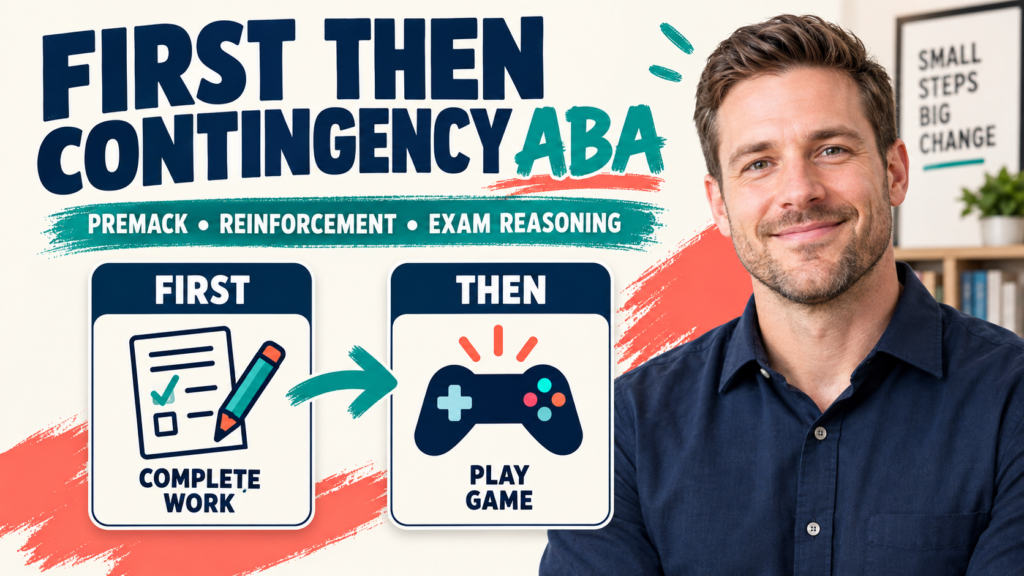
First then contingency ABA is a clear arrangement in which a learner completes a defined “first” response or activity and then gets access to a meaningful “then” activity. It is related to the Premack principle, but a useful first-then statement is more than a promise to make someone comply: it should be individualized, achievable, observable, and reviewed with data.
Table of Contents
- What Is a First Then Contingency ABA Arrangement?
- How Does It Relate to the Premack Principle?
- What Makes the Contingency Clear?
- How Do You Choose the First and Then?
- How Should You Present It?
- What Ethical Boundaries Matter?
- How Do You Test and Measure It?
- What If the First-Then Arrangement Is Not Working?
- How Does First-Then Contingency Reasoning Appear on the BCBA Exam?
- First-Then Contingency ABA Checklist
- Take the Free BCBA Mock Exam
This guide explains the behavioral logic, examples, visual supports, measurement choices, ethical boundaries, and BCBA exam reasoning behind the strategy. It is educational information, not an individualized behavior plan. A qualified professional should assess the learner, involve the relevant stakeholders, and adapt the procedure to the person’s communication, preferences, safety, and goals. Table of Contents
What Is a First Then Contingency ABA Arrangement?
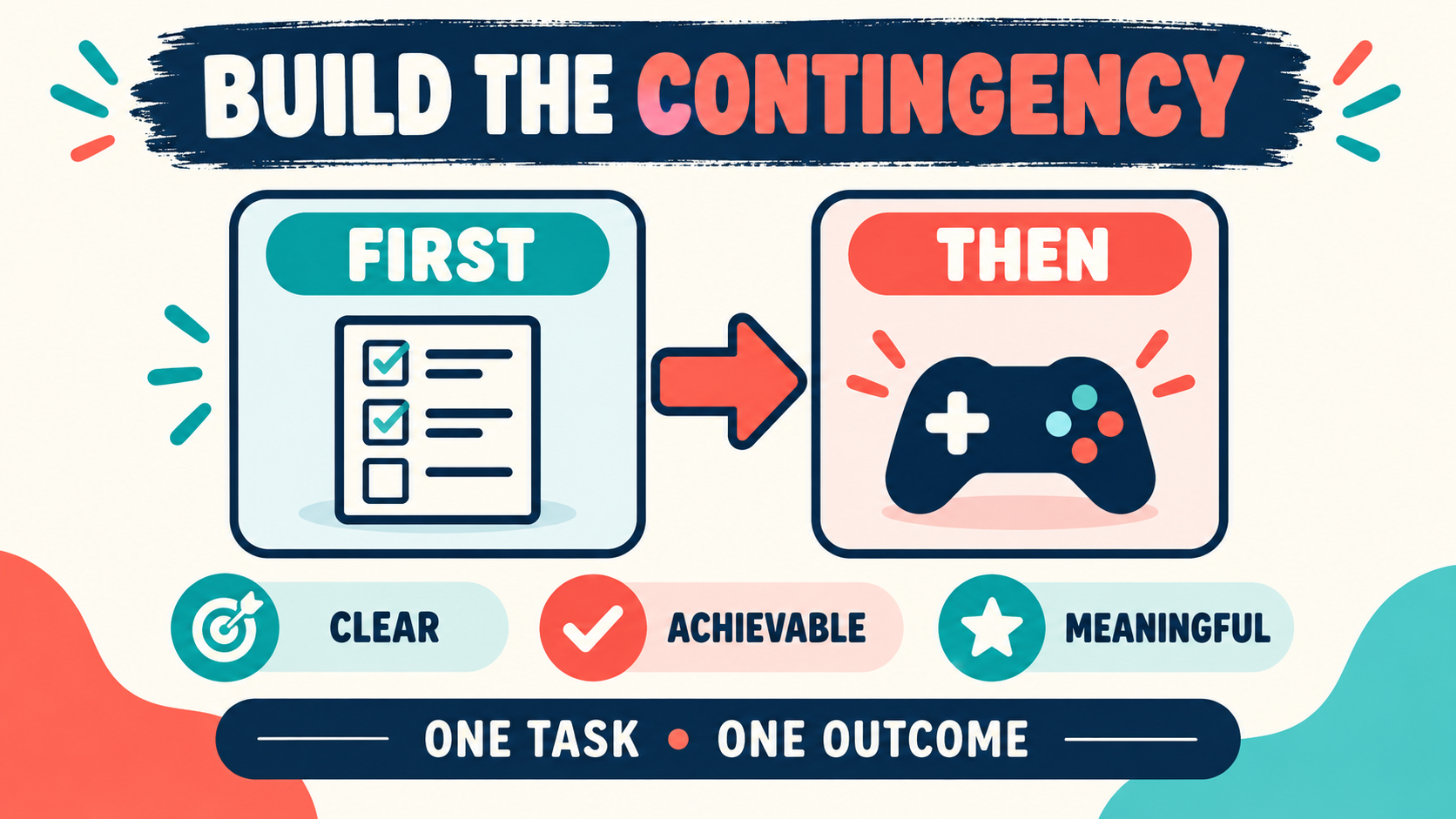
A first-then contingency in ABA describes a relation between two events: a defined first response or activity and a then consequence that becomes available after the first requirement is met. For example, a practitioner might say, “First place the three blocks in the bin, then choose a song.” The first part should describe something observable. The then part should identify a real activity, item, interaction, or break that the learner values.
The arrangement can be spoken, written, or shown on a two-part visual board. A visual may display the word FIRST above a task picture and THEN above a preferred activity picture. The format is simple, but the clinical reasoning is not. The team still has to decide whether the first task is reasonable, whether the then activity is actually preferred, how much work is required, what counts as completion, and what the learner can communicate if the arrangement is not acceptable.
“First” should not be a vague instruction such as “first be good” or “first calm down.” Define the response in a way that two people could recognize. “First put one worksheet in the folder” is more observable than “first cooperate.” The contingency should also be presented before the expected response, not invented after a learner protests or requests the then activity.
How Does It Relate to the Premack Principle?
The Premack principle is commonly summarized as using access to a higher-probability behavior to reinforce a lower-probability behavior. In plain language, a person may be more likely to complete a less-preferred activity when it reliably produces access to an activity they are more likely to choose. A first-then statement is one practical way to make that relation visible.
The terms are related, but they are not interchangeable in every sentence. The Premack principle is a behavioral concept about relative response probabilities. A first-then board or statement is a teaching arrangement that communicates one specific contingency. A board does not prove that the then activity is reinforcing; the team must observe whether the learner engages in the first response more readily or whether the arrangement produces a useful change in the target behavior.
Do not confuse a first-then contingency with an arbitrary threat or a delayed promise. If the learner completes the first response and the team repeatedly withholds the promised then activity, the arrangement loses predictability. If the then activity is unavailable, unsafe, or not meaningful, the issue is not that the learner “failed” the contingency. The plan needs a better match, a smaller first response, or a different support.
- Premack concept: relative likelihood of behaviors helps identify a possible reinforcer.
- First-then arrangement: one clearly stated first response contacts one clearly stated then activity.
- Data question: does the arrangement improve the target response under the conditions that matter?
What Makes the Contingency Clear?
A defensible first-then contingency has enough detail for the learner and the implementer to know what will happen. The exact wording changes by age, language, setting, and goal, but these components should be considered:
| Component | Question to answer | Example |
|---|---|---|
| First response | What observable action meets the first requirement? | Place three items in the bin. |
| Then activity | What meaningful activity becomes available? | Choose one song for two minutes. |
| Timing | When and how is the contingency shown? | Show the board before the task starts. |
| Completion rule | What counts as finished without adding surprise demands? | The three items are in the marked bin. |
| Fallback | What happens if the activity is unavailable or the learner communicates “no”? | Offer the approved alternative and record the reason. |
The more complex the task, the more important these details become. A short first task may be appropriate during acquisition, while a longer task may be appropriate only after the learner has a history of success. Avoid changing the deal after the first response has been completed.
How Do You Choose the First and Then?
Start with the goal, not with the board. Identify the skill or participation response that matters, define it, and examine what makes it difficult. The first response should be small enough to produce a reasonable opportunity for success while still connected to the goal. A task that is too large may create repeated failure; a task that is unrelated may teach a compliance routine without building the intended skill.
Use preference information to select the then activity. Preference is not a permanent label. An activity that was valuable in the morning may lose value after repeated access, illness, fatigue, or a change in context. Offer meaningful choices when possible and notice whether the learner actually engages with the promised activity. Do not assume that a toy, edible, social interaction, or break is reinforcing merely because an adult selected it. Examples can include:
- First match three cards, then choose a short movement activity.
- First place the materials in the container, then listen to one preferred song.
- First practice one communication response, then access a selected game or conversation.
- First complete one transition step, then take an agreed break with a timer.
How Should You Present It?
Present the first-then relation before the first response is expected. Use concise language or the learner’s preferred communication modality. Point to the first part, describe the action, point to the then part, and confirm that the activity is available under the stated condition. When a visual is used, keep the display uncluttered: one first item, one then item, and a clear left-to-right sequence are often easier to interpret than a crowded schedule.
Keep the contingency stable during the trial. Do not add “and then another task” after the first response, move the finish line, or require an unrelated behavior before honoring the then activity. If the learner needs a prompt, follow the approved prompting and fading plan and record it. The goal is not to make the learner guess what will earn access; the goal is to create a predictable opportunity to contact reinforcement and learn.
Involve communication and choice. A learner may request a different then activity, ask for help, indicate “not now,” or use an AAC response that changes the plan. Those signals are data about the arrangement and the learner’s needs. They should not automatically be treated as refusal to be defeated.
What Ethical Boundaries Matter?
The BACB Ethics Code for Behavior Analysts is relevant whenever a first-then procedure affects client welfare, assent when applicable, informed consent, dignity, communication, or the use of restrictive or aversive procedures. A visual board does not make an intervention automatically ethical, evidence-based, or appropriate for every person.
Before implementation, ask whether the first task is socially significant, whether the learner has a meaningful way to communicate, whether the then activity is available and safe, and whether the plan preserves reasonable choice. Do not use access to food, toileting, essential communication, medical care, or a necessary sensory support as a casual bargaining chip. A break may be part of a well-designed plan, but it should not become an impossible prize that the learner can never earn.
Document who approved the plan, how preferences were assessed, what data will be reviewed, and when the procedure should stop or be revised. The BACB’s BCBA overview describes the BCBA role in providing behavior-analytic services and supervising others; that responsibility includes professional judgment rather than simply following a board template.
How Do You Test and Measure It?
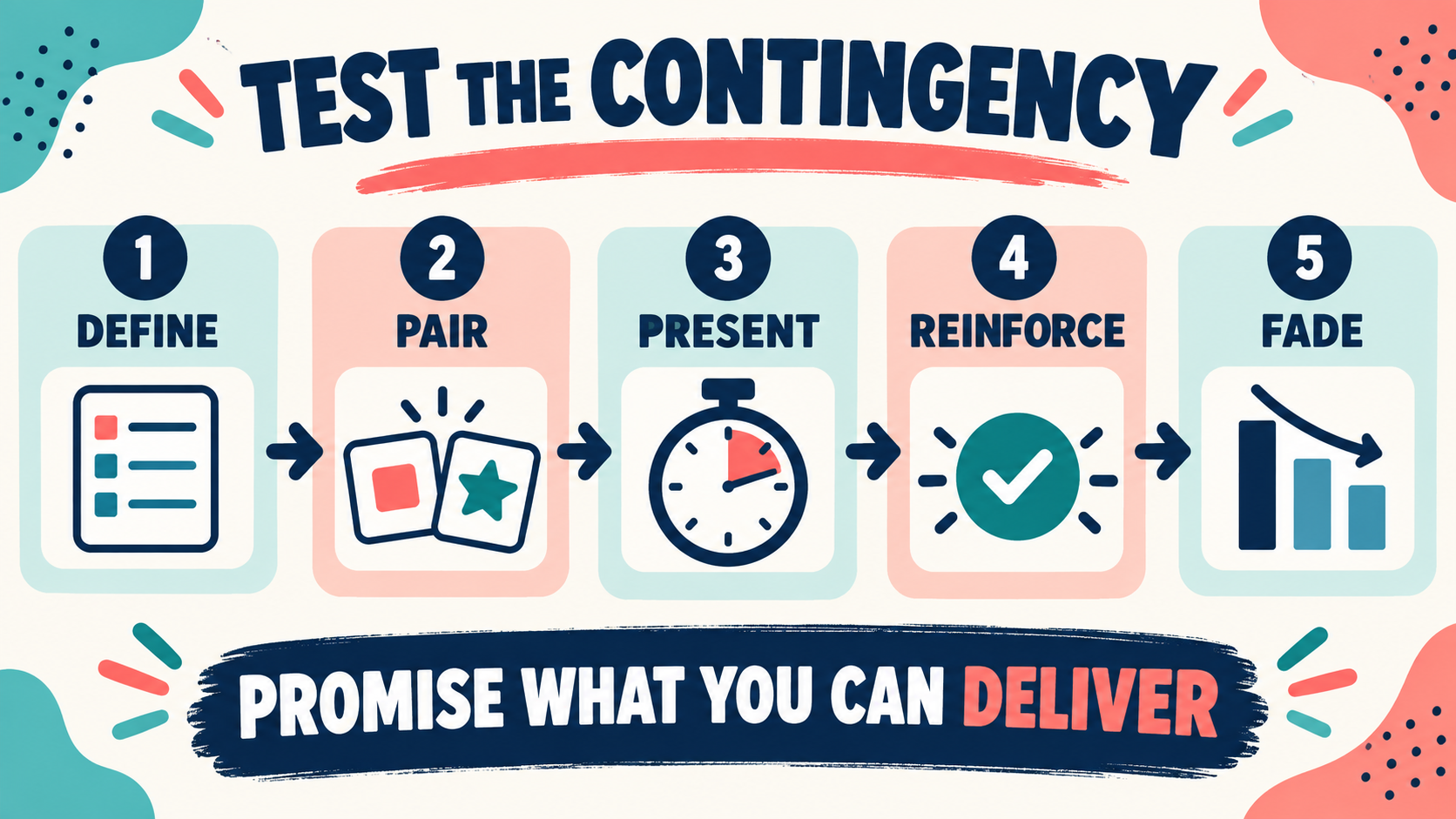
Test a first-then contingency as a small, observable change in a defined workflow. Establish a baseline or comparison condition when appropriate, then decide what the team will measure. Depending on the goal, useful measures might include independent task initiation, percentage of opportunities completed, latency to begin, prompt level, duration of engagement, requests for help, or the frequency of communication that signals a need to change the plan.
Record enough context to interpret the result. Note the first task, the then activity, the setting, who presented the contingency, the prompt used, whether the then activity was delivered as promised, and any competing events. A higher completion percentage does not automatically show that the procedure improved meaningful behavior if the task became easier, the prompt level increased, or the learner’s communication was ignored.
- Define: write the first response and completion rule in observable terms.
- Pair: confirm that the then activity is available and meaningful under current conditions.
- Present: show the relation before the first response and use the learner’s communication system.
- Reinforce: deliver the promised then activity promptly and record what actually happened.
- Fade: gradually reduce prompts or visual dependence only when data show the learner can contact the natural outcome.
Review the data with the responsible professional and relevant stakeholders. If the result is weak, do not simply increase the first demand. Check the definition, preference, prompt, timing, task difficulty, and fidelity first.
What If the First-Then Arrangement Is Not Working?
A first-then procedure can fail for several different reasons. The learner may not understand the representation, the first task may be too difficult, the then activity may not be preferred, the promised outcome may be delayed, or the plan may be competing with pain, fatigue, sensory overload, communication difficulty, or an environmental event. The data should help separate these possibilities.
- The learner does not begin: make the first response smaller, clarify the instruction, check access to communication, and review prompting.
- The learner completes the task but does not use the then activity: reassess preference and offer a choice rather than repeating the same assumed reward.
- The learner protests when the board appears: examine whether the first task predicts an aversive history, whether the choice is genuine, and whether the plan should pause for clinical review.
- Staff apply the sequence differently: clarify the completion rule, timing, prompt procedure, data sheet, and fallback response through training and performance feedback.
- The learner succeeds only with the board: plan for generalization and fading instead of treating dependence on the visual as failure.
Do not use the phrase “first then” to conceal a much larger demand. If the real sequence is “first finish a worksheet, then clean the room, then wait quietly, then maybe get a break,” the learner deserves an accurate representation of what is expected. A trustworthy contingency makes the next step more predictable, not less.
How Does First-Then Contingency Reasoning Appear on the BCBA Exam?
A BCBA-style question may describe a learner who avoids a task, a staff member who offers a preferred activity, or a visual schedule that changes behavior. The strongest answer usually requires more than recognizing the phrase “first then.” Reconstruct the contingency and ask what the behavior, antecedent, consequence, motivating operation, measurement, and ethical concern are. Use this reasoning sequence:
- Identify the target response and whether it is operationally defined.
- Ask whether the then activity is actually preferred under the current conditions.
- Check whether the contingency was stated before the response and honored after it.
- Look for a smaller task, a choice, a communication response, or a function-based alternative when the demand is too difficult.
- Reject answers that promise universal compliance, ignore assent or welfare, or use an unapproved restrictive procedure.
For additional scenario practice, our first then contingency ABA practice questions can help you rehearse reinforcement, motivating operations, ethics, measurement, and professional judgment. The free BCBA mock exam is a study aid, not official BACB material and not a substitute for the current BACB handbook or examination content.
First-Then Contingency ABA Checklist
Before using or revising a first-then arrangement, confirm the following:
- Is the first response observable, achievable, and connected to a meaningful goal?
- Is the then activity currently available, safe, and selected from real preference information?
- Has the complete contingency been presented before the first response?
- Does the learner have an accessible way to request help, a different choice, or a break?
- Is the completion rule stable, with no surprise demands added afterward?
- Will the promised then activity be delivered promptly and consistently?
- Are prompts, prompt fading, and staff responsibilities documented?
- Are baseline, implementation, fidelity, and stakeholder-relevant outcomes defined?
- Does the plan protect dignity, communication, assent when applicable, and client welfare?
- Is there a clear review date and a rule for stopping or revising the arrangement?
The practical takeaway is simple: a first-then contingency works best when the first response is clear, the then activity is meaningful, the promise is honored, and the team measures what matters. Use the arrangement to make learning more predictable—not to replace assessment, communication, choice, or professional judgment.
Take the Free BCBA Mock Exam
If you want a low-pressure way to check your recall, use the free practice resource below. Take the Free BCBA Mock Exam



