
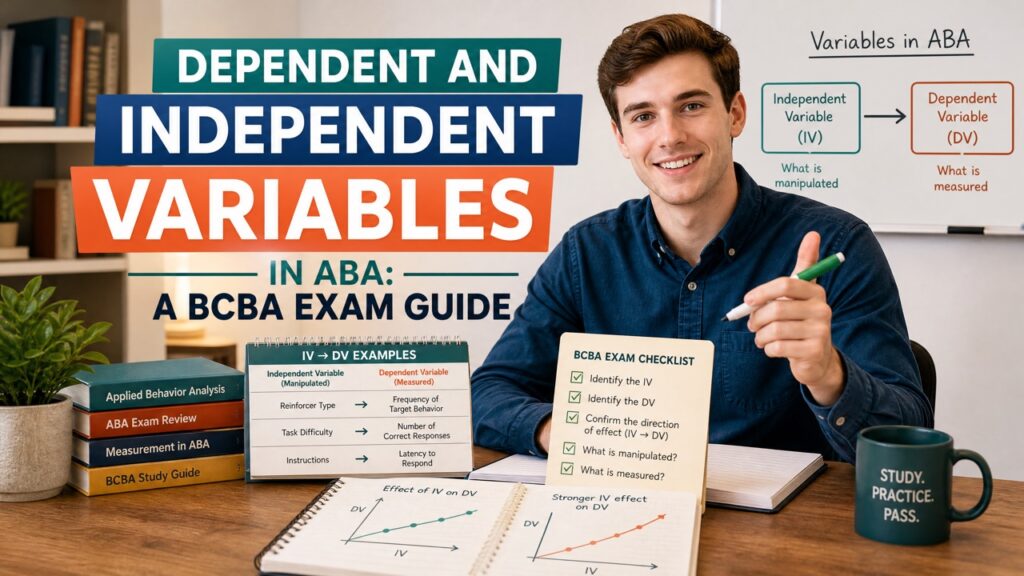
Understanding Variables in ABA Research
In applied behavior analysis, every intervention is built on the relationship between an independent variable and a dependent variable. For BCBA exam candidates, mastering this concept is not optional; it is essential for interpreting research, designing interventions, and answering scenario-based questions. This guide will break down the differences between these variables, show you how to spot them in real ABA scenarios, and help you avoid the common traps that trip up many test-takers.
Table of Contents
- Understanding Variables in ABA Research
- Defining the Independent Variable in Behavior Analysis
- Defining the Dependent Variable: The Measured Behavior
- Identifying Variables in ABA Scenarios: Worked Examples
- Common Exam Traps and How to Avoid Them
- Quick Checklist for Exam Success
- Summary and Final Tips
- Quick Review Checklist
- Take the Free BCBA Mock Exam
When we talk about dependent and independent variables, we are talking about the core structure of any scientific experiment. In ABA, the independent variable is the intervention or environmental manipulation you put in place, while the dependent variable is the behavior you measure to see if the intervention worked. Understanding this relationship is fundamental to behavior analysis, whether you are reading a journal article or planning your own treatment.
Defining the Independent Variable in Behavior Analysis
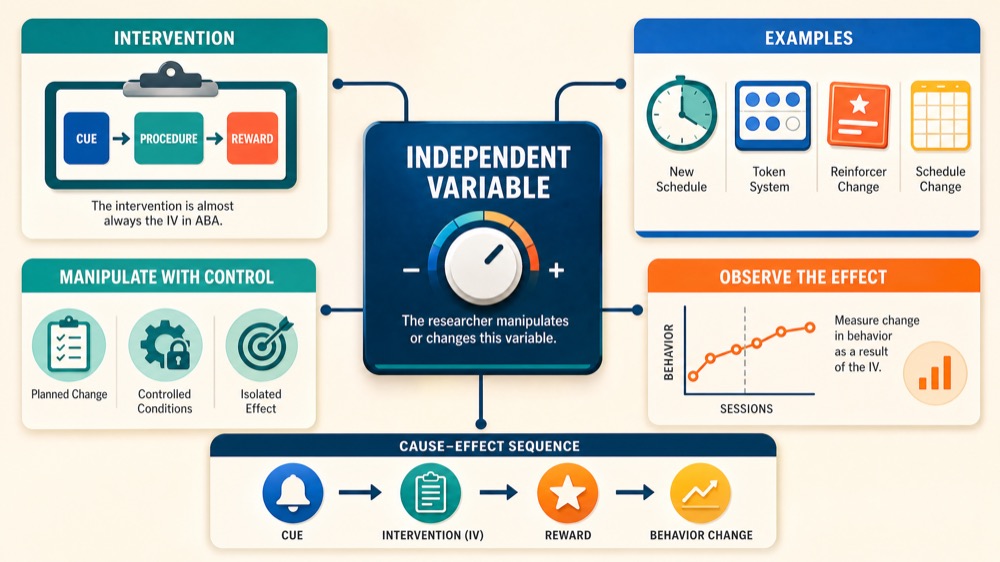
The independent variable (IV) is the component of an experiment that the researcher manipulates or changes to observe its effect on behavior. In ABA, this is almost always the intervention itself—such as a new reinforcement schedule, a prompting procedure, or an environmental modification. The IV is what you, as the BCBA, control and systematically alter to produce a change in the target behavior.
To be a true independent variable, the variable must be actively manipulated by the experimenter. This distinction is critical on the exam, as many questions will present variables that sound like IVs but simply are not.
The Role of the Independent Variable in an Experiment: In a typical ABA experiment, the IV is introduced, withdrawn, or varied across conditions to demonstrate a functional relation. For example, if you are implementing differential reinforcement to reduce tantrums, the DRA procedure is the IV. You are manipulating the consequences for appropriate versus inappropriate behavior. Without a clearly defined and consistently applied IV, the experiment lacks internal validity, making it impossible to attribute any behavior change to your intervention.
Experimental vs. Subject Variables: A common point of confusion is the difference between an independent variable and a subject variable. Subject variables such as age, gender, diagnosis, or IQ are characteristics of the participant that cannot be manipulated by the researcher. Because they are not under the experimenter’s control, they are not considered true independent variables in ABA. Instead, they are often called participant characteristics or attribute variables.
On the BCBA exam, any question that asks you to identify the IV should lead you to look for the intervention or environmental change, not for something the participant brings to the table. If the variable is not something the analyst actively manipulates, it is not an IV—even if it is measured and analyzed.
Defining the Dependent Variable: The Measured Behavior
The dependent variable (DV) is the behavior or response that is measured to determine the effect of the independent variable. In ABA, the DV is always the target behavior—the behavior you are trying to increase, decrease, or maintain. The DV is called dependent because its value is thought to depend on the IV; if the intervention works, the DV should change in a predictable direction.
For example, if you are using a token economy to increase on-task behavior, the percentage of intervals with on-task behavior is your DV. The tokens serve as the IV, and the behavior change is the DV. The clarity of your DV definition directly impacts the reliability of your data and the conclusions you can draw.
Operational Definitions and Measurement: To be a valid dependent variable, the behavior must be objectively and operationally defined. This means the behavior is described in observable and measurable terms, so that two independent observers could reliably collect data on it. On the exam, questions will often present a DV that is too vague, such as “feeling angry” or “being good.” Recognize these as invalid and look for terms like “frequency of hitting” or “duration of crying” instead.
The chosen measurement system—whether frequency, duration, latency, or interval recording—must align with the operational definition. If a DV is not measurable, it cannot serve as a credible outcome measure in an ABA experiment.
How the Dependent Variable Responds to the Independent Variable: In behavior analysis, the goal is to demonstrate a functional relation between the IV and the DV. This means that when you change the IV, you expect to see a corresponding change in the DV. For instance, if you introduce a visual schedule (IV) and observe a decrease in transition-related tantrums (DV), you have evidence that the intervention is effective.
However, the relationship is not always simple. The DV may be affected by extraneous variables, which is why ABA uses designs like reversal (ABAB) and multiple baselines to control for threats to internal validity. On the exam, you may be asked to identify which variable is the DV in a research summary, so always ask yourself: “What behavior is being measured?”
Identifying Variables in ABA Scenarios: Worked Examples
Now let us apply these concepts to realistic ABA scenarios you might encounter on the BCBA exam. Each example includes a brief description of the intervention and the target behavior, followed by the identification of IV and DV.
Example 1: Differential Reinforcement of Alternative Behavior (DRA): A BCBA implements a DRA procedure to reduce the frequency of tantrums in a 5-year-old child. The intervention involves providing attention when the child uses a functional communication response (e.g., saying “help me”) and ignoring tantrums. The hypothesized function is attention. Here, the independent variable is the DRA procedure—the specific contingencies of reinforcement and extinction. The dependent variable is the frequency of tantrums, which is the behavior being measured to evaluate the intervention.
When identifying variables in this scenario, break it down into ABC format: antecedent (e.g., demand presented), behavior (tantrum), and consequence (attention). The intervention alters the consequence for the behavior, making it the IV. The behavior itself is the DV.
Example 2: Token Economy to Increase On-Task Behavior: In a special education classroom, a teacher uses a token system to increase on-task behavior during independent work. Tokens are delivered every 3 minutes when the student is engaged, and they can be exchanged for a preferred activity. The dependent variable is the percentage of intervals with on-task behavior, measured using momentary time sampling. The independent variable is the token economy—the delivery of tokens and the exchange system. The hypothesized function is access to tangible reinforcers.
The key here is to recognize that the tokens are not the behavior; they are the intervention. The behavior is the on-task action, and that is what you measure to see if the tokens are effective.
Example 3: Functional Communication Training (FCT) to Reduce Aggression: A BCBA introduces FCT to decrease the rate of aggression in a teenager with autism. The intervention teaches the learner to request a break using a communication card, and aggression is placed on extinction. The independent variable is the FCT package—the teaching of the communication response plus the extinction procedure. The dependent variable is the rate of aggression, which is the primary outcome measure. A secondary DV might be the frequency of independent communication responses, but the primary DV is the behavior you are trying to reduce.
Notice that in this scenario, the function is escape from demands. The IV changes the consequence for aggression (extinction) and provides an alternative behavior (communication) that gets the same reinforcement. The DV remains the behavior of interest, not the intervention components.
Common Exam Traps and How to Avoid Them
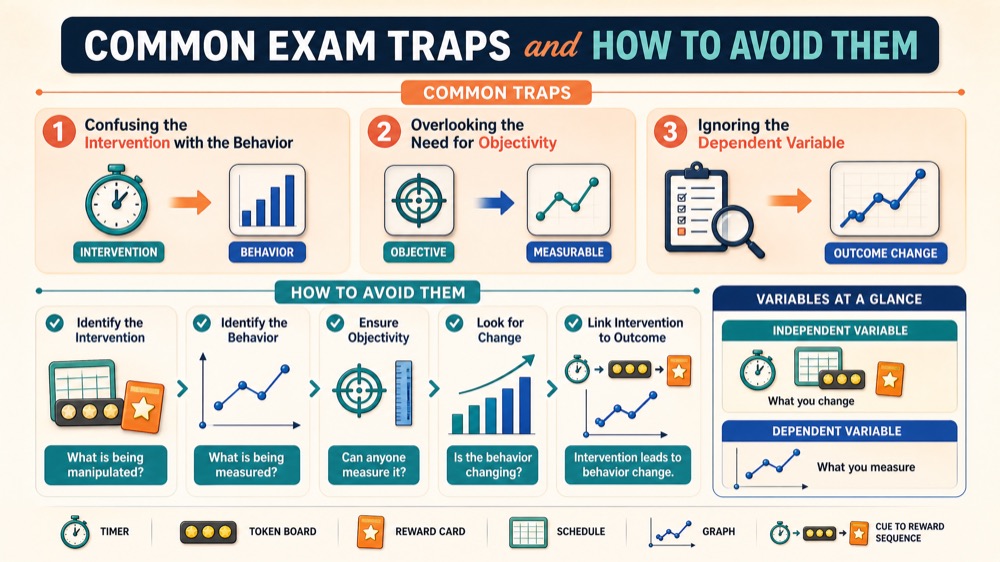
Many BCBA candidates stumble on questions about variables because they confuse the intervention with the behavior or overlook the need for objectivity. Here are the most common traps and strategies to steer clear of them.
- Confusing intervention with behavior: Remember that the IV is what you do, and the DV is what the client does. If you are implementing a token system, the tokens are the IV; the on-task behavior is the DV.
- Overlooking objective measurement: A DV must be measurable. If a scenario says “the child felt happier,” that is not a valid DV because it is not observable. Look for behaviors that can be counted, timed, or recorded.
- Misidentifying subject variables: Age, gender, or diagnosis are not IVs because they cannot be manipulated. Even if the study compares different age groups, the independent variable is not the age itself but something the researcher actively changes.
- Ignoring the functional relation: The DV must be the behavior that you hypothesize will change as a result of the IV. If a scenario includes multiple measures, choose the one that is the target behavior, not a collateral measure.
To avoid these traps, practice identifying variables in study abstracts and intervention descriptions. Ask yourself two questions: “What did the researcher manipulate?” and “What behavior was measured?” This simple mental check will keep you on track.
Quick Checklist for Exam Success
Use this checklist when approaching any question that asks you to identify variables:
- Locate the intervention or environmental change in the scenario.
- Verify the variable is actively manipulated by the analyst.
- Identify the behavior being measured as the dependent variable.
- Ensure the dependent variable is operationally defined and measurable.
- Check that the DV is the target behavior, not a component of the intervention.
- Eliminate subject variables like age or diagnosis from both IV and DV categories.
Run this checklist mentally in under 30 seconds during the exam, and you will significantly improve your accuracy.
Summary and Final Tips
Understanding dependent and independent variables is a cornerstone of ABA practice and research. The independent variable is the intervention you control, and the dependent variable is the behavior you measure. By consistently identifying both in any scenario, you will be better prepared for the BCBA exam and more effective in your daily work.
To solidify your skills, review is critical. For example, you might revisit how token economies work or how DRA procedures are applied, practicing variable identification in each. Additionally, keep in mind the broader context of ABA as a science by reading about the goals of behavior analysis. For further reading, the BACB website provides detailed task list resources and ethical guidelines that will help you connect these concepts to practice. Remember the golden rule: IV = intervention, DV = behavior. With practice, spotting them will become second nature.
Quick Review Checklist
Use this final checklist to turn dependent and independent variables into exam-ready reasoning. The goal is not to memorize a label in isolation; it is to identify the relevant evidence and explain why the best answer fits the scenario. Key ideas to review:
- State the central definition or decision point for dependent and independent variables in your own words.
- Identify the detail that makes dependent and independent variables different from its closest related ABA term.
- Separate the observable facts in a scenario from assumptions that are not supported by the facts.
- Write one example and one nonexample so you can recognize the concept in a new setting.
Exam application checks:
- Ask what the question is actually requesting before comparing the answer choices.
- Mark the antecedent, response, consequence, or other evidence that supports the selected answer.
- Look for a distractor that describes a related process but does not answer the specific question.
Final self-check:
- Explain how you would verify the interpretation with clear observations or data.
- Change one detail in the scenario and decide whether your answer should change.
- Give a one-sentence rationale that a supervisor or study partner could evaluate.
Take the Free BCBA Mock Exam
Ready for more practice? Use the free mock exam to keep testing your accuracy with realistic BCBA-style items. Take the Free BCBA Mock Exam



