
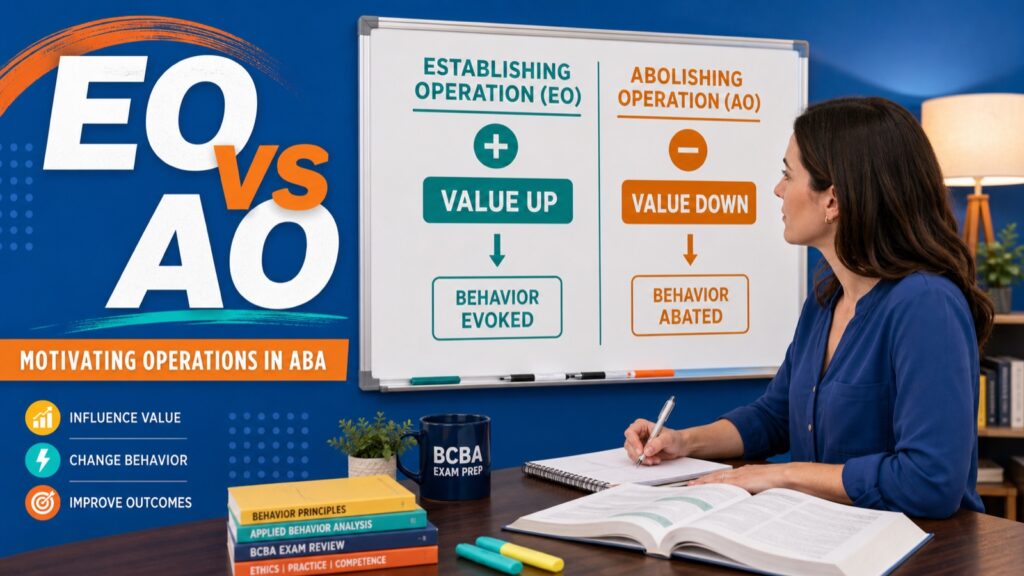
If you are reviewing abolishing vs establishing operation in ABA, start with the consequence whose value changes. An establishing operation, or EO, temporarily increases the effectiveness of a consequence and evokes behavior that has previously produced that consequence. An abolishing operation, or AO, temporarily decreases the effectiveness of a consequence and abates behavior that has previously produced it. The labels describe a value-altering relation, not whether an event is good or bad.
Table of Contents
- Direct Answer: EO or AO?
- Core Definitions
- Value-Altering and Behavior-Altering Effects
- Unconditioned Motivating Operations
- Conditioned Motivating Operations
- Side-by-Side Comparison
- Everyday ABA Examples
- One Scenario, Two Possible Effects
- Data and Assessment Clues
- MO Versus SD
- Programming Implications
- Ethical and Practical Safeguards
- A BCBA Exam Decision Rule
- Common Exam Traps
- Quick Review Checklist
- Frequently Asked Questions
- Take the Free BCBA Mock Exam
- Reference
The fastest BCBA exam rule is: EO makes a consequence more valuable and evokes related behavior; AO makes a consequence less valuable and abates related behavior. Food deprivation can establish food as a reinforcer and evoke food-seeking. Recent free access to food can abolish the value of food and reduce food requests. The same event is not an EO or AO in the abstract; its effect depends on the consequence, the learner, and the relevant history.
This guide uses original ABA scenarios, comparison tables, data clues, programming examples, and exam traps. The examples are study illustrations, not recalled examination items. When a scenario is ambiguous, identify the consequence and the behavior history before selecting a label.
Direct Answer: EO or AO?
Ask two questions. First, what consequence became more or less effective? Second, did behavior that previously produced that consequence become more or less likely? If the consequence became more effective and related behavior was evoked, the event functions as an EO. If the consequence became less effective and related behavior was abated, the event functions as an AO. Without the consequence and behavior history, the label is incomplete.
| Feature | Establishing operation (EO) | Abolishing operation (AO) |
|---|---|---|
| Effect on consequence value | Increases effectiveness of a reinforcer or punisher | Decreases effectiveness of a reinforcer or punisher |
| Effect on related behavior | Evokes behavior that has produced the consequence | Abates behavior that has produced the consequence |
| Simple example | Food deprivation increases food value and evokes food requests | Satiation decreases food value and abates food requests |
| Key exam question | What became more valuable and what behavior increased? | What became less valuable and what behavior decreased? |
| Common error | Calling every antecedent that increases responding an EO | Calling every antecedent that precedes less responding an AO |
- EO: consequence value goes up; behavior related to that consequence is evoked.
- AO: consequence value goes down; behavior related to that consequence is abated.
- Function matters: an event may be an EO for one consequence and neutral for another.
- History matters: behavior must have contacted the relevant consequence before the behavior effect can be interpreted.
- Do not use pleasant or unpleasant as the definition: value and behavior effects are the central evidence.
For example, a long delay before a preferred social activity may increase the value of that activity and evoke a request if requesting has produced it before. After ten minutes of free access, the same activity may be less effective as a reinforcer and requesting may abate. The physical activity did not change category; the motivating condition changed its current value.
Core Definitions
Motivating operations are environmental events or conditions that alter the effectiveness of a consequence and alter the current frequency of behavior that has produced that consequence. Establishing and abolishing describe the direction of the value change. The behavior-altering effect is commonly described as evocative when related behavior increases and abative when related behavior decreases.
The term operation does not require a deliberate manipulation by a practitioner. Deprivation, satiation, effort, pain, delay, and access conditions can occur naturally. A programmed procedure can arrange an EO or AO, but the analyst should describe the actual event and its effect rather than assume the intended label was achieved.
- Name the consequence whose effectiveness changed.
- Name the response that previously produced or contacted that consequence.
- Describe whether the consequence became more or less effective.
- Describe whether the related response was evoked or abated.
- Check the learner’s history and context before generalizing the label.
An antecedent is not automatically an MO because it occurs before behavior. A stimulus that signals reinforcement availability may function as an SD, while an event that changes consequence value may function as an MO. Some situations contain both. Keep the two relations separate when the question asks for one specific function.
Value-Altering and Behavior-Altering Effects
The value-altering effect answers, “How effective is the consequence right now?” The behavior-altering effect answers, “What happens to behavior that has produced that consequence?” Food deprivation can increase the effectiveness of food as a reinforcer and evoke food requests. Those are two related effects, but they are not the same statement.
In an exam scenario, a distractor may name only the response increase and call it an EO. A stronger answer identifies both the consequence value change and the related behavior effect. If the stem asks for the value-altering effect, answer with the change in consequence effectiveness. If it asks for the behavior-altering effect, answer with evocation or abatement of the relevant response.
- Value effect: changes how much the consequence functions as a reinforcer or punisher.
- Behavior effect: changes the momentary likelihood of behavior with a history of contacting that consequence.
- EO pattern: more effective consequence plus more related behavior.
- AO pattern: less effective consequence plus less related behavior.
- Evidence: compare behavior and consequence-contact measures under relevant conditions.
A response can increase for reasons other than an EO, including an SD, a prompt, a change in response effort, or direct reinforcement. A response can decrease for reasons other than an AO, including punishment, extinction, illness, competing reinforcement, or loss of opportunity. The complete relation is what makes the classification defensible.
Unconditioned Motivating Operations
Unconditioned motivating operations have value-altering effects that do not depend on a particular learning history in the same way conditioned motivating operations do. Common examples include deprivation or satiation for biologically relevant consequences and changes in stimulation or pain. The analyst still needs to identify the relevant consequence and behavior effect; the label is not a shortcut for every physiological event.
For example, a period without water can increase the value of water and evoke drinking or an established request for water. Recent access to water can reduce its value and abate those responses temporarily. A learner’s medical needs and individual context must be respected; a conceptual example is not permission to arrange unsafe deprivation.
- Identify the biological or environmental condition that changed.
- Identify the consequence whose effectiveness changed.
- Identify the response that has produced or accessed that consequence.
- Measure the response under comparable opportunity conditions.
- Use safe, ethical, and clinically appropriate arrangements only.
Temperature, sleep, hunger, pain, and sensory conditions may affect behavior, but the analyst should avoid broad claims without data. One condition can change multiple consequences at once, while a small change may matter greatly for one learner and little for another.
Conditioned Motivating Operations
Conditioned motivating operations acquire their effects through learning history. A transitive CMO can make another stimulus valuable because that stimulus is needed to access a terminal consequence. A locked box may make a key valuable, and the box may evoke asking for the key if asking has produced it before. A reflexive CMO can signal worsening conditions and make removal or improvement reinforcing, while a surrogate CMO can acquire similar effects through correlation with another MO.
On an exam, identify the terminal consequence, the needed stimulus, and the response that has produced the needed stimulus. A locked box is not simply an SD because it precedes asking. If the box changes the value of a key or assistance, the transitive CMO relation may be the intended analysis.
- Transitive CMO: makes a needed stimulus valuable because it is required for access to another consequence.
- Reflexive CMO: signals worsening or improving conditions and changes the value of its own removal or improvement.
- Surrogate CMO: acquires MO effects through a history of correlation with another MO.
- Use the learner’s history, not the physical appearance of the stimulus, to identify conditioned function.
Side-by-Side Comparison
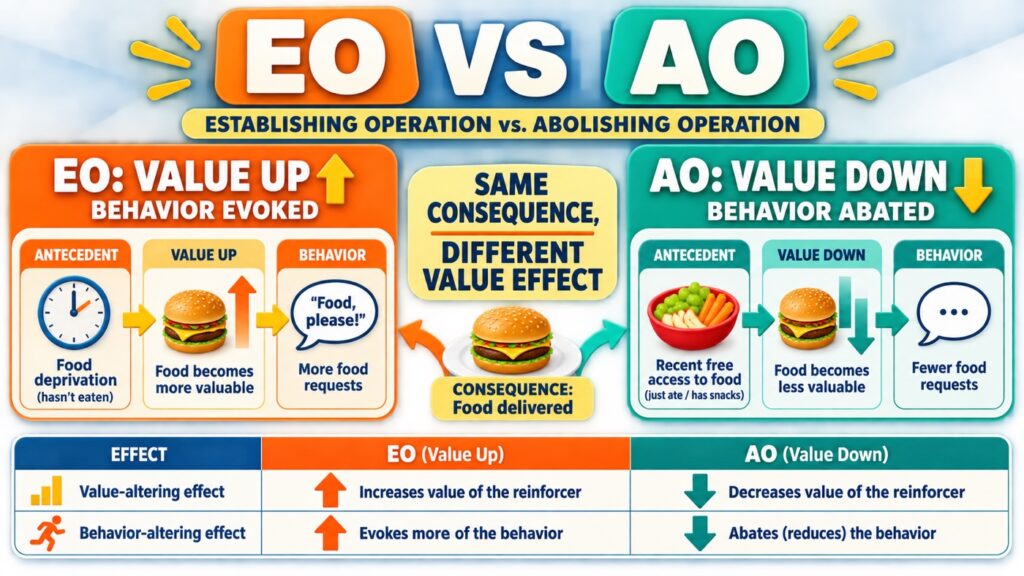
This comparison is designed as a study aid. The same physical event can function as an EO in one context, an AO in another context, or have no clear motivating function if the relevant consequence and behavior history are absent.
| Question | EO | AO |
|---|---|---|
| What changes? | Effectiveness of a consequence increases | Effectiveness of a consequence decreases |
| What happens to behavior? | Related behavior is evoked | Related behavior is abated |
| Food example | Limited access makes food more effective and evokes requests | Free access makes food less effective and abates requests |
| Attention example | Long period without attention may evoke an established attention bid | Recent sustained attention may abate that bid |
| Escape example | Accumulated task effort may increase the value of a break and evoke a break request | A task reduction or easy task may reduce the current value of escape and abate escape-related behavior |
| Exam caution | Do not infer EO from any response increase | Do not infer AO from any response decrease |
- Value direction comes before behavior direction.
- The response must be related to the consequence whose value changed.
- MO labels are functional and conditional, not permanent properties of objects.
- A behavior effect without a consequence analysis is incomplete.
- Ethical programming limits must be considered for deprivation, delay, and aversive conditions.
Everyday ABA Examples
Imagine a learner who has not used a tablet for several hours. If access to the tablet has previously reinforced a request, the current restricted access may increase the tablet’s effectiveness and evoke requesting. If the learner has just had extended free access, the tablet may be less effective and requesting may abate. The example is classified from the value and behavior effects, not from the fact that the tablet is preferred.
For attention, a long period without social interaction may increase the value of attention and evoke an established attention bid. After a rich period of conversation, the value of attention may temporarily decrease and the bid may abate. The analyst should measure opportunities and actual attention contact rather than assume the learner experienced the condition identically every day.
- Food: deprivation can establish food; satiation can abolish its reinforcing effectiveness.
- Attention: restricted access can establish attention; recent access can abolish its immediate value.
- Breaks: accumulated effort can establish escape; reduced task effort can abolish the immediate value of escape.
- Activities: delayed access can establish a preferred activity; extended free access can reduce its current value.
- Assistance: a blocked task can establish the value of help when help has produced progress before.
One Scenario, Two Possible Effects
Consider a learner working on a difficult assembly task. In one condition, the task has continued for twenty minutes and the learner has not received a break. The value of a break may increase, and a previously reinforced break request may be evoked. In a second condition, the learner has just received a brief break and the task has been simplified. The current value of escape may be lower, and the break request may abate.
- Condition one: accumulated effort may function as an EO for escape or break access.
- Condition two: task reduction or recent break access may function as an AO for escape.
- Relevant response: the learner’s established break request or another response that has produced a break.
- Relevant data: task context, response opportunity, request rate, break delivery, and task completion.
- Interpretation: confirm the value and behavior effects rather than labeling from the task alone.
The same task can also be an SD for a different response if the learner has a history that responding in its presence produces assistance. That is why the exam may include several plausible antecedent labels. Identify which relation the question actually asks about and which consequence supports the label.
Data and Assessment Clues
To evaluate an EO or AO, record the condition, the relevant consequence, and the response that has contacted that consequence. If the target is food requesting, record the access condition, available food, requests, food delivery, and competing options. If the target is escape, record task difficulty, effort, break opportunity, requests, problem behavior, task removal, and completion.
- Measure response frequency or rate by comparable opportunity.
- Record the consequence delivered and whether it was actually contacted.
- Track value indicators such as preference, choice, latency, or persistence when appropriate.
- Record prompts, response effort, delay, and competing reinforcement.
- Compare conditions across repeated observations rather than relying on one event.
A response increase is not sufficient evidence if opportunities also increased. A request decrease is not sufficient evidence if the reinforcer was unavailable or the learner was prevented from responding. The analyst should separate opportunity, response, consequence, and value indicators in the data system.
When reading a graph, first mark the condition change, then the behavior line, and finally the relevant consequence. Ask whether the pattern is consistent with the expected EO or AO effects. If the line changes but the contingency is unclear, select the answer that acknowledges the missing information rather than overclaiming a function.
MO Versus SD
An SD signals that reinforcement is available for a particular response because of a history of differential reinforcement. An MO changes the effectiveness of a consequence and related behavior. A water fountain sign can signal where a request or approach response can produce water, while thirst can increase the value of water and evoke water-seeking. The sign and thirst can operate together but do different work.
- MO question: did the event change how valuable the consequence is?
- SD question: did the stimulus signal that a response can contact the consequence now?
- History question: what response previously produced the consequence?
- Function question: is the proposed label supported by the specific consequence?
- Do not call every evocative antecedent an SD or every response increase an EO.
For a related example, a locked box can function as a transitive CMO when it makes a key or help valuable, while a visible “help available” cue can function as an SD for asking. The distinction is based on the relation and history, not the order in which the stimuli appear.
Programming Implications
Practitioners can arrange motivating conditions through access, task design, delays, effort, prompts, and environmental changes, but every arrangement should be individualized and ethically reviewed. The goal is not to make a learner hungry, distressed, or dependent on deprivation. The goal is to understand and arrange meaningful reinforcement while preserving communication, assent, dignity, and safety.
- Use natural and safe opportunities to contact meaningful consequences.
- Teach functional communication so the learner can request access, help, or a break.
- Adjust response effort and task difficulty before assuming motivation is the only problem.
- Plan how prompts and contrived motivational arrangements will be faded.
- Monitor whether the consequence remains valuable in the natural setting.
If a learner is not responding, do not automatically increase deprivation or remove preferred activities. Review the consequence, the response definition, the SD, the response effort, the delay, and competing reinforcement. An AO may be useful in one teaching moment, but forcing the condition can be inappropriate or unsafe.
Ethical and Practical Safeguards
Motivating operations affect access to consequences and can influence communication and distress. A practitioner should use the least intrusive effective arrangement, consider assent and stakeholder priorities, and avoid withholding essential needs as a routine behavior-change tool. The learner should have a reasonable way to communicate discomfort, refusal, help, and breaks.
- Do not arrange unsafe deprivation, pain, sleep loss, or medical risk.
- Do not treat a preferred item as universally reinforcing for every learner.
- Document the consequence, response, and value-altering rationale.
- Review whether the plan improves meaningful participation and quality of life.
- Revise the plan if adverse effects, distress, or communication loss appear.
A correct EO or AO label is only the start of clinical reasoning. The intervention must also be feasible, respectful, measurable, and responsive to the learner’s needs. Current professional and ethical guidance should be reviewed whenever a plan uses restricted access, delay, or aversive task conditions.
A BCBA Exam Decision Rule
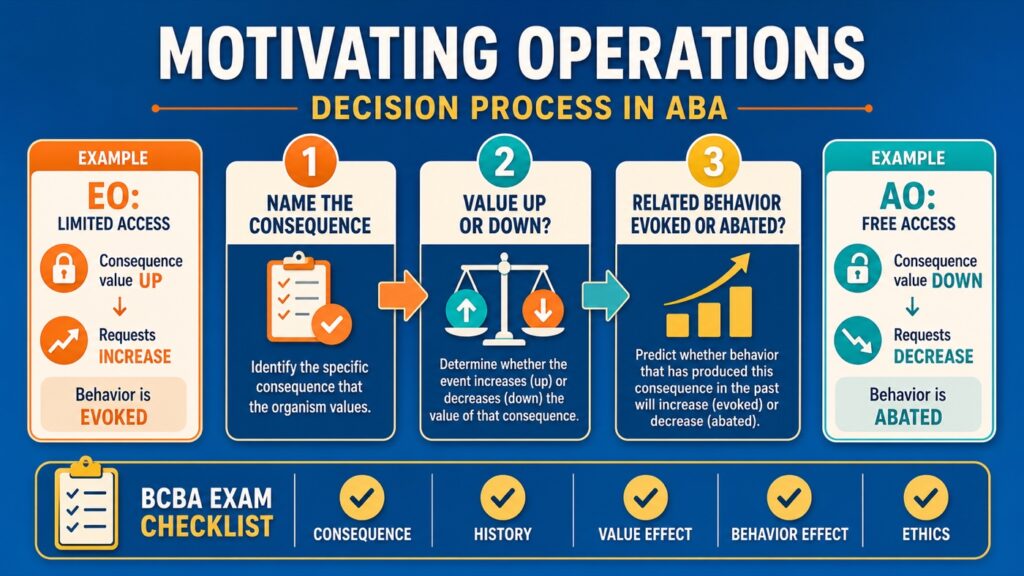
Use this sequence when a question mentions deprivation, satiation, access, effort, delay, or a behavior increase or decrease.
- Name the consequence: food, attention, escape, a tangible, help, sensory stimulation, or another outcome.
- Name the related response: what behavior has previously produced or contacted that consequence?
- Check value direction: did the condition make the consequence more or less effective?
- Check behavior direction: was the related response evoked or abated?
- Classify: more value plus more related behavior suggests EO; less value plus less related behavior suggests AO.
- Check alternative explanations: could the change reflect an SD, prompt, extinction, punishment, illness, or loss of opportunity?
- Check ethics: is the arrangement safe, necessary, and respectful?
If the stem says a learner has had no access to a snack, then requests for that snack increase, the condition may be an EO for the snack reinforcer. If the learner has just had free access and requests decrease, the condition may be an AO. The answer is strongest when it names the consequence and the behavior effect, not just the acronym.
Common Exam Traps
These terms are often tested with short scenarios that contain an antecedent, a behavior, and a consequence but omit one important relation. Use the complete contingency rather than a keyword.
- Trap 1: EO means the event is pleasant. EO means the consequence becomes more effective and related behavior is evoked.
- Trap 2: AO means the event is unpleasant. AO means the consequence becomes less effective and related behavior is abated.
- Trap 3: every response increase is an EO. An SD, prompt, direct reinforcement, or opportunity change can also increase responding.
- Trap 4: every response decrease is an AO. Extinction, punishment, illness, competing reinforcement, or no opportunity can reduce behavior.
- Trap 5: an object has one permanent MO function. Function depends on consequence, learner, history, and context.
- Trap 6: deprivation is automatically acceptable. Conceptual value effects do not justify unsafe or coercive arrangements.
- Trap 7: MO and SD are interchangeable. MO changes consequence value; SD signals differential availability.
- Trap 8: value effect and behavior effect are the same answer. Name both when the question requires a complete analysis.
Quick Review Checklist
- What consequence is involved?
- What response has previously produced or contacted it?
- Did the consequence become more or less effective?
- Did related behavior increase or decrease?
- Does the pattern support EO or AO?
- Could the event instead be an SD, prompt, extinction procedure, punishment, or opportunity change?
- Are the data and reinforcement history sufficient?
- Is the arrangement safe, ethical, and useful for the learner?
Memory aid: EO establishes value and evokes; AO abolishes value and abates. Always attach the acronym to the consequence and the behavior history that make the relation meaningful.
Frequently Asked Questions
What is the difference between an establishing operation and an abolishing operation?: An EO increases the effectiveness of a consequence and evokes behavior that has produced it. An AO decreases the effectiveness of a consequence and abates related behavior. Both are motivating operations and must be interpreted in relation to a specific consequence and history.
Is food deprivation always an EO?: Food deprivation can establish food as a reinforcer and evoke food-seeking or food-requesting behavior when the relevant history exists. The analyst should still consider the learner, the actual condition, medical safety, and the response measured.
What is an example of an AO?: Recent free access to a preferred snack can reduce the snack’s current reinforcing effectiveness and temporarily abate snack requests. The response and consequence history should support that interpretation.
How are an MO and an SD different?: An MO changes how effective a consequence is and changes related behavior. An SD signals that a consequence is available for a particular response because of differential reinforcement history.
Can an event be an EO in one situation and an AO in another?: Yes. The label depends on the current consequence value, the learner’s history, and the behavior effect. The same physical event can have different functions across people, times, and contexts.
Take the Free BCBA Mock Exam
Ready to practice establishing operations, abolishing operations, conditioned motivating operations, stimulus control, and value-versus-behavior effects? Take the free BCBA mock exam for realistic scenarios across reinforcement, measurement, assessment, behavior change, and ethics. For each item, name the consequence and the related behavior before selecting EO or AO. For related concept review, read our establishing operations in ABA guide and abolishing operation in ABA guide. Use this comparison page to decide which direction of value change the scenario supports.
Reference
For examination content context, review the BACB BCBA Test Content Outline, 6th edition. Apply motivating-operation analyses with current ethical, measurement, supervision, learner-specific, and setting-specific guidance.
Next step for BCBA exam prep
Turn this topic into exam-day practice
Use this topic as a focused review, then test it in exam-style conditions with a free mock before deciding whether five full-length mocks are the right next step.
Start the Free BCBA Mock ExamContinue with Five Full-Length Mocks — $99
Review the included materials and access details before ordering. No pass guarantee is implied.



