

Introduction: Why Understand Ontogeny for the BCBA Exam?
When preparing for the BCBA exam, you will encounter terms that sound scientific but have very specific meanings in applied behavior analysis. One such term is ontogeny, which describes the development of an individual’s behavior across their lifespan. Understanding this concept is not just about memorizing a definition; it is about grasping how behavior changes over time due to learning and experience, which is central to effective behavior analytic practice.
Table of Contents
- Introduction: Why Understand Ontogeny for the BCBA Exam?
- Ontogeny Defined: A Straightforward Explanation
- Phylogeny vs. Ontogeny: Key Distinctions
- Why Ontogeny Matters in ABA: Real-World Applications
- Worked ABA Examples: Applying Ontogeny with ABC Analysis
- Exam Relevance and Common Traps
- Quick Checklist: Ontogeny Essentials
- Final Summary: Ontogeny for BCBA Success
- Take the Free BCBA Mock Exam
- References
In this guide, we will define ontogeny in ABA, contrast it with phylogeny, explore its practical applications, and walk through real-world examples. We will also highlight common exam traps and provide a quick checklist to solidify your understanding. By the end, you will feel confident in your ability to apply this concept both on the exam and in your future work as a BCBA.
Ontogeny Defined: A Straightforward Explanation
At its core, ontogeny refers to the developmental history of an individual organism, from conception to death. In biology, this term originally described the physical development of an organism, such as how a fertilized egg becomes a fully formed adult. In behavior analysis, the term is adapted to focus on the development of an individual’s behavior over their lifetime, shaped by their unique experiences and learning history.
In ABA, ontogeny is often contrasted with phylogeny, which refers to the evolutionary history of a species. While phylogeny operates across generations, ontogeny operates within a single lifetime. This distinction is crucial because it highlights the different mechanisms that influence behavior: phylogenetic changes are driven by natural selection, whereas ontogenetic changes are driven by learning processes like reinforcement and punishment.
Origins and Etymology: The word ontogeny comes from the Greek roots ontos (being) and genesis (origin or development). It literally means the origin or development of an individual being. This etymology underscores the idea that ontogeny is about the unfolding of an individual’s characteristics, whether biological or behavioral, over time.
Ontogeny in Behavior Analysis: In the context of applied behavior analysis, ontogeny is not just about physical growth; it is about the accumulation of learned behaviors. Every time an individual experiences reinforcement, punishment, or extinction, their behavior changes. These changes are part of their ontogenetic development. For example, a child who learns to request a drink by saying ‘juice’ instead of crying has undergone an ontogenetic change in their communication repertoire.
Phylogeny vs. Ontogeny: Key Distinctions
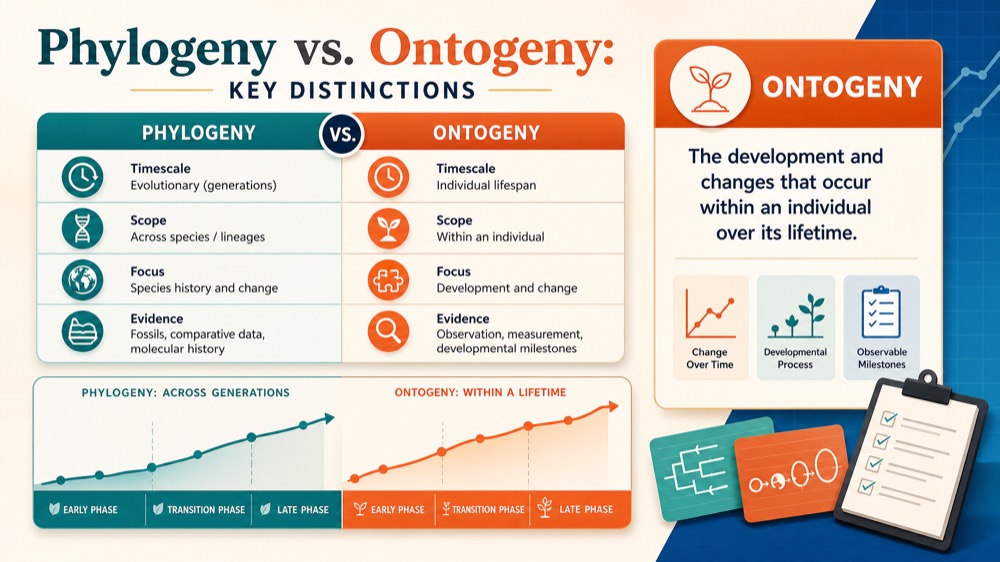
To fully understand ontogeny, it is essential to contrast it with phylogeny. These two concepts are often confused, but they operate on fundamentally different timescales and mechanisms. The table below summarizes the main differences.
- Timescale: Phylogeny occurs across many generations, often over thousands or millions of years. Ontogeny occurs within a single individual’s lifetime, from birth to death.
- Mechanism: Phylogeny is driven by natural selection, which favors traits that enhance survival and reproduction. Ontogeny is driven by learning processes, including reinforcement, punishment, and extinction.
- Scope: Phylogeny applies to species-wide characteristics, such as the tendency for humans to learn language. Ontogeny applies to individual behavioral repertoires, such as a specific person’s language skills.
- Observability: Phylogenetic changes are typically not observable within a single lifetime; they are inferred from fossil records or genetic evidence. Ontogenetic changes are directly observable as behavior changes over time.
On the BCBA exam, you may be asked to identify which concept a particular statement refers to. For example, if a question mentions ‘the evolutionary history of a species that has shaped the behavior of all humans,’ that is phylogeny. If it mentions ‘the learning history of a specific child that has shaped their request for attention,’ that is ontogeny.
Why Ontogeny Matters in ABA: Real-World Applications
Understanding ontogeny is not just an academic exercise; it has practical implications for behavior analysts. By recognizing that an individual’s current behavior is the product of their unique ontogenetic history, you can better assess, predict, and change behavior.
For example, when designing an intervention, you must consider the client’s age and developmental stage. A behavior that is appropriate for a toddler may not be appropriate for an adolescent. Similarly, a skill that was mastered in childhood may need to be adapted as the individual’s environment changes. This is where ontogeny becomes a guiding framework.
Behavior Change Across Development: Behavior analysts work with clients across the lifespan, from early intervention programs for children with autism to geriatric care for older adults. In each case, the client’s ontogenetic history plays a critical role. For a young child, early learning experiences can set the stage for future skill development. For an older adult, maintaining adaptive skills may be a priority. Understanding ontogeny helps you select interventions that are developmentally appropriate and relevant.
Implications for Treatment Planning: When creating a behavior intervention plan, you should consider the client’s learning history. This includes their past experiences with reinforcement and punishment, which have shaped their current behavior. For instance, if a client has a history of escape-maintained behavior, you might focus on teaching them functional communication skills to request a break. This is a direct application of ontogenetic principles.
Worked ABA Examples: Applying Ontogeny with ABC Analysis
To make the concept of ontogeny more concrete, let’s look at three examples that illustrate how behavior changes over time. Each example includes an ABC analysis (Antecedent-Behavior-Consequence) to highlight the learning mechanisms involved. Example 1: Language Development in a Toddler: Setting: A 2-year-old child, Mia, is at home with her mother.
- Antecedent: Mother asks, ‘Do you want some juice?’
- Behavior: Mia says ‘juice’ clearly.
- Consequence: Mother gives her a cup of juice.
Hypothesized function: Positive reinforcement (access to juice). Over time, Mia’s language development is an ontogenetic change from babbling to functional words, shaped by reinforcement. Example 2: Social Skills in a Teenager: Setting: A 15-year-old, Alex, is at a friend’s house.
- Antecedent: Friend invites Alex to play a video game.
- Behavior: Alex engages in appropriate conversation and takes turns.
- Consequence: Friend continues the interaction, and both have fun.
Hypothesized function: Social positive reinforcement (continued social interaction). Alex’s social skills have evolved from parallel play in childhood to complex reciprocal exchanges, reflecting ontogenetic development. Example 3: Adaptive Skills in an Older Adult: Setting: A 75-year-old, Mr. Smith, is starting his morning routine.
- Antecedent: He sees his clothes laid out on the bed.
- Behavior: He dresses himself independently.
- Consequence: He feels a sense of accomplishment and maintains his independence.
Hypothesized function: Automatic reinforcement (self-sufficiency). Maintaining this skill over time is an ontogenetic process, as it has been shaped by years of successful independent living.
Exam Relevance and Common Traps
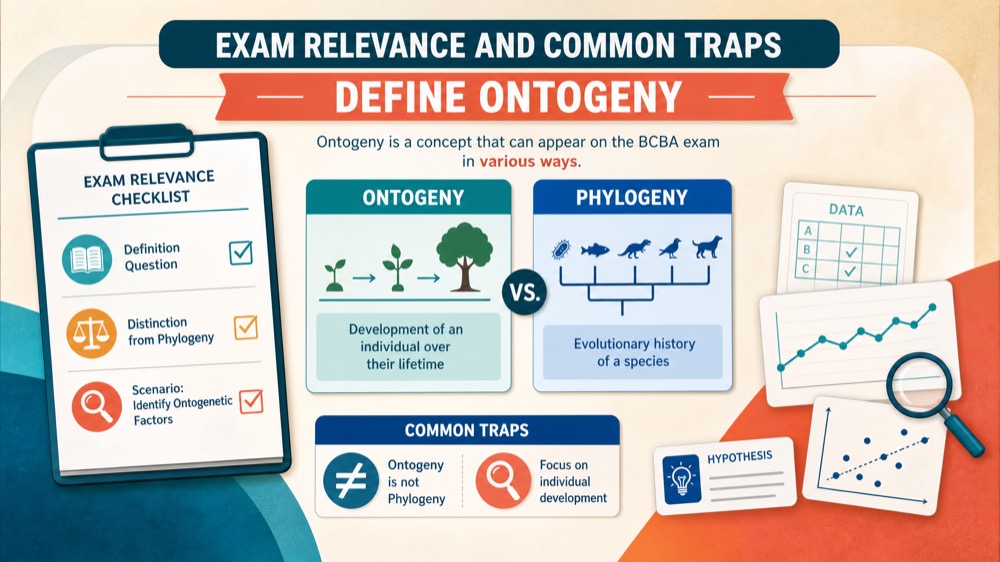
Ontogeny is a concept that can appear on the BCBA exam in various ways. It may be tested as a definition question, a distinction from phylogeny, or in a scenario where you must identify the ontogenetic factors influencing behavior. To help you prepare, here are some common traps to watch out for.
- Confusing Ontogeny and Phylogeny: The most frequent mistake is mixing up the two timescales. Remember, ontogeny is within a lifetime; phylogeny is across generations. If a question mentions ‘evolutionary history,’ it is likely about phylogeny.
- Overlooking Learning History: Ontogeny encompasses the individual’s complete learning history, including all experiences with reinforcement and punishment. When analyzing behavior, consider the client’s past experiences, not just the current environment.
- Ignoring Developmental Context: Behavior that is adaptive at one age may not be at another. For example, tantrum behavior might decrease as a child develops language skills. This is an ontogenetic change that should be considered in assessment.
- Assuming Behavior is Static: Behavior is not fixed; it changes over time. Interventions should be designed with the understanding that ontogenetic changes are ongoing.
To avoid these traps, always ask yourself: ‘Is this behavior changing within this individual’s life due to learning, or is it part of the species’ evolutionary history?’ This simple question can guide you to the correct answer.
Quick Checklist: Ontogeny Essentials
Use this checklist to review the key points about ontogeny before the exam.
- Definition: Ontogeny is the development of an individual’s behavior over their lifespan due to learning and experience.
- Timescale: Within a single lifetime, not across generations.
- Mechanisms: Reinforcement, punishment, extinction, and other learning processes.
- Contrast with Phylogeny: Phylogeny is evolutionary and species-wide; ontogeny is individual and behavioral.
- Application: Consider the client’s learning history when designing interventions and predicting behavior change.
Final Summary: Ontogeny for BCBA Success
In summary, ontogeny is a fundamental concept in ABA that refers to the development of behavior within an individual’s lifetime. It is shaped by learning experiences and is distinct from phylogeny, which operates on an evolutionary timescale. By understanding ontogeny, you can better assess, predict, and change behavior, making you a more effective behavior analyst.
As you continue your exam prep, remember to review other key concepts that relate to ontogeny, such as reinforcement and learning history. For more practice, explore our guide on maturation in ABA to see how biological development interacts with learning. Additionally, you can learn about generalization of skills, which is another important aspect of ontogenetic development. Keep studying, and you’ll be well-prepared for the BCBA exam.
Take the Free BCBA Mock Exam
Ready for more practice? Use the free mock exam to keep testing your accuracy with realistic BCBA-style items. Take the Free BCBA Mock Exam



