

Understanding the difference between contingent and noncontingent consequences is fundamental to applied behavior analysis. These concepts form the backbone of effective intervention design and appear frequently on the BCBA exam. This guide breaks down the distinction with clear definitions, practical examples, and exam-focused strategies.
Table of Contents
- Contingent vs Noncontingent: Defining the Core Concepts: Contingent vs. Noncontingent
- Applied Examples: Seeing Contingent and Noncontingent in Action
- Exam Relevance and Common Traps for BCBA Candidates
- Quick-Reference Checklist and Summary
Contingent vs Noncontingent: Defining the Core Concepts: Contingent vs. Noncontingent
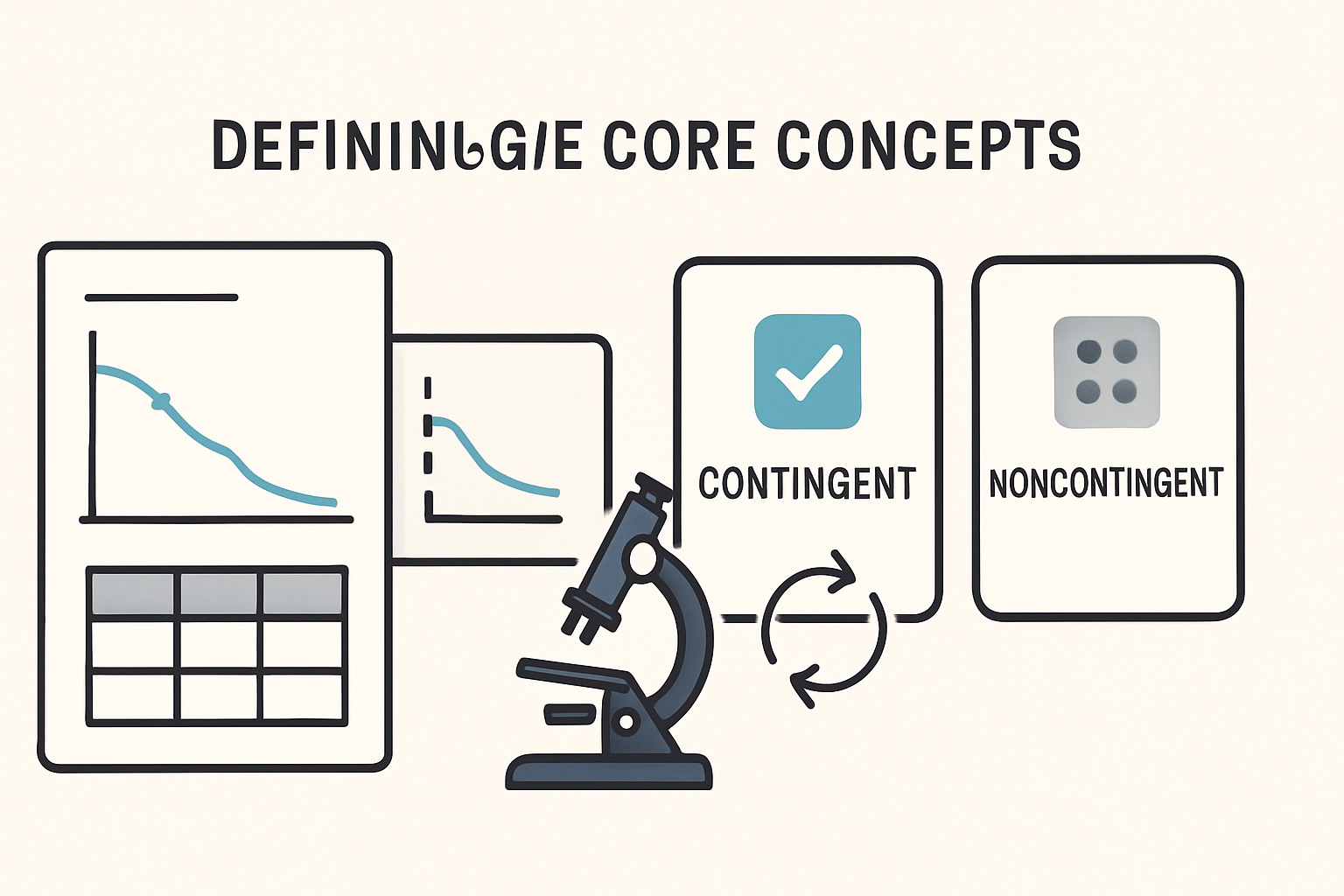
At the heart of behavior analysis lies the relationship between behavior and its consequences. The terms ‘contingent’ and ‘noncontingent’ describe whether a consequence depends on a specific behavior occurring.
What Does ‘Contingent’ Mean in ABA?
A consequence is contingent when it is delivered only if a specific target behavior occurs. This creates an ‘if-then’ relationship that forms the basis of operant conditioning. The contingency establishes a clear dependency between the response and the consequence.
Think of it as a behavioral contract: if [behavior occurs], then [consequence follows]. This dependency is what makes reinforcement and punishment procedures effective when properly implemented. For more on how consequences affect behavior, see our guide on how consequence affects behavior in ABA.
What Does ‘Noncontingent’ Mean in ABA?
A consequence is noncontingent when it is delivered independent of any specific behavior. The consequence occurs regardless of what the individual does, typically on a time-based schedule rather than in response to behavior.
Noncontingent reinforcement (NCR) is a specific intervention where reinforcers are provided freely, without requiring any particular response. This approach is often used to reduce problem behaviors by satiating the motivating operation. The key distinction is the lack of dependency between behavior and consequence.
Applied Examples: Seeing Contingent and Noncontingent in Action
Let’s examine how these concepts play out in real-world ABA scenarios. Each example includes the antecedent, behavior, and consequence to model exam thinking.
Example 1: Contingent Reinforcement to Increase Hand Raising
In a classroom setting, a teacher wants to increase appropriate attention-seeking behavior. The contingency is clearly established:
- Antecedent: Teacher asks a question to the class
- Behavior: Student raises hand quietly
- Consequence: Teacher calls on student (attention reinforcer)
The reinforcement is contingent because the teacher’s attention follows only if the student raises their hand. This strengthens the target behavior through a clear if-then relationship.
Example 2: Noncontingent Reinforcement to Reduce Attention-Maintained Behavior
A child engages in property destruction maintained by attention. Instead of waiting for problem behavior, the therapist implements NCR:
- Antecedent: Fixed-time interval elapses (e.g., every 2 minutes)
- Behavior: No specific behavior required for consequence delivery
- Consequence: Therapist delivers brief, high-quality attention
The attention is noncontingent because it’s delivered regardless of the child’s behavior. This reduces the motivating operation for attention-seeking behaviors. For more on this concept, explore our article on motivating operations in ABA.
Example 3: Contingent vs. Noncontingent Punishment
Understanding the contingency distinction is crucial for ethical punishment procedures:
- Contingent punishment: Response cost where a specific privilege is removed only if problem behavior occurs
- Noncontingent punishment: Time-out applied regardless of behavior (an ethical violation)
Effective punishment must be response-contingent to establish the appropriate behavioral relationship. Noncontingent punishment is not only ineffective but violates ethical standards.
Exam Relevance and Common Traps for BCBA Candidates
The contingent vs. noncontingent distinction appears throughout the BCBA exam. Understanding these common traps can help you avoid costly mistakes.
Trap 1: Confusing Noncontingent Reinforcement with an Unearned Reward
Many candidates mistake NCR for simply ‘being nice’ or giving unearned rewards. However, NCR is a function-based intervention with specific procedural components:
- It requires a functional assessment to identify the maintaining variable
- It involves systematic schedule thinning over time
- It’s designed to create an abolishing operation for problem behavior
Exam questions often test whether you recognize NCR as a technical intervention rather than a casual approach.
Trap 2: Overlooking the Schedule of Delivery
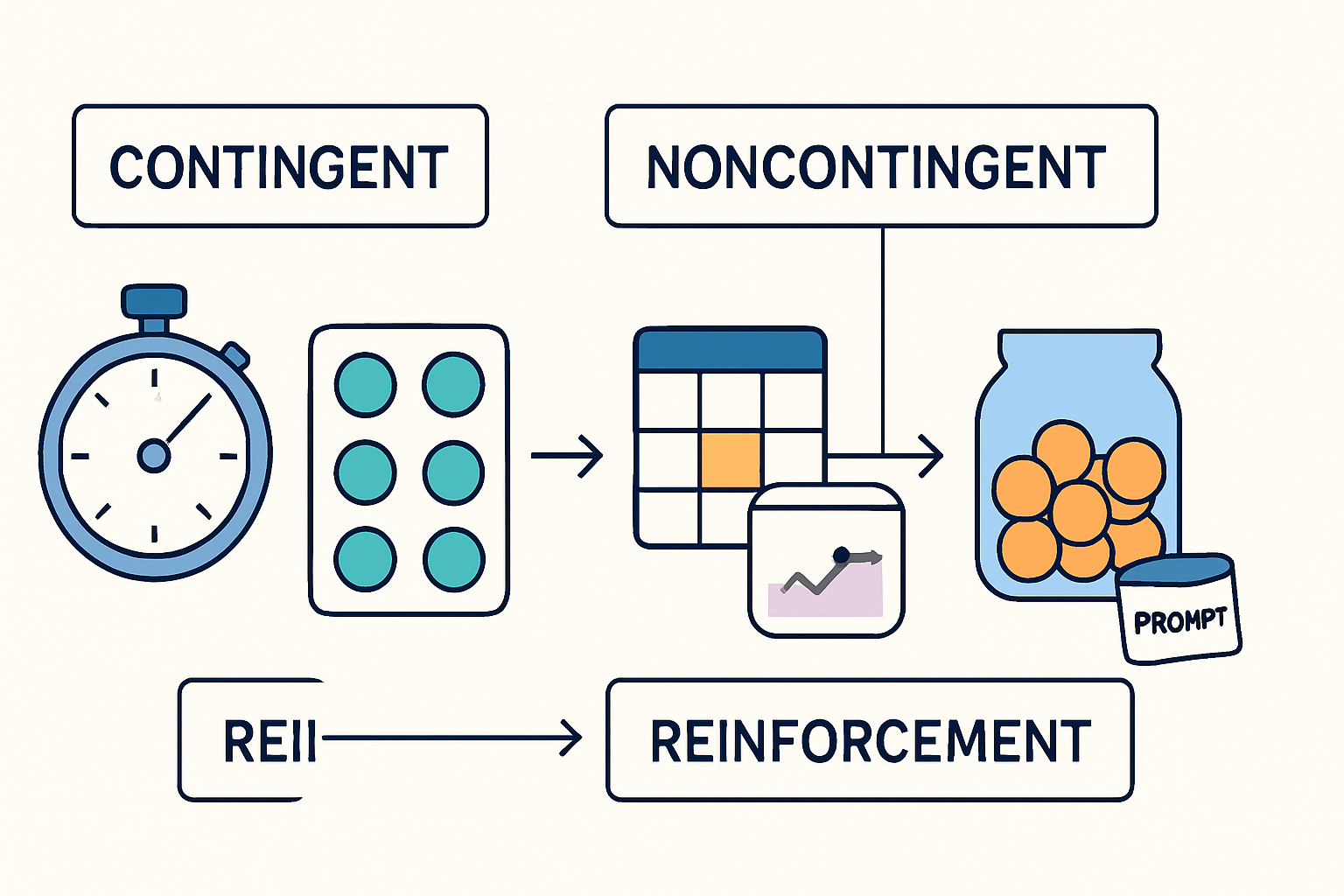
While ‘noncontingent’ refers to the lack of behavior-consequence dependency, candidates must also identify the delivery schedule:
- Fixed-time (FT): Reinforcement delivered at consistent time intervals
- Variable-time (VT): Reinforcement delivered at varying time intervals
Questions may ask you to identify both the contingency type AND the specific schedule being used.
How This Topic is Tested
The exam typically presents these concepts in several formats:
- Scenario analysis: Identify whether a described intervention uses contingent or noncontingent procedures
- Intervention selection: Choose the appropriate procedure based on assessment data
- Ethical application: Determine whether a punishment procedure is properly contingent
- Procedural description: Match intervention descriptions to their correct labels
For comprehensive exam preparation, check our BCBA exam prep guide.
Quick-Reference Checklist and Summary
Use this checklist to quickly review the key distinctions before your exam:
- Contingent means dependent: Consequence occurs ONLY IF target behavior occurs
- Noncontingent means independent: Consequence occurs regardless of behavior
- Look for the if-then relationship to identify contingent procedures
- NCR requires functional assessment and systematic implementation
- All effective punishment must be response-contingent
- Noncontingent procedures still follow specific time-based schedules
- Exam questions often test conceptual understanding beyond simple definitions
The distinction between contingent and noncontingent consequences is more than academic terminology—it’s the foundation of effective behavior change procedures. Mastering this concept will help you design better interventions and navigate exam questions with confidence. Remember that the BACB’s Task List emphasizes these fundamental principles throughout the assessment domains.
Complete BCBA Exam Prep
Turn this topic into exam-day practice
Practice concepts in context with five full-length 6th Edition mock exams, two bonus practice exams, a 6th Edition study guide, and key-term flashcards—all in one $120 USD package.
Get the $120 All-in-One Prep Pack
Review everything included on the product page before ordering. No pass guarantee is implied.



