

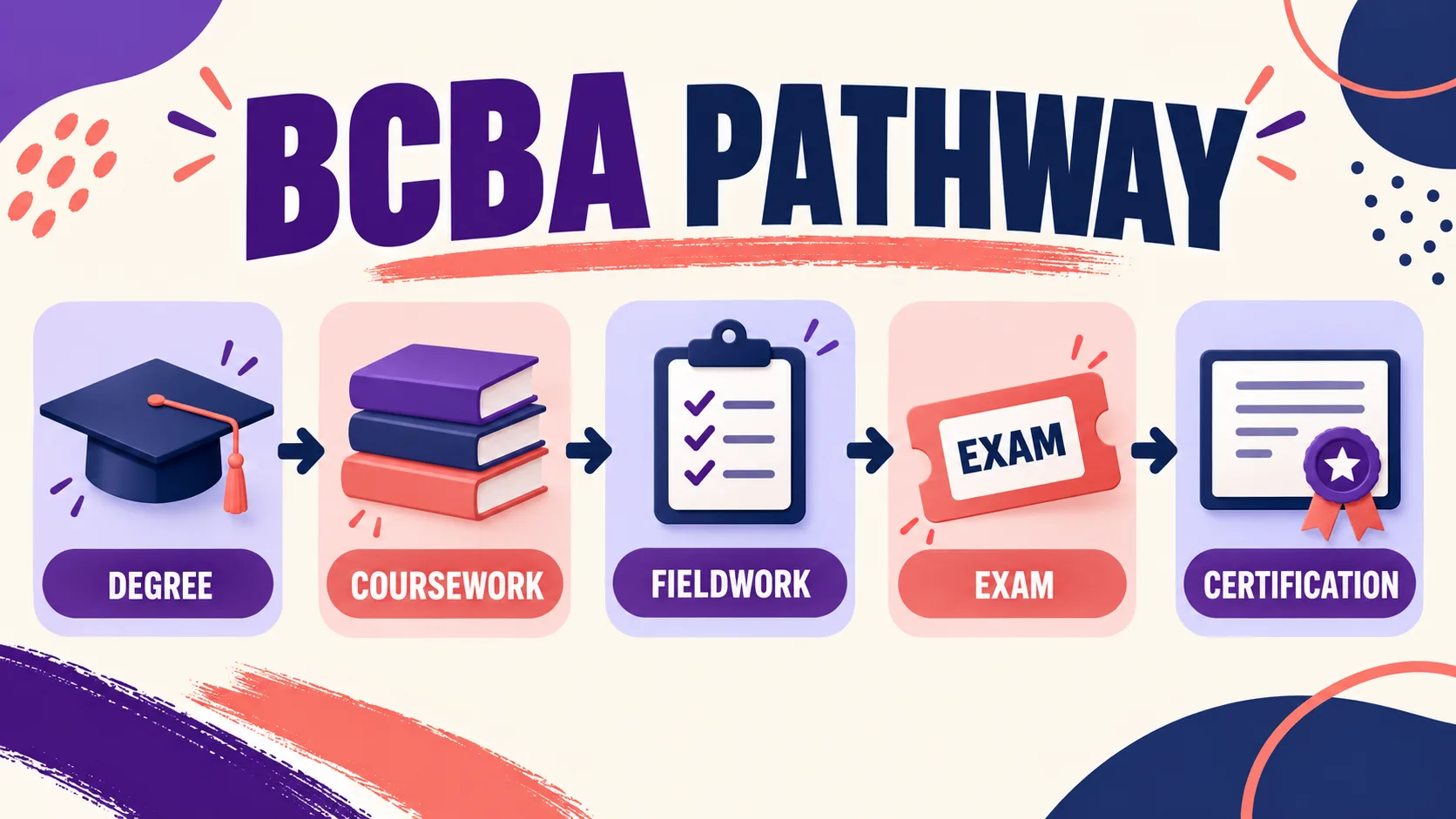
Board certified behavior analyst education requirements are not one degree name or one online course. A BCBA applicant must map a sequence: a qualifying graduate degree, behavior-analytic coursework, supervised fieldwork, the BCBA examination, and the application evidence that shows each requirement was met.
Table of Contents
- Board Certified Behavior Analyst Education Requirements: The Five-Box Path
- Choose the Degree and Pathway Before You Count Coursework
- Verify Behavior-Analytic Coursework as Evidence
- Verify Fieldwork and Examination Separately
- Use the 2027 Transition Checklist
- Application-Ready Audit and FAQ
- Sources for Further Study
The exact pathway and transition rules matter. The BACB’s current BCBA Handbook and official 2027 requirements documents are the controlling sources, while university pages and exam-prep guides are study aids. This guide turns the sequence into a practical verification checklist so you can identify what to confirm before enrolling, counting hours, or applying.
Board Certified Behavior Analyst Education Requirements: The Five-Box Path
Start with the pathway diagram in the current BACB materials, then confirm the evidence behind each box. The common planning sequence is degree, behavior-analytic coursework, supervised fieldwork, examination, and certification application. The order in which a person completes parts may vary, but an applicant should not assume that one box substitutes for another.
| Requirement box | What it answers | Evidence to verify |
|---|---|---|
| Degree | Do I have the type and level of degree required by my pathway? | Official transcript, conferral date, institution and pathway criteria. |
| Behavior-analytic coursework | Does my coursework cover the required content and structure? | Course titles, content hours, freestanding-course structure, and attestation or program evidence. |
| Supervised fieldwork | Did I accrue eligible hours under a qualified supervisor and the applicable rules? | Contracts, monthly records, supervision, observations, activity categories, and final verification. |
| Examination | Am I applying for and preparing for the correct current exam content? | Current BACB application approval and applicable Test Content Outline. |
| Application | Can I demonstrate every requirement at the time I submit? | Complete application, required forms, signatures, and supporting records. |
This map prevents a common planning error: treating a master’s degree in any field as if it automatically proves the behavior-analytic coursework requirement. Under one pathway, an accredited or recognized behavior-analysis program may package the degree and coursework together. Under another, the degree and behavior-analytic coursework are separate checks. Read the pathway language that applies to your application date.
Choose the Degree and Pathway Before You Count Coursework
The official 2027 requirements describe two BCBA eligibility pathways beginning January 1, 2027. Pathway 1 uses a qualifying degree from an APBA-accredited or ABAI-accredited or recognized behavior-analysis program. Pathway 2 uses a qualifying master’s degree or higher plus behavior-analytic coursework that meets the specified requirements. Both pathways also require supervised fieldwork and passing the examination.
| Planning question | Pathway 1 check | Pathway 2 check |
|---|---|---|
| Degree | Is the behavior-analysis degree program accredited or recognized under the applicable BACB wording? | Do I have a qualifying master’s degree or higher from an acceptable institution? |
| Coursework evidence | Does the program itself meet the pathway requirements and provide the relevant evidence? | Do separate courses meet the required content areas, hours, and freestanding-course rules? |
| Program conversation | Ask the program how accreditation/recognition applies to your degree and conferral date. | Ask for a course-by-course content-hour and attestation review before assuming equivalence. |
| 2027 risk | Check the 2027 accreditation/recognition wording and application date. | Check new standalone and freestanding-course requirements in the transition guidance. |
Do not select a pathway solely because a school’s marketing page says “BCBA eligible.” Ask for the evidence that the BACB requires and compare it with the current official documents. A program advisor can help map your transcript, but the BACB’s requirements and the application review process control eligibility.
Verify Behavior-Analytic Coursework as Evidence
Coursework verification is more than counting credits. The transition guidance for applicants who apply on or after January 1, 2027 highlights changes such as standalone Basic Principles of Behavior, standalone Theory and Philosophy in Behavior Analysis, two freestanding courses covering Behavior Assessment and Intervention, 45 content hours in a freestanding Organizational Behavior Management course, and one standalone 45-hour Ethics course.
If you completed coursework under earlier requirements, compare your transcript and course descriptions with the official transition guidance. Do not assume that a course title proves the content, or that two partial courses automatically satisfy a new standalone-course rule. Ask your program advisor for a written content-hour mapping and preserve the response with your records.
A useful audit separates four questions: Is the course behavior analytic? Does it cover the required content area? Does it contain the required instructional hours? Does the course structure meet the applicable freestanding or standalone rule? The answer to one question does not prove the other three.
- Save the official transcript and the date each degree was conferred.
- Keep course syllabi or program documentation that identifies content areas and instructional hours.
- Ask whether the program can provide the required coursework attestation or pathway evidence.
- Record which application-date rules your advisor used for the review.
Verify Fieldwork and Examination Separately
Education requirements do not end when coursework is complete. Supervised fieldwork is a separate eligibility component. The current and 2027 BACB materials describe supervised and concentrated supervised fieldwork options, activity and supervision requirements, observations, documentation, and unrestricted-activity rules. A trainee should confirm the fieldwork type, qualified supervisor, monthly form, and application-date requirements before counting hours.
The examination is also a separate box. Passing practice questions or completing a university course does not equal exam approval. Use the current BACB application instructions and the applicable Test Content Outline to check the content version. The BACB’s official resources note that the Test Content Outline describes examination content; it is not a complete fieldwork curriculum.
Keep three records separate: academic evidence, fieldwork evidence, and application/exam evidence. This makes an audit easier and reduces the chance that a course completion, supervisor signature, or practice score is mistaken for a different requirement.
Use the 2027 Transition Checklist
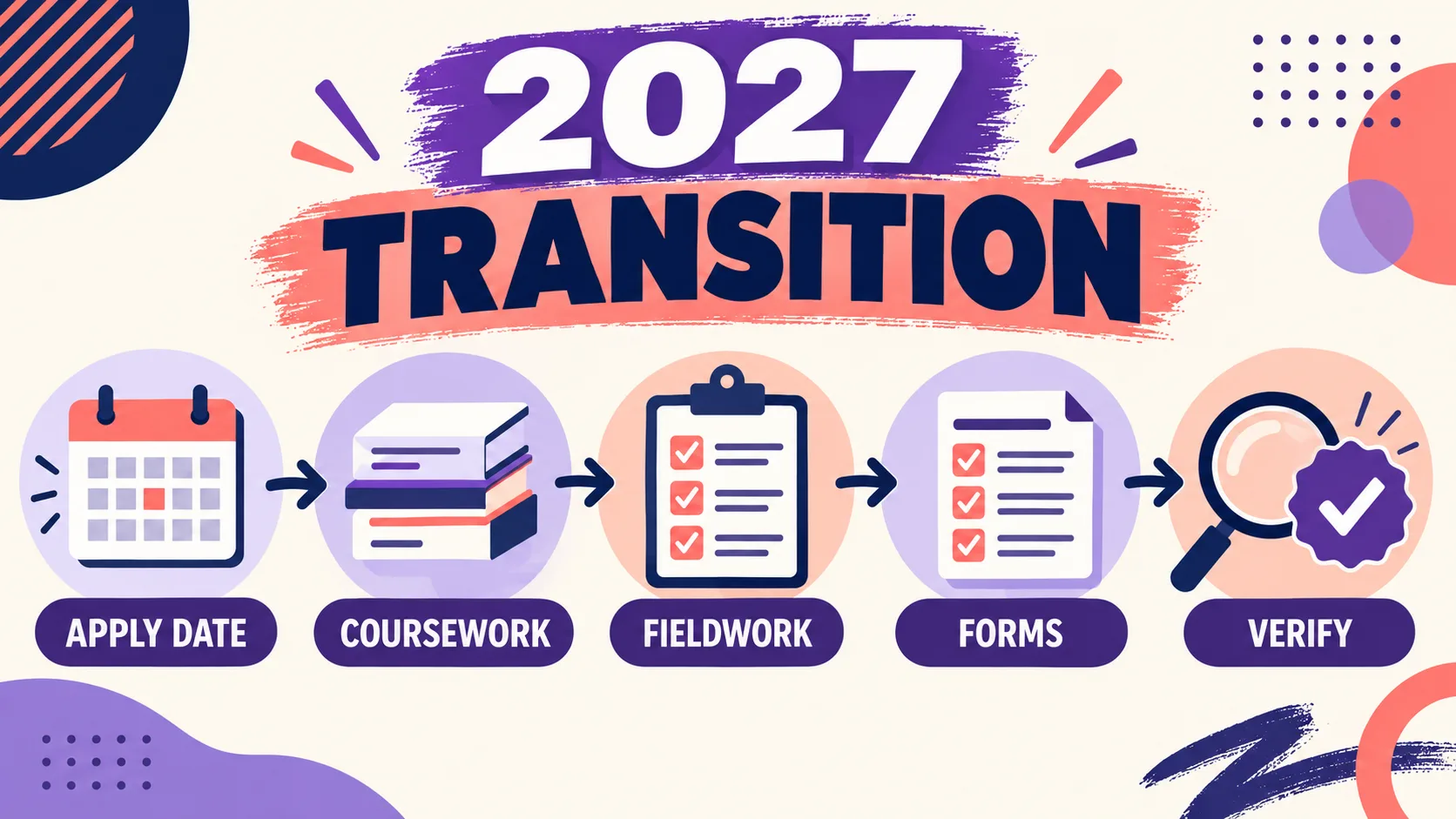
The 2027 transition is an application-date problem as much as a coursework problem. The official guidance says that applicants who submit on or after January 1, 2027 need to meet the requirements in place for that application. If your coursework or fieldwork spans the transition, plan conservatively and ask your advisor or supervisor which documentation should be maintained.
| Transition item | What may change | Action to take |
|---|---|---|
| Application date | The applicable eligibility version and forms. | Write down the intended submission date and verify against the official transition document. |
| Course structure | Standalone or freestanding content rules and required hours. | Map each transcript line to the current content-area requirement. |
| Fieldwork records | Monthly/final forms and pathway-specific supervision or observation rules. | Keep documentation that can demonstrate compliance with the applicable set of rules. |
| Pathway availability | Some older pathways are not part of the 2027 eligibility structure. | Do not plan from an old pathway diagram; use the current BACB document. |
When two sources appear to conflict, prefer the current official BACB handbook, requirements document, and transition guidance that apply to your application date. A third-party article may be easier to read, but it cannot override an official form or eligibility rule.
Application-Ready Audit and FAQ
Before treating your education plan as complete, run one final cross-check:
- Degree: confirm conferral date, institution, level, and pathway fit.
- Coursework: confirm content areas, hours, course structure, and attestation or program evidence.
- Fieldwork: confirm supervisor qualifications, activity totals, unrestricted percentage, supervision, observations, and forms.
- Exam: confirm application approval and current Test Content Outline.
- Application: confirm signatures, records, fees, dates, and the current submission instructions.
Do I need a master’s degree in behavior analysis?: Not necessarily. The applicable pathway may allow a qualifying master’s degree or higher in another field combined with behavior-analytic coursework, while another pathway uses an accredited or recognized behavior-analysis program. Check the current BACB pathway wording instead of relying on a degree title alone.
Does a BCBA program automatically satisfy every requirement?: No automatic assumption is safe. Confirm the program’s accreditation or recognition, pathway, coursework structure, fieldwork arrangement, and evidence for your application date. A program’s marketing statement is not the same as an official application determination.
Can I use old coursework for a 2027 application?: Possibly, but the answer depends on the official transition rules, the content and structure of the coursework, and your application date. Compare your records with the BACB transition guidance and ask the program advisor for a course-by-course review.
What is the quickest way to find a gap?: Create a five-column checklist for degree, coursework, fieldwork, exam, and application. Put the evidence you have in each column and leave a separate “official source to verify” note. For scenario practice on BCBA requirements and exam distinctions, the Take the Free BCBA Mock Exam can help identify whether your gap is recall or application. It is a practice diagnostic, not a guarantee of passing.
Sources for Further Study
- Behavior Analyst Certification Board: BCBA Handbook
- Behavior Analyst Certification Board: 2027 BCBA Requirements
- Behavior Analyst Certification Board: Guidance for Meeting the BCBA Requirements During the 2027 Transition
- Behavior Analyst Certification Board: University Training for Those Pursuing BCBA Certification
- Behavior Analyst Certification Board: Task Lists for BACB Certifications
This article is for educational and BCBA exam-preparation purposes. Eligibility, coursework equivalence, fieldwork acceptance, and application decisions should be confirmed with current BACB materials and the qualified professionals responsible for your program and supervision.



