
A plain-English BCBA and ABA career guide to ABA BT: understand what “behavior technician” usually means, how the role differs from RBT and BCBA credentials, and where supervision and scope boundaries matter. If you searched for ABA BT, you are probably trying to decode a job title. In most ABA settings, BT means behavior technician: a direct-service team member who implements behavior-analytic programs, records objective data, and communicates observations to a supervisor. The important qualification is that BT is generally a job title, not automatically a BACB certification. A person may work as a BT without being an RBT, or may be hired as a BT while also holding an RBT credential.
Table of Contents
- ABA BT: What Does It Mean?
- BT, RBT, and BCBA: Title Versus Credential
- What Does an ABA Behavior Technician Do?
- Supervision and Scope Boundaries
- How to Evaluate an ABA BT Job
- Common ABA BT Mistakes
- How This Connects to BCBA Study
- Frequently Asked Questions
- Quick Review Checklist
- Take the Free BCBA Mock Exam
That distinction matters for families, applicants, and BCBA exam candidates. “BT,” “ABA therapist,” and “behavior technician” are often used by employers in different ways. The actual duties, training, supervision, and legal requirements must be checked in the job description, service setting, payer rules, and applicable state rules. The title alone does not prove a person’s credential or scope.
Scope note: This is an educational role-and-credential guide, not legal, employment, or individualized clinical advice. Confirm a specific person’s credential through the appropriate board or employer and follow the supervising professional’s written plan.
ABA BT: What Does It Mean?
ABA BT usually means an ABA behavior technician who provides direct implementation of a program created or overseen by a qualified behavior analyst. The BT may work in a home, clinic, school, community, or other service setting. Typical work includes preparing materials, presenting teaching opportunities, implementing behavior-support procedures as written, collecting data, and reporting relevant changes or concerns.
“Usually” is important because BT is not one universally protected title in every setting. Employers may use related labels such as behavior therapist, behavior interventionist, direct-care staff, or ABA therapist. Some organizations use BT for people who are working toward RBT certification; other organizations use the title for technicians who are not pursuing that credential. The reliable question is not “What does this label always mean?” but “What training, credential, supervision, and duties apply in this case?”
The behavior-technician explanation from Finni makes the central distinction useful: a BT is commonly a role in direct care, while an RBT is a BACB credential. The ABA roles overview from ABA Cases similarly treats BT as a general job title that may or may not be paired with RBT registration.
For a family choosing a provider, ask for the person’s exact title, credential, supervisor, and responsibilities. For an applicant comparing jobs, ask what training is paid, who provides feedback, how data are reviewed, and whether the role offers a clear path to RBT certification. For a BCBA candidate, recognize the terminology trap: a job title is not the same thing as a certification level.
BT, RBT, and BCBA: Title Versus Credential
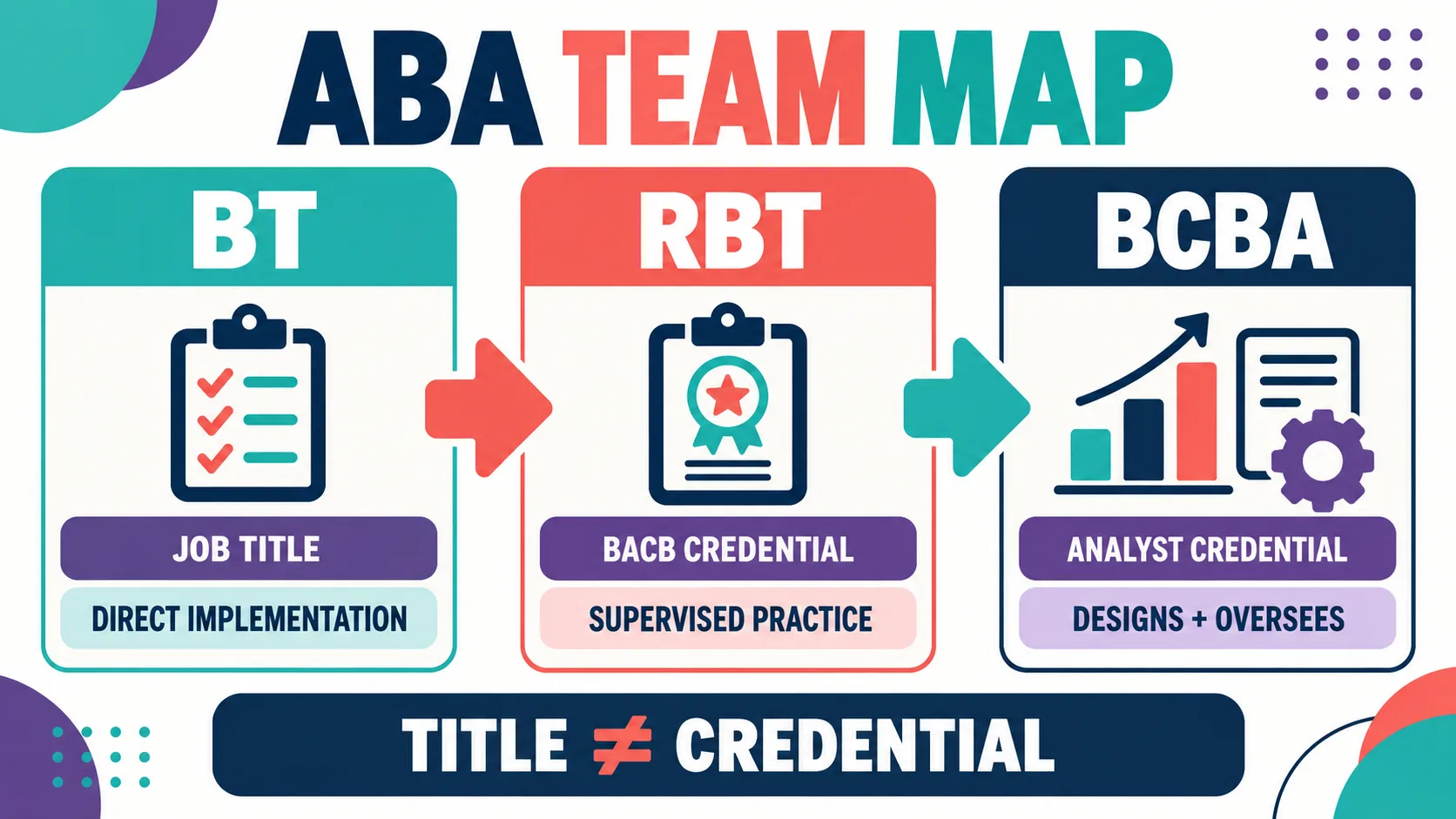
ABA teams often include people with different levels of training and authority. The terms can appear in the same job posting, but they answer different questions. BT describes a role. RBT describes a BACB credential for a behavior technician. BCBA describes a graduate-level behavior-analytic certification with a different scope and responsibility.
| Term | What it describes | What to verify |
|---|---|---|
| BT | A general behavior-technician job role or title used by an employer. | Employer training, assigned duties, supervisor, setting rules, and whether a credential is held. |
| RBT | A Registered Behavior Technician credential governed by the BACB. | Current BACB status, qualified supervision, required training, and applicable documentation. |
| BCBA | A Board Certified Behavior Analyst credential and professional role. | Active certification, jurisdictional authorization, competence for the case, and supervision responsibilities. |
The BACB RBT resource is the appropriate starting point for RBT certification questions. It should not be used to assume that every BT is an RBT. Conversely, the fact that someone is called a BT does not by itself show that they lack training or competence. Verify the person and the role rather than inferring from initials.
What Does an ABA Behavior Technician Do?
A BT’s daily work depends on the program and setting, but the role commonly centers on faithful, observable implementation. The technician may run skill-acquisition opportunities, support communication, practice daily-living routines, implement reinforcement or prompting procedures, and respond according to a behavior-support plan. The technician also collects data so the supervisor can evaluate whether the program is working. Examples of responsible BT activities include:
- Reviewing the current program, definitions, materials, and safety instructions before a session.
- Presenting teaching opportunities according to the written procedure and recording the learner’s observable response.
- Using approved prompts, reinforcement, error-correction, and data-collection procedures within the technician’s training.
- Recording frequency, duration, latency, trial-by-trial, or other measures exactly as defined by the program.
- Reporting changes in health, environment, communication, preference, risk, or response pattern to the supervisor.
- Protecting privacy, dignity, assent, communication access, and the learner’s opportunity to pause or refuse when the plan allows.
A BT is not simply a person who “makes behavior change happen.” A quality role includes a feedback loop: the technician implements, observes, records, and communicates; the supervisor reviews data and makes qualified programming decisions. The peer-reviewed discussion of technician supervision illustrates why supervision arrangements and jurisdictional context matter when technicians implement programs in ABA services.
Supervision and Scope Boundaries
Supervision is not just a name on an organizational chart. It means that the person responsible for the program provides direction, observes or reviews implementation as required, gives feedback, and responds to data and safety concerns. The exact requirements depend on whether the person is an RBT, a trainee, an employee under a state license, or a technician working under a different service model. In a well-defined ABA BT role, the technician should know:
- Who the supervising BCBA or other qualified professional is.
- Which written programs and behavior definitions are current.
- What the technician should do when the learner refuses, the procedure is unclear, or a safety concern appears.
- Which data fields must be completed and how errors are corrected.
- When and how to report a change instead of changing the plan independently.
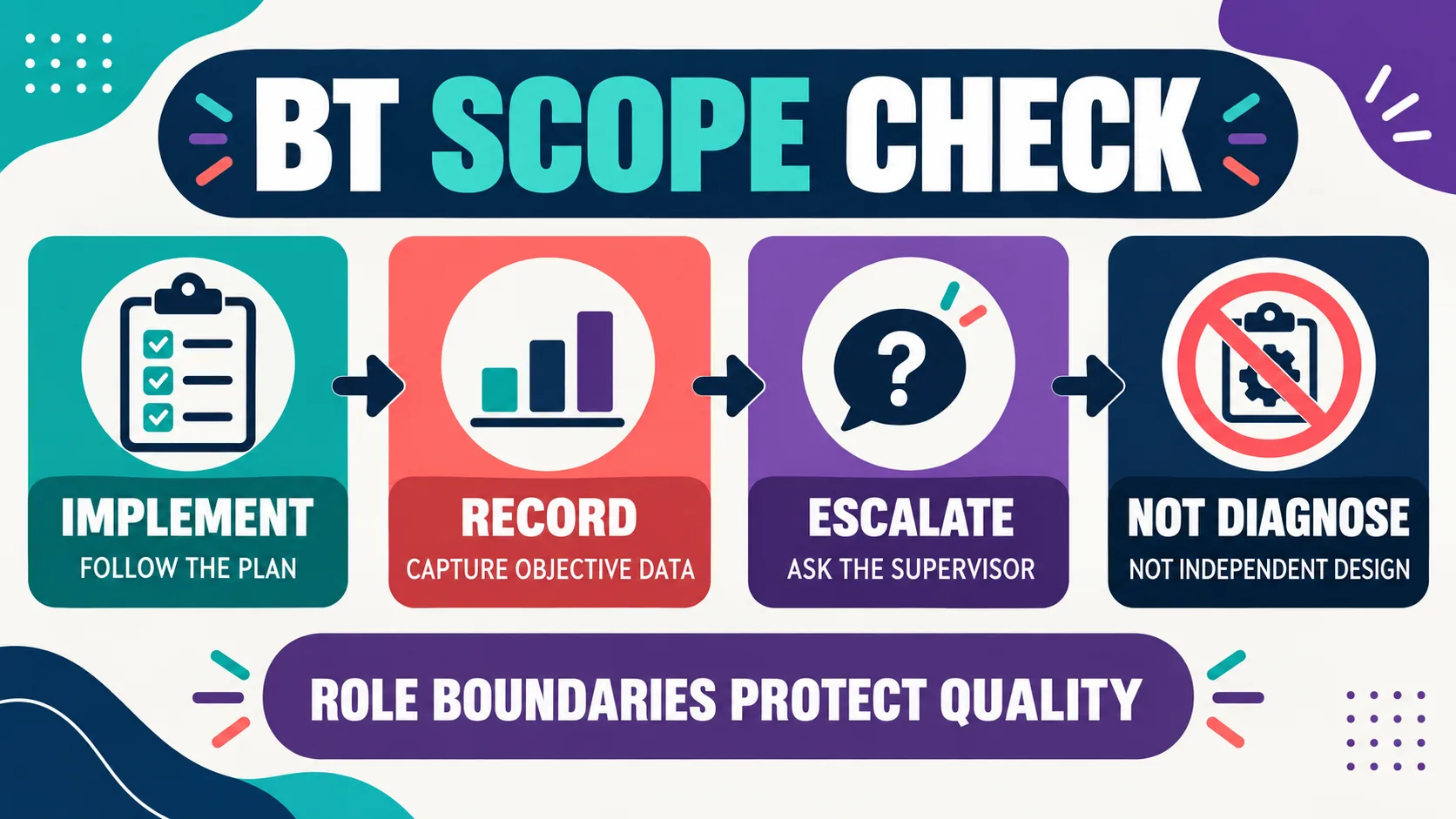
The boundary can be summarized simply: a BT can implement within training and authorization, but should not independently diagnose, create a treatment plan, change a function-based procedure, or represent a general job title as a BACB credential. A technician may suggest that a plan needs review; that is different from independently rewriting the plan during a session.
Families can use the same checklist. Ask who writes the plan, who supervises the technician, how often observation and feedback occur, what data are shared, how assent and refusal are handled, and what happens when progress stalls. Applicants should ask these questions before accepting a position. Clear role boundaries protect the learner and the technician.
How to Evaluate an ABA BT Job
Because the title is broad, compare BT jobs by the structure behind the title. A responsible posting should explain the population and setting, the essential duties, required training, supervision, data expectations, safety procedures, and whether RBT certification is required or supported. “Work with children and change behavior” is not enough information to evaluate a professional role.
| Check before accepting | Good question to ask | Warning sign |
|---|---|---|
| Supervision | Who observes, gives feedback, and answers urgent questions? | No named supervisor or no reliable escalation route. |
| Training | What training is required, paid, and documented before solo work? | Pressure to implement procedures without demonstrated competence. |
| Scope | Which tasks are implementation, and which decisions remain with the analyst? | The job expects a BT to diagnose or independently rewrite plans. |
Use this decision sequence:
- Identify the title: Is the employer hiring a BT, RBT, behavior interventionist, or another role?
- Identify the credential: Is certification required, preferred, supported, or not part of the position?
- Identify supervision: Who provides direction, observation, feedback, and escalation support?
- Identify the work: Will you implement existing programs, collect data, assist with assessment, or be asked to design procedures?
- Identify the documentation: How are sessions, incidents, progress, corrections, and supervision recorded?
- Identify the safeguards: How are consent, assent, privacy, cultural responsiveness, and safety handled?
A position can be a good entry point to behavior analysis without being a direct route to BCBA certification. Working as a BT may build practical experience, but BCBA eligibility still depends on the applicable education, coursework, fieldwork, and examination pathway. The site’s RBT-before-BCBA guide explains why RBT work is not a universal prerequisite for BCBA certification.
Common ABA BT Mistakes
- Assuming BT means RBT: BT is generally a job title; RBT is a BACB credential. Verify the distinction.
- Assuming a title proves competence: look for training, supervision, observation, and documented performance.
- Changing a plan without authorization: report the pattern and ask the supervisor to review it.
- Recording impressions instead of behavior: use the operational definition and measurement procedure, not labels such as “bad day” or “uncooperative.”
- Ignoring assent or communication: a technician should notice refusal, distress, access barriers, and communication attempts and follow the plan’s safeguards.
- Confusing experience with a credential: experience can be valuable, but it does not replace the requirements of RBT or BCBA certification.
- Accepting unclear supervision: if no one can explain who gives direction and how concerns are escalated, the role needs clarification before services begin.
How This Connects to BCBA Study
On a BCBA exam question, separate the technician’s implementation role from the analyst’s assessment, design, and oversight role. Look for the person who is qualified to define the target, interpret the data, select or modify the intervention, and supervise implementation. A BT can be the person collecting important session data without being the person authorized to draw every clinical conclusion.
When you are studying credential boundaries, practice identifying whether a scenario tests role, supervision, measurement, ethics, or treatment design. The Free BCBA Mock Exam can help you turn those distinctions into timed practice. Review each missed item by asking: who is implementing, who is supervising, what evidence is available, and what decision is within scope?
Frequently Asked Questions
What does ABA BT stand for?: ABA BT usually stands for ABA behavior technician. It commonly refers to a direct-service job role that implements behavior-analytic programs, collects objective data, and works under the direction of a qualified supervisor.
Is a BT the same as an RBT?: No. BT is generally a job title, while RBT is a Registered Behavior Technician credential governed by the BACB. A person may be both a BT and an RBT, but the titles are not automatically interchangeable.
What does an ABA behavior technician do?: A BT may implement skill-acquisition and behavior-support programs, collect data, use approved prompts and reinforcement, prepare materials, and report observations to a supervisor. Duties depend on training, authorization, setting, and the written program.
Can a BT write an ABA treatment plan?: A general BT job title does not by itself authorize independent assessment or treatment-plan design. The technician should implement within training and refer program changes, safety concerns, and unclear procedures to the qualified supervisor.
Does working as a BT make someone eligible for the BCBA exam?: Not by itself. BT experience may be useful, but BCBA eligibility depends on the applicable education, coursework, supervised fieldwork, application, and examination requirements. Check current BACB rules rather than relying on the job title.
What should a family ask about a BT?: Ask whether the person is a BT, RBT, or another credentialed professional; who supervises them; how data and feedback are handled; how refusal and communication are respected; and who changes the treatment plan when the data show a problem.
Bottom line: ABA BT usually means a behavior technician role, not automatically a certification. Understand the duties, verify the credential, confirm supervision, protect scope boundaries, and judge the quality of the role by its training and feedback system—not by the initials alone.
Quick Review Checklist
Use this final checklist to turn aba bt into exam-ready reasoning. The goal is not to memorize a label in isolation; it is to identify the relevant evidence and explain why the best answer fits the scenario. Key ideas to review:
- State the central definition or decision point for aba bt in your own words.
- Identify the detail that makes aba bt different from its closest related ABA term.
- Separate the observable facts in a scenario from assumptions that are not supported by the facts.
- Write one example and one nonexample so you can recognize the concept in a new setting.
Exam application checks:
- Ask what the question is actually requesting before comparing the answer choices.
- Mark the antecedent, response, consequence, or other evidence that supports the selected answer.
- Look for a distractor that describes a related process but does not answer the specific question.
Final self-check:
- Explain how you would verify the interpretation with clear observations or data.
- Change one detail in the scenario and decide whether your answer should change.
- Give a one-sentence rationale that a supervisor or study partner could evaluate.
Take the Free BCBA Mock Exam
When you are ready to apply the idea, use the free practice resource below for additional feedback. Take the Free BCBA Mock Exam



