
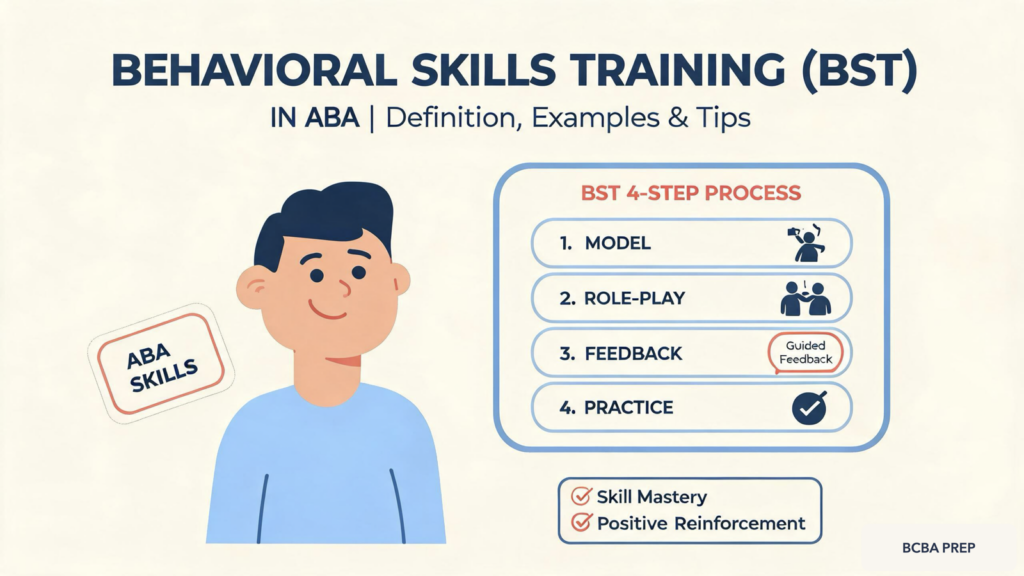
What Is Behavioral Skills Training (BST)?
Behavioral Skills Training (BST) is an evidence-based teaching package used to train new skills across a variety of populations, including parents, staff, and individuals with developmental disabilities. BST combines active instruction, live or video modeling, opportunities for practice, and corrective feedback to promote efficient skill acquisition. In ABA, BST is commonly employed to teach social skills, safety skills, and professional competencies.
Table of Contents
- What Is Behavioral Skills Training (BST)?
- BST in Action: Three Worked Examples with ABC Analysis
- Why BST Matters for the BCBA Exam
- Quick Checklist: Using BST in Practice
- Final Summary
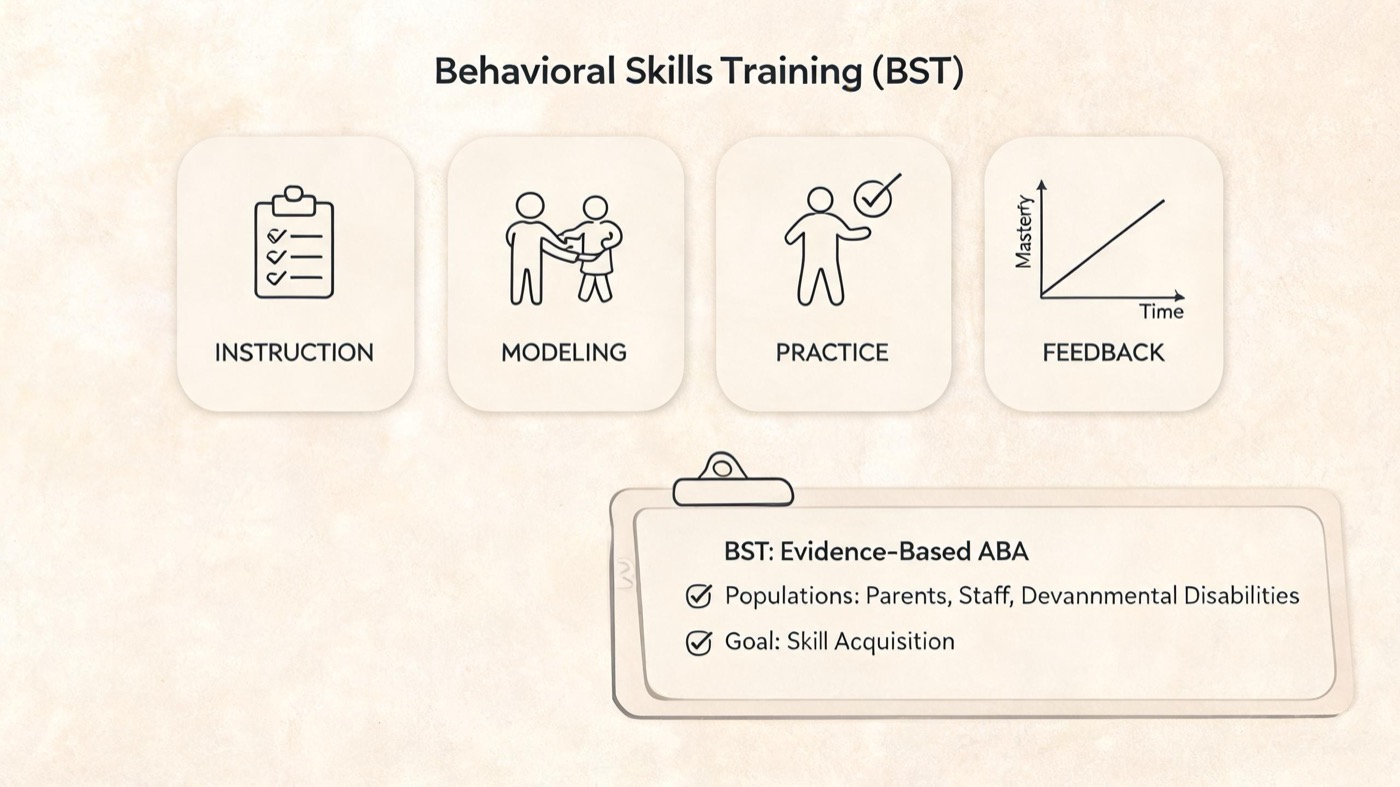
The Four Core Components of BST
BST consists of four sequential steps. Each component is critical for competency-based training and must be implemented with fidelity.
- Instructions: Provide clear, concise, and behaviorally specific descriptions of the target skill. Avoid jargon and ensure the learner understands what to do.
- Modeling: Demonstrate the skill correctly, either live or via video. The model should perform the exact behaviors expected of the learner.
- Rehearsal: The learner practices the skill in a simulated or natural environment. Repeated practice is essential for skill fluency.
- Feedback: Deliver immediate, specific, and corrective feedback. Praise correct performance and provide constructive guidance for errors.
BST in Action: Three Worked Examples with ABC Analysis
Understanding BST requires seeing it applied to real-world scenarios. Below are three examples with ABC analysis and hypothesized function, showing how BST is implemented.
Example 1: Teaching a Parent to Implement a Token Economy
A BCBA wants to teach a parent to use a token economy to increase compliance during homework. The antecedent is the child refusing to start homework; the behavior is the parent explaining the token system; the consequence is the child complying after earning a token. Hypothesized function: positive reinforcement (access to backup reinforcer).
BST steps: The BCBA gives written instructions on the token system, models the procedure with the parent as a learner, has the parent rehearse with a role-play child, and provides immediate feedback on token delivery rate and praise quality.
Example 2: Training a Paraprofessional to Use Prompting and Fading
A paraprofessional is working with a student who needs prompts to complete a task. The antecedent is the student struggling with a math problem; the behavior is the paraprofessional immediately giving a full physical prompt; the consequence is the student making errors. Hypothesized function: negative reinforcement (escape from difficulty).
BST corrects this by providing instructions on prompt hierarchies, modeling a least-to-most prompting sequence, having the paraprofessional rehearse with a confederate, and giving feedback on prompt delay and fading.
Example 3: Teaching a Child to Request a Break Using PECS
A child with limited vocal language is taught to exchange a picture to request a break. The antecedent is a demand to complete a task; the behavior is the child handing a break card; the consequence is a 2-minute break. Function: escape from demands.
BST: Instructions describe the exchange, the trainer models handing the card, the child rehearses with a communication partner, and feedback is given on correct picture orientation and appropriate timing.
Why BST Matters for the BCBA Exam
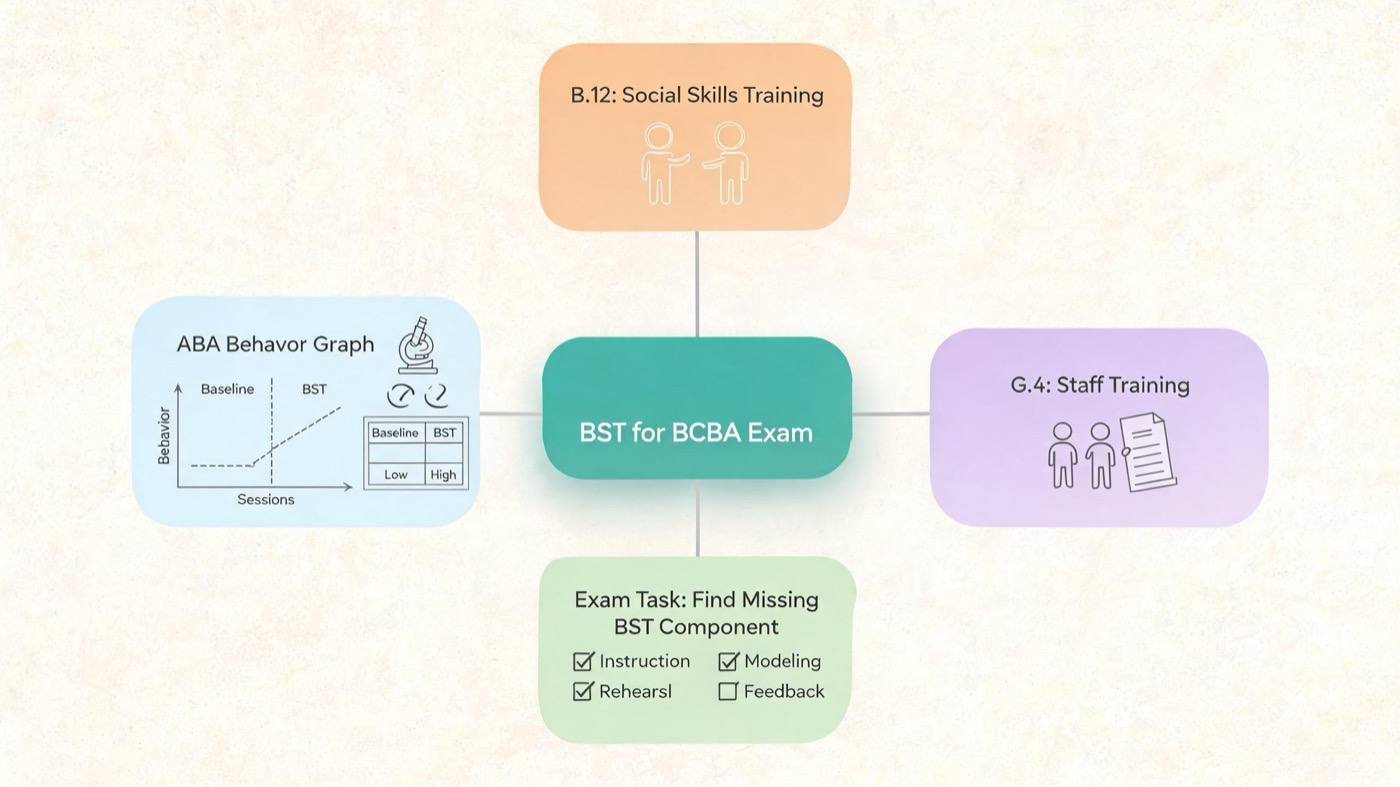
The BCBA exam tests your ability to design and apply BST across various contexts. Items may align with task list items such as B.12 (social skills training) and G.4 (staff training). You may be asked to identify the missing component of BST or evaluate the effectiveness of a training session.
Common Exam Traps and How to Avoid Them
- Trap 1: Confusing BST with other training procedures. BST is a specific four-step process; do not confuse it with PECS training or DTT. Focus on the presence of instructions, modeling, rehearsal, and feedback.
- Trap 2: Forgetting feedback must be immediate and corrective. Feedback is not just praise; it must include specific corrective guidance. Delayed feedback reduces effectiveness.
- Trap 3: Missing that rehearsal is essential for competency. Some items ask whether a trainee must practice before being observed. Rehearsal is non-negotiable in BST.
- Trap 4: Overlooking the need for modeling that matches the learner’s context. A model must be relevant; using a different setting or stimuli can impair generalization.
Practice Prompts to Test Your Knowledge
- A BCBA provides instructions and models the skill, but the staff member is asked to implement the skill the next day without practice. Which BST component is missing? Rehearsal
- During BST, feedback is provided immediately after rehearsal. What type of feedback is most effective? Specific, corrective, and praise for accurate components
- A trainee receives feedback on their use of discrete trial training. The feedback is general (e.g., ‘good job’). Is this sufficient? No, feedback must be behaviorally specific
Quick Checklist: Using BST in Practice
Use this checklist during supervision or exam review to ensure your BST sessions are complete.
- Instructions are written or verbal, behaviorally specific, and jargon-free
- Modeling is demonstrated live or via video, with the exact target behaviors
- Rehearsal occurs in a safe environment with opportunities for repeated practice
- Feedback is immediate, specific, and includes both praise and correction
- Data are collected on the trainee’s performance to monitor progress
- The trainer adjusts instructions or modeling if the trainee does not improve
Final Summary
Behavioral Skills Training is a powerful, evidence-based approach in ABA that ensures skills are taught effectively and efficiently. By mastering the four steps—instructions, modeling, rehearsal, and feedback—you can train caregivers, staff, and clients with confidence. On the BCBA exam, look for questions that test your ability to identify missing components, evaluate feedback quality, and apply BST across settings. For more study resources, check out our detailed guide on BST and practice with our free BCBA mock exam questions. For authoritative references, refer to the BACB Task List and peer-reviewed literature on BST.
Complete BCBA Exam Prep
Turn this topic into exam-day practice
Practice concepts in context with five full-length 6th Edition mock exams, two bonus practice exams, a 6th Edition study guide, and key-term flashcards—all in one $120 USD package.
Get the $120 All-in-One Prep Pack
Review everything included on the product page before ordering. No pass guarantee is implied.



