
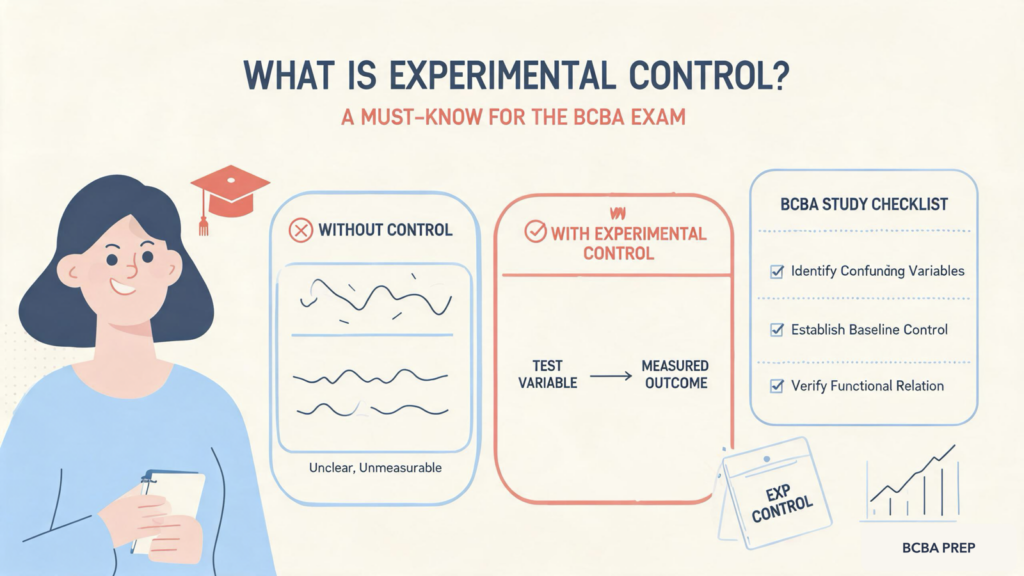
What Does Experimental Control Mean in Behavior Analysis?
In applied behavior analysis, experimental control is the demonstration that a specific intervention (independent variable) reliably produces a change in the target behavior (dependent variable). It is the gold standard for establishing a functional relation between the two. Without experimental control, you cannot confidently say that your treatment caused the behavior change.
Practice this concept
Table of Contents
- What Does Experimental Control Mean in Behavior Analysis?
- Classic ABA Examples of Experimental Control in Action
- How to Distinguish Experimental Control from Related Concepts
- Quick Exam Checklist for Experimental Control Questions
- Final Summary: Experimental Control and Your Exam Success
- References
On the BCBA exam, you will be tested on how experimental control is achieved through single-subject experimental designs such as reversal designs, multiple baseline designs, and alternating treatments designs. The key is to recognize patterns where data show consistent, replicated effects of the independent variable across conditions or subjects.
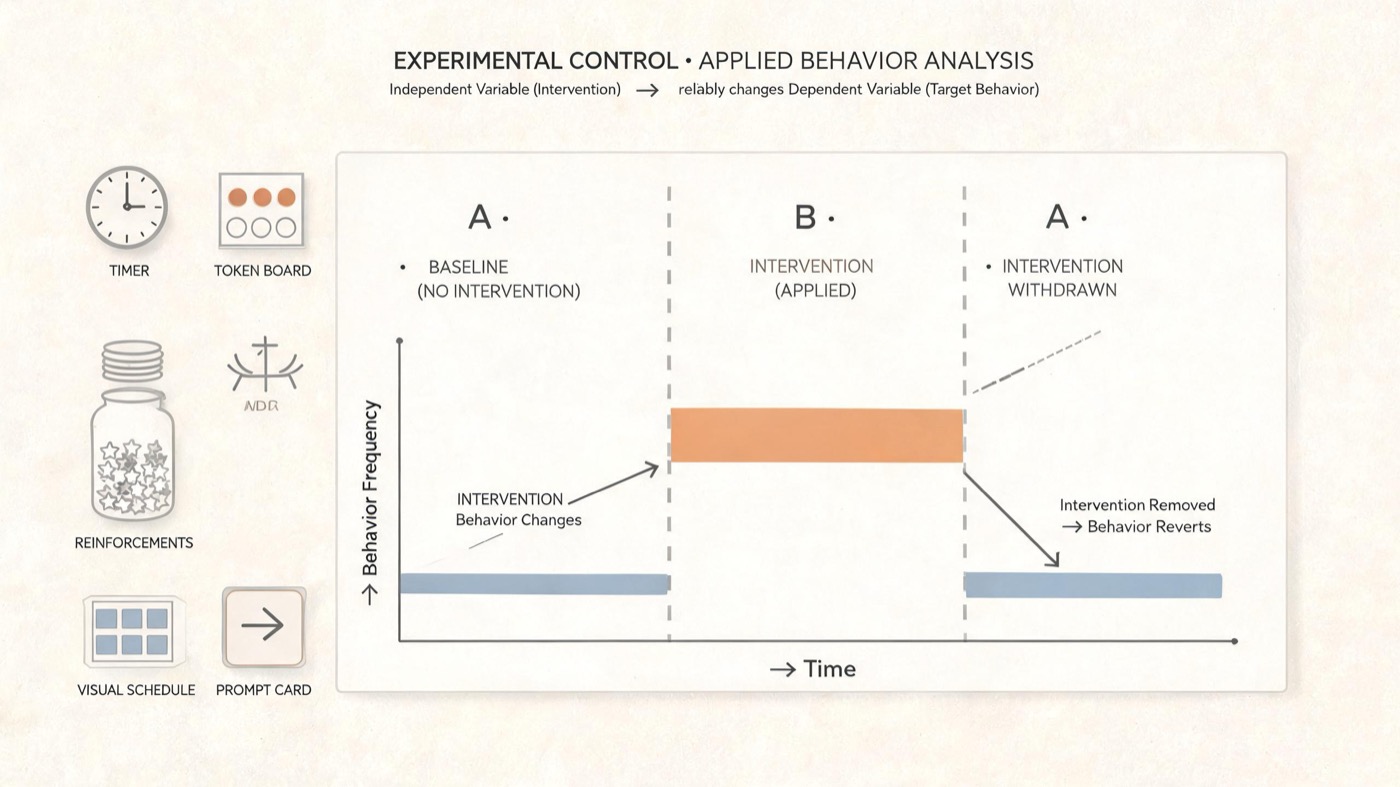
The Core Idea: Demonstrating Functional Relations
Experimental control is essentially the functional relation between an independent variable and a dependent variable. When a researcher systematically introduces and withdraws the independent variable and the behavior changes predictably, experimental control is established. For example, if every time you provide a reinforcer for on-task behavior the behavior increases, and when you remove the reinforcer it decreases, you have demonstrated control.
Why This Matters for the BCBA Exam
Experimental control is a cornerstone of the BCBA exam. You will see questions about identifying which design demonstrates experimental control, interpreting graphs for control, and understanding threats to internal validity. Many exam scenarios ask you to judge whether a functional relation was demonstrated. Read more about independent and dependent variables in ABA to solidify your foundation.
Classic ABA Examples of Experimental Control in Action
Example 1: Escape-Maintained Disruption
ABC Sequence: Antecedent: Teacher presents a math worksheet. Behavior: Student throws pencil and yells. Consequence: Teacher removes the worksheet and says, “You can take a break.” The hypothesized function is escape from demands. Experimental control is achieved when the teacher systematically provides escape (IV) contingent on disruption and the disruption reliably increases. In a reversal design, when escape is withdrawn, disruption should decrease, confirming the functional relation.
Example 2: Attention-Maintained Requesting
ABC Sequence: Antecedent: Peer ignores the child. Behavior: Child taps peer’s shoulder. Consequence: Peer turns and looks. The hypothesized function is attention. Experimental control is demonstrated when peer attention (IV) is delivered after tapping and the tapping rate increases. Withdrawing attention (extinction) should reduce tapping, thus showing control.
Example 3: Sensory-Stimulating Hand Flapping
Sometimes behavior is maintained by automatic reinforcement. Suppose a child flaps hands and the sensory stimulation follows. Experimental control can be shown by providing alternative sensory stimulation (IV) that matches the hypothesized function. If hand flapping decreases when alternative stimulation is available and increases when it is removed, experimental control is established. This example highlights how control can be tested even without a social mediator.
How to Distinguish Experimental Control from Related Concepts
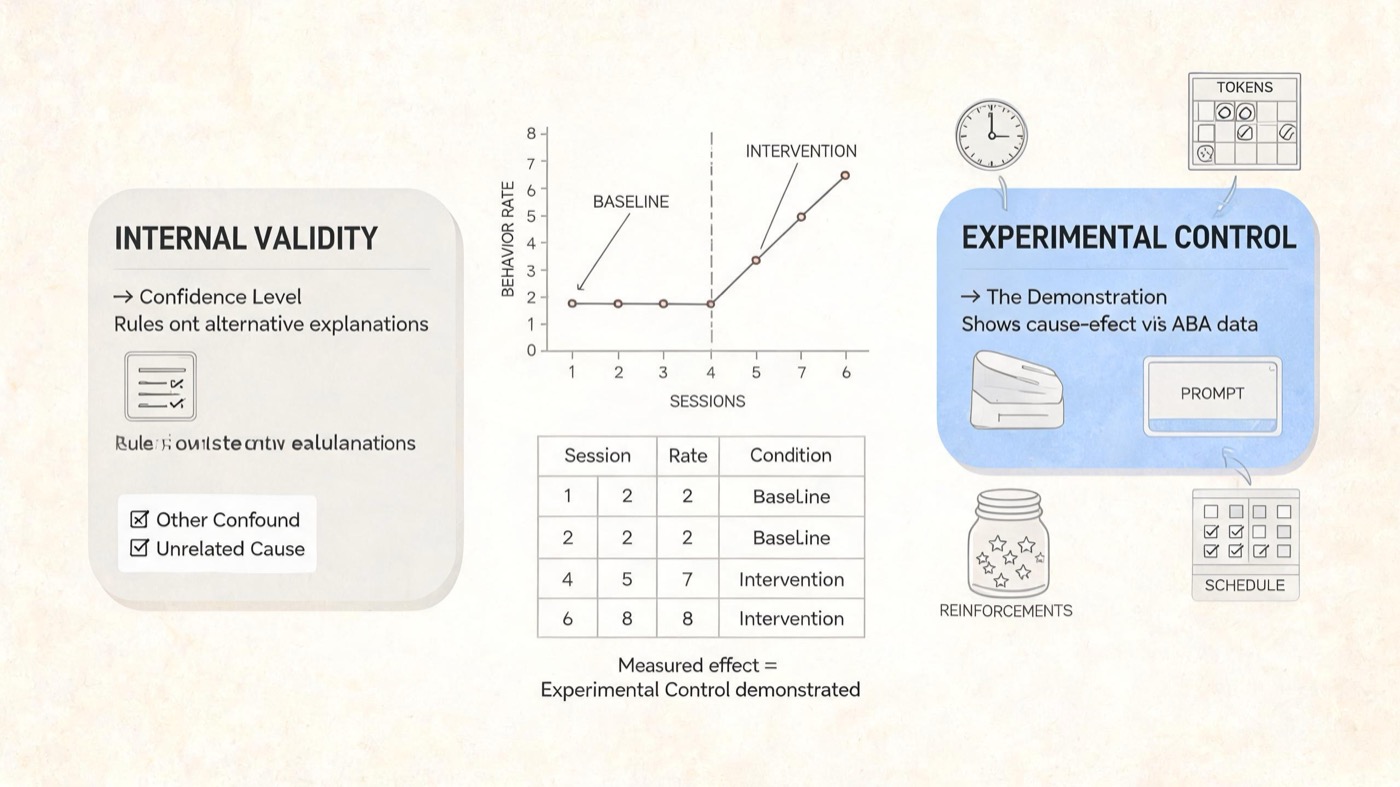
Experimental Control vs. Internal Validity
Internal validity is the degree to which a study can rule out alternative explanations for the observed effect. Experimental control is the demonstration itself. Think of internal validity as the confidence level, and experimental control as the evidence that produces that confidence. Both are essential, but they are not interchangeable terms on the exam.
Experimental Control vs. External Validity
External validity refers to how well the findings generalize across settings, people, and time. Experimental control focuses only on the internal demonstration of cause and effect. A study can have strong experimental control but low external validity if conducted in a highly controlled setting that does not reflect real-world conditions.
Common Exam Trap: Confusing Correlation with Control
A frequent mistake is equating correlation with experimental control. Just because two variables change together does not mean one caused the other. Experimental control requires active manipulation of the independent variable and repeated demonstration of effect. Look for replication and reversal in graphed data.
Quick Exam Checklist for Experimental Control Questions
Use this checklist when analyzing BCBA exam scenarios to identify experimental control:
- Identify the independent variable (IV): Was it systematically manipulated by the researcher? Look for changes in intervention conditions.
- Identify the dependent variable (DV): Was the behavior measured repeatedly across phases? Check for stable baselines.
- Look for replication: Did the behavior change consistently each time the IV was introduced or withdrawn? Reversal designs and multiple baseline designs rely on replication.
- Check for confounding variables: Are there alternative explanations (e.g., history, maturation, carryover effects) that weaken control? Treat internal validity threats seriously.
- Examine visual analysis: Do the data paths show clear changes in level, trend, or variability at the phase change lines? This is the hallmark of experimental control.
- Consider design strength: Which single-subject design provides the strongest experimental control for this situation? For example, withdrawal designs often show clear control if the behavior is reversible.
Practice with graphing and visual analysis in ABA to sharpen your skills.
Final Summary: Experimental Control and Your Exam Success
Mastering the experimental control definition is critical for passing the BCBA exam. Remember that experimental control is the demonstration of a functional relation through systematic manipulation and replication. Use the examples above to visualize how control appears in real data. Apply the checklist to every scenario question you encounter. Avoid the common traps of confusing correlation with causation or misidentifying internal validity. For further study, review single-subject experimental designs and practice interpreting graphs. With a solid grasp of experimental control, you will confidently answer related questions and earn a higher score. Good luck!



