
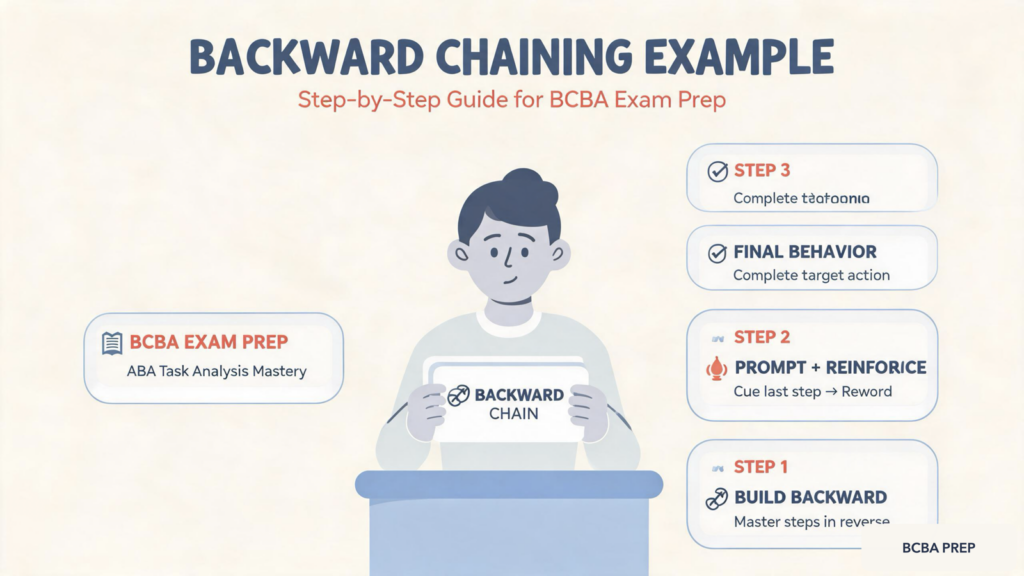
What Is Backward Chaining?
Backward chaining is a teaching strategy where you start by teaching the last step of a behavior chain first. Once the learner masters that final step independently, you move backward to teach the second-to-last step, and so on. This ensures the learner experiences reinforcement for completing the entire chain from the very first trial, because they always finish the sequence successfully.
Table of Contents
- What Is Backward Chaining?
- Step-by-Step Backward Chaining Example: Putting on a Jacket
- Another Backward Chaining Example: Tying Shoes (Exam-Focused)
- Backward Chaining on the BCBA Exam: What You Need to Know
- Summary: Key Takeaways for Your Exam
- References
This method is especially useful for learners who struggle with multistep tasks or have low tolerance for errors. By starting at the end, the learner gets immediate access to the reinforcer that follows the completed chain, which builds momentum and motivation.
Backward Chaining vs. Forward Chaining
In forward chaining, you teach the first step first, then add steps in order. With backward chaining, you start with the last step. Which to choose? Backward chaining works best when the terminal step is the most reinforcing or when the learner needs to experience success at the very end to stay engaged. Forward chaining may be better when the initial steps are simpler or when the learner has a strong history of following a sequential routine.
When to Use Backward Chaining in ABA
- Self-help skills: putting on a jacket, tying shoes, brushing teeth.
- Vocational tasks: assembling a product, sorting mail, packaging items.
- Academic routines: completing a worksheet (last step: turn in paper), logging into a computer.
Backward chaining is ideal when the learner can already do some earlier steps but struggles to finish independently, or when the natural reinforcer is at the end (e.g., playing outside after putting on a coat).
Step-by-Step Backward Chaining Example: Putting on a Jacket
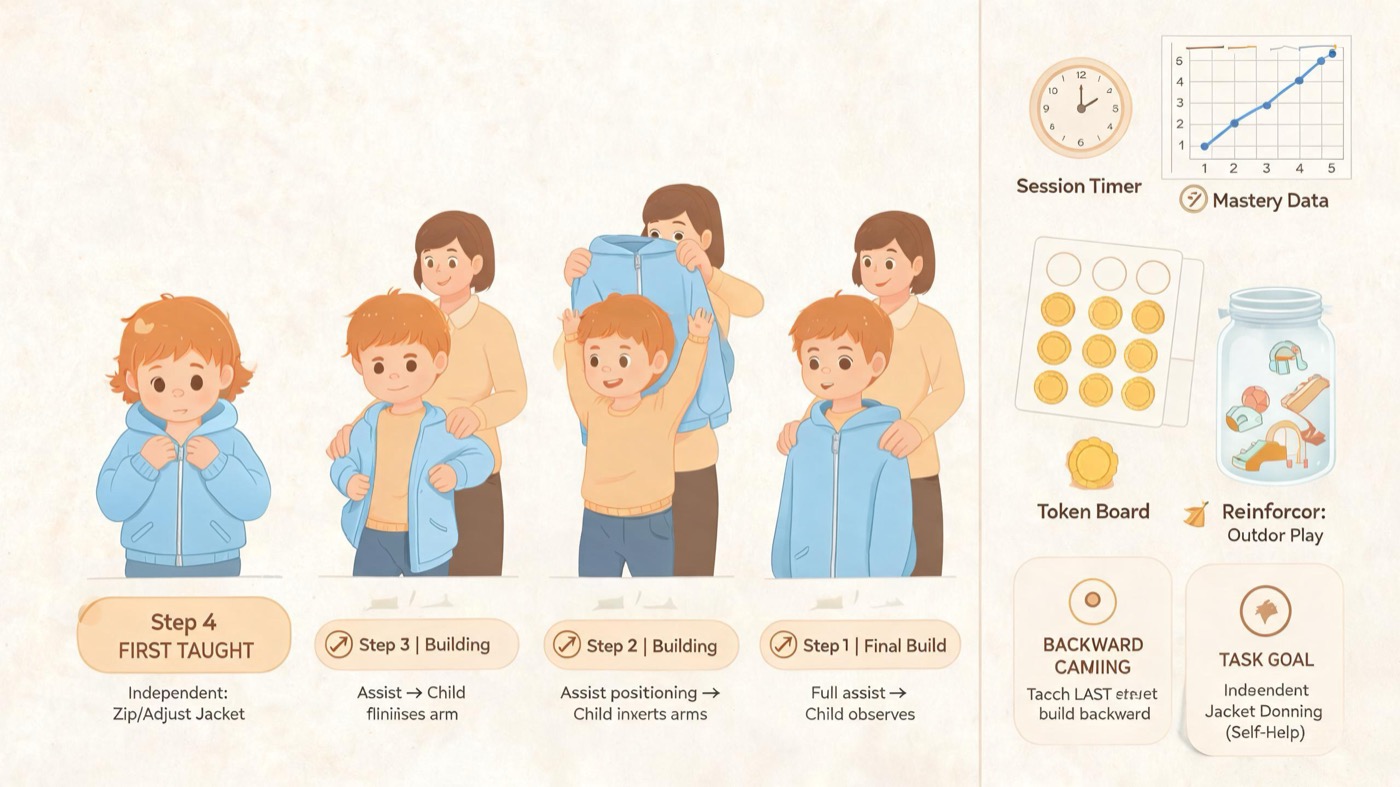
Let’s walk through a concrete backward chaining example with a common self-help skill: putting on a jacket. The goal is for the child to put on the jacket independently before going outside to play.
Task Analysis: Steps for Jacket Putting-On
- Pick up the jacket from the hook.
- Hold it with the opening facing forward.
- Insert one arm into the sleeve.
- Insert the other arm and pull the jacket into place.
In backward chaining, we start by teaching step 4 first. The teacher completes steps 1–3, and the learner completes step 4 (pulling the jacket into place). Once the learner does step 4 independently, we teach step 3 (insert the second arm), then step 2, and finally step 1.
ABC Data and Function
For each step, we record Antecedent-Behavior-Consequence to track progress. Hypothesized function: access to outdoor play (positive reinforcement).
- Antecedent: Teacher says ‘Time to go outside’ and hands the jacket with arms partially inserted.
- Behavior: Learner pulls the jacket into place (step 4).
- Consequence: Teacher says ‘Great job, you put on your jacket!’, then opens the door to go outside.
As steps are added, reinforcement shifts: after completing multiple steps, the learner gets the same reinforcer (outdoor time). This maintains motivation because the terminal behavior always produces the natural payoff.
Fading Prompts and Error Correction
Use a prompt hierarchy from most to least intrusive, such as physical guidance, then partial physical, then gestural. For errors, provide immediate corrective feedback and repeat the step. For example, if the learner struggles with step 3, prompt physically and then fade to a light touch on the elbow. Always ensure the learner reaches the terminal step to access reinforcement, even if it requires re-prompting earlier steps.
Another Backward Chaining Example: Tying Shoes (Exam-Focused)
This second example is more complex and often appears on the BCBA exam. Consider a child learning to tie shoelaces, a skill that can be anxiety-provoking. Using backward chaining, you teach the final step first: pulling the loops tight.
Task Analysis for Shoe Tying
- Cross the laces to make an X.
- Tuck one lace under the X and pull tight.
- Make two loops with the laces.
- Cross the loops.
- Tuck one loop under the other.
- Pull the loops tight to complete the bow.
Start teaching step 6. The teacher does steps 1–5, and the learner only pulls the loops tight. Once mastered, add step 5 (tucking one loop under), and so on. This ensures the learner always experiences the satisfying final knot, which becomes the natural reinforcer.
Exam Trap: Chaining vs. Shaping
A common exam question confuses backward chaining with shaping. Remember: chaining teaches a fixed sequence of steps where each step is a discrete behavior. Shaping reinforces successive approximations to a single target behavior (e.g., gradually improving the tightness of a knot). On the BCBA exam, if the scenario describes teaching steps in order (forward or backward), it is chaining. If it describes reinforcing closer approximations to one behavior, it is shaping. For a deeper dive, check out our guide on shaping behavior in ABA.
Backward Chaining on the BCBA Exam: What You Need to Know
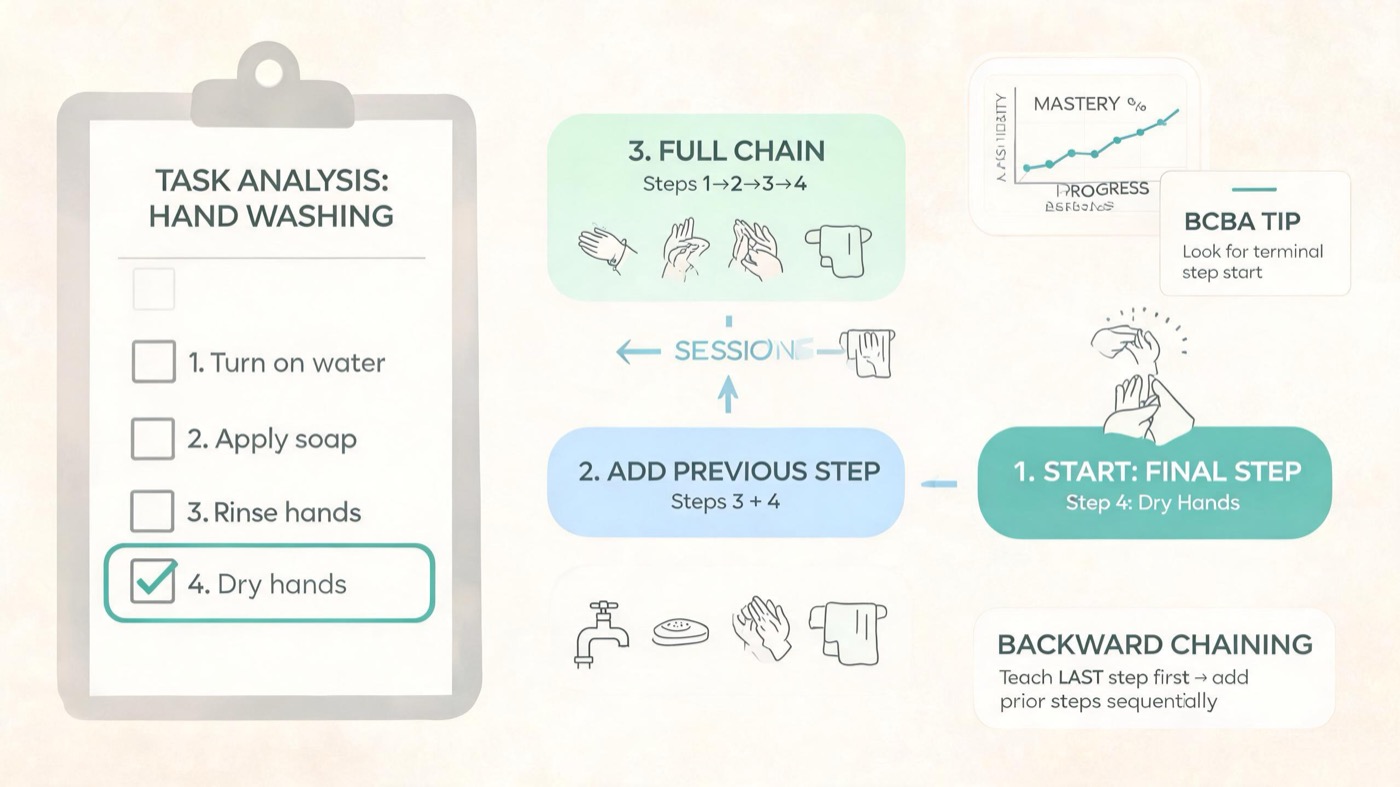
The BCBA exam will test your ability to identify, compare, and apply chaining procedures. Task analysis questions are frequent: you may be asked to order steps or choose the correct chaining method for a given client.
Common Exam Trap: Confusing Backward and Forward Chaining
Many test items describe a scenario and ask ‘Which chaining procedure is being used?’ The key difference is the direction of training: backward chaining starts with the last step; forward chaining starts with the first. Use the mnemonic ‘Backward = Last first‘. For example, if the teacher completes all steps except the final one, that is backward chaining. If the teacher completes steps after the first, that is forward chaining.
Quick Checklist for Backward Chaining Questions
- Identify the last step of the task analysis as the initial target.
- Fade prompts from the last step backward to earlier steps.
- Reinforce after each completed chain, even if only the terminal step is independent at first.
- Avoid extending the chain before the learner achieves mastery at the current step (e.g., 80% independent across 3 sessions).
- Collect data on each step separately to monitor progress.
Summary: Key Takeaways for Your Exam
Backward chaining is a powerful ABA technique that builds success by teaching the final step first. Use it for self-help, vocational, and academic tasks where the terminal reinforcer is strongest. On the BCBA exam, remember: backward starts with the last step, while forward starts with the first. Differentiate chaining from shaping by noting whether steps or approximations are targeted. Practice with real task analyses to sharpen your skills. For more exam strategies, visit our BCBA exam prep page.
Mastering backward chaining examples will help you answer at least 2–3 questions correctly on the exam. Keep this guide handy during your study sessions.



