

Short answer: The current BACB PDU requirements are an RBT professional-development requirement, not a second name for BCBA continuing-education units. After an RBT becomes certified or recertifies in 2026, the RBT must earn 12 professional development units during each two-year recertification cycle. The units can come from qualifying university behavior-analytic coursework, in-service training, ACE professional-development events, or a combination of those paths.
Table of Contents
- What Are the BACB PDU Requirements?
- Who Needs RBT PDUs, and When Do They Start?
- How Can an RBT Earn the Required PDUs?
- What Counts as an RBT PDU, and What Does Not?
- How Should RBTs Document and Upload PDUs?
- How Can You Track All 12 PDUs?
- Which BACB PDU Mistakes Cause Problems?
- BACB PDU Requirements FAQ
- Take the Free BCBA Mock Exam
- References
The most important planning step is to match the activity to the credential before you count it. A BCBA or BCaBA CE event does not automatically produce RBT PDUs, and a routine supervision meeting, client-specific training, or BCBA exam-prep activity does not become an RBT PDU simply because it is educational. Use the current BACB forms and requirements for the exact pathway you choose. Table of Contents
What Are the BACB PDU Requirements?
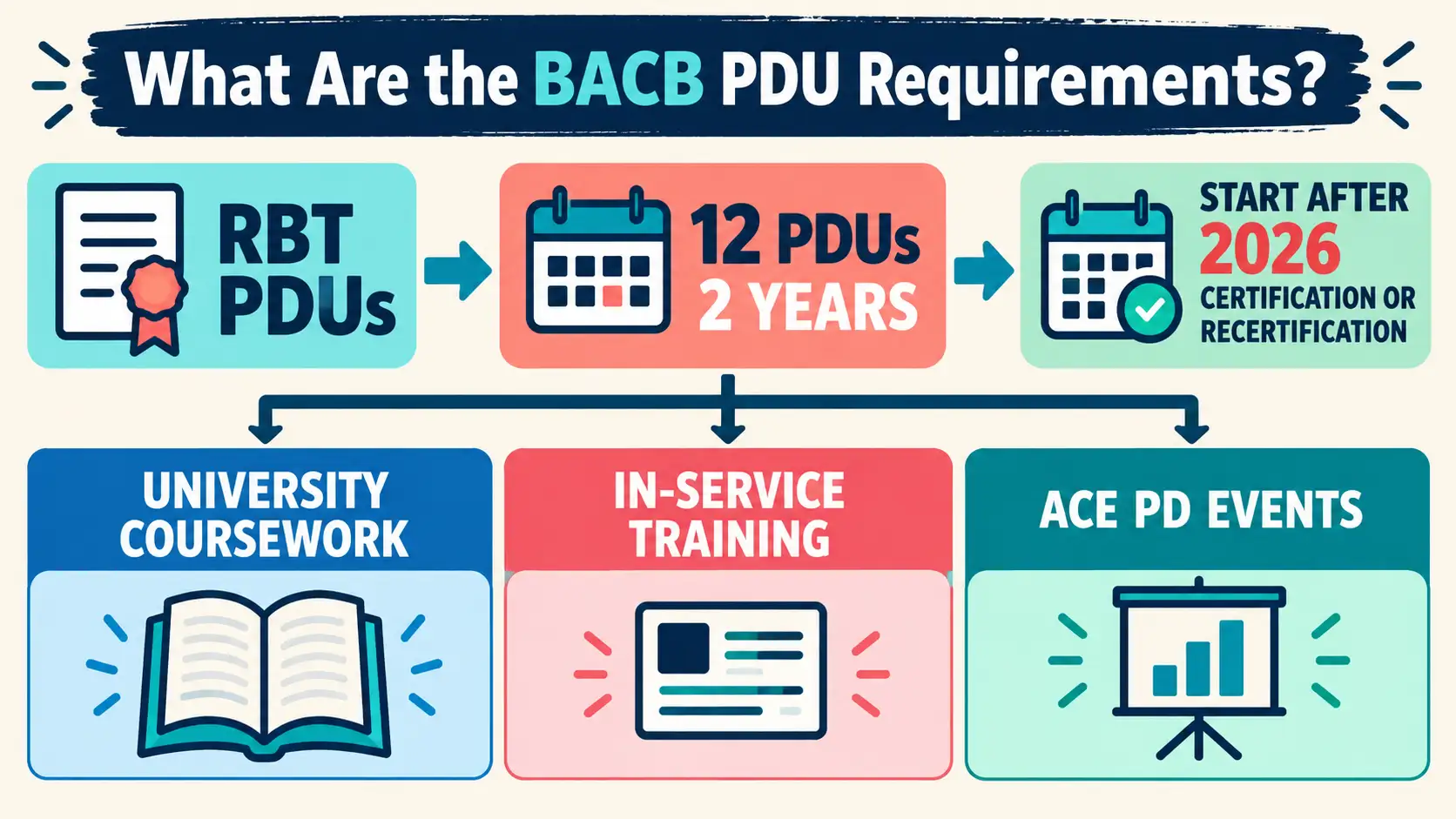
For RBTs covered by the new professional-development process, the headline rule is 12 PDUs in a two-year recertification cycle. The cycle is connected to the RBT’s certification or recertification timing, so a reader should not borrow a date from another RBT’s account. The BACB’s current RBT professional-development guidance says that an RBT must certify or recertify in 2026 before beginning to earn PDUs under this process.
“PDU” means professional development unit in this context. It is not a universal credit label that can be exchanged across every BACB credential. RBT professional development is designed for RBT-level practice and may cover current foundational skills, ethics, communication, assent-based treatment, behavior-analytic procedures, or other content appropriate to RBT work. The audience and content level are part of the qualification decision.
| Rule | What it means | Evidence to keep |
|---|---|---|
| Total | 12 PDUs during each applicable two-year RBT recertification cycle. | A cycle-specific tracker and the documents for every completed event or course. |
| Audience | The activity must be designed for RBT professional development and appropriate to RBT practice. | Course or event title, objectives, provider or trainer information, and the current BACB form. |
| Path | Qualifying university coursework, in-service training, ACE PD events, or a combination. | Syllabus and transcript for coursework, or the relevant in-service/ACE event documentation. |
| Credential boundary | RBT PDUs are not automatically BCBA or BCaBA CEUs, and BCBA/BCaBA CE events are not automatically RBT PDUs. | The event description and form should identify the intended credential and pathway. |
This rule is a planning framework, not permission to label every training activity as a PDU. The safest approach is to confirm the current BACB source, check that the content and audience fit, and collect the required record while the event or course is still easy to verify.
Who Needs RBT PDUs, and When Do They Start?
The transition timeline matters because the PDU requirement is attached to certification and recertification events. A current RBT who recertified in 2026 has a two-year window leading to the next recertification date. A new RBT certified in 2026 also receives a two-year recertification window. The BACB transition guidance describes a PDU-upload area in the BACB account for these RBTs.
Current RBTs do not need to recertify in 2027 under the transition guidance, but the account changes and future timing still matter. RBTs who became certified or recertified in 2026 should plan to have the 12 PDUs completed before their 2028 recertification date. The exact date is individual, so use the date shown in the BACB account rather than assuming that every 2026 credential has the same deadline.
| Timing | Planning point | What to do |
|---|---|---|
| 2026 certification or recertification | The RBT can begin earning qualifying PDUs after that certification or recertification. | Open a tracker, confirm the account’s cycle dates, and choose a pathway. |
| 2027 | Current RBTs do not need to recertify in 2027 under the transition guidance; new RBTs still receive their own two-year window. | Do not wait for the deadline. Upload and organize evidence as you earn it. |
| 2028 and after | RBTs who certified or recertified in 2026 should have 12 PDUs before the applicable recertification date. | Recheck the current handbook, forms, and account instructions before submitting. |
- Write down the certification or recertification date shown in your BACB account.
- Confirm that the account includes the professional-development upload area for your situation.
- Use the current BACB forms, because a saved copy from an earlier transition year may no longer match.
How Can an RBT Earn the Required PDUs?
The BACB identifies three broad pathways. You can use one pathway or combine them, but the activity must satisfy the requirements for that pathway. Choosing a pathway based on convenience alone is risky: a course may be behavior-analytic but still lack the transcript, event form, audience, or active participation required for the PDU record. 1. Behavior-analytic university coursework
Accredited university coursework can count when it is behavior-analytic in nature and the RBT earns a grade of C or better. The current BACB explainer says that one semester credit hour equals 15 hours of classroom instruction, or 15 PDUs, when the course meets the requirements. That makes university coursework potentially significant, but it also makes documentation essential: keep the syllabus and transcript showing the course and passing grade. 2. In-service professional development
In-service training is typically organized by the company where the RBT works and may occur during company time. The event should be intentionally structured to deliver knowledge, skills, or competencies appropriate to RBT practice. It can include activities such as Behavior Skills Training, role-play, active responding, or questions tied to the approved content. Passive work completed alone at home is not the same as a qualifying in-service event. 3. ACE professional-development events
ACE Providers may offer professional-development events designed specifically for RBTs. These events may be online or live and may be open to RBTs beyond one employer. The provider must use the appropriate RBT PD documentation, and the RBT must retain the completed record for upload. Do not assume that an ACE event offering BCBA or BCaBA CEUs also offers RBT PDUs; read the event audience and credential language carefully.
- Use coursework when you are already enrolled in qualifying behavior-analytic university classes and can preserve the syllabus and transcript.
- Use in-service training when your organization provides structured RBT professional development with an eligible trainer and attendance record.
- Use an ACE PD event when you need an external or online event specifically documented for RBT professional development.
- Combine pathways when one source does not fit your schedule, content needs, or remaining PDU balance.
What Counts as an RBT PDU, and What Does Not?
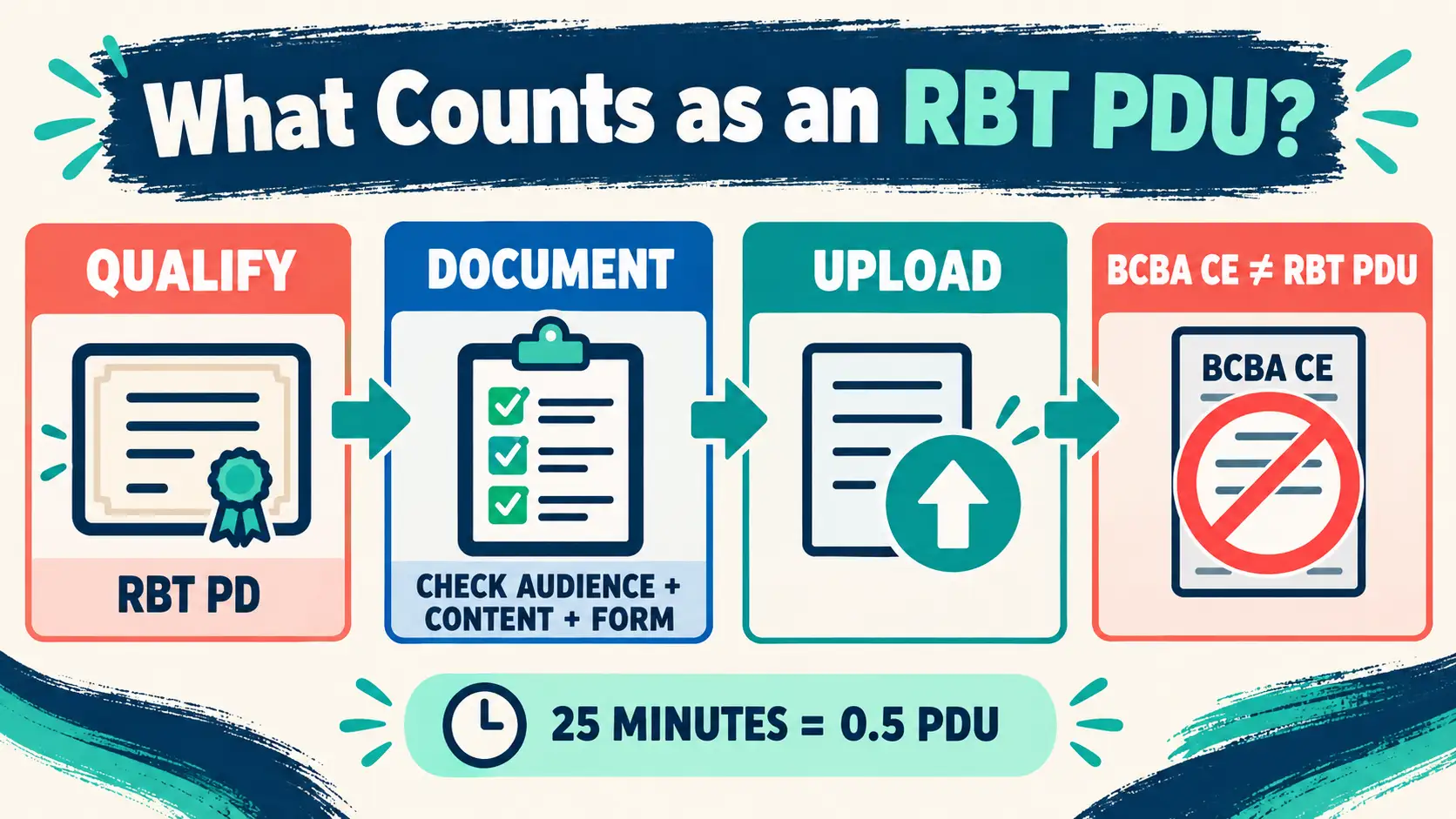
A qualifying activity should pass four tests: the content is appropriate for RBT practice, the event is designed for active professional development, the trainer or provider meets the pathway rules, and the record can be documented with the current BACB form or evidence. If one of those pieces is missing, pause before adding the activity to your tracker.
| Usually fits the PDU screen | Does not qualify merely because it is educational |
|---|---|
| Structured training on assent-based treatment, caregiver communication, token economies, discrete-trial teaching, or RBT ethics. | Client- or program-specific training, routine onboarding, or a review of company policies. |
| An eligible event with active responding, role-play, questions, or another structured learning activity. | Listening to a podcast or reading an article alone without the required active participation or event structure. |
| Current RBT-focused professional development documented by the organization or ACE Provider. | BCBA exam-prep material, CPR training, ABA software training, or a BCBA/BCaBA CE event counted as an RBT PDU. |
| An in-service event with at least 25 minutes of instruction for 0.5 PDU, with additional units awarded under the current increments. | Rounding up time, counting supervision meetings, or counting supervised fieldwork toward the PDU requirement. |
The 25-minute rule is especially easy to misread. The current in-service requirements describe 0.5 PDU for at least 25 minutes of instruction, with additional PDUs awarded in 0.5-unit or 1-unit increments based on instruction time. Rounding up is not permitted. Keep the event duration and the provider’s completed form rather than estimating the total later.
How Should RBTs Document and Upload PDUs?
Documentation is part of the requirement, not an administrative detail to solve at the end. The correct record depends on the pathway: an in-service event uses the organization’s current in-service form, an ACE event uses the ACE event form, and university coursework requires the syllabus and transcript evidence described by the BACB. The documents should identify the activity clearly enough for an audit or account review.
For each activity, record the title, date, pathway, amount, provider or trainer, learning objectives, and evidence location. Keep attendance evidence for events and preserve the original certificate or form. In-service documentation also has timing and record-retention responsibilities for the trainer or organization, so ask for the completed participant record promptly rather than relying on an informal email summary.
- Check the current BACB page or handbook before downloading a form.
- Confirm that the event is for RBT professional development, not only BCBA or BCaBA CE.
- Save the completed form, certificate, syllabus, transcript, or attendance record in a named folder.
- Compare the PDU amount on the document with the amount entered in your tracker.
- Upload the required evidence through the BACB account area when instructed, and keep your own copy.
A useful file name includes the date, provider, event title, pathway, and amount, such as 2026-09-18_ACE_RBT-assent-training_1-PDU.pdf. This does not replace the BACB form, but it reduces the chance of uploading the wrong document when several activities have similar titles. If the current portal or handbook gives a different instruction than an older article, follow the current BACB source.
How Can You Track All 12 PDUs?
Track the requirement as a small evidence system rather than a single number. A spreadsheet or note should have one row per activity and separate columns for the cycle, pathway, date, minutes or credit hours, PDU amount, credential audience, form status, upload status, and source link. Mark an activity as “pending” until its documentation is complete; do not count a promise that a provider will send a certificate later.
| Field | Example | Why it matters |
|---|---|---|
| Cycle and date | 2026–2028; September 18, 2026 | Prevents an activity from being placed in the wrong two-year window. |
| Pathway and audience | ACE RBT PD event | Makes the credential and form check visible. |
| PDU amount and evidence | 1 PDU; ACE event form saved | Separates earned units from an unverified registration or attendance claim. |
- Set a first checkpoint at 3 PDUs so you discover documentation gaps early.
- Set a second checkpoint at 6 PDUs and review whether the remaining pathway fits your schedule.
- At 9 PDUs, check the account instructions and confirm that each record is complete.
- Before the recertification date, verify the final total and retain the source documents.
Which BACB PDU Mistakes Cause Problems?
Most errors come from credential confusion or incomplete evidence, not from arithmetic. An RBT may attend a valuable training but discover that it was marketed only as BCBA CE, was client-specific, had no active-response structure, or used the wrong form. A tracker that records only the title and number cannot reveal those problems, so add a qualification check before you add the PDU to the total.
- Mixing CEUs and PDUs: verify the intended credential and event type.
- Counting supervision: ongoing RBT supervision and supervised fieldwork are not automatically PDU activities.
- Counting exam preparation: BCBA exam-prep materials do not qualify as RBT professional development merely because they teach ABA.
- Rounding minutes: use the current duration rule and do not round up.
- Waiting for the deadline: request forms and correct errors while the provider or organization can still confirm the event.
If your goal is also to prepare for the BCBA exam, keep that study plan separate from the RBT PDU tracker. You can use a BCBA CEU requirements comparison for the different credential’s continuing-education rules, and you can use the free BCBA mock exam when you are ready to practice exam-style decisions. Neither resource changes the BACB’s RBT PDU documentation rules.
BACB PDU Requirements FAQ
Are BACB PDUs the same as BCBA CEUs?: No. RBT PDUs and BCBA/BCaBA CEUs serve different credential pathways and may have different audiences, forms, and content rules. Check the event language before you enroll or count the activity.
How many PDUs does an RBT need?: The current RBT professional-development rule is 12 PDUs during each applicable two-year recertification cycle. Your individual start and deadline should be confirmed in the BACB account and current guidance. Can an RBT count a BCBA exam-prep course?: Not as an RBT PDU merely because it is educational. The BACB’s in-service examples identify BCBA exam-prep materials as non-qualifying RBT professional development.
What should an RBT do if a training record is missing?: Contact the organization or ACE Provider while the event details are still available, ask for the current form or corrected record, and keep the communication with your other evidence. Do not silently estimate the amount or substitute a different credential’s certificate.
Take the Free BCBA Mock Exam
When you are ready to apply the idea, use the free practice resource below for additional feedback. Take the Free BCBA Mock Exam
References
- BACB: RBT Professional Development—In-Service and ACE Events
- BACB: RBT Professional Development—In-Service Training Requirements
- BACB: Guidance for Meeting RBT Requirements During the 2026 Transition
- BACB: RBT Professional Development for ACE Providers



