
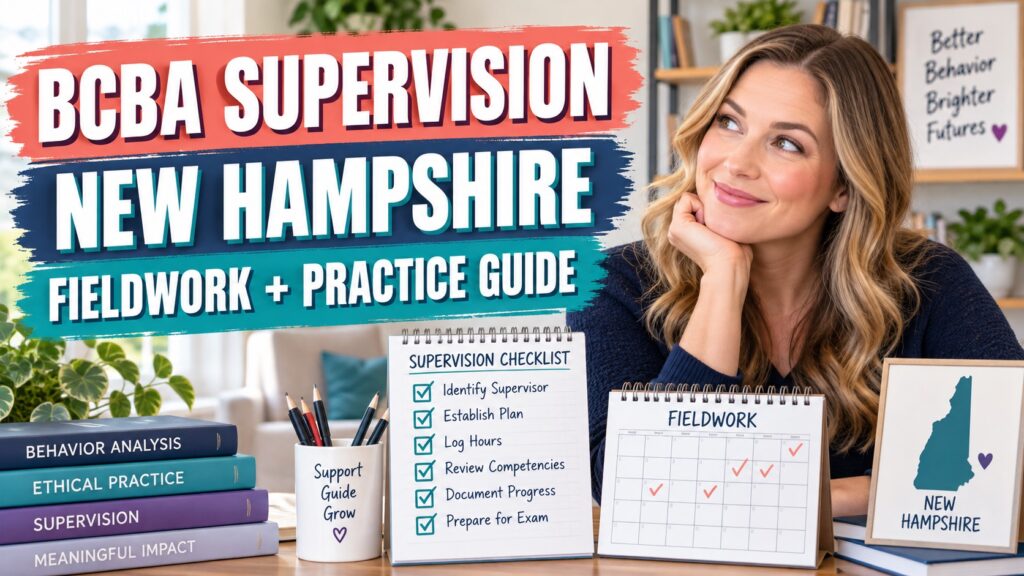
BCBA supervision New Hampshire usually means one of three different questions: how to earn BACB fieldwork hours, how a BCBA supervises trainees or ongoing behavior-analytic services, or what New Hampshire programs and payers require before services can be delivered or covered. Those questions overlap, but they do not have the same authority.
Table of Contents
- BCBA supervision New Hampshire: the short answer
- Which supervision role are you asking about?
- What does BACB supervision mean for BCBA fieldwork?
- What about ongoing services, RBTs, and BCaBAs?
- What does New Hampshire add?
- How should you choose a New Hampshire supervisor?
- How should 2027 changes affect your plan?
- What should you document before starting?
- Common supervision mistakes
- How can supervision questions improve BCBA exam study?
- BCBA supervision New Hampshire FAQ
- Take the Free BCBA Mock Exam
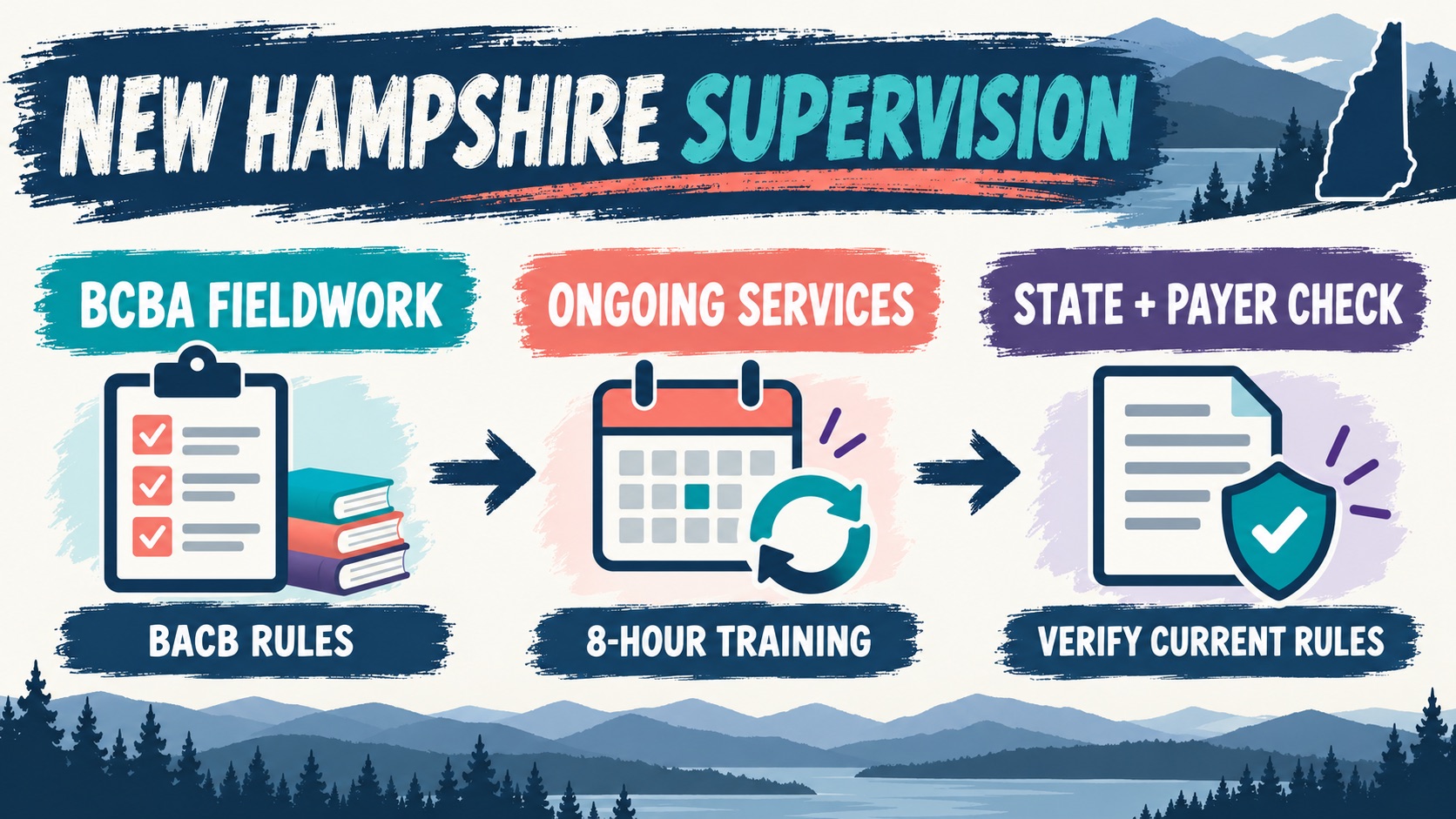
The safest plan is to start with the current BACB rules for your role, then verify the New Hampshire setting, payer, employer, and effective-date requirements. The state’s insurance statute addresses ABA coverage, while program-specific administrative rules may add provider qualifications. This guide separates those layers so a candidate does not treat a national certification rule, a state registration question, and a Medicaid or insurance condition as if they were one checklist. Table of Contents
BCBA supervision New Hampshire: the short answer
There is no single New Hampshire supervision rule that answers every BCBA question. Use this split:
- BCBA candidate completing fieldwork: follow the BACB’s supervised-fieldwork requirements, use an eligible supervisor, establish the required supervision arrangement, and document hours and activities in the format that applies to your application date.
- BCBA supervising a trainee: follow the BACB fieldwork-supervisor requirements. The BACB currently says supervisors overseeing people acquiring BCBA or BCaBA fieldwork must complete the required 8-hour supervision training before providing that supervision.
- BCBA supervising ongoing services: distinguish service oversight for RBTs or BCaBAs from supervision of a trainee pursuing certification. The roles have different responsibilities and documentation expectations.
- Provider, family, or payer question: check the current New Hampshire statute, program rule, contract, or payer manual for the particular service. A BCBA credential alone does not answer every coverage, enrollment, or billing question.
The first practical question is therefore not “What is the New Hampshire supervision percentage?” It is “Which relationship, service, and authority am I trying to document?” Once that is clear, the right checklist becomes much shorter.
Which supervision role are you asking about?
Use the table below before you contact a potential supervisor. It identifies the decision owner and prevents a common category error: using a state payer document to decide whether BACB fieldwork counts.
| Your situation | Primary authority | What to verify |
|---|---|---|
| Trainee collecting BCBA fieldwork | BACB BCBA Handbook | Supervisor eligibility, fieldwork structure, observations, contacts, activities, forms, and application-date rules. |
| BCBA supervising a trainee | BACB supervision resources | Role qualifications, 8-hour training, contracts, documentation, and any consulting-supervisor requirement. |
| ABA service coverage in New Hampshire | NH RSA 417-E:2 plus the current plan or payer rules | Who may provide or supervise covered ABA, treatment-plan conditions, enrollment, claims, and records. |
| Specific residential, school, or Medicaid program | NH Administrative Rules and the agency or payer | Whether a rule is proposed or effective, the setting’s staff qualifications, scope, and documentation duties. |
What does BACB supervision mean for BCBA fieldwork?
For a BCBA candidate in New Hampshire, the location is usually less important than the quality and structure of the supervised-fieldwork relationship. The BACB is the national certification authority. Your supervisor should be able to explain which current BCBA pathway and handbook provisions apply, how the fieldwork activities will be selected, and how the evidence will be reviewed before it becomes part of your application file. Before counting the first hour, confirm all of the following:
- Who is the responsible supervisor, and what credential and status make that person eligible for the role?
- Which BACB handbook, form version, and application-date rules will control your documentation?
- How will unrestricted activities be planned rather than added at the end of the month?
- How will observations, individual supervision, group supervision, contacts, feedback, and corrective action be recorded?
- Who owns the records if you change employers, move from in-person to remote work, or change supervisors?
A good New Hampshire arrangement is not simply a person who signs a monthly form. It is a teaching and quality-assurance relationship. The supervisor should observe relevant work, explain why activities meet the current standard, review data and written products, identify ethical or scope concerns, and make corrections while the record is still easy to fix.
If you are a newly certified BCBA who will supervise trainees, read the BACB’s current consulting-supervisor guidance as well. The BACB distinguishes supervising certification fieldwork from supervising ongoing services, and a first-year BCBA who supervises trainees may have additional consultation obligations. Do not assume that experience as a trainee automatically prepares you to document another person’s fieldwork.
What about ongoing services, RBTs, and BCaBAs?
The BACB’s supervision overview separates several roles: supervising RBTs, assessing or training RBTs, supervising BCaBAs, and supervising fieldwork. A BCBA may be responsible for more than one role, but the role does not become interchangeable just because the word “supervision” appears in each description.
The BACB currently states that supervisors who oversee people acquiring BCBA or BCaBA fieldwork, as well as current BCaBA or RBT certificants who require ongoing supervision, must complete an 8-hour supervision training based on the Supervisor Training Curriculum Outline 2.0 before providing that supervision. The same page identifies BCBA as the responsible role for supervising fieldwork and lists the applicable handbooks and checklists.
For a New Hampshire employer, that means a supervisor-selection conversation should cover both clinical workflow and certification responsibility. Ask who observes sessions, who reviews treatment data, who signs which document, who is available when a safety or scope question appears, and how the organization handles missed supervision. A job title such as “clinical director” does not, by itself, prove that the person can sign every BACB document or meet every payer requirement.
What does New Hampshire add?
New Hampshire’s state layer matters most when the question concerns access to a covered service, a program’s staff qualifications, or a provider’s authority to submit claims. Under RSA 417-E:2, the state’s autism-coverage statute includes applied behavior analysis among covered professional services and says eligible ABA must be provided by a person professionally certified by the national Behavior Analyst Certification Board or performed under the supervision of a person professionally certified by that board. The statute also preserves other treatment-plan and insurance conditions.
That language is important, but it is not a complete fieldwork manual. It addresses an insurance-coverage condition, not every BACB rule for a trainee, and not every employer or public-program rule. If you are asking whether services can be billed, review the current plan document, payer contract, provider enrollment rules, and claim requirements as well.
New Hampshire’s rule repository and DHHS materials may also contain setting-specific requirements. A January 2026 initial proposal for He-C 6420 includes language describing ABA in certain covered residential, foster-care, or related settings as provided by a BCBA certified by the national behavior certification board, with supervisory certification if the BCBA supervises others, or by specified staff under that person’s supervision. Because the document is labeled an Initial Proposal, treat it as a proposed-rule signal—not proof of the final rule in force. Check the current effective rule and confirm with the responsible New Hampshire agency before relying on it. In other words, New Hampshire may affect the service setting and payer path, while BACB controls the national certification and supervision framework. Keep those source files separate.
How should you choose a New Hampshire supervisor?
Interview the supervisor as if you were evaluating a small educational program. A practical decision matrix looks like this:
| Question | Strong answer | Warning sign |
|---|---|---|
| How will fieldwork be planned? | Written plan, clear activities, regular review, and a process for changing goals. | “Just collect hours and we will sign later.” |
| How often will I receive feedback? | A predictable schedule with documented observation and feedback. | No fixed supervision contact or observation plan. |
| Who checks the current BACB rule? | The supervisor names the handbook, form, and application-date version. | An old template is treated as permanent. |
| What happens if I leave? | Records, verification, and transition responsibilities are written into the agreement. | No access to your own logs or no exit process. |
How should 2027 changes affect your plan?
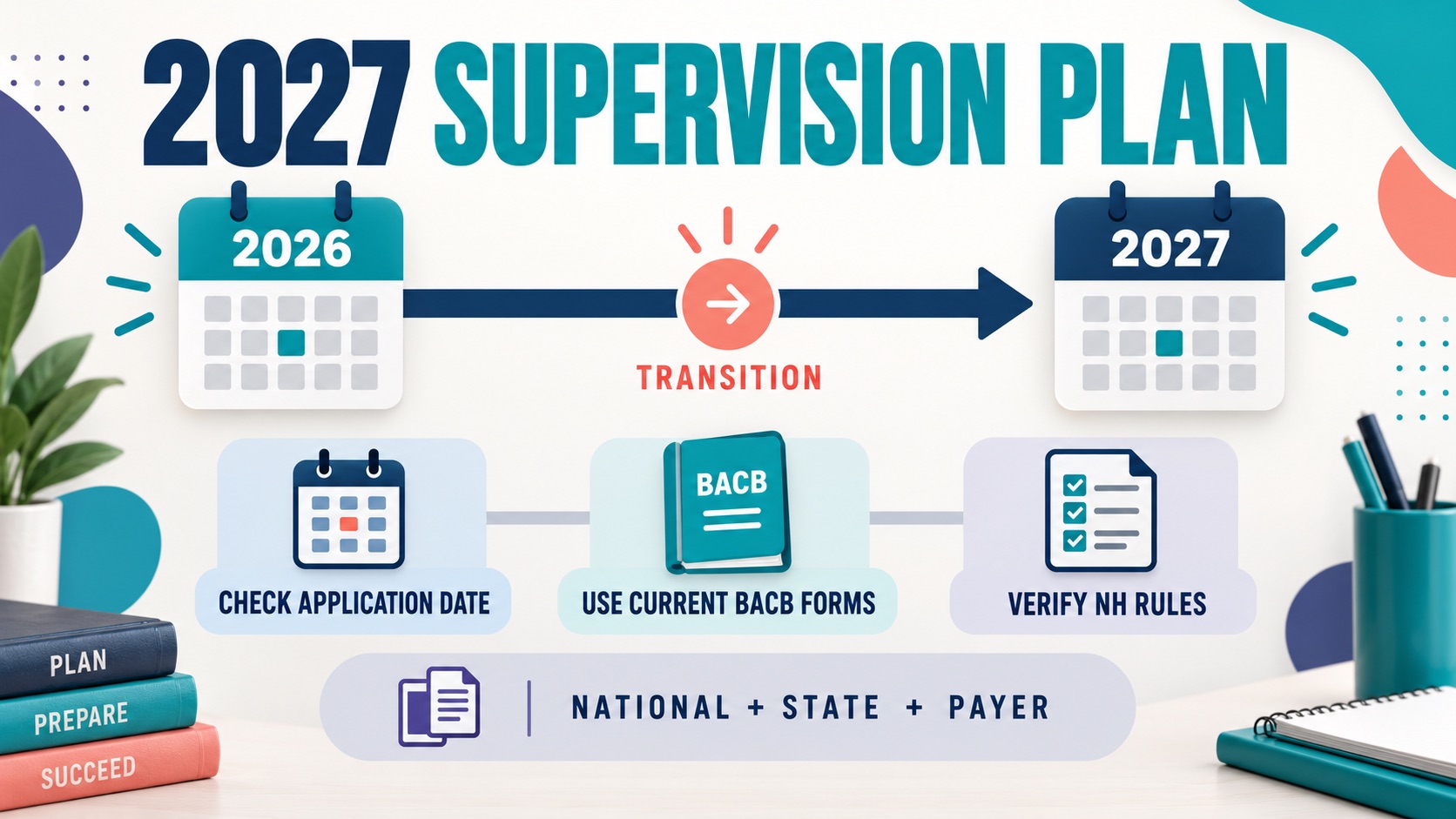
The BACB’s current BCBA page tells candidates to prepare for changes beginning in 2027 and links to the 2027 BCBA Requirements, transition guidance, and an updated handbook. If your application, fieldwork, or supervision relationship crosses the 2026–2027 boundary, write the planned application date at the top of your study and fieldwork file.
Do not copy a 2026 supervision form into a 2027 plan without checking the transition guidance. Confirm the applicable pathway, degree and coursework route, fieldwork documentation, supervisor obligations, examination timing, and maintenance rules from the official materials. Then ask your supervisor which parts of your existing record need to be carried forward, recreated, or signed with the newer form.
For state and payer work, make a second date check. A BACB change does not automatically amend New Hampshire insurance law, a DHHS rule, an employer agreement, or a payer manual. Use the effective date of each authority instead of assuming that one calendar change updates all of them.
What should you document before starting?
Keep a small supervision file that can survive a supervisor or employer change:
- your target BACB application date and the handbook or transition page used;
- the supervisor’s current credential verification and role eligibility;
- a written supervision agreement and the planned contact schedule;
- fieldwork activities, observations, individual and group contacts, and feedback records;
- copies of monthly and final verification forms before submission;
- the New Hampshire setting or payer rule that applies to the service;
- provider enrollment, treatment-plan, claim, and record-retention instructions when billing is involved;
- a dated note showing what changed when a rule, form, employer, or supervisor changed.
Common supervision mistakes
- Using “New Hampshire” as the whole answer: the BACB, state, program, employer, and payer may control different pieces.
- Counting a signed form as quality supervision: supervision is an active teaching, observation, feedback, and documentation process.
- Confusing fieldwork with ongoing service oversight: the BACB identifies different roles and resources for them.
- Assuming a proposed rule is effective: an initial proposal must be checked against the final rule and effective date.
- Ignoring the application date: the 2027 transition can change which BACB guidance and forms control.
- Letting a payer answer a certification question: coverage rules do not replace the BACB handbook.
How can supervision questions improve BCBA exam study?
Turn the topic into an authority-and-role exercise. For each practice question, label the fact as one of five types: BACB certification, supervised fieldwork, ongoing service supervision, New Hampshire coverage or program rule, or employer documentation. Then explain why the answer belongs to that source. This is more useful than memorizing a list of “New Hampshire numbers” without knowing which relationship they describe.
After reviewing the official materials, use the free BCBA mock exam to practice under time pressure. Tag missed items as supervision role, fieldwork documentation, ethics and scope, state-versus-national authority, or 2027 transition. The resource is study support, not BACB approval, legal advice, a licensing decision, or a guarantee of a passing score.
BCBA supervision New Hampshire FAQ
Does New Hampshire replace the BACB supervision rules?: No. The BACB controls the national BCBA certification and fieldwork framework. New Hampshire statutes, administrative rules, programs, employers, and payers may add requirements for a particular service or setting.
Does a New Hampshire BCBA supervisor need 8-hour supervision training?: The BACB states that supervisors overseeing BCBA or BCaBA fieldwork, and certain ongoing supervision for BCaBAs or RBTs, must complete the required 8-hour supervision training before providing that supervision. Confirm the current BACB role guidance and any setting-specific requirements.
Does RSA 417-E:2 tell me how to collect BCBA fieldwork hours?: No. RSA 417-E:2 is an insurance-coverage statute. It addresses who may provide or supervise eligible ABA for coverage purposes; it is not a substitute for the BACB handbook and fieldwork documentation rules.
Can I rely on the 2026 New Hampshire He-C 6420 document?: Not as a final rule without checking. The document is labeled an initial proposal. Use the New Hampshire rule repository and the responsible agency to verify whether a final text was adopted, its effective date, and which setting it covers.
The best answer to BCBA supervision New Hampshire is a dated, role-specific plan: identify whether you are a trainee, a supervisor, or a service provider; follow the current BACB requirements; then verify the New Hampshire setting and payer rules that actually apply. Keep the source, form, and supervision records together so your hours and professional decisions remain explainable.
Take the Free BCBA Mock Exam
When you are ready to apply the idea, use the free practice resource below for additional feedback. Take the Free BCBA Mock Exam



