
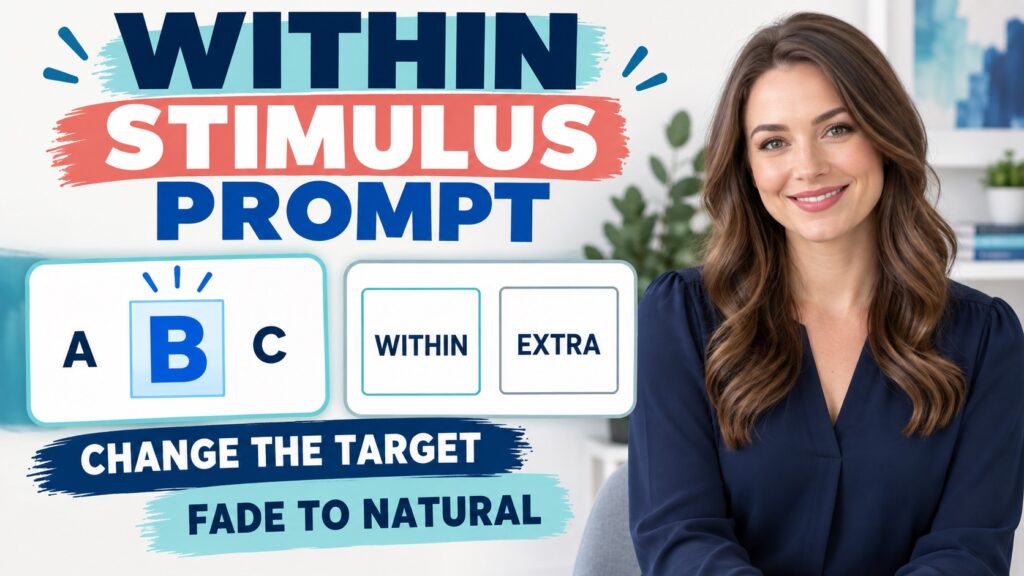
What is a within stimulus prompt? A within stimulus prompt is a stimulus prompt that changes a physical feature of the target stimulus so the correct discrimination becomes easier. The practitioner might make the target letter larger, increase its contrast, exaggerate a relevant color, or otherwise alter the stimulus that the learner must eventually respond to. The added cue is inside the target stimulus itself, rather than being a separate object or a direct instruction.
Table of Contents
- What is a within stimulus prompt in ABA?
- How does a within stimulus prompt work?
- How is it different from other prompts?
- What is a within stimulus prompt example?
- How is a within stimulus prompt faded?
- When should a practitioner select this prompt?
- What are the BCBA exam traps?
- Within stimulus prompt FAQ
- Quick Review Checklist
- Take the Free BCBA Mock Exam
That distinction matters because a within stimulus prompt is not the same as a verbal prompt, a model, or an extra-stimulus prompt. The learner is still expected to respond to the relevant stimulus, but one of its dimensions has temporarily been made more salient. This guide explains the definition, examples, comparison points, fading logic, and BCBA exam traps for the keyword within stimulus prompt. Table of Contents
What is a within stimulus prompt in ABA?
A within stimulus prompt is a temporary change to a feature of an existing discriminative stimulus (SD) or stimulus array that increases the likelihood of the correct response. The change may involve size, brightness, color, position within the stimulus, movement, or another physical dimension that makes the relevant feature easier to notice. The prompt is called “within stimulus” because it modifies the stimulus that already belongs in the teaching arrangement.
The Pass the Big ABA Exam glossary defines it as a stimulus prompt that helps a learner make a correct discrimination by manipulating a specific physical characteristic of the target stimulus. A classic Journal of Applied Behavior Analysis study compared within-stimulus and extra-stimulus prompting in discrimination learning. These sources support the central exam distinction: the relevant stimulus is changed in a within-stimulus prompt, while an extra cue is added in an extra-stimulus prompt.
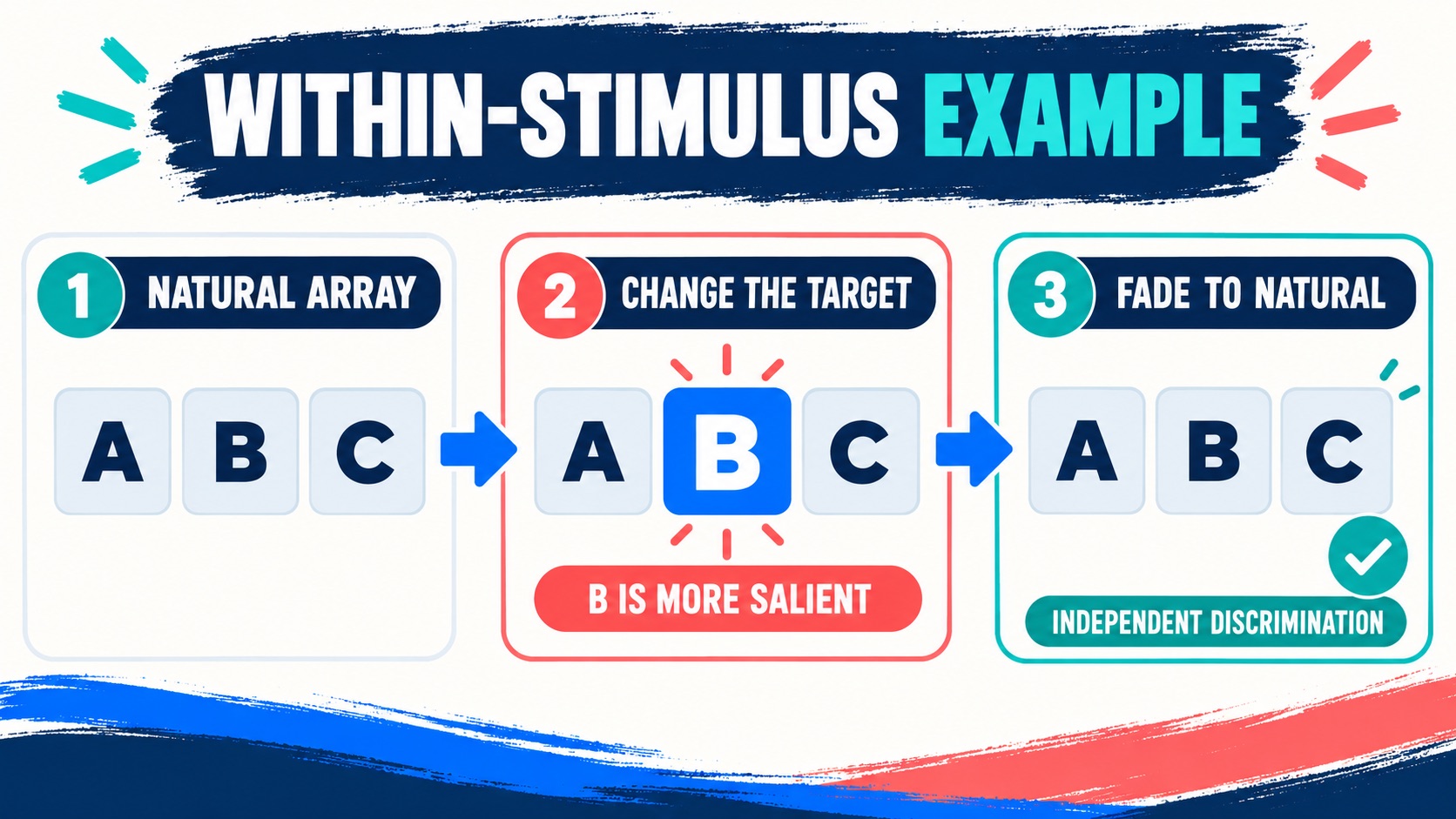
Consider a learner who is learning to select the letter B from a small array. If the instructor temporarily makes B larger or brighter than the other letters, the learner is receiving a within stimulus prompt. If the instructor places a star next to B, the star is a separate added cue and is therefore an extra-stimulus prompt. If the instructor says “Touch B,” that is a verbal response prompt or instruction, not a within-stimulus prompt.
- Temporary change: the altered feature is used to support acquisition and should eventually be reduced or removed.
- Inside the relevant stimulus: the change affects the target stimulus or its existing dimensions.
- Discrimination support: the change makes a correct stimulus easier to detect or distinguish.
- Transfer requirement: the learner must ultimately respond to the natural stimulus without the exaggerated feature.
How does a within stimulus prompt work?
Stimulus control depends on which environmental event reliably evokes the response. Early in teaching, the natural feature may not be salient enough for the learner to discriminate. A within stimulus prompt temporarily changes that feature so the learner can contact reinforcement for the correct response. The practitioner then fades the alteration while monitoring whether responding remains accurate.
For example, suppose the target is selecting a red card from red and blue cards, but the learner does not yet attend to color. The practitioner might initially present the red card with a stronger color contrast or a larger target area. If the learner selects it correctly, the team can gradually reduce the contrast or size difference. The instructional goal is not “choose the unusually large card.” The goal is to choose the red card when color is the relevant dimension.
A within stimulus prompt should be paired with a clear response definition and a plan for what happens after correct, incorrect, or no responding. Without that plan, a visual alteration can become a permanent feature that controls responding or can obscure whether the learner has learned the intended discrimination.
How is it different from other prompts?
The easiest way to classify a prompt is to ask what was changed. Was a feature of the existing stimulus altered, was another stimulus added, or was the learner’s response directly assisted? The wording of the teacher’s explanation is less important than the physical and functional relation between the cue and the target.
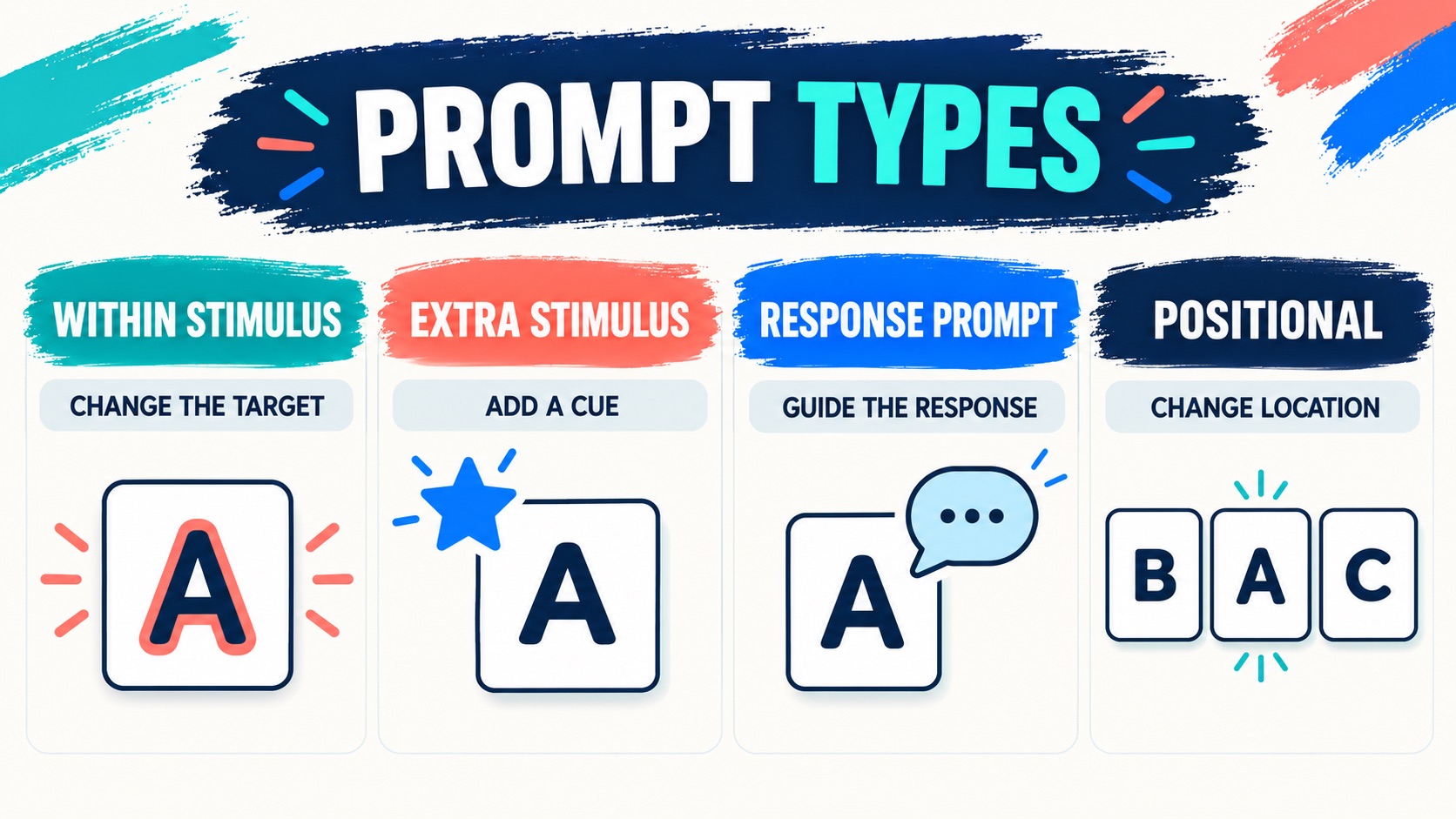
| Prompt type | What changes? | Example | Fading question |
|---|---|---|---|
| Within stimulus | A physical feature of the existing target stimulus. | Make the correct letter larger or brighter. | Can the relevant feature return to its natural form? |
| Extra stimulus | A separate cue that is not part of the target stimulus. | Place a star or arrow next to the correct card. | Can the added cue be removed while the target controls responding? |
| Response prompt | The learner’s response is guided by language, a model, or physical assistance. | Say “Touch B,” point to B, or guide the hand. | Can the learner respond to the natural SD without assistance? |
| Positional prompt | The location or arrangement of response options. | Place the correct card closer or in a more prominent position. | Can location vary without changing accuracy? |
Some prompt labels overlap across textbooks, so read the scenario carefully. A color change to the target card is a within-stimulus example. A colored border placed around the card may be a within-stimulus change if it is part of the stimulus itself, but a separate arrow or sticker is more naturally classified as an extra-stimulus cue. The exam answer depends on what the prompt physically changes and how it is arranged.
What is a within stimulus prompt example?
Imagine a sorting program in which the learner must place a triangle with other triangles and a circle with other circles. During baseline, the learner often selects by position instead of shape. To support shape discrimination, the practitioner might temporarily make the target triangle larger or outline its triangular edges more strongly. The learner receives reinforcement for sorting correctly, while the relevant shape dimension remains the basis of the task.
Another example involves letter identification. The target is the letter M, but the learner confuses M and N. The practitioner might initially present M in a larger font or increase the spacing between its diagonal lines. The goal is not for the learner to select “the largest letter.” The goal is for the learner to respond to the letter’s relevant visual features as the prompt is gradually faded.
The practitioner should define the teaching materials, the target response, the prompt level, and the fading criterion. If the learner responds correctly only while the target is oversized, the data show prompted accuracy, not yet independent discrimination. A later probe with ordinary materials is needed to test whether stimulus control has transferred.
- Present the natural discrimination. Show the learner the ordinary stimulus array and observe the current response pattern.
- Add a targeted feature change. Alter only the relevant stimulus dimension when possible, such as size, contrast, or salience.
- Deliver the planned consequence. Reinforce the correct response according to the teaching arrangement.
- Fade the feature change. Reduce the difference in small steps while checking accuracy and prompt level.
- Probe natural materials. Test whether the learner responds correctly when the stimulus looks like it will in the everyday setting.
How is a within stimulus prompt faded?
Stimulus fading reduces the difference between the prompted stimulus and the natural stimulus. If the target was made much larger, the practitioner may reduce its size difference across sessions. If contrast was exaggerated, contrast can be returned gradually toward the natural arrangement. The steps should be selected from the learner’s data rather than assumed to be equally effective for every target.
The BACB 6th Edition Test Content Outline includes selecting and evaluating stimulus and response prompting procedures and designing procedures to fade them. That exam language matters: identifying a within stimulus prompt is only part of the task. A strong answer also explains how the prompt will be evaluated and faded so the intended natural stimulus controls the response.
- Track prompted and independent responses separately. Accuracy with a larger or brighter target is not equivalent to accuracy with the natural stimulus.
- Change one relevant dimension when possible. If size, position, color, and adult language all change at once, the team cannot easily identify what controls responding.
- Check for prompt dependence. A learner may continue searching for the exaggerated feature rather than attending to the natural discrimination.
- Test generalization. Vary materials, examples, locations, and people when those variations are part of the desired skill.
When should a practitioner select this prompt?
A within stimulus prompt may be appropriate when a physical feature of the target is difficult to notice and the teaching objective is to bring that feature under stimulus control. It can be useful in discrimination learning, visual matching, letter or symbol identification, and other tasks in which a specific physical dimension is relevant.
It is not a universal solution for errors. If the learner does not understand the task, lacks the prerequisite skill, cannot see the materials, or is responding for a different reason, simply exaggerating a stimulus may not address the problem. The practitioner should consider assessment, accessibility, instructional history, reinforcement, and competing sources of control before selecting a prompt.
What are the BCBA exam traps?
Within-stimulus prompt questions often test whether the candidate can classify the location of the change rather than memorize a phrase. Use this sequence: identify the natural SD, identify what the practitioner added or altered, and ask whether that change is part of the target stimulus.
- Do not confuse within stimulus with extra stimulus. Enlarging the correct card changes the card; adding a star next to it adds another cue.
- Do not confuse stimulus prompting with response prompting. “Touch the red one” is verbal response assistance, even if a red card is present.
- Do not treat every visual change as the answer. Determine whether the modified dimension is actually relevant to the discrimination being taught.
- Do not call prompted accuracy mastery. The natural stimulus must evoke the response after the prompt is faded.
- Do not invent a fixed fading schedule. The best procedure is data-based and individualized rather than a universal number of trials.
For additional unofficial practice with stimulus control and prompting decisions, use the free BCBA mock exam. It is a study resource, not an official BACB product, a prediction of specific exam items, or a guarantee of certification.
Within stimulus prompt FAQ
What is the simplest definition of a within stimulus prompt?: It is a temporary change to a feature of the stimulus the learner is supposed to discriminate, such as making the target larger, brighter, or more visually salient.
Is highlighting the correct answer a within stimulus prompt?: It depends on what was highlighted. Highlighting or changing a feature of the target itself can be a within-stimulus prompt. An arrow, star, or separate marker placed next to the target is more likely an extra-stimulus prompt.
How is a within stimulus prompt removed?: Use stimulus fading: gradually reduce the exaggerated feature while measuring whether the learner continues responding correctly to the natural stimulus. The steps should be based on performance data.
What is the key BCBA exam takeaway?: Within stimulus prompts alter the existing target stimulus to make a relevant feature easier to discriminate. Extra-stimulus prompts add a separate cue, and response prompts guide the learner’s behavior directly. Classify the prompt by what changed, then look for a plan to fade it and transfer control to the natural SD.
In short, a within stimulus prompt is a temporary visual or physical modification of the stimulus itself. The quality of the procedure is determined not only by whether it produces correct responding, but also by whether the learner can eventually respond accurately when the natural stimulus is restored.
Quick Review Checklist
Use this final checklist to turn within stimulus prompt into exam-ready reasoning. The goal is not to memorize a label in isolation; it is to identify the relevant evidence and explain why the best answer fits the scenario. Key ideas to review:
- State the central definition or decision point for within stimulus prompt in your own words.
- Identify the detail that makes within stimulus prompt different from its closest related ABA term.
- Separate the observable facts in a scenario from assumptions that are not supported by the facts.
- Write one example and one nonexample so you can recognize the concept in a new setting.
Exam application checks:
- Ask what the question is actually requesting before comparing the answer choices.
- Mark the antecedent, response, consequence, or other evidence that supports the selected answer.
- Look for a distractor that describes a related process but does not answer the specific question.
Final self-check:
- Explain how you would verify the interpretation with clear observations or data.
- Change one detail in the scenario and decide whether your answer should change.
- Give a one-sentence rationale that a supervisor or study partner could evaluate.
Take the Free BCBA Mock Exam
When you are ready to apply the idea, use the free practice resource below for additional feedback. Take the Free BCBA Mock Exam



