
Short answer: A BCBA supervision log is a private, session-level documentation system that records what happened during fieldwork, how hours were classified, what supervision or feedback occurred, and what evidence supports the monthly total. It helps a trainee and supervisor reconcile records before signing an official form, but it is not automatically an official BACB form.
Table of Contents
- BCBA Supervision Log: What Is It?
- What should you record in a BCBA supervision log?
- How does a supervision log differ from the BACB forms?
- How do you build a monthly reconciliation workflow?
- What changes should you check for the 2027 requirements?
- What mistakes make a supervision log unreliable?
- What should you review before a signature?
- BCBA supervision log FAQ
- Take the Free BCBA Mock Exam
If you are searching for a BCBA supervision log because you need to document fieldwork, start with the current BACB requirements and forms. The safest workflow is to record details close to the time they occur, reconcile the log with the supervisor at the end of the month, complete the applicable Monthly Fieldwork Verification Form, and retain the signed records according to the current instructions. Table of Contents
BCBA Supervision Log: What Is It?
A BCBA supervision log is best understood as the working record behind your fieldwork documentation. It may be a spreadsheet, secure electronic record, or another system that lets you track activities by date, duration, setting, client or case identifier, supervision contact, and evidence. The format can vary; the record must still be accurate, contemporaneous, reviewable, and consistent with the current BACB requirements.
The phrase “supervision log” can cause confusion because it is not the name of one universal BACB document. The BACB publishes Monthly and Final Fieldwork Verification Forms, while the trainee’s documentation system may contain much more detail than the final form. A good log supports those forms. It does not replace them, and a self-created template should never be presented as BACB-approved. Think of the log as an evidence chain:
- Activity: what behavior-analytic work occurred?
- Time: when did it occur, and how long did it take?
- Classification: which fieldwork category or activity type applies?
- Supervision: what contact, observation, feedback, or review occurred?
- Evidence: where could the trainee and supervisor verify the entry?
This chain matters because a monthly total without supporting detail is difficult to investigate. A concise entry linked to a treatment-plan review, data analysis, assessment note, or supervision agenda is easier to reconcile than a late entry that only says “ABA work.”
What should you record in a BCBA supervision log?
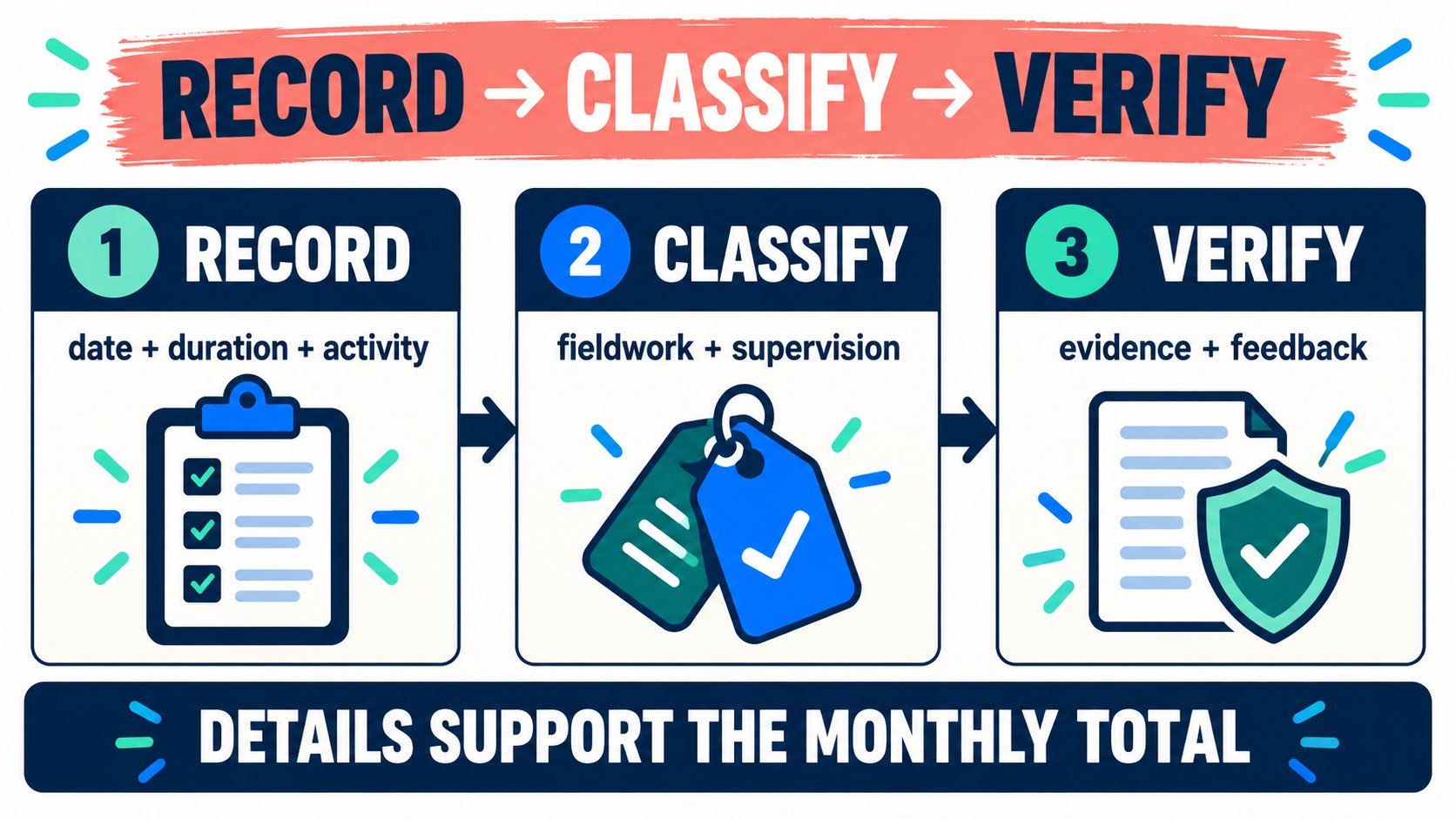
The exact fields in your private log should fit your organization’s documentation system and the current BACB instructions. The following fields are a practical audit-ready baseline, not a replacement for the official form.
- Date and time: record the date, start and end time, or duration using one consistent convention. Avoid estimating a whole week from memory.
- Setting and case identifier: identify the service setting and use the minimum client information needed for reconciliation. Follow privacy rules; a study tracker should not contain unnecessary protected information.
- Activity description: state the observable work completed, such as reviewing graphed data, conducting a preference assessment, revising a skill-acquisition procedure, or evaluating treatment integrity.
- Fieldwork category: classify the entry using the current requirements and your supervisor’s review. Do not label every administrative task as unrestricted behavior-analytic work.
- Supervision contact: record whether the supervisor was present, what was observed or discussed, the contact format, and the feedback or decision that followed.
- Evidence location: link or reference the secure note, agenda, data display, assessment record, or other source that supports the entry. The evidence should be retrievable without putting confidential material into the tracker itself.
- Action and follow-up: capture the next step, owner, due date, and whether the task was completed. This turns a log into a supervision tool rather than a passive time sheet.
Write entries so another qualified reviewer could understand what occurred without guessing. “Worked on client” is too vague. “Reviewed latency data for the mand response, compared the last three sessions, and drafted a measurement decision for supervisor feedback” communicates the activity, the data, and the next decision.
How does a supervision log differ from the BACB forms?
The current BCBA supervision log source form is an official 2027 Monthly Fieldwork Verification Form, not a general diary. Use the applicable current BACB document for the official fields and signatures, then use your private log to support accurate completion.
| Record | Main purpose | Typical timing | What it cannot do |
|---|---|---|---|
| Private supervision log | Capture session-level activities, contacts, evidence, feedback, and follow-up. | As close to each activity as practical. | It is not automatically a BACB-approved form or proof of eligibility. |
| Monthly Fieldwork Verification Form | Document the applicable monthly fieldwork totals and the required supervisor and trainee attestations. | For each applicable supervisory period, using the current version. | It does not contain every session detail that may be needed to support an audit. |
| Final Fieldwork Verification Form | Summarize the completed fieldwork experience for the applicable certification application. | At the end of the qualifying fieldwork experience. | It cannot repair missing monthly records or make an inaccurate total accurate. |
| Supervision contract | Define the relationship, responsibilities, expectations, and signatures before or during the arrangement. | Before the applicable supervision relationship and whenever amended. | It is not a daily hour log or a substitute for monthly verification. |
Keep the documents connected but separate. The official BACB BCBA Handbook and current form control the requirements. Your log supplies the detail needed to notice a mismatch before the signature line is completed.
How do you build a monthly reconciliation workflow?
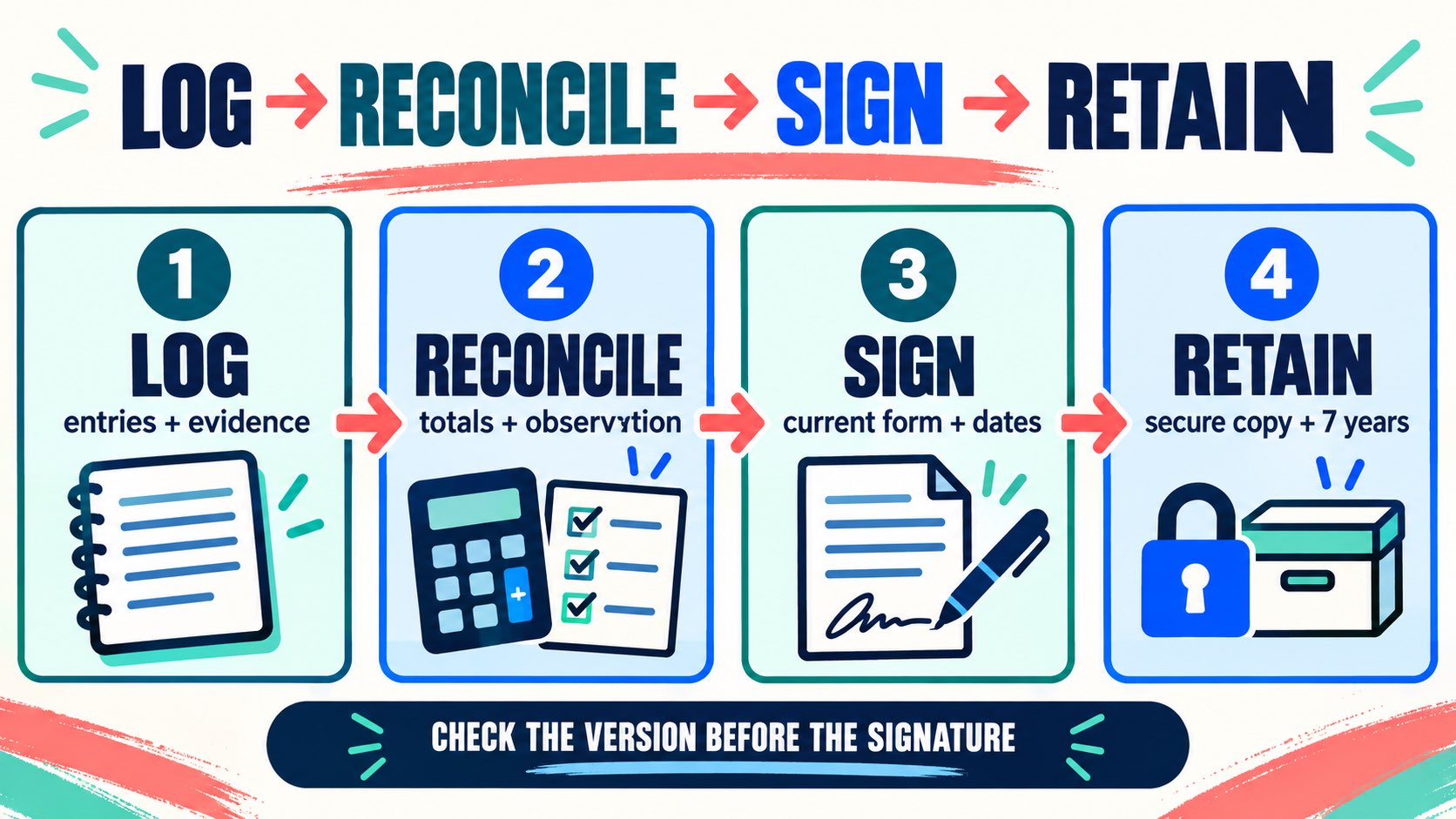
A reliable workflow has four passes. The goal is to make errors visible while they are still fixable, not to create a large spreadsheet that no one reviews.
- Record after the activity: enter the date, duration, activity, case identifier, and evidence location while the details are fresh. If an entry is corrected, keep a transparent correction history rather than silently overwriting it.
- Review during supervision: use supervision time to check classification, data interpretation, client observation, feedback, and follow-up. A supervision meeting should not be reduced to signing a total.
- Reconcile at month-end: total the log, compare independent and supervised hours, check observation and contact records, and confirm that the numbers match the current monthly form. Investigate missing or duplicated entries before asking for signatures.
- Sign and retain: complete the current official form, obtain the required signatures by the stated deadline, store the signed copy securely, and preserve the supporting log and evidence under the applicable retention policy.
For example, suppose a trainee records 45 minutes of direct observation, two hours reviewing skill-acquisition data, and one hour revising a program. The log should show what was observed, which data were reviewed, what decision was made, and which supervisor feedback followed. The monthly form may only require totals and attestations, but those details explain how the total was produced.
What changes should you check for the 2027 requirements?
Version control is part of the logging process. The BACB’s 2027 BCBA requirements overview separates the 2022 and 2027 pathways and identifies the 2027 monthly and final fieldwork forms. Candidates applying after January 1, 2027, should verify which requirements and forms govern their application rather than assuming that an old tracker or old PDF remains sufficient. At minimum, add a version check to the top of your system:
- Which fieldwork requirement set applies to the planned application?
- Which monthly and final form version is required?
- Does the log capture the hours, supervision, observation, and activity distinctions needed by that version?
- Has the supervisor’s qualification and any applicable consultation requirement been verified from the current source?
- Are unrestricted-activity totals and other percentage checks calculated from the correct denominator?
The current 2027 monthly form also states that it must be signed by the last day of the calendar month following the month of supervision and that both parties retain a copy for at least seven years. Do not treat those details as permanent: check the current document at the time you complete it. If a transition question affects your application, use the BACB’s current FAQ or contact route instead of guessing from a third-party tracker.
What mistakes make a supervision log unreliable?
- Backfilling from memory: a month of vague totals is not equivalent to contemporaneous documentation.
- Using one category for everything: “ABA” does not explain whether an activity is appropriate, supervised, unrestricted, or administrative.
- Counting supervision twice: the contact itself and the work discussed must be recorded without duplicating the same minutes.
- Ignoring observation: a total supervision percentage does not prove that the required observation or client contact occurred.
- Mixing form versions: a 2022 form, 2027 form, and homemade tracker may not carry the same fields or rules.
- Leaving corrections unexplained: unexplained edits weaken the audit trail; document the reason, date, and reviewer.
- Putting client identifiers in an unsecured sheet: minimize sensitive information and follow the organization’s privacy and record rules.
If a supervisor cannot verify an entry, pause the monthly signature and resolve the evidence gap. A missing note is a documentation problem to investigate, not a reason to invent a description that sounds plausible.
What should you review before a signature?
Use this quick review before the trainee and supervisor sign:
- Confirm the trainee, supervisor, organization, fieldwork type, month, and requirement version.
- Recalculate the total from the underlying entries and compare it with the official form.
- Check that supervised hours, observation, contacts, and unrestricted activity records are supported.
- Check that every questionable activity has a decision or supervisor note rather than an unexamined label.
- Save the signed form, log export, supporting evidence, and correction history in the secure record system.
- Record the next review date so missing documentation is found before the next deadline.
For BCBA exam preparation, the same habit improves scenario reasoning: identify the observable activity, the measurement or evidence supporting it, the supervision decision, and the ethical or documentation boundary. You can test those distinctions with the free BCBA mock exam. It is a study resource and does not reproduce official BACB questions.
BCBA supervision log FAQ
Is there one official BACB supervision log? Not necessarily. The BACB publishes official fieldwork verification forms and documentation guidance. A trainee may use a separate log or documentation system to support those forms, but the private log should not be represented as a BACB-approved document.
What is the difference between a BCBA fieldwork log and a monthly verification form? A fieldwork log records detailed activities and evidence as work occurs. The Monthly Fieldwork Verification Form is the official monthly record that summarizes the applicable totals and includes the required attestations. The log supports the form; it does not replace it.
How long should I keep supervision records? Follow the current BACB form, handbook, organization policy, and applicable law. The current 2027 individual monthly form states that the supervisor and trainee each retain a copy for at least seven years, but always verify the current version before relying on a retention rule.
Can I use an old BCBA supervision log template? You can use an older layout only after checking that it captures the current requirements and protects confidential information. Never let a template determine which form version, activity classification, or signature rule applies.
Take the Free BCBA Mock Exam
When you are ready to apply the idea, use the free practice resource below for additional feedback. Take the Free BCBA Mock Exam



