
Short answer: BCBA ethical violations are alleged failures to meet the ethics requirements that apply to BCBA, BCaBA, and BCBA-D applicants or certificants. The phrase does not mean that a person has been found responsible. A careful review separates the reported conduct, the relevant standard, the available evidence, the BACB’s jurisdiction, and the outcome of the applicable process.
Table of Contents
- What are BCBA ethical violations?
- Which ethics problems should candidates recognize?
- What is the difference between a concern, a violation, and a licensing issue?
- What should you do when a concern appears?
- When does BACB reporting make sense?
- How do ethical violations appear on the BCBA exam?
- What study mistakes should you avoid?
- What is a 15-minute review method?
- BCBA ethical violations FAQ
- Take the Free BCBA Mock Exam
For a BCBA candidate, the goal is not to memorize a scary list of offenses. It is to learn how to recognize an ethics problem, protect confidential information, choose the right source, and select a proportionate next step. The current BACB ethics-code hub, reporting guidance, Code-Enforcement Procedures, and the BCBA Test Content Outline should be read together. Table of Contents
What are BCBA ethical violations?
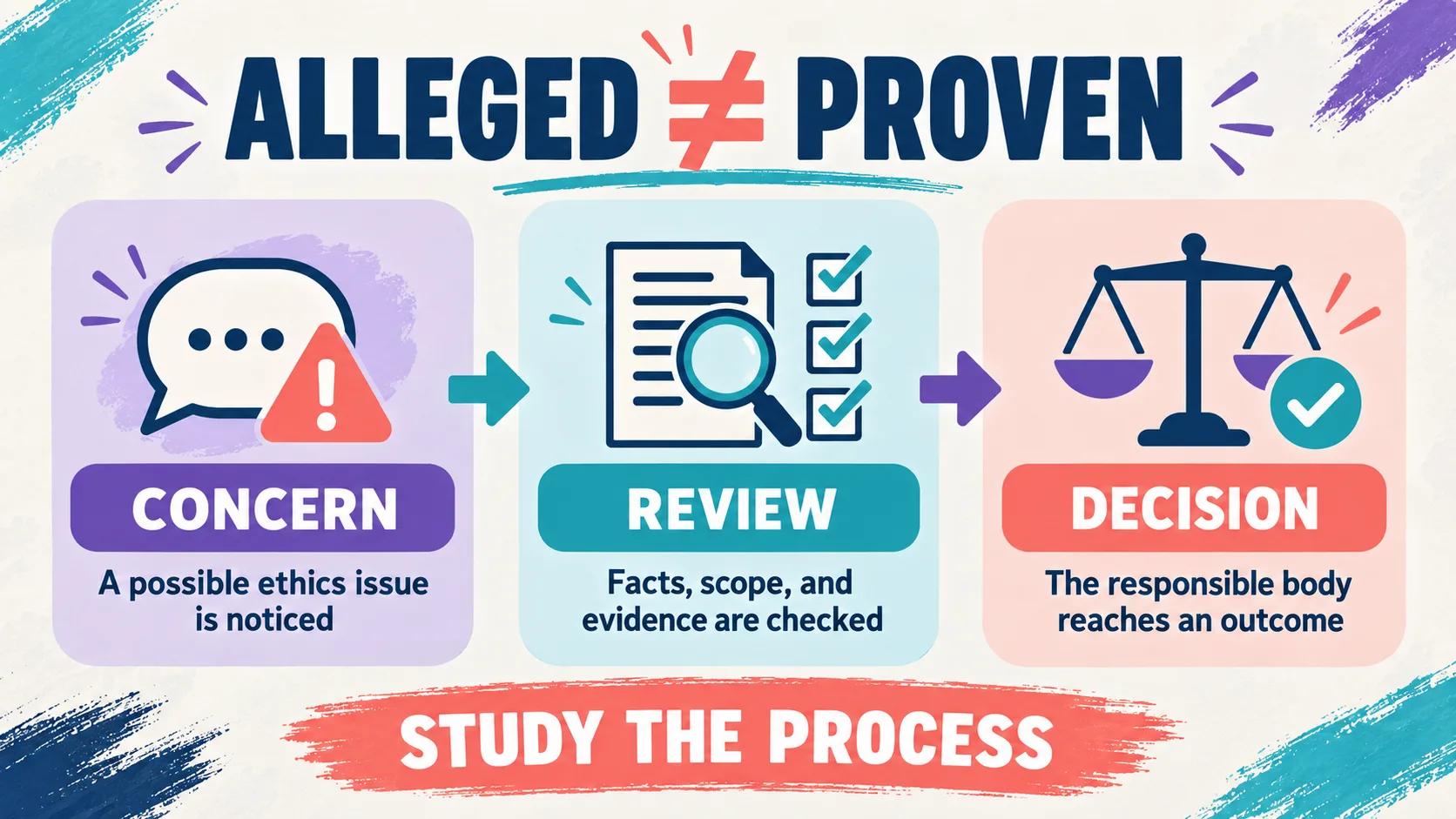
An ethics violation is a conclusion that identified conduct did not meet an applicable ethics requirement. Before that conclusion exists, there may be a concern, an internal complaint, a Notice of Alleged Violation, or a self-report. Those stages are not interchangeable. Calling an allegation a proven violation can harm a client, a professional, or a reporting party and can also produce a poor exam answer.
The Ethics Code for Behavior Analysts is the central professional source for BCBA and BCaBA applicants and certificants. It covers responsibilities as a professional, responsibility in practice, responsibility to clients and stakeholders, responsibility to supervisees and trainees, responsibility in public statements, and responsibility in research. The code is not a substitute for state law, a payer rule, an employer policy, or an emergency response plan. A scenario can involve more than one of those systems at the same time. For study purposes, think of the word “violation” as the end of a reasoning chain:
- What happened, and what part is directly observed rather than repeated?
- Who was affected or placed at risk?
- Which ethics requirement, law, license rule, or policy might apply?
- Who has authority to review that concern?
- What evidence and response would protect confidentiality and due process?
Which ethics problems should candidates recognize?
The following patterns are useful for BCBA exam practice. They are categories for analysis, not a frequency ranking and not a finding about any individual. A single fact can implicate more than one category, so read the complete scenario before choosing a response.
| Pattern in a scenario | Question to ask | Evidence to look for |
|---|---|---|
| Truthfulness or public statements | Is a credential, service, result, or testimonial represented accurately? | The actual statement, its audience, dates, and the supporting record. |
| Scope and competence | Was the practitioner qualified, trained, supervised, and authorized for the task? | Role description, training history, supervision notes, and the decision made. |
| Client and stakeholder protection | Were consent, assent when applicable, dignity, privacy, and medical or safety needs considered? | Service agreement, communication, risk information, and the client-centered rationale. |
| Documentation, data, or billing | Are records accurate, protected, retained, and consistent with the service or claim? | Original record, correction history, data source, invoice, and access trail. |
| Supervision and training | Did the supervisor provide appropriate direction, observation, feedback, and follow-up? | Supervision agreement, meeting notes, competency evidence, and unresolved actions. |
| Relationships and responsiveness | Could a multiple relationship, harassment, discrimination, or unexamined bias affect the service? | Roles, communications, safeguards, stakeholder input, and the effect on care. |
A strong exam answer usually identifies the most immediate risk, returns to the applicable source, and protects the client before debating labels. It does not assume that a poor outcome automatically proves unethical conduct. Nor does a signed form prove that the underlying work was competent or accurate.
What is the difference between a concern, a violation, and a licensing issue?
These terms answer different questions. A concern is information that deserves review. An alleged violation is a reported claim that a requirement may have been breached. A finding or disciplinary outcome is the result of an authorized review. A licensing issue belongs to a state or other regulatory authority and may exist even when the BACB is not the right decision-maker.
The BACB’s reporting page explains that its Ethics Department does not have jurisdiction over non-certificants or organizations. If the person is outside BACB jurisdiction, the appropriate route may be an employer, supervisor, state licensing or regulatory board, payer, law-enforcement agency, or another authority. Which route applies depends on the facts and the risk. Do not put private client details into a public post while trying to identify the right route.
- “The client may be at immediate risk” is a safety question, not merely an exam-label question.
- “The record may be inaccurate” is an evidence and documentation question that may also affect billing or reporting.
- “The person is not a BACB applicant or certificant” is a jurisdiction question.
- “The conduct may violate state law” is a regulatory or legal question; the BACB cannot provide legal advice.
- “The concern can be corrected safely” is a next-step question, not proof that no issue occurred.
What should you do when a concern appears?
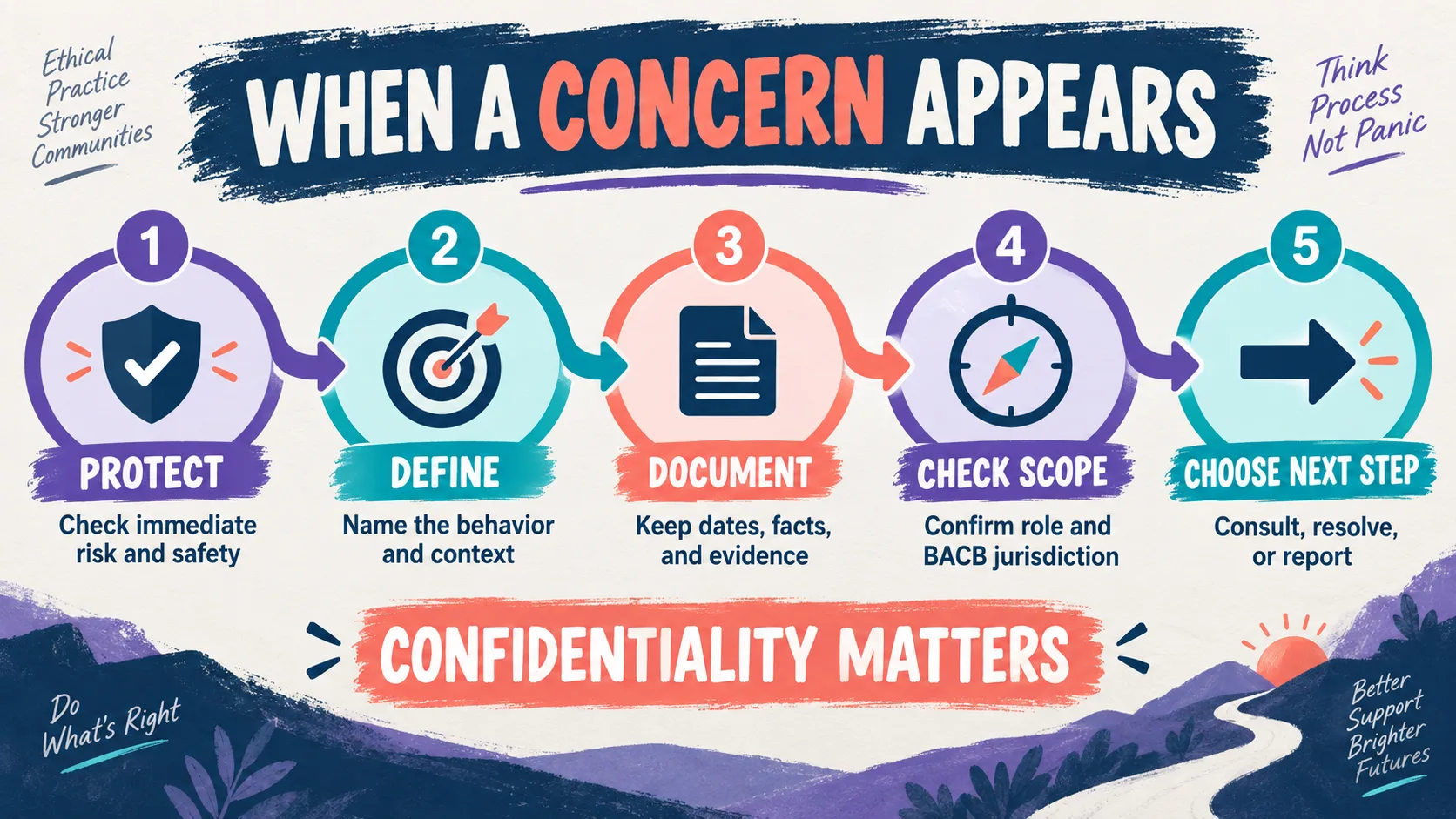
Use a calm, source-first response. The BACB’s current Ethics Code describes a systematic ethical decision-making approach that begins by defining the issue and considering risk of harm, then identifying people involved, gathering supporting information, considering bias, identifying relevant principles and standards, consulting resources, and developing actions that reduce risk. That sequence is useful for exam questions and real professional review.
- Protect people first. If there is an immediate health, safety, abuse, or serious confidentiality risk, follow the applicable emergency, mandated-reporting, organizational, or regulatory process. Do not wait for a study worksheet to solve an urgent danger.
- Define the conduct. Write a neutral description of what was observed, when it happened, who was involved, and what remains unknown. Avoid conclusions such as “the BCBA is unethical” when the evidence only supports “the record appears inconsistent.”
- Preserve evidence and privacy. Keep original dates and records, restrict access, and redact client or stakeholder identifiers before sharing material. A screenshot without context can be misleading; a long unorganized file can bury the key fact.
- Check role and jurisdiction. Open the current BACB source, identify whether the subject is an applicant or certificant, and check whether the problem is also controlled by state licensure, an employer, a payer, or another authority.
- Choose the least risky effective next step. If a direct conversation or supervisor escalation could safely resolve the concern, document it. If direct contact could worsen the risk, use the appropriate reporting or protective route instead.
When does BACB reporting make sense?
Begin with the official BACB Reporting to the Ethics Department page and the current Considerations for Reporting an Alleged Violation Against a BCaBA/BCBA document. The latter is a decision aid, not a substitute for professional or legal advice.
The current guidance asks a notifier to think about whether the matter can be resolved directly, whether the BACB has jurisdiction, whether there is an identifiable ethics concern, and when the conduct occurred or became known. The document states that Notices are generally filed within six months of the situation date or the date the notifier became aware of it, while noting that staff may extend the deadline in cases involving consumers’ physical or emotional safety or billing fraud. Confirm the live document before relying on any time window.
Reporting is not the same as proving. The Code-Enforcement Procedures describe notice to the subject, an opportunity to respond, possible outcomes, and an appeal process. The BACB expects a notifier to provide a complete and accurate Notice; the process is not a promise of monetary relief or a substitute for a court. Keep that distinction visible in both practice questions and public writing.
For a more specific routing question, see the site’s BCBA Ethics Hotline guide. It separates the BACB Ethics Department from state boards, employers, emergency services, and self-reporting. That page supports routing; this article owns the broader “what counts as an alleged BCBA ethics violation and how should a candidate reason through it?” intent.
How do ethical violations appear on the BCBA exam?
The 6th-edition BCBA Test Content Outline includes an Ethics and Professional Issues domain. It lists 22 questions, or 13% of the outline, for that domain. Treat that percentage as an outline allocation rather than a guarantee of the exact mix on your appointment. The current BACB examination information page controls current administration details. Ethics questions often hide the real issue inside a practical scenario. Practice translating each stem into four notes:
- Role: Who is responsible for the decision?
- Risk: Who could be harmed, and how urgently?
- Source: Which Code standard, handbook instruction, law, or organizational rule applies?
- Action: What step protects the client, improves the evidence, and preserves due process?
For example, if a supervisor signs a monthly record without reviewing the underlying activities, do not jump straight to “report the supervisor.” First ask what the record says, what the supervisor actually observed, whether the issue can be corrected, whether the trainee or client faces an immediate risk, and which current requirement governs the form. The best answer is usually the one that addresses the strongest immediate responsibility while preserving accurate documentation.
What study mistakes should you avoid?
- Calling an allegation a fact: use precise stages and neutral descriptions.
- Memorizing code numbers without application: connect every standard to a scenario and evidence.
- Assuming the BACB handles every complaint: check the subject’s credential and the authority involved.
- Ignoring client risk while collecting paperwork: safety can change the order of operations.
- Sharing unredacted screenshots: confidentiality is part of the ethical decision, not an afterthought.
- Treating a form signature as proof: signatures document a step; they do not erase missing or inaccurate work.
- Using an old PDF as the only source: return to the live BACB page and confirm the version date.
- Choosing the most punitive answer: examine the least risky effective action that protects people and due process.
What is a 15-minute review method?
Turn a practice scenario into a one-page decision record. First write one neutral sentence describing the conduct. Next mark the people affected, immediate risks, and information you do not yet have. Then open the current BACB source and one relevant organizational or state source. Finally, write two possible actions and explain why one is safer, more evidence-based, and within the decision-maker’s authority. Use this checklist for each set of questions:
- Can I distinguish direct observation from hearsay?
- Can I name the relevant role and stakeholder?
- Can I identify the confidentiality boundary?
- Can I separate BACB jurisdiction from state licensure?
- Can I explain why my chosen action comes before the alternatives?
- Can I state what evidence would change my decision?
After that reasoning pass, use a mixed practice set rather than rereading the same ethics paragraph. The free BCBA mock exam is a natural next step for timed practice on ethics, supervision, and professional judgment. It is an independent study resource, not an official BACB exam and not a guarantee of a passing result.
Bottom line: BCBA ethical violations should be studied as a process of careful classification and responsible action. Start with the current Ethics Code, separate concern from finding, protect people and records, verify BACB jurisdiction, and choose a next step that supports both safety and due process. For current versions, always return to the BACB’s live ethics pages and reporting documents.
BCBA ethical violations FAQ
What is an example of a BCBA ethical violation? A possible example is knowingly misrepresenting a credential, service, result, or record in a way that conflicts with an applicable ethics requirement. In a real case, the conduct still needs evidence and review; an example is not a finding about a person.
Are all unprofessional actions BACB violations? No. A concern may involve an employer policy, state licensing rule, payer requirement, clinical standard, or interpersonal conflict rather than a BACB ethics requirement. Some events involve several systems, so identify the authority before choosing a reporting route.
Can a BCBA report another BCBA to the BACB? A person may use the BACB’s reporting process when the subject and conduct fall within BACB jurisdiction. Review the current reporting page and the BCaBA/BCBA considerations document first. If a direct conversation could safely resolve the concern, the guidance encourages considering that step; it is not appropriate when it would increase risk.
Does filing a report prove that an ethics violation occurred? No. A Notice communicates an allegation. The Code-Enforcement Procedures describe notice, response, review, possible outcomes, and appeal. Use “alleged” until an authorized process reaches an outcome.
What should I study first for BCBA ethical violations? Start with the current Ethics Code and the BCBA Test Content Outline’s Ethics and Professional Issues domain. Then practice identifying roles, risks, evidence, jurisdiction, and the least risky effective next action in realistic scenarios.
Where can I find the current reporting instructions? Use the official Reporting to the Ethics Department page, then check the linked consideration document and Code-Enforcement Procedures. BACB pages and documents can be updated, so do not rely on an undated copy saved in an old study folder.
Take the Free BCBA Mock Exam
When you are ready to apply the idea, use the free practice resource below for additional feedback. Take the Free BCBA Mock Exam



