
Short answer: An attesting certificant is a qualified BACB certificant who verifies specific information on an application attestation form and signs that the information is accurate. If you searched for attesting certificant BACB meaning, this is the key idea: the signer has a form-defined verification role, not a general reference role. The exact eligibility, relationship, documentation, and deadline depend on the BACB form being used.
Table of Contents
- Attesting Certificant BACB Meaning: What Does It Mean?
- Who is the attesting certificant for an RBT application?
- Is a coursework attestor the same role?
- How do the BACB attestation roles compare?
- What does the signer verify?
- How should an applicant prepare?
- What are common attestation mistakes?
- Attesting certificant BACB FAQ
- Take the Free BCBA Mock Exam
The phrase appears most visibly in the RBT certification application attestation. It should not be confused with a university Pathway 2 Program Contact who submits a BCBA or BCaBA coursework attestation. Both processes involve verification, but they verify different requirements and use different roles and documents. Always open the current BACB form before asking someone to sign. Table of Contents
Attesting Certificant BACB Meaning: What Does It Mean?
In plain language, an attesting certificant is an eligible BACB certificant who makes a formal statement about information the BACB requires for a particular application. The person signs because they are qualified to verify the specified facts and can support the statement with documentation if the BACB audits the application.
The term does not mean “the person who supervises me” in every situation. It also does not mean that the signer takes responsibility for every part of the applicant’s certification. The form controls the scope: it identifies the applicant, the attesting certificant, the organization or program relationship, the facts being confirmed, the signature, and any retention or deadline rules.
The current attesting certificant BACB meaning in the current RBT form is the primary source for the RBT role. It states that a qualified attestor verifies defined application requirements and must be able to support the attestation if the BACB requests an audit. Because forms and requirements can change, the current BACB version outranks an old template or an online explanation.
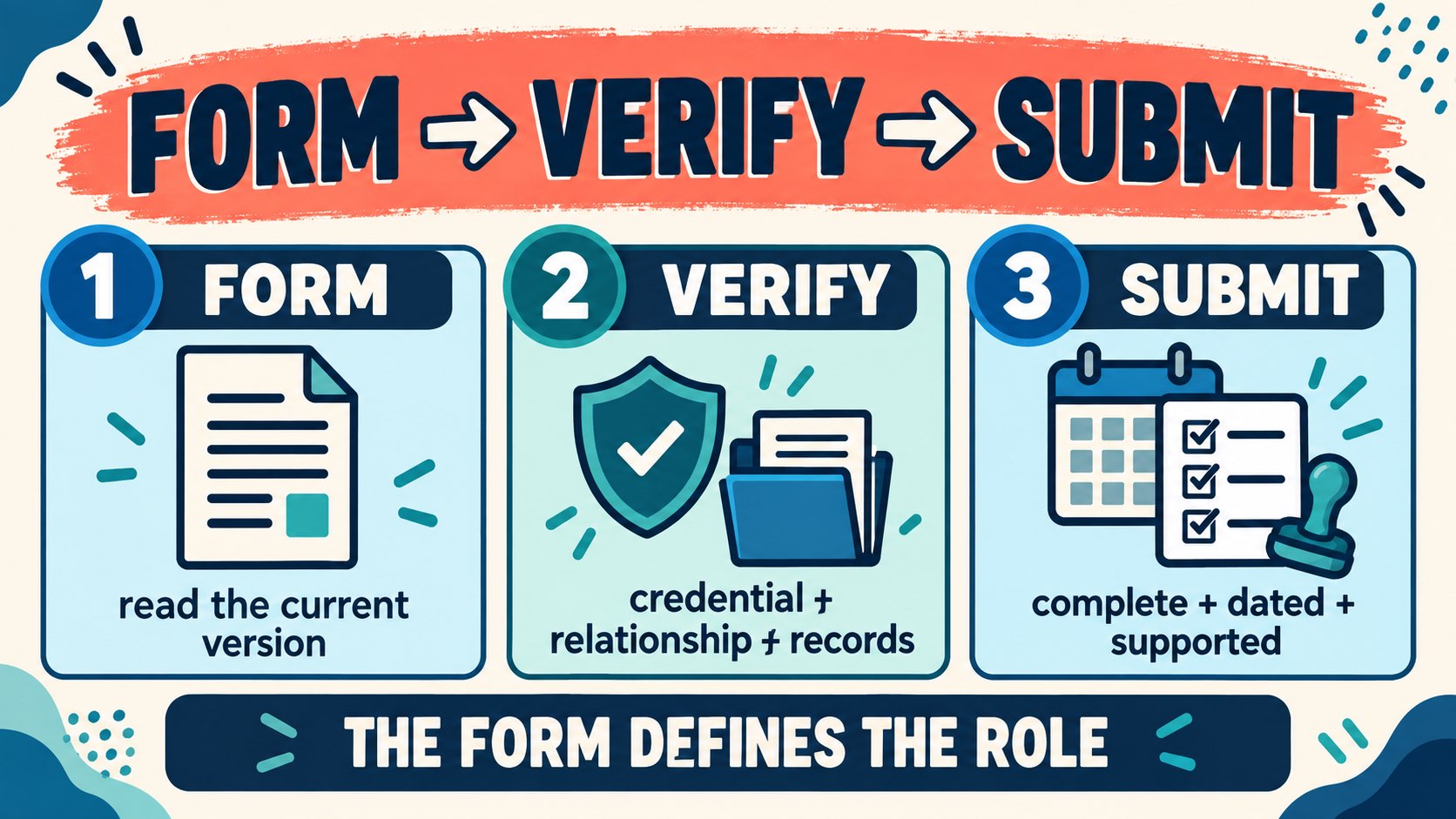
For a candidate, the practical rule is simple: do not find a convenient signature first and read the form later. Read the form, identify the exact verification task, and then locate a person whose credentials and relationship satisfy that form.
Who is the attesting certificant for an RBT application?
For the RBT certification application attestation, the signer must meet the conditions written on the current BACB form. The version reviewed for this article identifies an active BCaBA, BCBA, BCBA-D, or FL-CBA as an eligible certification type and requires the attestor to be employed by, or contractually related to, the same organization as the applicant.
The attesting certificant’s job is to verify the items assigned by the form. In the current RBT attestation, those items include the applicant’s age, education level, criminal background check, and abuse-registry check, as applicable to the form’s instructions. The attestor must be familiar with the organization’s screening policies and able to provide supporting documentation if audited.
This is a verification role, not a shortcut around the RBT requirements. The attestor does not “approve” the applicant independently, guarantee that the BACB will accept the application, or replace any required training, competency assessment, exam, or background-check process. The BACB reviews the submitted application under its own requirements. What the RBT role is not: Use the points below as a quick study guide.
- Not any BCBA: the certification and organization-relationship conditions on the form matter.
- Not a personal reference: the signer verifies defined facts and keeps support for the attestation.
- Not an applicant: the attesting certificant and the RBT applicant are different people with different fields.
- Not a permanent authorization: the form is tied to the application and the version-specific instructions.
Is a coursework attestor the same role?
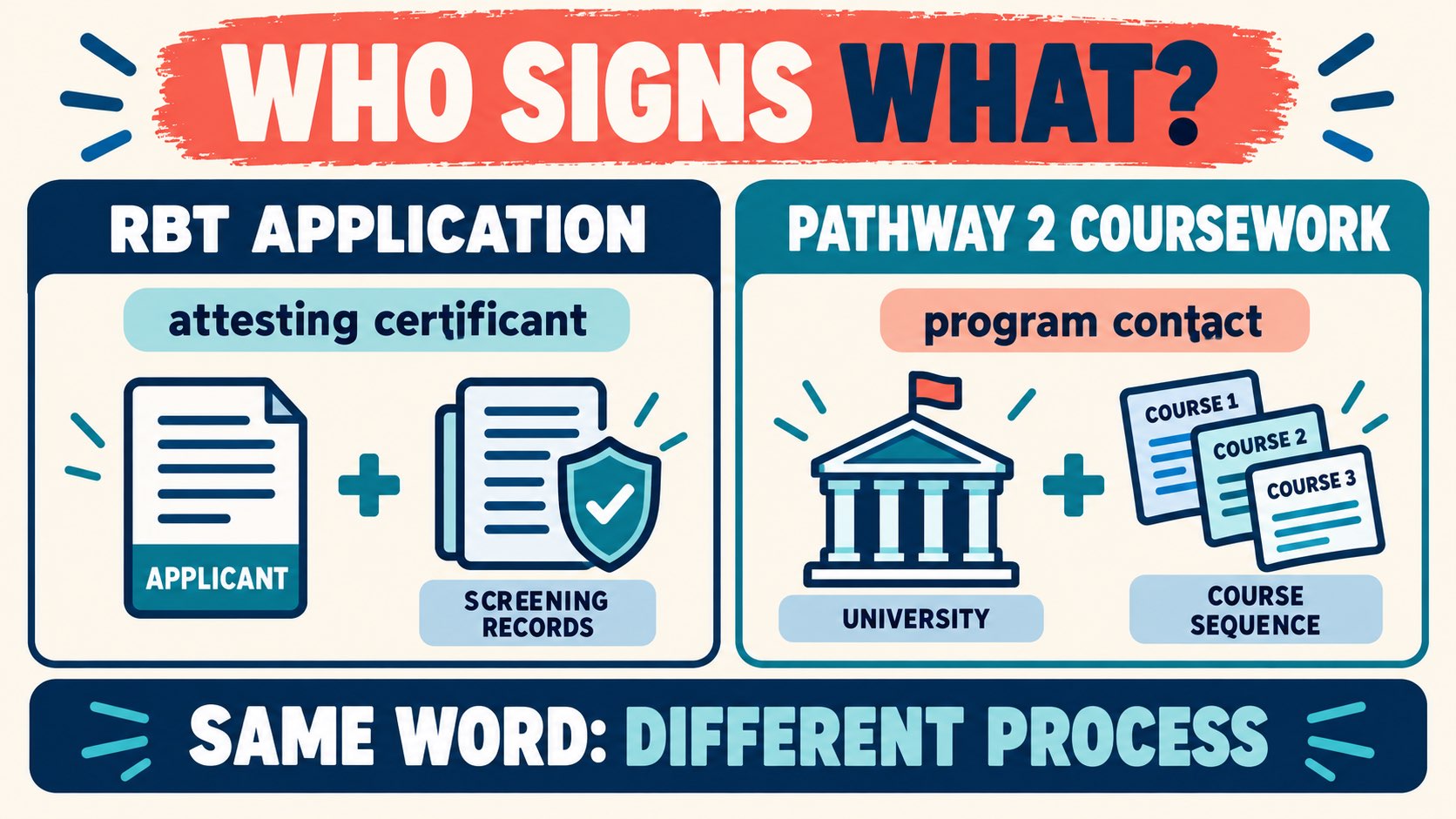
Not necessarily. BACB university guidance describes a Pathway 2 Program Contact who reviews a student’s behavior-analytic coursework and, when appropriate, submits a coursework attestation to the BACB. That program contact is verifying coursework requirements for a BCBA or BCaBA pathway, not signing the RBT application attestation described above.
The distinction matters during the 2026–2027 transition. The BACB university training guidance explains the Pathway 2 Program Contact’s responsibility to review the course sequence and submit an attestation when the student has completed the applicable coursework. A university program contact may hold an active BCBA, but the role is defined by the Pathway 2 process and the institution’s relationship with the student.
Do not assume that an RBT attesting certificant can sign a coursework attestation, or that a university coursework contact can sign an RBT application form. They may be the same human in a particular situation, but the authority comes from the applicable form and role—not from the person’s title alone.
How do the BACB attestation roles compare?
Use the procedure and form name as the anchor. The table below is a study-oriented distinction, not a replacement for the current BACB instructions.
| Process | Role named by the process | What is being verified? | Key boundary |
|---|---|---|---|
| RBT certification application | Attesting certificant | Specified applicant, screening, and organization-related facts listed on the current RBT attestation form | Signer must meet the form’s credential and organization-relationship conditions |
| BCBA or BCaBA Pathway 2 coursework | Pathway 2 Program Contact / coursework attestor | Whether the student’s institution and course sequence meet the applicable coursework requirements | Institutional program role and current pathway rules control |
| Fieldwork verification | Responsible supervisor or named supervisor on the current form | Hours, supervision activities, signatures, and records required by the fieldwork process | Do not substitute an attestation role for the fieldwork form’s signer rules |
| Employer or school screening | Organization-designated verifier, if the form permits | Only the records and checks assigned by that specific document | Internal confirmation is not automatically a BACB attestation |
What does the signer verify?
The safest way to answer this question is to read the exact form section rather than rely on a generic checklist. A signer should be able to identify each statement they are making, the date or timeframe it covers, and the records that support it.
- Identity and relationship: confirm the applicant, organization, program, and signer fields are complete and accurate.
- Credential status: check the credential type and active status required by the form.
- Required facts: verify only the age, education, screening, coursework, or other items listed on that document.
- Timing: check the form’s signature window, application window, background-check date, or transition deadline.
- Documentation: retain copies and supporting records for the period required by the current instructions.
- Accuracy: decline or pause the signature if a fact cannot be supported or the form is incomplete.
The BACB Ethics Codes page is the appropriate place to check the current ethics requirements. Signing a form is a professional statement, not a courtesy favor. If the signer is uncertain about eligibility or documentation, the responsible next step is to consult the current BACB instructions or the relevant regulatory authority.
How should an applicant prepare?
An applicant can reduce delays by preparing the information before requesting a signature. The goal is not to persuade someone to sign; it is to make the verification accurate and easy to audit.
- Download the current form: confirm the version date and the form’s name on BACB.com.
- Fill your own fields first: use the legal name and BACB ID exactly as required, and leave signer-only sections for the signer.
- Map each statement to evidence: identify the record, date, organization policy, transcript, check, or other document that supports it.
- Confirm the relationship: ask whether the signer meets the credential and employment or contract conditions before scheduling a signature.
- Plan the timeline: allow time for corrections, signatures, submission, and any request for additional documentation.
Keep the roles separate in your notes. A BCBA supervisor may help you understand an application, but that does not make the supervisor the correct attesting certificant unless the form’s conditions are satisfied. Similarly, a university contact may explain a coursework attestation without being the signer for a different application.
What are common attestation mistakes?
- Using an old PDF: a familiar form can be out of date, especially during a requirements transition.
- Confusing certification with a certificate: a course completion certificate or school letter is not automatically BACB certification or an attestation.
- Choosing by job title: “supervisor,” “manager,” or “professor” does not by itself satisfy an attestor rule.
- Leaving fields blank: incomplete forms can be delayed or rejected; follow the current document’s instructions for fields that do not apply.
- Signing without records: the signer must be able to support the statements if the BACB audits the application.
- Mixing pathways: RBT application attestation, BCBA/BCaBA coursework attestation, and fieldwork verification are different processes.
- Assuming a signature guarantees approval: the BACB still reviews the complete application and all applicable requirements.
Quick review: name the form, identify the exact requirement being verified, confirm the signer’s role and relationship, match each statement to evidence, and check the version date. For scenario practice on certification terminology, ethics, and application decisions, try the free BCBA mock exam. It is a study resource and does not reproduce official BACB questions.
Attesting certificant BACB FAQ
What is an attesting certificant on a BACB form? It is a qualified BACB certificant who verifies the specific facts assigned by the applicable attestation form and signs that statement. Can any BCBA be an attesting certificant? Not automatically. The current form may require an active credential type plus an employment or contractual relationship with the applicant’s organization. Read the form before choosing a signer.
Is an attesting certificant the same as an RBT supervisor? Sometimes one person may hold both roles, but they are conceptually different. The attesting certificant verifies the items on the application form; supervision responsibilities are governed by separate requirements and agreements.
Is a Pathway 2 coursework attestor the same as an RBT attesting certificant? No, not by default. A Pathway 2 Program Contact verifies a student’s coursework under the applicable BCBA or BCaBA pathway. The RBT attesting certificant signs the RBT application attestation. One person could potentially hold different roles, but each role must satisfy its own process.
What if nobody at my organization qualifies? Do not ask an unqualified person to sign. Check the current BACB instructions, speak with the organization’s designated contact, and determine whether the application or employment arrangement needs to change before submission.
Take the Free BCBA Mock Exam
When you are ready to apply the idea, use the free practice resource below for additional feedback. Take the Free BCBA Mock Exam



