

Quick answer: A strong behavior analyst job description explains the role’s clinical purpose, setting, reporting relationship, essential duties, credential requirements, supervision authority, documentation expectations, and measurable outcomes. It should tell a qualified candidate what the work actually involves and help an employer avoid assigning duties that conflict with BACB standards, state rules, or the limits of another team member’s role.
Table of Contents
- What Should a Behavior Analyst Job Description Include?
- How Do You Define the Role’s Clinical Purpose?
- What Responsibilities Belong in a BCBA Job Description?
- How Should Supervision and Delegation Be Written?
- Which Qualifications Are Required, and Which Are Preferred?
- What Documentation and Outcomes Should the Posting Name?
- What Does a Practical Behavior Analyst Job Description Template Look Like?
- What Red Flags Should Candidates and Employers Notice?
- How Do Ethics Shape a Behavior Analyst Job Description?
- Behavior Analyst Job Description FAQ
- Key Takeaway
- Quick Review Checklist
- Take the Free BCBA Mock Exam
Use a job description as a scope-and-expectations document, not as a collection of impressive phrases. The exact duties will change by setting, population, payer, state license, and service model. A clinic, school district, home-based provider, and telehealth team should not publish identical postings simply because they use the title “behavior analyst.”
What Should a Behavior Analyst Job Description Include?
Start with the facts that define the position before listing preferred personality traits. State the working title, employment type, supervisor, team, service setting, population, expected travel, schedule, and whether the role includes direct service, supervision, assessment, program design, training, or a combination. If the organization uses BCBA, BCaBA, RBT, behavior technician, or a local license title differently, define those terms.
Next, describe the role mission in one or two sentences. For example: “The BCBA designs, monitors, and updates individualized behavior-analytic services while coaching the implementation team and communicating data-based decisions to caregivers and other stakeholders.” That sentence is more useful than “help clients reach their potential” because it identifies the decisions and relationships the role owns. The site’s BCBA director guide discusses a leadership role; this page is broader. It is about how to write and review the actual job-description document for a behavior-analytic position at any level.
How Do You Define the Role’s Clinical Purpose?
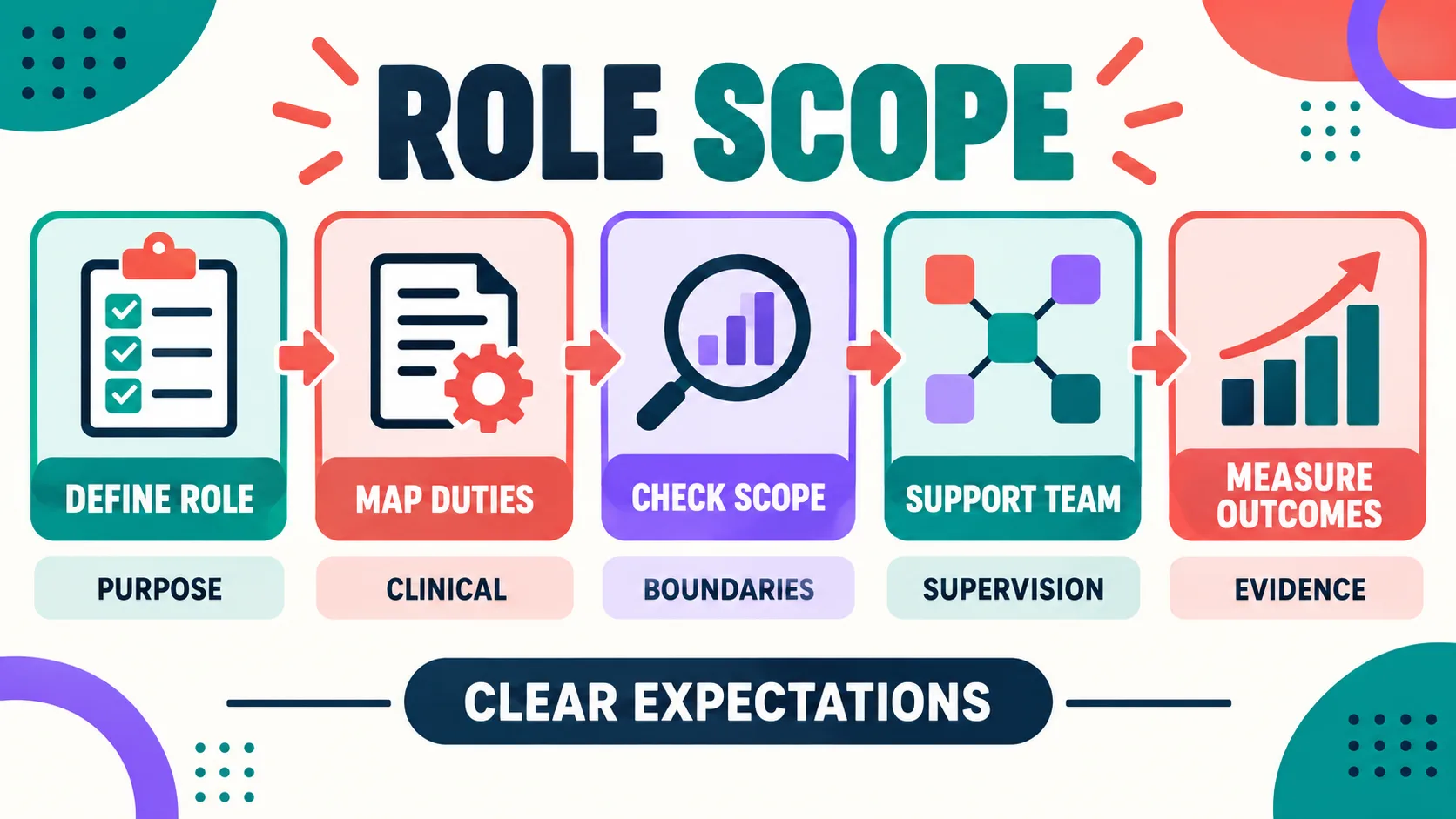
A behavior analyst job description should connect each major duty to a client or service outcome. Avoid making the role sound like an administrative checklist. “Completes assessments” is incomplete unless the posting explains what the analyst does with the information: identify meaningful goals, develop or revise a plan, train implementers, review data, and communicate recommendations within the organization’s scope.
Describe the service context precisely. A school-based analyst may collaborate with educators and align behavior support with educational plans. A clinic analyst may coordinate authorization reports, caregiver training, and technician schedules. A home-based analyst may travel between settings and need a clear process for caregiver participation. A job description can be flexible while still being specific about the conditions under which the work occurs.
What Responsibilities Belong in a BCBA Job Description?
Most postings should organize duties into clinical, team, documentation, and quality responsibilities. The list below is a framework, not a universal scope of practice:
- Assessment and goal development: gather relevant information, conduct or participate in appropriate assessments, identify socially meaningful targets, and write observable goals with stakeholders.
- Plan design and implementation support: develop, monitor, and revise behavior-analytic procedures; specify antecedent strategies, teaching procedures, response definitions, data systems, and decision rules.
- Data-based review: inspect graphs, evaluate level, trend, and variability, investigate data gaps, and document why a plan is continued, changed, faded, or discontinued.
- Training and supervision: train caregivers, technicians, teachers, or other approved implementers; observe performance; provide feedback; and document supervision according to the applicable requirements.
- Collaboration and communication: explain recommendations in understandable language, coordinate with relevant professionals, respect client and caregiver preferences, and address disagreement professionally.
- Documentation and compliance: complete required notes, reports, authorizations, progress summaries, incident records, and other documentation accurately and on time.
- Quality and risk response: identify treatment-integrity problems, safety concerns, barriers to progress, and conditions that may interfere with effective service delivery.
Be careful with verbs. “Supervise” can imply a formal responsibility; “support implementation under the direction of the supervising BCBA” describes a different role. “Conduct functional analysis” may require training, resources, and organizational approval that are not present in every job. The more consequential the duty, the more carefully the posting should describe authority, training, and review.
How Should Supervision and Delegation Be Written?
Do not use “supervises staff” as a catch-all. Identify who the employee may supervise, what supervision means in this organization, how often observation and feedback occur, who signs or approves clinical documents, and which tasks cannot be delegated. If the role involves RBTs, BCaBAs, trainees, or assistant assessors, state the applicable supervision structure rather than implying that every credential carries the same authority.
The BACB’s supervision, assessment, training, and oversight guidance distinguishes several roles and resources. Use the current BACB materials and the relevant state requirements when finalizing a posting. A job description should not promise a supervision opportunity that the organization cannot legally or ethically provide.
Also explain the support the employee receives. A posting that demands independent clinical decisions but gives no access to a qualified supervisor, case consultation, training, or protected documentation time is describing risk, not a sustainable role. This is especially important for new certificants and for positions that combine a caseload with management duties.
Which Qualifications Are Required, and Which Are Preferred?
Separate minimum qualifications from preferences. Minimum qualifications might include a specified credential, an active certification or license where applicable, background checks, required training, and the ability to perform the essential functions of the position. Preferences might include experience with a particular population, electronic data systems, caregiver coaching, school collaboration, or a second language.
Do not write “BCBA preferred” if the role requires the employee to perform duties that the organization expects only a qualified BCBA to perform. Conversely, do not list a long set of credentials that are not used in the actual work. Candidates need to know whether the employer is hiring a BCBA, a BCaBA, a behavior technician, a clinical manager, or a hybrid position.
Credential status is also different from state authorization. The BACB explains its certification and ethics role, but state licensing boards, payer rules, school regulations, and employer policies may add requirements. Link to the relevant official sources in the final posting and state that requirements must be verified for the work location.
What Documentation and Outcomes Should the Posting Name?
Good outcomes are observable without encouraging unsafe quotas or distorted data. Instead of “maintain a high success rate,” specify responsibilities such as “review program data on the organization’s defined schedule and document data-based treatment decisions.” Instead of “manage a large caseload,” state the expected caseload range, service mix, travel, supervision load, report deadlines, and how complexity is considered. Useful outcome categories include:
- timely and accurate clinical documentation;
- clear operational definitions and measurement systems;
- scheduled review of progress and treatment integrity data;
- documented caregiver, staff, or teacher training;
- responsive communication with clients and stakeholders;
- ethical escalation of safety, consent, assent, or service-quality concerns; and
- continuous improvement that is based on data rather than a fixed number of billable activities.
Ask whether each outcome is within the employee’s control and whether the organization will provide the time, tools, access, and supervision needed to meet it. If not, revise the expectation before publishing the job description.
What Does a Practical Behavior Analyst Job Description Template Look Like?
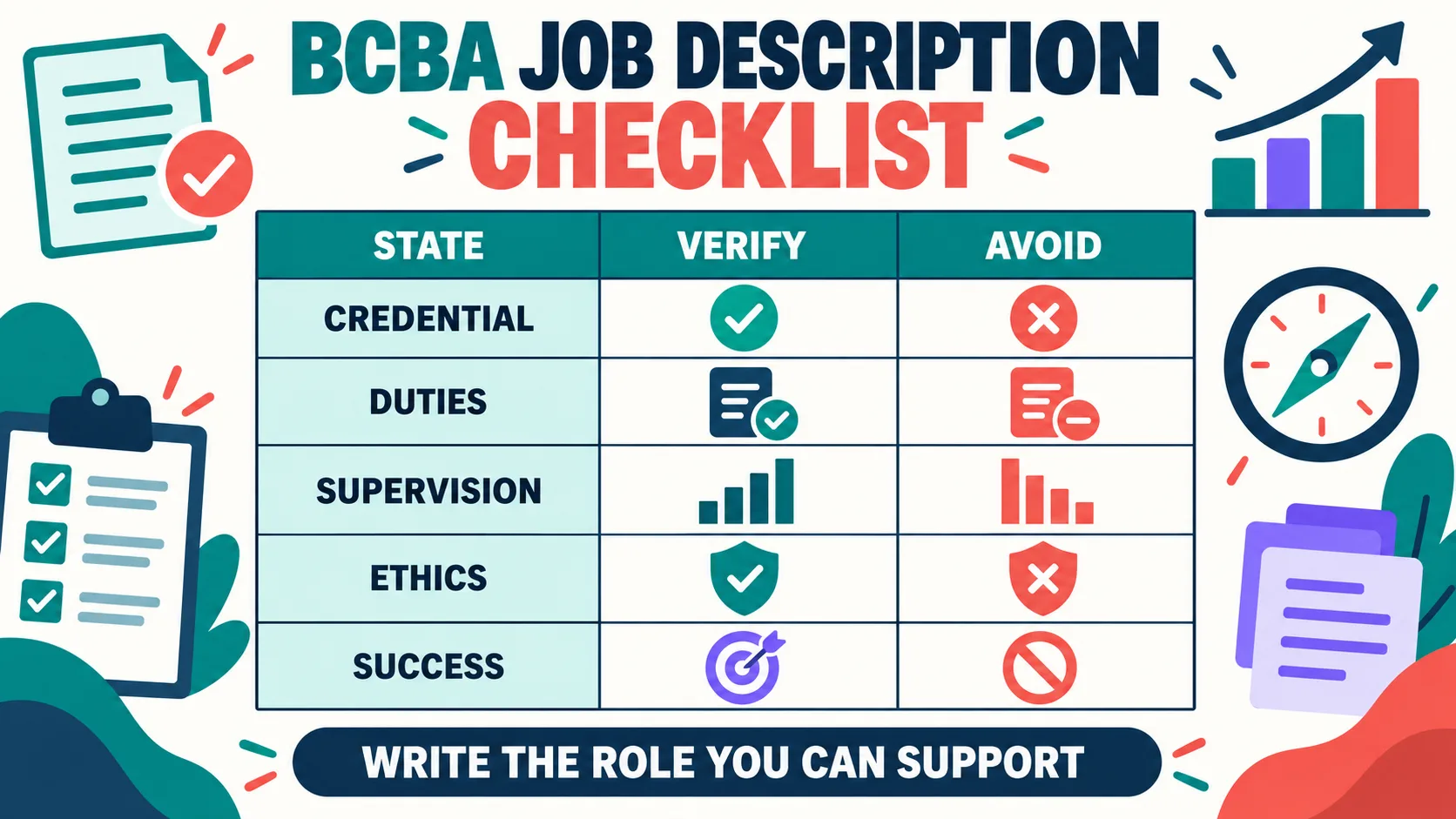
The following structure can be adapted for an employer posting or used by a candidate to evaluate an offer. Fill in the local details instead of copying the table word for word.
| Section | What to state | Review question |
|---|---|---|
| Role mission | The client and service outcomes the position is responsible for supporting. | Could a candidate explain the purpose in one sentence? |
| Clinical duties | Assessment, goals, plan design, data review, training, communication, and documentation. | Are the duties tied to the actual setting and population? |
| Scope and supervision | Who the employee supervises, who supervises the employee, and what is delegated. | Does the wording match credential, state, and organizational requirements? |
| Qualifications | Required credential, license or registration where applicable, training, and preferred experience. | Are required items genuinely required for the listed duties? |
| Working conditions | Caseload, travel, schedule, setting, physical demands, tools, and protected documentation time. | Would the posting prevent a surprise after hiring? |
| Success measures | Timeliness, quality, collaboration, data review, and ethical escalation expectations. | Can the organization support and fairly evaluate each measure? |
Compensation and benefits should be stated separately from the clinical scope. The site’s BCBA salary guide addresses compensation research; a job description should not imply that a salary number determines credential scope or professional authority.
What Red Flags Should Candidates and Employers Notice?
Be cautious when a posting combines a BCBA credential with an undefined “do everything” list, promises an unusually high caseload without complexity information, treats supervision as an extra task with no protected time, or expects a technician to make independent clinical decisions. Also question a role that asks for data-based treatment changes but provides no access to graphs, no clear documentation system, or no process for raising safety and ethics concerns.
Employers should look for the reverse problem: a posting that uses vague mission language, lists only personality traits, hides the setting and travel, or copies a generic template without stating how the team works. Clarity improves hiring, onboarding, supervision, and retention because both sides can compare the actual role with their expectations.
How Do Ethics Shape a Behavior Analyst Job Description?
A job description cannot waive professional duties. The current BACB ethics codes provide the professional context for protecting clients and stakeholders, practicing within competence, handling confidential information, and responding to ethical concerns. Include a clear reporting path for safety, consent, assent, conflicts, documentation problems, and requests outside the employee’s competence.
Use respectful, person-centered language. A posting should describe support for meaningful goals and collaborative services, not a promise to make people appear “normal” or to suppress harmless differences. Ethical expectations belong in onboarding, supervision, performance review, and the daily workflow—not only in a link at the bottom of the advertisement.
Behavior Analyst Job Description FAQ
Is a behavior analyst job description the same as a BCBA job description?: Not necessarily. “Behavior analyst” can be used broadly, while BCBA is a specific certification title. The document should state the credential, license or registration requirements, setting, and actual responsibilities instead of assuming the titles mean the same thing.
Should a job description list the BCBA Task List?: It may reference relevant competencies, but a task list is not a substitute for a job description or a supervised-fieldwork curriculum. Name the work the employee will perform, the decisions they own, the supervision available, and the documentation required.
Can a BCaBA job description use the same duties as a BCBA posting?: Some duties may overlap, but supervision and decision authority may differ. Compare the current BACB requirements, applicable state rules, payer requirements, and the organization’s supervision structure before reusing language.
What should a candidate ask before accepting the role?: Ask who supervises the role, how caseload and complexity are measured, how much time is protected for data review and documentation, which duties are delegated, what happens when a safety or ethics concern arises, and how performance is evaluated. Those answers often reveal more than the job title.
Key Takeaway
A useful behavior analyst job description makes the role visible before the interview: mission, clinical duties, supervision, qualifications, working conditions, documentation, and outcomes. Customize it to the setting and verify credential, licensing, and ethics requirements with current official sources. If you are preparing for the BCBA exam, reinforce the connection between supervision, ethics, documentation, and data-based practice with the site’s free BCBA mock exam. For targeted review, use our behavior analyst job description practice questions to apply the concept in exam-style scenarios.
Quick Review Checklist
Use this final checklist to turn behavior analyst job description into exam-ready reasoning. The goal is not to memorize a label in isolation; it is to identify the relevant evidence and explain why the best answer fits the scenario. Key ideas to review:
- State the central definition or decision point for behavior analyst job description in your own words.
- Identify the detail that makes behavior analyst job description different from its closest related ABA term.
- Separate the observable facts in a scenario from assumptions that are not supported by the facts.
- Write one example and one nonexample so you can recognize the concept in a new setting.
Exam application checks:
- Ask what the question is actually requesting before comparing the answer choices.
- Mark the antecedent, response, consequence, or other evidence that supports the selected answer.
- Look for a distractor that describes a related process but does not answer the specific question.
Final self-check:
- Explain how you would verify the interpretation with clear observations or data.
- Change one detail in the scenario and decide whether your answer should change.
- Give a one-sentence rationale that a supervisor or study partner could evaluate.
Take the Free BCBA Mock Exam
If you want a low-pressure way to check your recall, use the free practice resource below. Take the Free BCBA Mock Exam



