
Definitions from ABA
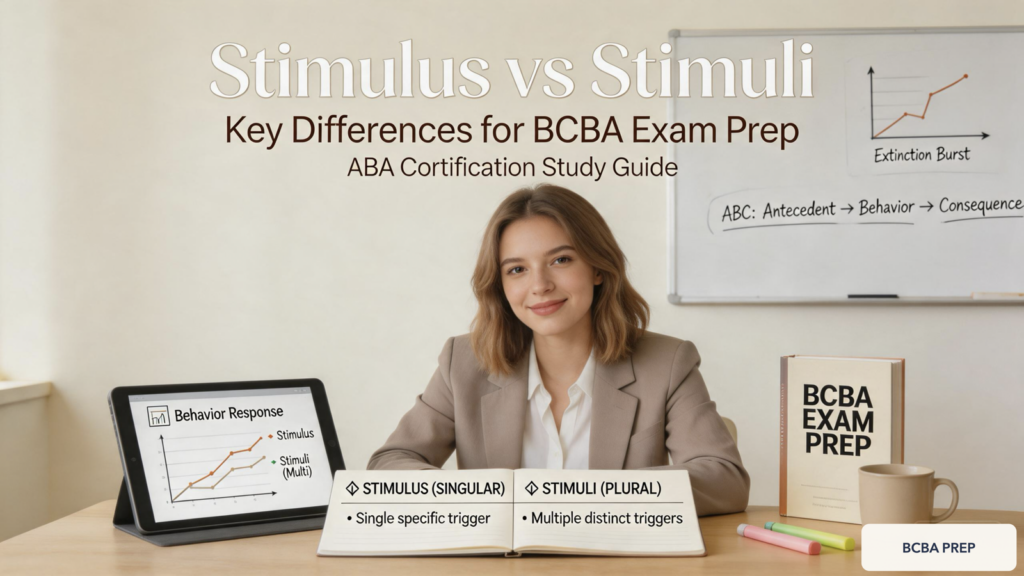
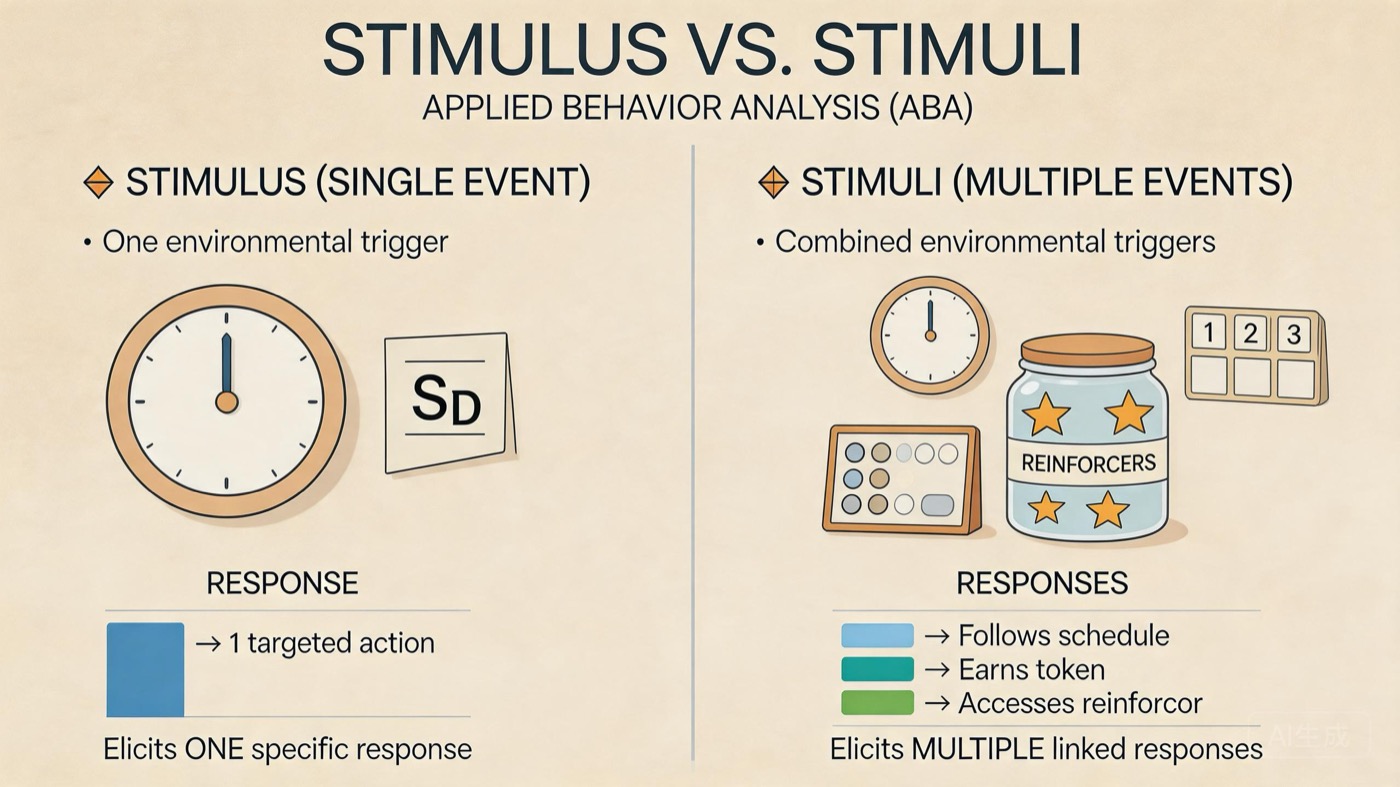
In ABA, the terms stimulus and stimuli are foundational but often confused. A stimulus is a single environmental event that elicits or occasions a response. Examples include a discriminative stimulus (SD), motivating operation (MO), or S-delta. Stimuli is the plural form, referring to multiple environmental events. The BCBA exam frequently tests your ability to distinguish between singular and plural usage, especially in the context of stimulus classes.
Table of Contents
- Definitions from ABA
- How Stimulus and Stimuli Appear in ABC Examples
- Exam Relevance and Common Traps
- Quick Checklist: Stimulus vs Stimuli
- Summary
What Is a Stimulus in ABA?
A stimulus is any change in the environment that can affect behavior. In ABA, common types include:
- Discriminative stimulus (SD): Signals that a behavior will be reinforced.
- Motivating operation (MO): Alters the value of a reinforcer.
- S-delta: Signals that a behavior will not be reinforced.
It is crucial to remember that a stimulus is always a single, specific event. For example, a red light is a single discriminative stimulus that signals the availability of reinforcement for pressing a lever. Similarly, a teacher’s verbal prompt “Look here” functions as a single stimulus that evokes attending behavior. When you encounter the term in BCBA exam questions, always ask yourself: “Is this one event or multiple?” If it’s one, the correct term is stimulus.
What Are Stimuli in ABA?
Stimuli refers to two or more environmental events. A stimulus class is a group of stimuli that share a common effect on behavior. For example, all pictures of fruits may belong to the same class if they evoke the same response. The exam often asks you to identify when to use the plural form, such as in questions about stimulus equivalence. In stimulus equivalence training, multiple stimuli (e.g., the written word “DOG”, a picture of a dog, and the spoken word “dog”) become functionally equivalent. Another example is a set of three different colored buttons that all produce the same outcome when pressed; those buttons are multiple stimuli within a single stimulus class.
How Stimulus and Stimuli Appear in ABC Examples
Understanding singular vs plural becomes clearer with ABC (Antecedent-Behavior-Consequence) examples. Below are three scenarios that illustrate correct usage. Pay close attention to whether the antecedent consists of one event or several.
Example 1: Single Stimulus (SD)
Antecedent: A teacher says ‘point to car.’ Behavior: The child points to a picture of a car. Consequence: The teacher says ‘good job!’ (positive reinforcement). Here, the stimulus ‘point to car’ is singular and functions as an SD. There is only one antecedent event—the verbal instruction.
Example 2: Multiple Stimuli (Stimuli) in a Stimulus Class
Antecedent: An array of pictures (apple, banana, orange, chair). Behavior: The child selects all fruits. Consequence: The child receives a token (positive reinforcement). The pictures of fruits are stimuli that belong to the same stimulus class. The plural form is correct because multiple antecedents are present. Notice that the array contains four distinct pictures; these are four separate stimuli that all share the function of evoking a fruit-selection response.
Example 3: Motivating Operation as a Stimulus
Antecedent: Food deprivation (6 hours without eating). Behavior: The child requests a snack. Consequence: The child receives food (positive reinforcement). Here, food deprivation is a stimulus (MO) that alters the value of food as a reinforcer. Although the MO is a single event, it affects the value of other stimuli (food items). However, the MO itself is one stimulus—the state of deprivation. Do not pluralize it unless you are referring to multiple MOs (e.g., both food deprivation and water deprivation).
Example 4: Multiple Discriminative Stimuli
Antecedent: A therapist presents two cards—one with a smiley face (SD for clapping) and one with a frowny face (S-delta for clapping). The client claps only when the smiley face is shown. Behavior: Clapping when smiley face is present, not when frowny face is present. Consequence: Therapist gives praise for correct response. Here, there are two distinct antecedent stimuli: the smiley face (SD) and the frowny face (S-delta). Together they form multiple stimuli, so we use the plural term.
For more ABC examples, see our guide on antecedent ABA exam traps.
Exam Relevance and Common Traps
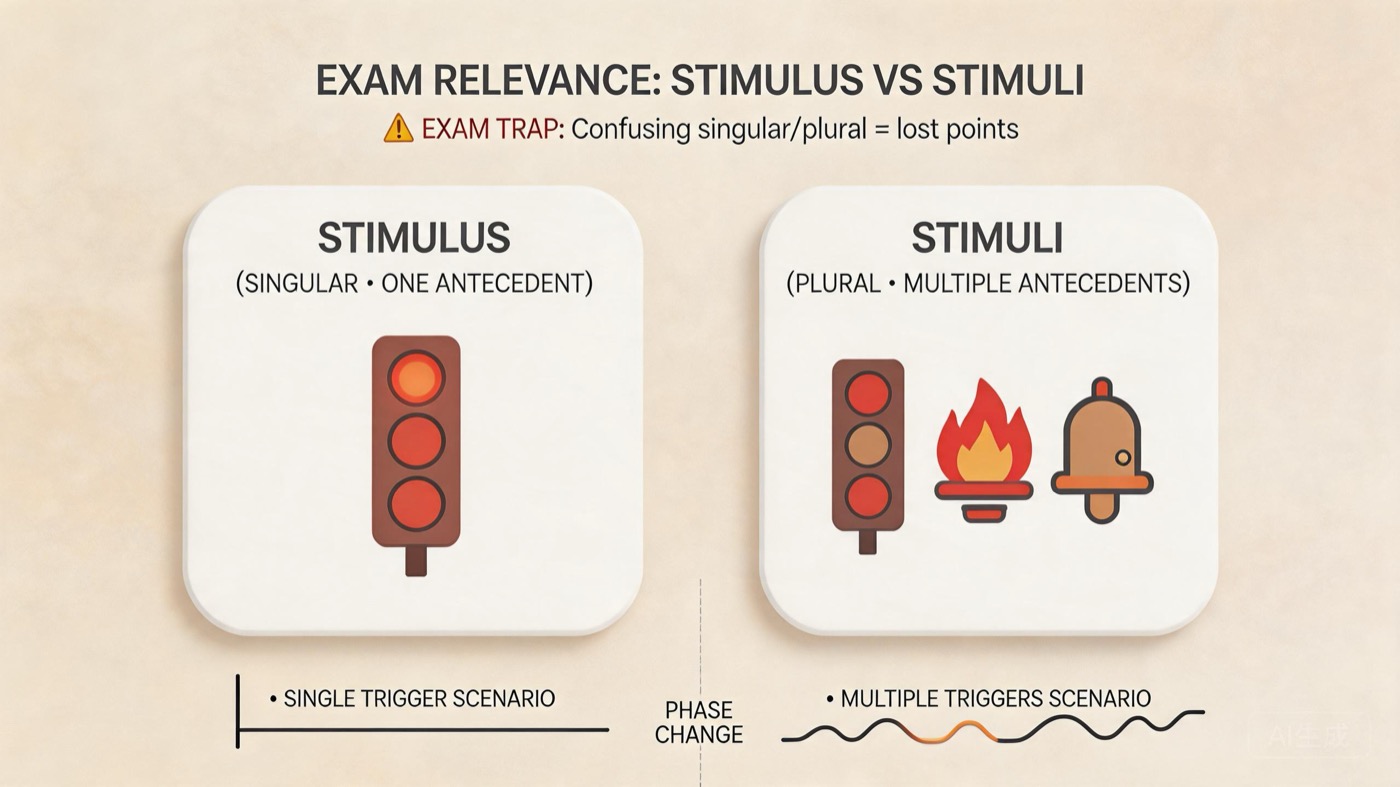
The BCBA exam tests your precision with terminology. Mixing up stimulus vs stimuli can cost points. Here’s why it matters and what to watch out for.
Why BCBA Questions Test Stimulus vs Stimuli
Questions often ask you to identify whether a scenario involves a single antecedent or multiple. For example:
- Which term describes a single environmental event that evokes a response? (Answer: stimulus)
- What is the term for a group of environmental events that share a function? (Answer: stimulus class, involving multiple stimuli)
Beyond simple definition questions, the exam may embed this distinction in more complex scenarios. For instance, a question might describe a matching-to-sample task where a sample stimulus is presented along with three comparison stimuli. The sample is a single stimulus, while the three comparisons are multiple stimuli. Correctly identifying which form to use can help you eliminate distractors. Understanding stimulus control also requires distinguishing singular from plural events. For more, read about stimulus control in ABA.
Top 3 Traps to Avoid
- Using ‘stimuli’ for a single SD: If only one antecedent is present, use ‘stimulus.’ For example: “The teacher’s instruction ‘raise your hand’ is a stimulus that evokes hand-raising.” Do not say ‘stimuli’ here.
- Confusing stimulus with stimulus class: A stimulus class contains multiple stimuli; avoid using ‘stimulus’ to describe the whole class. For instance, “all red objects” is a stimulus class comprising many stimuli, not a single stimulus.
- Pluralizing ‘discriminative stimulus’ incorrectly: The correct plural is ‘discriminative stimuli,’ not ‘discriminative stimulus.’ Similarly, ‘motivating operation’ becomes ‘motivating operations’ in plural.
A fourth common trap is using ‘stimuli’ when referring to a complex but unitary antecedent, such as a compound stimulus (e.g., a red square that is both a color and shape). Although it has multiple features, it is one stimulus. For more exam strategies, check our BCBA test questions strategies guide.
Quick Checklist: Stimulus vs Stimuli
Use this table for a rapid review before your exam.
| Term | Definition | Example |
|---|---|---|
| Stimulus | A single environmental event | Teacher says ‘touch nose’ |
| Stimuli | Multiple environmental events | Array of pictures (cat, dog, bird) |
| Stimulus class | A set of stimuli that evoke the same response | All red objects |
Also remember: a compound stimulus (e.g., a green triangle) is still a single stimulus, not multiple stimuli. When in doubt, count the number of distinct antecedents present. If it’s one, use ‘stimulus’; if more than one, use ‘stimuli.’
Summary
Mastering stimulus vs stimuli is crucial for the BCBA exam. Remember: stimulus is singular, stimuli is plural. Use our ABC examples and checklist to reinforce your understanding. For additional practice, explore our BCBA mock exam and related resources. You can also read the BACB official website for more details on terminology.



