
If you are searching for BCBA requirements California, you are probably trying to combine two questions: what the Behavior Analyst Certification Board (BACB) requires for national certification, and what may be required in the California setting where you want to work. Those questions overlap, but they are not identical.
Table of Contents
- What do BCBA requirements in California actually include?
- What are the core BACB requirements?
- What changes on January 1, 2027?
- Does California require a separate BCBA license?
- How should you verify a California BCBA program before enrolling?
- How should you plan the application timeline?
- What mistakes should California BCBA candidates avoid?
- BCBA requirements California FAQ
Short answer: you must meet the BACB’s BCBA eligibility requirements, submit a complete application, and pass the BCBA examination. Then you must verify any California-specific rules attached to your setting, employer, payer, school system, or business model. California questions are easy to mishandle when a program treats BACB certification, state regulation, school authorization, and Medi-Cal enrollment as if they were the same credential.
This guide is organized for candidates planning in late 2026 and around the BACB changes that take effect on January 1, 2027. Always confirm the current BACB BCBA resource page, the current handbook, and the California agency page that matches your intended work setting before you pay tuition, count fieldwork, or submit an application. Table of Contents
What do BCBA requirements in California actually include?
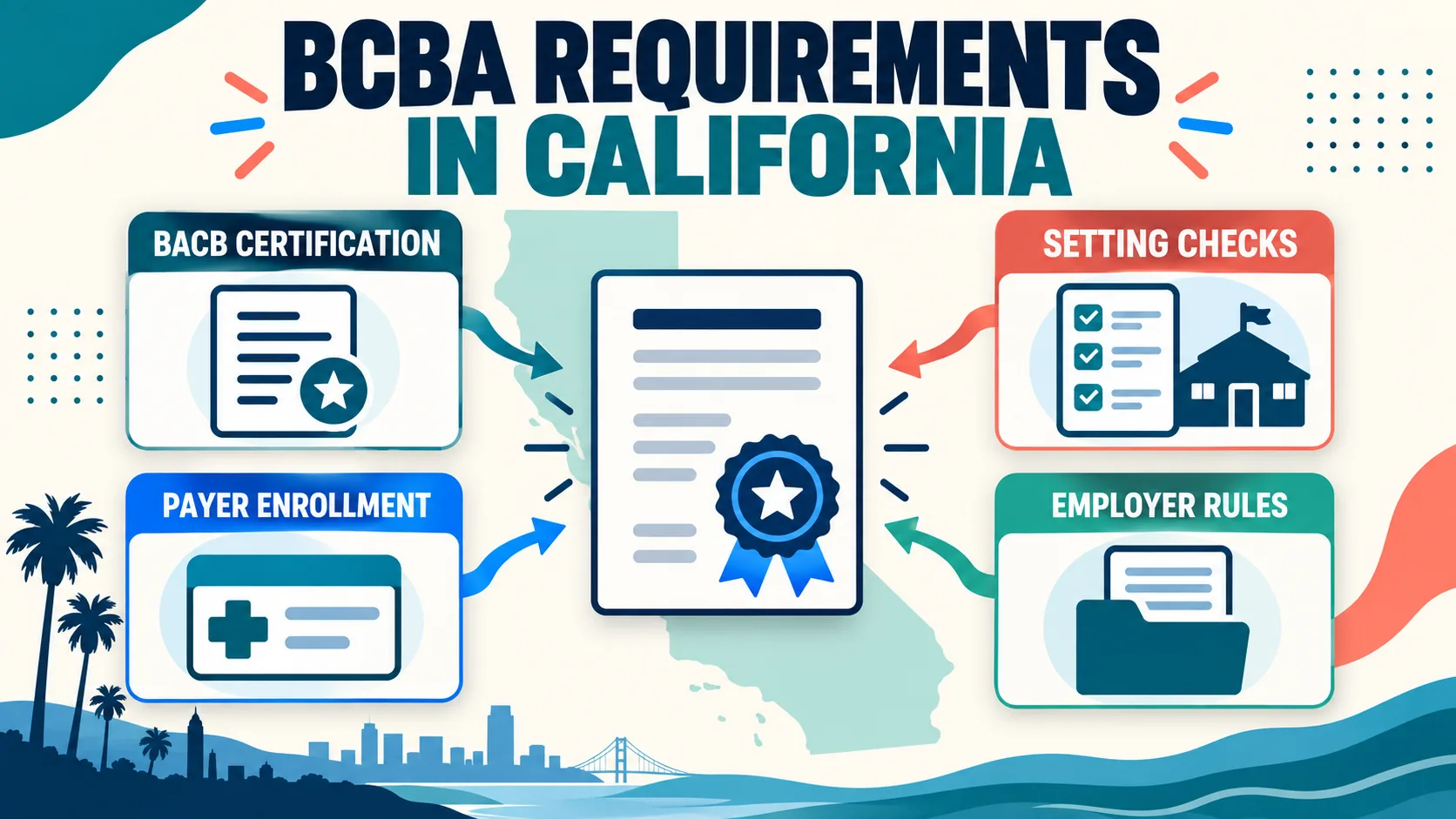
Think of the requirements as four layers. The first layer is the national BCBA credential. The second is the legal or professional context of the California setting. The third is payer or program enrollment when you bill a public or private system. The fourth is the employer’s hiring and documentation process. A candidate can satisfy the first layer and still need to complete the others before beginning a specific job or billing arrangement.
| Layer | What it answers | Evidence to keep |
|---|---|---|
| BACB certification | Have you met the education, coursework, fieldwork, application, and examination requirements for BCBA certification? | Transcript, coursework evidence, fieldwork forms, application record, and certification status |
| California setting | What rules apply in a public school, private practice, regional-center service, or another workplace? | The relevant California agency guidance, contract, or employer checklist |
| Payer or program enrollment | Can you or your organization enroll and bill the payer for the service? | Enrollment approval, NPI, business documents, insurance, and attestation records when applicable |
| Employer practice | What does the employer require before you can provide services or supervise staff? | Job requirements, background-check status, training records, and supervision policies |
This layered model is also an exam-prep safeguard. If a vignette asks whether a person is eligible for the BCBA examination, start with BACB eligibility. If it asks whether that person can bill Medi-Cal or work in a school program, identify the California setting and its separate rules. Do not answer a payer question with a certification definition.
What are the core BACB requirements?
The BACB describes BCBA certification as a graduate-level certification in behavior analysis. The national pathway is the part that remains common whether a candidate lives in California, Texas, or another jurisdiction. The exact handbook version and the date when a complete application is received control which requirements are evaluated, so use the live BACB documents instead of an old program webpage. At a practical level, a candidate should verify each of these checkpoints:
- Degree: confirm that your graduate degree fits the pathway and the applicable BACB date rules.
- Behavior-analytic education: confirm that the coursework, program contact, attestation, or accreditation evidence matches the route you plan to use.
- Supervised fieldwork: document the correct fieldwork type, supervisor qualifications, supervision contacts, observations, individual/group balance, and unrestricted activities.
- Application: submit the required forms, transcript evidence, payment, and supporting documents through the BACB process.
- Examination: receive authorization and pass the BCBA examination based on the applicable test content outline.
- Maintenance: renew on time, complete continuing education, follow ethics and self-reporting rules, and keep your certification active.
For example, a California student may have a master’s degree from a respected university but still need to confirm how the behavior-analytic coursework is documented and who can attest to it. Conversely, a candidate may have a strong fieldwork record but discover that a missing transcript or incomplete form prevents the application from being considered complete. The credential is a chain; one unverified link can delay the whole application.
- Keep the program’s pathway statement and version date.
- Save transcript and coursework-attestation instructions.
- Store every monthly fieldwork verification form.
- Record supervisor names, dates, observations, and corrections.
- Keep a copy of the final application and payment confirmation.
What changes on January 1, 2027?
The 2027 changes affect BCBA eligibility and maintenance, not the fact that California candidates must still verify their work setting. The BACB’s current summary describes two eligibility pathways beginning January 1, 2027: Pathway 1 through an accredited or recognized program, and Pathway 2 through a qualifying master’s degree plus behavior-analytic coursework. The pathway choice should be made with the application date and your school’s documentation process in mind.
| 2027 planning item | What the current BACB summary says | Candidate action |
|---|---|---|
| Eligibility pathways | Two pathways remain: an accredited or recognized program route and a behavior-analytic coursework route. | Ask your program which pathway evidence it can provide for your application date. |
| Fieldwork | The overview lists 2,000 supervised-fieldwork hours or 1,500 concentrated hours, with different supervision and observation requirements. | Use the 2027 fieldwork forms and verify monthly records with your supervisor. |
| Coursework route | Pathway 2 lists 315 hours across required content areas, with freestanding-course and one-calendar-year rules. | Do not assume an old course sequence automatically satisfies the 2027 structure. |
| Exam boundary | The BCBA examination is based on the 6th edition Test Content Outline, effective January 1, 2025. | Separate eligibility changes from claims that the examination itself is changing. |
The transition date is not a reason to rush into an incomplete application. BACB transition guidance says that a complete application, including payment and required documents, must be received by December 31, 2026, to be reviewed under the current requirements. If you are unsure which date or pathway applies, compare the current and 2027 handbook instructions with your program coordinator and supervisor. Do not rely on a course advertisement that says “2027 eligible” without checking the evidence behind it.
Does California require a separate BCBA license?
The safest answer is that certification and jurisdictional practice rules are separate questions. The BACB is the certification body; it does not regulate every jurisdiction’s permission to practice. Its consumer resources state that many, but not all, U.S. states require behavior analysts to be licensed and direct readers to verify the rule for the relevant state.
That means a California candidate should not treat a search snippet, a university claim, or another state’s LBA form as proof of what applies in California. Instead, identify the service setting and confirm the current rule with the responsible California agency, employer, payer, or contract. In a California public-school context, the Department of Education explains that a person recognized by the national BACB as a BCBA may provide behavioral intervention services, although a local educational agency is not required to use a BCBA for that purpose. That is a setting-specific education rule, not a replacement for BACB certification.
Medi-Cal creates another distinct layer. California’s Department of Health Care Services explains that QAS provider organizations and individuals offering behavioral health treatment services may apply for enrollment through the PAVE portal. The page specifically identifies individual BCBAs as applicants who may use the QAS application, while also listing supporting business, identity, insurance, and attestation documents. QAS enrollment is a payer-enrollment process; it does not award BCBA certification.
- School work: confirm the district or local educational agency’s credential, role, and supervision expectations.
- Medi-Cal work: confirm whether you or your organization needs QAS enrollment, what PAVE documents are required, and which people must be reported or supervised.
- Regional-center or contract work: verify the current vendor, contract, and documentation requirements for the service model.
- Private practice: confirm payer credentialing, business registration, insurance, records, and any professional regulation that applies to the services you plan to provide.
When a California requirement is unclear, write down the exact question and the authority that must answer it. “Can I sit for the BCBA exam?” belongs primarily to BACB eligibility. “Can I bill this payer?” belongs to the payer and its enrollment rules. “Can I provide this service in this school?” belongs to the school and California education rules. This separation prevents costly category errors.
How should you verify a California BCBA program before enrolling?
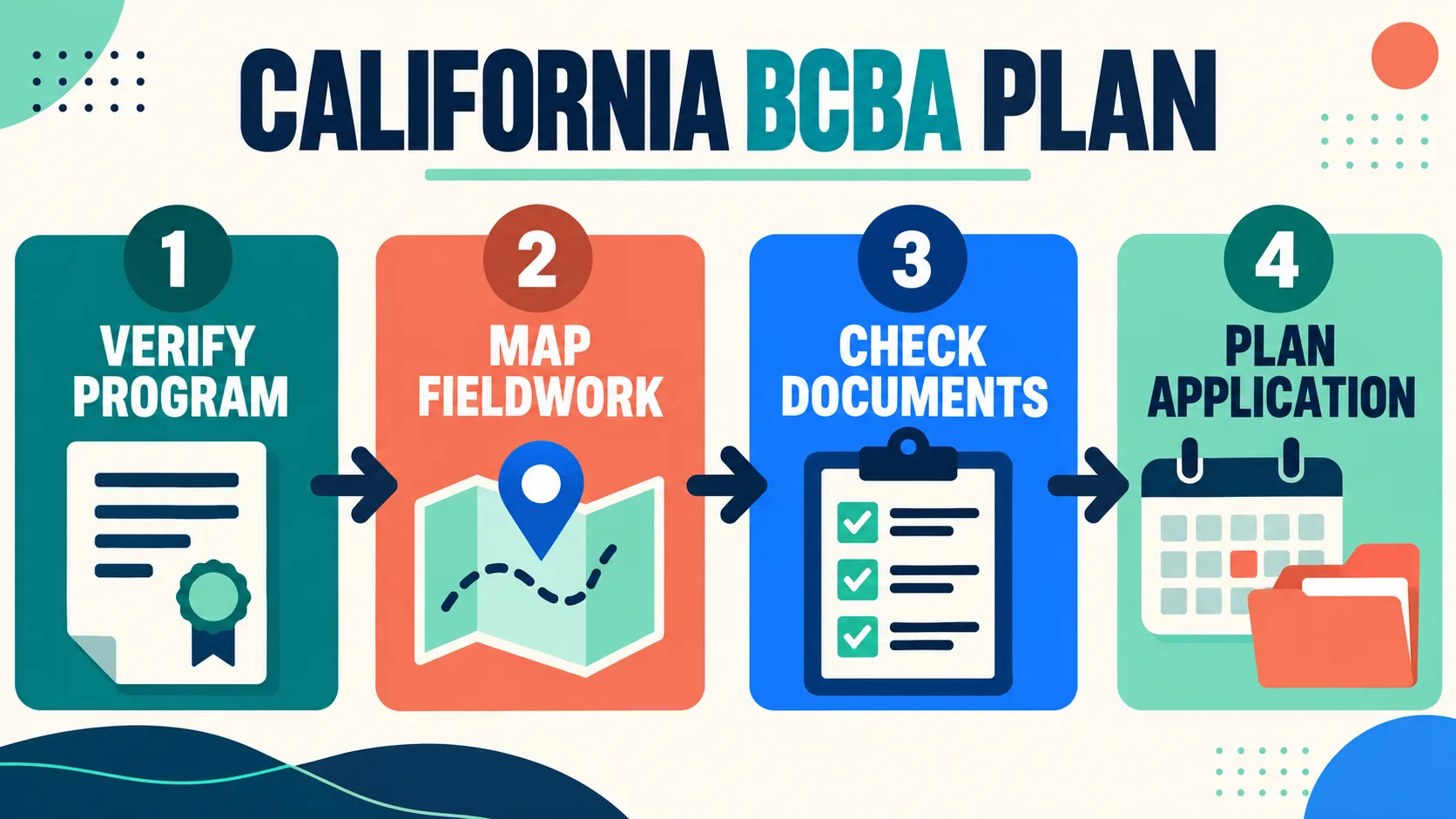
Before choosing a California master’s program or online coursework sequence, ask for evidence rather than a slogan. A program can be excellent academically and still require you to complete a separate fieldwork arrangement or use a particular attestation process. Verify the program against the BACB pathway that you expect to use when you apply.
- Identify whether the program is presenting a 2027 Pathway 1 accredited or recognized route, a Pathway 2 coursework route, or preparation for another credential.
- Ask which organization or program contact supplies the coursework attestation or accreditation evidence, and when that evidence becomes available.
- Map each required content area, hour allocation, grade rule, and one-calendar-year rule to an actual course and transcript line.
- Confirm who arranges supervised fieldwork, who supervises you, how monthly forms are completed, and whether your work is genuinely unrestricted when counted that way.
- Check whether the program’s California claims refer to certification, a school role, Medi-Cal enrollment, or an employer relationship. Those are different promises.
- Save the version date of every handbook, form, email, and program disclosure you use in your decision.
A useful test is to ask, “What document would prove this statement?” If the answer is a transcript, request a sample transcript. If it is a BACB attestation, ask who submits it and when. If it is a payer enrollment approval, ask which agency issues it. This evidence-first habit is more reliable than comparing program labels alone.
How should you plan the application timeline?
Use a decision timeline instead of a single promised number of months. Your pace depends on degree completion, coursework sequencing, fieldwork availability, supervisor capacity, documentation accuracy, and examination scheduling. A program may estimate a calendar length, but the BACB and California agencies decide whether your evidence meets their rules.
| Planning stage | Question to answer | Do not move forward until |
|---|---|---|
| Program choice | Which BACB pathway and application date am I planning for? | The program can show the relevant accreditation, recognition, or attestation path. |
| Fieldwork | Who supervises me, and how will every supervisory period be documented? | You understand the hours, observations, supervision percentage, and unrestricted activity rules. |
| Application | Are the transcript, forms, payment, and supporting documents complete for the applicable version? | You can verify the submission and keep a copy of everything sent. |
| California work | What does the employer, school, payer, or contract require after certification? | You have a written answer from the responsible organization, not a general internet summary. |
Budgeting belongs in the same plan. Tuition and exam costs are only part of the total; fieldwork may involve supervision, travel, background checks, professional liability coverage, or business setup. Review our guide to BCBA certification cost for a budgeting framework, then confirm current fees directly with the BACB, school, employer, and payer.
What mistakes should California BCBA candidates avoid?
- Assuming the word “California” changes the BACB’s national certification exam into a state exam.
- Confusing an active BCBA certification with payer enrollment or an employer’s credentialing approval.
- Using a 2026 program brochure as proof that the same coursework will satisfy a 2027 application.
- Counting fieldwork hours without checking the supervisor, monthly period, observation, individual, and unrestricted-activity rules.
- Assuming a school district, Medi-Cal plan, regional center, and private payer use the same definition of qualified provider.
- Relying on a generic statement that California does or does not require a license without checking the actual setting and current authority.
- Paying for an online program before confirming who supplies the required transcript, attestation, fieldwork, or accreditation evidence.
- Studying only for the exam while leaving application documents and transition dates until the last minute.
If you are already studying, use the requirements checklist to identify the next missing document or decision. Then review our practical guide on how long it takes to become a BCBA and make the timeline personal rather than treating a school’s estimate as a guarantee. When your study plan is ready, Take the Free BCBA Mock Exam to find content gaps and decide what to review next.
BCBA requirements California FAQ
Are BCBA requirements different in California?: The BACB eligibility requirements are national, but the work setting can add California-specific education, payer, employer, business, or contract checks. Separate the certification question from the permission-to-practice or billing question.
Does a California master’s degree automatically qualify me for the BCBA exam?: No. The degree, coursework evidence, pathway, fieldwork, application documents, and timing all matter. Ask the program which current BACB route it supports and what evidence will be available when you apply.
Is Medi-Cal QAS enrollment the same as BCBA certification?: No. QAS enrollment is a California Medi-Cal provider-enrollment process. An individual BCBA may be eligible to use the QAS application, but enrollment and certification are separate decisions with separate documentation.
Will the BCBA examination change on January 1, 2027?: The 2027 eligibility summary and the examination timeline should be read separately. The current BACB materials identify the 6th edition Test Content Outline as effective January 1, 2025; do not assume that an eligibility change automatically means a new exam version.
Bottom line: BCBA requirements in California begin with the BACB’s certification pathway, then branch according to where and how you will work. Verify the correct 2026 or 2027 evidence, keep certification separate from licensure and payer enrollment, and obtain setting-specific answers from the responsible California organization before you act.



