
BCBA Certification: A Stage-by-Stage Timeline
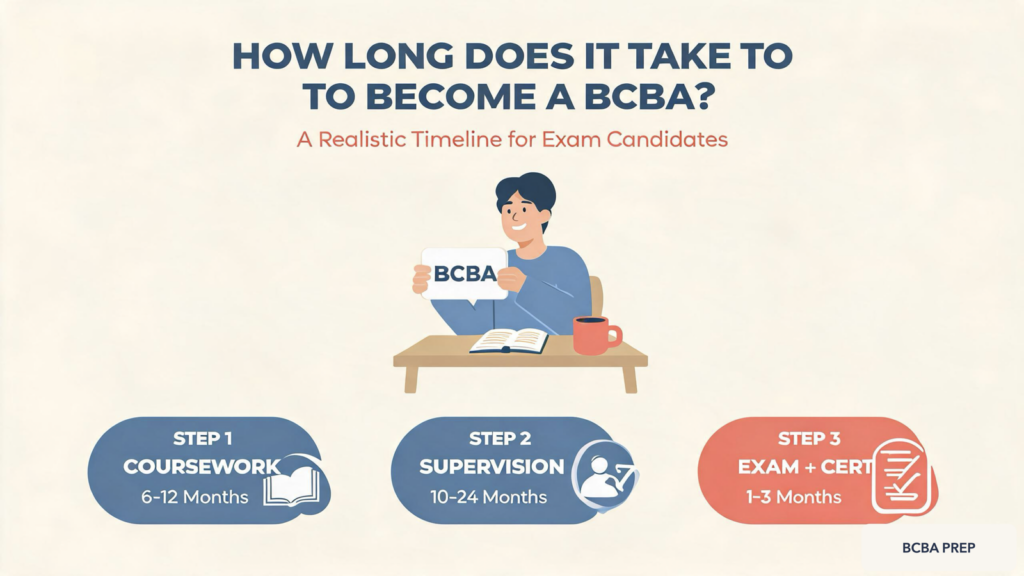
Becoming a Board Certified Behavior Analyst (BCBA) typically takes 4 to 6 years. The path includes a master’s degree, supervised fieldwork, and passing the BCBA exam. Here we break down each stage with realistic timeframes and key requirements.
Table of Contents
- BCBA Certification: A Stage-by-Stage Timeline
- Factors That Can Shorten or Lengthen Your BCBA Timeline
- ABA in Action: Real-World Examples Relevant to the Exam
- BCBA Exam Prep: Common Traps and How to Steer Clear
- Your BCBA Timeline Quick Checklist
- References
Understanding how long does it take to become a bcba helps you plan your journey and avoid unnecessary delays. The total time depends on your enrollment status, supervision availability, and study pace.
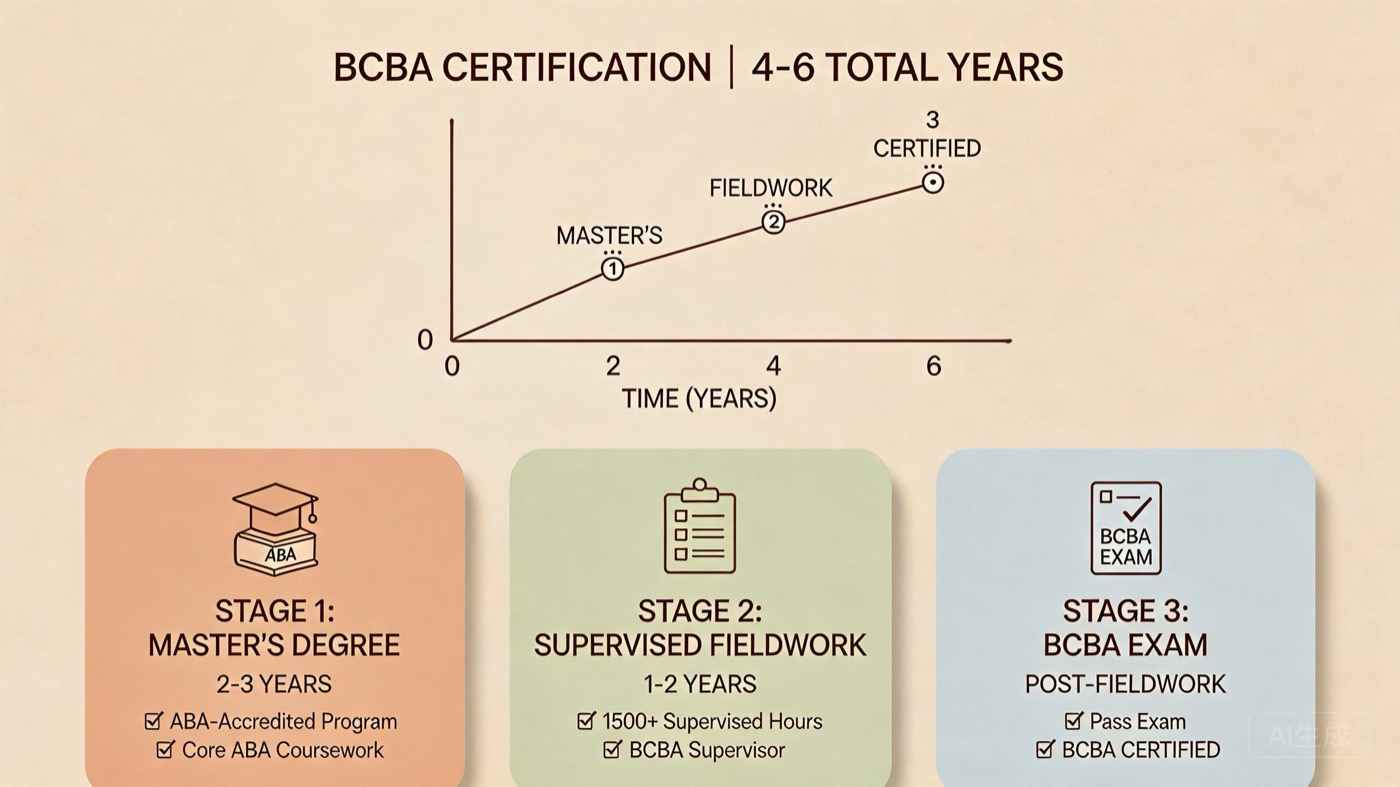
Master’s Degree Coursework (2–3 years)
You must complete a BACB-approved graduate program in applied behavior analysis (ABA) or a related field with specific coursework. Full-time students often finish in 2 years, while part-time students may need 3 or more. Programs typically require 30–45 credit hours, covering ABA principles, ethics, research methods, and behavior assessment. It’s crucial to verify your program’s accreditation early to ensure eligibility for the exam. Some universities offer accelerated options that can shorten this phase, but the standard duration remains 2–3 years depending on course load.
Supervised Experience Hours (1–2 years)
After or during your master’s, accumulate supervised fieldwork hours. Two pathways exist: 1,500 hours (concentrated) or 2,000 hours (standard). Most candidates go for concentrated to shorten the timeline. With consistent supervision, expect 12–18 months of data collection. Monthly targets are around 50–125 hours depending on the pathway. Supervision must be provided by a qualified BCBA, and you need to document every session meticulously. The BCBA requires at least 5% of your hours to be supervised, with at least 2 of those being individual. Planning ahead can prevent delays due to supervision gaps.
BCBA Exam Preparation (3–6 months)
Once your hours are approved, focus on exam prep. The BCBA exam tests your mastery of the BACB Task List. Dedicate at least 3–6 months of structured study, using mock exams and review materials to identify weak areas. Many candidates underestimate the time needed for content review and practice. Our BCBA Exam Prep page offers targeted resources. Consistent study sessions, such as 1–2 hours daily, can help you stay on track. Remember, exam eligibility requires submission of the final experience verification form to the BACB.
Factors That Can Shorten or Lengthen Your BCBA Timeline
Several variables influence your total duration. Recognize these factors to set realistic expectations.
Full-Time vs Part-Time Path
A dedicated full-time candidate may complete everything in 4 years: 2 for coursework, 1 for supervision, and 3 months of exam prep. Part-time students may take 6 years or more, especially if balancing work and family. However, some students combine coursework and supervision to overlap these phases and potentially reduce total time.
Common Delays and How to Avoid Them
- Incomplete prerequisites: Ensure your bachelor’s includes required courses or take them early. Prerequisites like ABA terminology might be offered as foundational courses.
- Supervision gaps: Secure a qualified BCBA supervisor before starting hours. Plan for backup in case of schedule changes. Joining local ABA groups can help find supervisors.
- Exam failure: Invest in quality study materials and take practice exams to simulate the real test. Many candidates benefit from group study or coaching.
- Documentation errors: Keep detailed records of supervision and hours. Use BACB-verified tracking tools to ensure compliance.
ABA in Action: Real-World Examples Relevant to the Exam
Understanding functional behavior assessment (FBA) and intervention design is crucial for both the exam and fieldwork. These examples illustrate common functions and exam-relevant strategies.
Example 1: Aggression Maintained by Escape
A child throws objects when asked to do math homework. The behavior consistently results in removal of the task. The hypothesized function is escape from demands. A function-based intervention might include teaching a request for a break and gradually increasing task demands. On the exam, identifying the maintaining function from ABC data is a core skill. Practice with mock scenarios is essential to differentiate escape from attention.
Example 2: Self-Injurious Behavior Maintained by Sensory Stimulation
A student hits their head against a wall when alone, and the behavior produces auditory and tactile feedback. This suggests automatic reinforcement. A common exam trap is overlooking this function and assuming social reinforcement. Always consider the context: if behavior occurs across settings when alone, sensory may be the cause. Interventions focus on providing alternative sensory input (e.g., vibration toys) and blocking the behavior safely.
Example 3: Disruptive Behavior Maintained by Attention
A child yells during independent work, and the teacher looks at and speaks to them. The function is attention. An appropriate plan uses differential reinforcement of alternative behavior (DRA) to teach appropriate requesting and extinguishes yelling by ignoring it (extinction). Remember to always teach a replacement behavior and ensure extinction is safe to implement.
BCBA Exam Prep: Common Traps and How to Steer Clear
Exam candidates often stumble on certain concepts. Being aware of these traps can boost your score.
Confusing Verbal Operants and Function
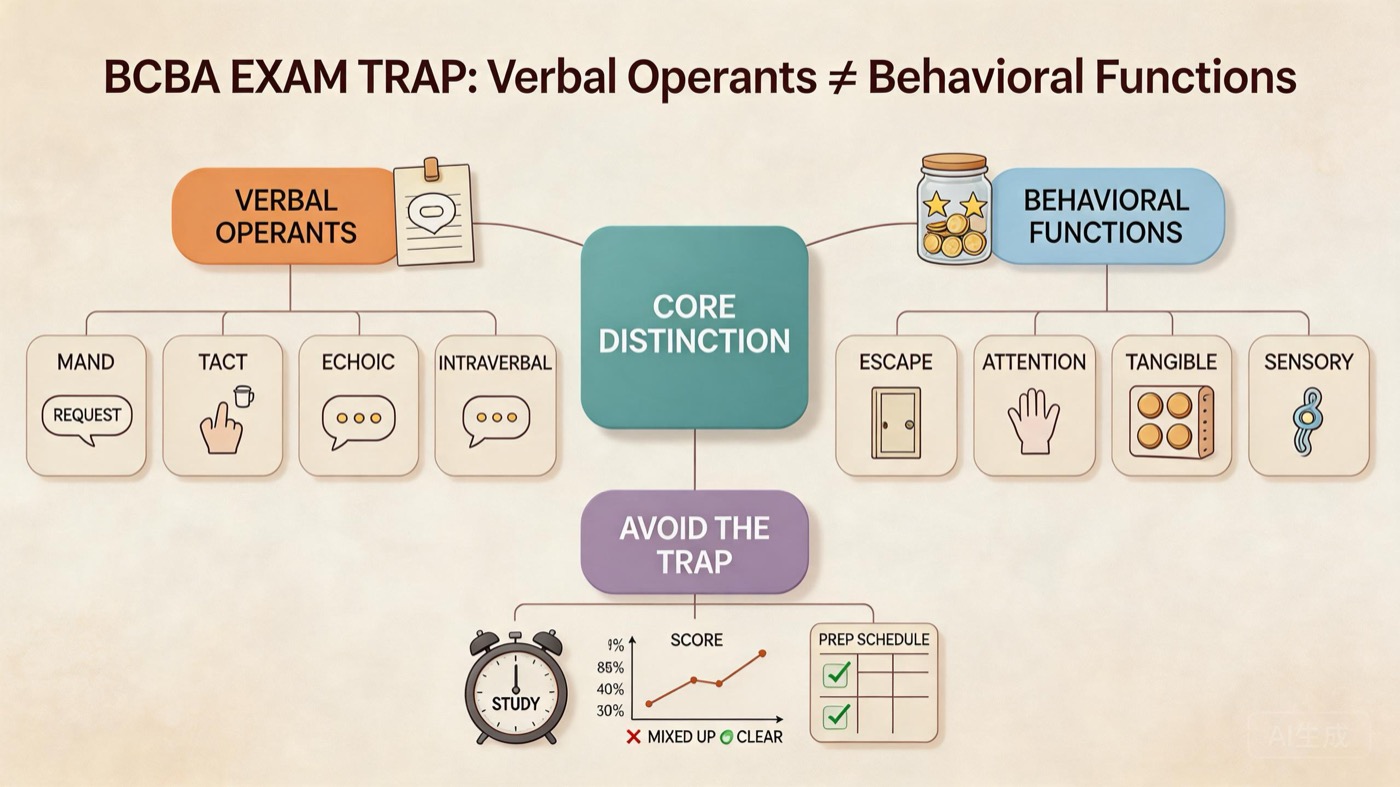
Verbal operants (mand, tact, echoic, intraverbal) are distinct from behavioral functions (escape, attention, tangible, sensory). A mand is a request under control of a motivating operation, while a tact is labeling under control of a stimulus. Use mnemonics like “MAND = Demand” to remember. Review the verbal operants frequently as they are heavily tested.
Misapplying Reinforcement Schedules
Fixed vs variable, ratio vs interval: these combinations are tested frequently. For example:
- Fixed Ratio (FR): Reinforcement after a set number of responses (e.g., FR 5).
- Variable Interval (VI): Reinforcement after a variable amount of time (e.g., VI 5 minutes).
- Common mistake: Thinking variable schedules always produce lower response rates. Actually, variable ratio (VR) often produces high, steady rates. Also, be careful about differentiating FR and VR from FI and VI on graphs.
Overlooking Ethics Questions
Ethics are a major part of the exam. Questions may involve conflicts of interest, confidentiality, or scope of competence. Always apply the BACB Ethics Code to scenarios. Practice with ethics vignettes to internalize principles.
Your BCBA Timeline Quick Checklist
Use this checklist to track your progress and stay on schedule.
Stage 1: Education
- Confirm your program is BACB-approved.
- Plan your course sequence to cover all required content areas.
- Complete prerequisite courses if not already done.
- Maintain a GPA that meets program requirements; some programs have minimums.
Stage 2: Supervision
- Find a qualified BCBA supervisor early.
- Set monthly hour goals: ~50–100 hours depending on your pathway.
- Document every supervision session and keep records.
- Track your monthly progress to ensure you meet the supervised vs unsupervised ratio.
Stage 3: Exam
- Register for the BCBA exam through the BACB.
- Use practice exams to assess readiness.
- Focus extra study on your weakest content areas.
- Create a study schedule for 3–6 months and stick to it.
The journey to becoming a BCBA requires dedication, but a clear timeline and proactive planning can make it manageable. Stay consistent with your studies and supervision, and you’ll be ready for the exam when the time comes.



