
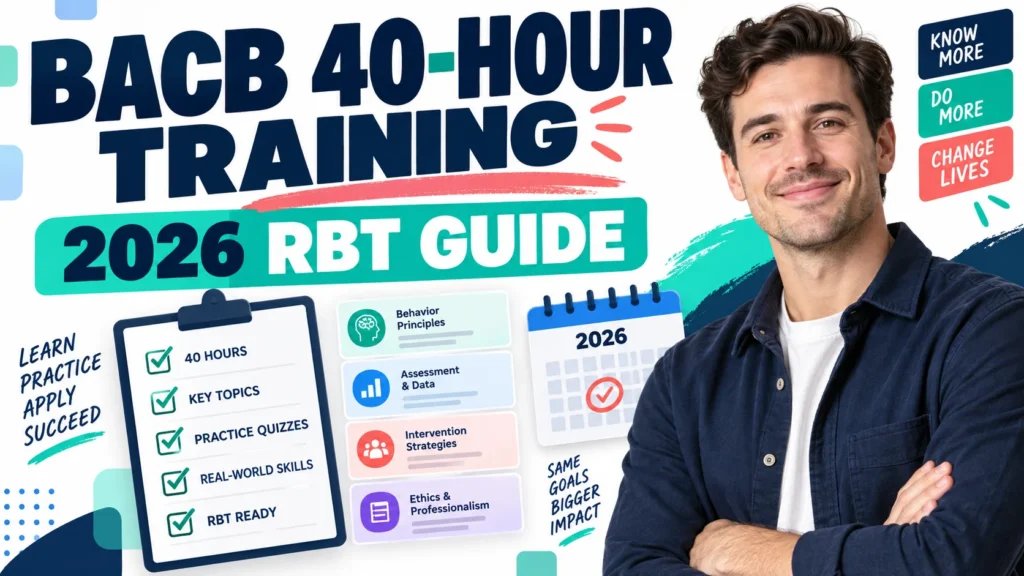
Quick answer: The current bacb 40 hour training requirements describe the 2026 training that new RBT applicants must complete before applying. The training must cover the BACB curriculum, total at least 40 hours, take place over no fewer than 5 days and no more than 180 days, include active learning such as modeling or role-play with feedback, and end with a complete certificate. The responsible trainer must also meet BACB qualifications and keep the training records.
Table of Contents
- What are the current bacb 40 hour training requirements?
- Who needs this training—and who does not?
- How long can the training take?
- What does the 2026 curriculum cover?
- What delivery, trainer, and certificate rules matter?
- How should you verify a course before paying?
- What mistakes should exam-prep readers avoid?
- BACB 40-hour training FAQ
- Official sources to check before enrollment
- Take the Free BCBA Mock Exam
One important boundary comes first: this is an RBT training requirement, not a BCBA graduate-course requirement, supervised BCBA fieldwork requirement, or promise that someone will pass an examination. BCBA candidates may encounter it when they supervise technicians, compare career steps, or consider RBT experience. Use the current BACB document as the authority, then use the checklist below to decide whether a course has the evidence you need. Table of Contents
What are the current bacb 40 hour training requirements?
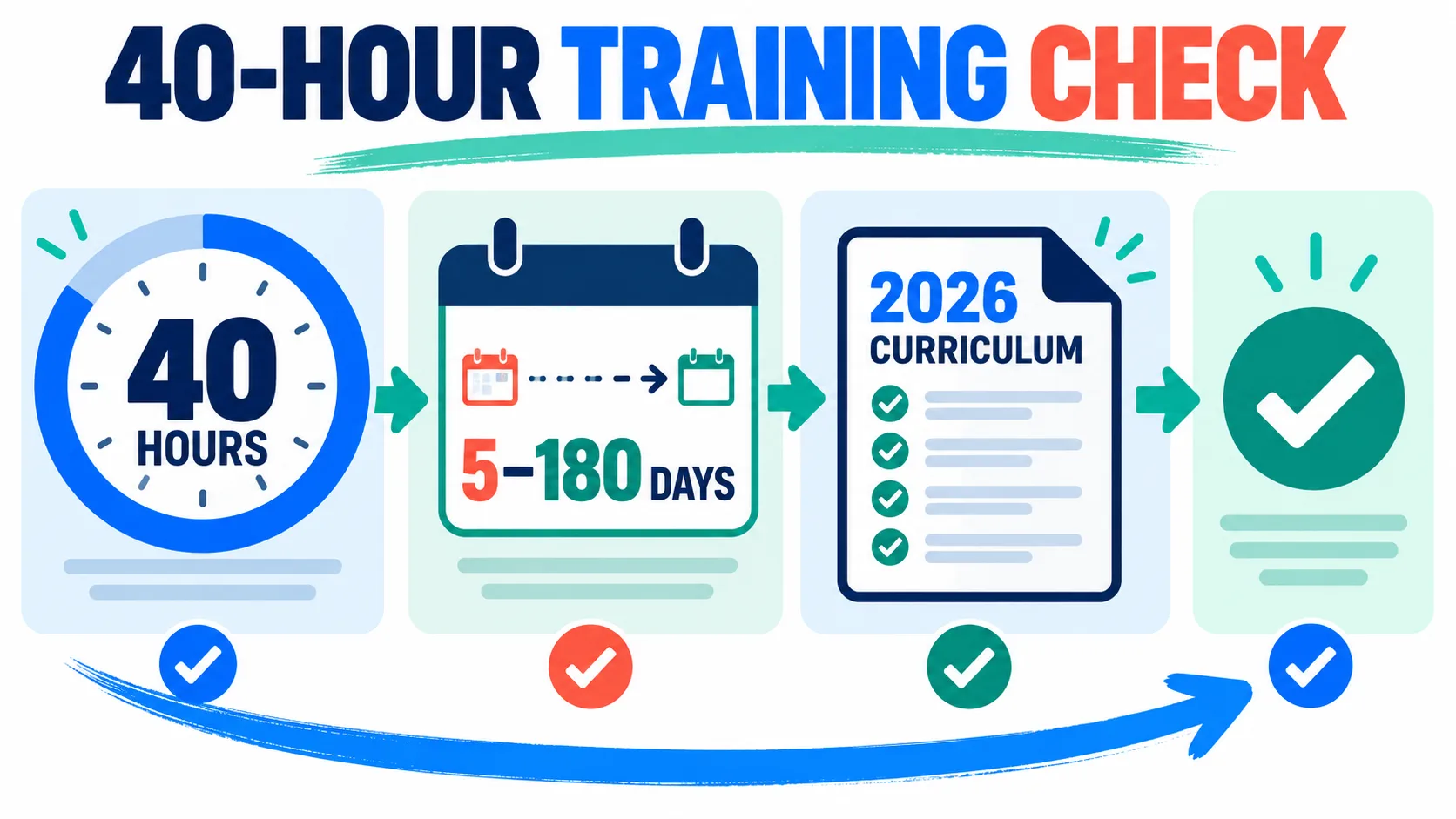
The BACB’s current RBT 2026 outline says that applicants applying on or after January 1, 2026, must complete training that meets the current requirements. The word “complete” matters: a course page that advertises 40 hours is not enough by itself. The content, time window, delivery method, responsible trainer, certificate, and supporting records must fit together.
At a glance, a compliant training plan should answer every question in this table. If a provider cannot answer one of them in writing, pause before paying and ask which current BACB document supports the claim.
| Checkpoint | Current rule to verify | Evidence to save |
|---|---|---|
| Total time | At least 40 hours of training covering the required outline | Provider schedule, time log, and certificate |
| Completion window | No fewer than 5 days and no more than 180 days | Start date, end date, and attendance records |
| Learning format | In-person, online, or a combination, with behavioral-skills-training components | Syllabus, activities, quizzes, role-play or modeling plan |
| Responsible trainer | Active BCaBA, BCBA, or BCBA-D who completed the 8-hour supervision training | Trainer name, certification number, and training documentation |
| Final record | A completed 2026 40-hour training certificate that includes the required fields and statement | One complete certificate plus your copy of the course records |
Who needs this training—and who does not?
This 40-hour curriculum is the core training requirement for a new RBT applicant. It is designed around behavior-technician service delivery: preparing for sessions, collecting and graphing data, assisting with assessments, implementing behavior-change procedures, documenting services, practicing ethically, and understanding the next certification steps. It is not a general “ABA course” label that automatically satisfies every credential.
For a BCBA candidate, the most useful way to interpret the scope is to separate the credentials and the tasks. An RBT may complete this training and then continue through the other RBT eligibility steps. A BCBA candidate has a different graduate-level education, fieldwork, application, and examination pathway. Someone can hold both credentials, but one training record does not replace the other credential’s requirements.
- RBT application: the 2026 40-hour training is a core prerequisite for a new applicant, subject to the other current eligibility steps.
- BCBA coursework: graduate behavior-analytic coursework is a separate education pathway and cannot be replaced by an RBT certificate.
- BCBA fieldwork: supervised fieldwork hours and their documentation are separate from technician training hours.
- Continuing education: a short webinar or reading-based activity is not automatically the same thing as the initial 40-hour training.
- Exam preparation: practice questions can support study, but they do not turn an incomplete course into compliant training.
How long can the training take?
The minimum is 40 hours, but the calendar window has two additional constraints: the training must take place over at least 5 days and must be completed within 180 days. Those rules prevent a provider from treating a short, single-session cram event or a course that remains open indefinitely as equivalent to the current training format.
The outline lists minimum durations that total 38 hours, leaving 2 unallocated hours that can be added to any section. That arithmetic is easy to miss. A syllabus can show eight sections and still be incomplete if it does not reach the full 40 hours. Conversely, the extra two hours do not create permission to omit a required content area.
| Schedule example | Likely issue | Better question |
|---|---|---|
| 40 hours completed in one weekend | The schedule is shorter than the 5-day minimum. | How is the course distributed across at least five days? |
| A self-paced course open for a year | The completion window may exceed 180 days. | What dates will appear on the certificate and attendance log? |
| 30 hours of videos plus 10 hours of assigned reading | Assigned reading cannot count toward the overall training duration. | What active training activities account for all 40 hours? |
If a provider changes the schedule after you enroll, keep both versions and ask for a corrected record. The date range and time completed should be internally consistent. A certificate that says 40 hours but does not show the start and end dates, or conflicts with the provider’s attendance record, creates an avoidable documentation problem.
What does the 2026 curriculum cover?
The current outline has eight sections. The largest block is behavior-change interventions, but the training is broader than intervention procedures. It also covers how a technician prepares for service, describes and measures behavior, assists with assessments, protects confidentiality, communicates with supervisors, and behaves professionally. The sections can be taught in a different order, but the content cannot simply disappear.
- Introduction to Applied Behavior Analysis — 2 hours: service delivery, the three-term contingency, reinforcement, common behavior functions, elementary verbal operants, and intervention phases.
- Preparing for Service Delivery — 1 hour: reviewing prior documentation, preparing materials and the environment, building rapport, and gaining assent.
- Data Collection and Graphing — 3 hours: observable definitions, measurement procedures, calculations, graphs, data entry, and timely reporting of changes.
- Assisting with Behavior Assessments — 3 hours: skill-based, preference, and functional assessment support, including preparation, data collection, and summaries.
- Behavior-Change Interventions — 20 hours: procedural integrity, reinforcement systems, discrete-trial and naturalistic teaching, prompting, discrimination, differential reinforcement, extinction, shaping, antecedent strategies, generalization, self-monitoring, and crisis intervention.
- Service Delivery Documentation and Reporting — 3 hours: confidentiality, objective notes, timely reports, changes that may affect progress, and communication with the supervisor and team.
- Ethics and Professionalism — 5 hours: the RBT Ethics Code 2.0, consumer protection, cultural humility, multiple relationships, public statements, misconduct reporting, professional conduct, and effective supervision.
- Next Steps in the Certification Process — 1 hour: remaining eligibility steps, the RBT examination, supervision, ethics, self-reporting, certification statuses, and recertification.
For exam preparation, the high-value distinction is between recognizing a term and applying it in service delivery. For example, an RBT should not merely define operational measurement; the trainee should know how an observable definition changes what gets recorded. Likewise, “prompting” is not a license to improvise a procedure. The trainee works within the supervisor’s plan and reports data and concerns through the proper channel.
What delivery, trainer, and certificate rules matter?
The BACB allows the training to be online, in person, or a combination. Format alone does not determine quality. The course must include components of behavioral skills training, such as didactic instruction, video or in-vivo modeling with examples and nonexamples, role-play with feedback, quizzes, interactive activities, or instructor-led discussion. Assigned readings may supplement the course, but they cannot be counted as training time.
The responsible trainer must be an active BCaBA, BCBA, or BCBA-D who has completed the 8-hour supervision training. That person designs and oversees the program, identifies themselves on the documentation, checks the quality of assistant-delivered portions, and maintains records. An assistant trainer may hold an RBT certification or higher, but the responsible trainer remains accountable for the overall training.
The trainer relationship also matters. During the training, the responsible trainer and assistant trainers may not be related to, subordinate to, or employed by the trainee. The outline clarifies that payment made by the trainee for training services is not itself employment, but a provider should still explain who is serving in each role and how the arrangement is documented.
The certificate must be a single completed document. It should include the trainee’s name and BACB ID, training start and end dates, the amount of time spent in training, the responsible trainer’s name and certification number, a signature or company branding, and any assistant trainer names and certification numbers. It must also include the statement that the program is designed to meet the 2026 RBT training eligibility requirement and is offered independent of the BACB.
- Ask for the responsible trainer’s full name and certification number before enrollment.
- Confirm that the responsible trainer completed the required 8-hour supervision training.
- Check whether assistants are identified and whether their certification information will appear.
- Confirm that the certificate will show dates and actual time, not only a generic completion label.
- Save the syllabus, attendance or activity log, certificate, and provider communications together.
- Look for the independence statement on the provider’s online and printed materials.
The BACB outline also says that the responsible trainer must retain training documentation for at least 7 years and may be subject to an audit. That does not mean every trainee will be audited, but it does mean that “I deleted the attendance record after issuing the certificate” is not a sound provider practice.
How should you verify a course before paying?
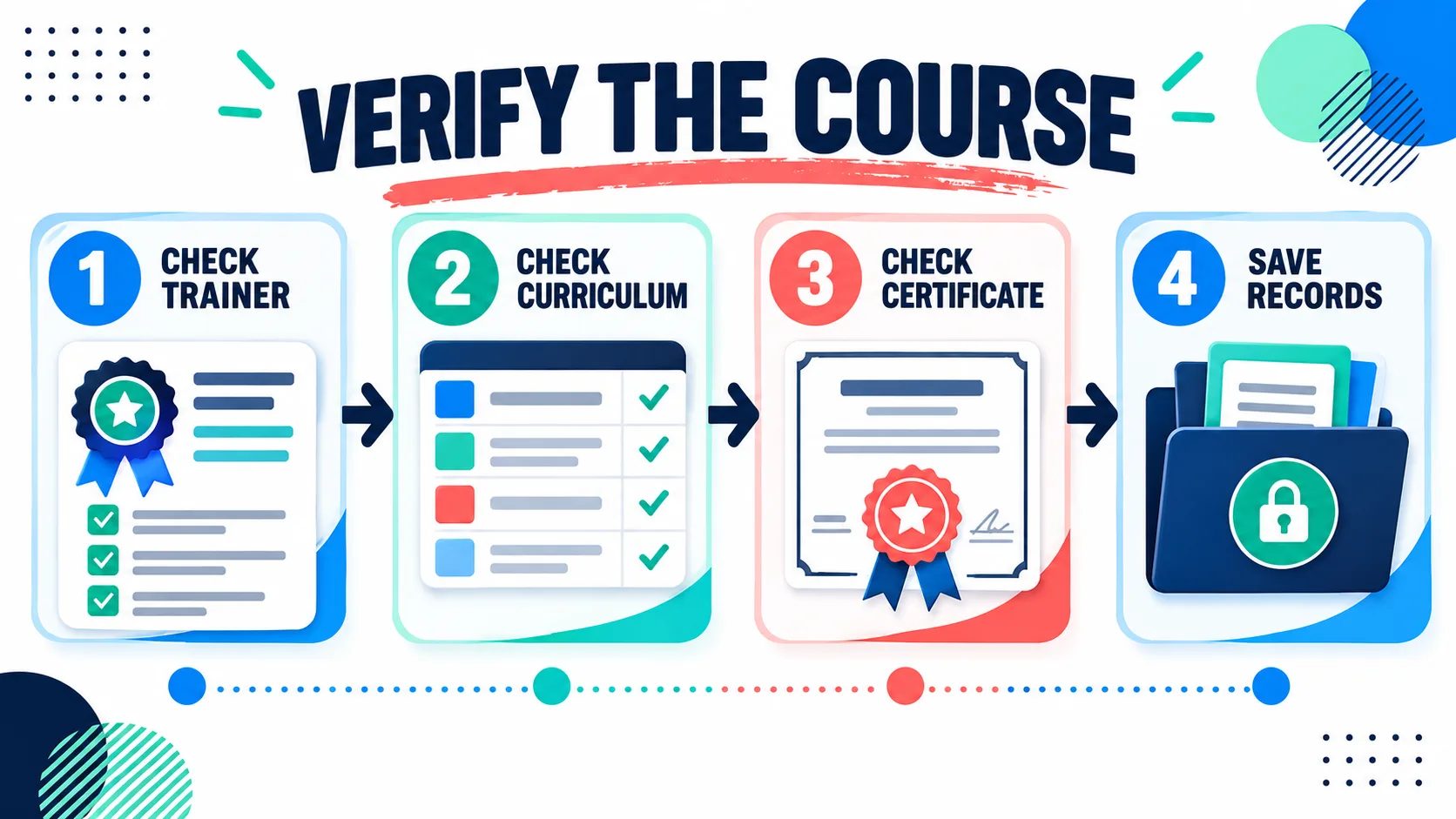
Use an evidence-first screen, especially when comparing an online course, a low-cost offer, or a provider that uses phrases such as “BACB approved.” The BACB requirements are the authority; a provider should not imply that the BACB endorses its business unless the current official source explicitly says so. Ask for documents, not just badges or testimonials.
- Match the credential: confirm the course is for the RBT 2026 40-hour requirement, not BCBA coursework, CEUs, or a different technician credential.
- Check the calendar: verify that the schedule spans at least 5 days and ends within 180 days of the start date.
- Inspect the hour map: add the curriculum section times and confirm that the plan reaches 40 hours without counting assigned reading.
- Find active practice: ask where modeling, nonexamples, role-play with feedback, quizzes, interactive activities, or discussion occur.
- Verify the responsible trainer: confirm the credential, certification number, 8-hour supervision training, and oversight role.
- Review the certificate sample: look for every required field and the exact independent-of-BACB statement.
- Clarify records: ask how attendance, partial completion, trainer assignments, and corrections are retained.
Red flags include a one-day “40-hour” boot camp, a course that counts reading as all of its hours, a certificate with no trainer certification number, a provider that refuses to identify the responsible trainer, or a sales page that promises RBT certification simply because you paid. A course may be inexpensive and still be well organized; price is not the compliance test. Evidence is.
What mistakes should exam-prep readers avoid?
Readers preparing for the BCBA exam often recognize a familiar ABA term and then overgeneralize it. The same problem appears with credential requirements. A question about the 40-hour RBT course is not answered by quoting BCBA fieldwork hours, and a question about BCBA eligibility is not answered by presenting an RBT certificate.
- Confusing an RBT training certificate with a BCBA degree, coursework sequence, or fieldwork record.
- Assuming “online” means the provider may skip role-play, feedback, quizzes, or other active learning.
- Counting assigned reading toward the 40 hours when the BACB outline excludes it.
- Ignoring the 5-day minimum because the course advertises a fast completion date.
- Ignoring the 180-day maximum because the course remains open indefinitely.
- Treating the phrase “BACB approved” as proof when the provider has not shown a current official basis.
- Saving only a payment receipt and not the syllabus, dates, trainer details, certificate, and activity records.
When a practice question gives you a training scenario, identify the credential first, then locate the controlling document. Ask whether the issue is time, content, delivery, trainer qualification, documentation, or the boundary between credentials. That sequence is more reliable than choosing the option with the most familiar ABA vocabulary.
After you have reviewed the bacb 40 hour training requirements study check, a free BCBA mock exam can help you identify broader study gaps in measurement, ethics, supervision, and intervention logic. It is a practice tool—not an official BACB exam, a leaked question source, or a pass guarantee. For the role boundary itself, you can also review our guides to RBT supervision frequency and the RBT and ABAT ethics code.
BACB 40-hour training FAQ
Can I finish the BACB 40-hour training in one day?: Not under the current 2026 outline. The training must take place over no fewer than 5 days, even though the total training time is at least 40 hours. A provider should show the schedule and the dates that will appear in the training record.
Do assigned readings count toward the 40 hours?: No. Assigned readings may support learning, but the current BACB outline says they may not count toward the overall training duration. Ask how the provider accounts for the full 40 hours through instruction and active learning activities.
Does an online course need live role-play?: The rule is about including components of behavioral skills training, not about using one single delivery format. The outline lists options such as modeling, in-vivo role-play with feedback, quizzes, interactive activities, and instructor-led discussion. Ask the provider exactly how the online course delivers and records those components.
Is the 40-hour RBT course a BCBA exam requirement?: No. It is an RBT training requirement. BCBA candidates follow a separate graduate-level certification pathway with its own education, supervised fieldwork, application, and examination requirements. The two credentials can appear in the same career path, but their evidence should not be combined.
Official sources to check before enrollment
- BACB RBT 2026 40-Hour Training Requirements and Curriculum Outline
- BACB RBT 2026 curriculum and certificate PDF
- BACB RBT application resources
- BACB supervision, assessment, training, and oversight hub
- BACB task lists and test content outlines
Bottom line: A current RBT 40-hour training plan is more than a number on a sales page. Verify the eight content sections, the 40-hour total, the 5-to-180-day window, active learning, trainer qualifications, certificate fields, independence statement, and recordkeeping. If you are studying for BCBA certification, keep this RBT requirement in its proper lane and use official BACB materials for the credential you are actually pursuing.
Take the Free BCBA Mock Exam
When you are ready to apply the idea, use the free practice resource below for additional feedback. Take the Free BCBA Mock Exam



