
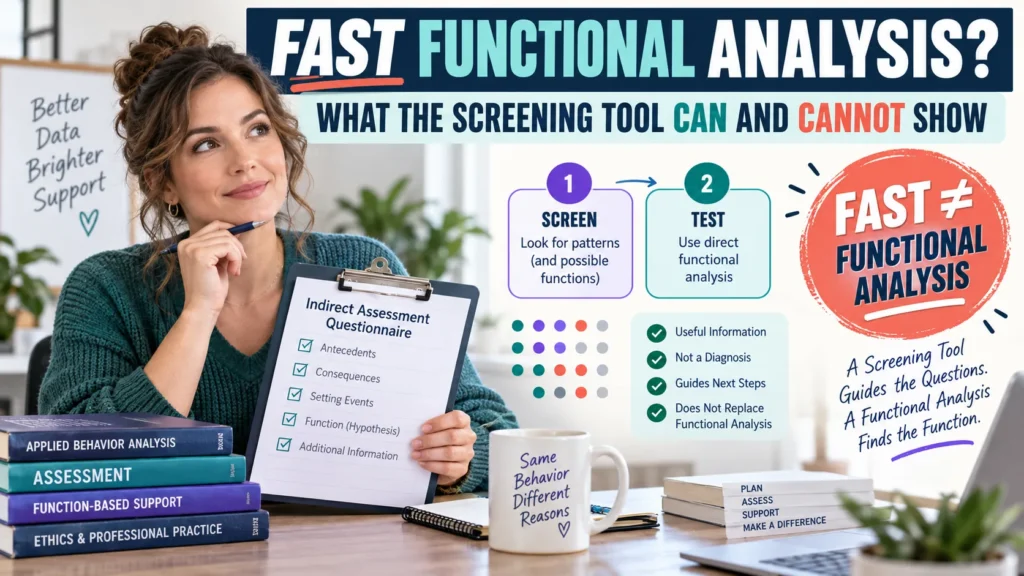
If you search for fast functional analysis while studying for the BCBA exam, the phrase usually points to a common abbreviation problem: FAST is the Functional Analysis Screening Tool, while a functional analysis is an assessment arrangement that systematically tests functional relations. FAST can help organize informant reports and suggest hypotheses. It does not, by itself, demonstrate the function of behavior.
Table of Contents
- What Does “Fast Functional Analysis” Mean?
- What Is the Functional Analysis Screening Tool?
- Why Isn’t FAST a Functional Analysis?
- What Did the Original FAST Research Show?
- How Should You Interpret a FAST Result?
- Worked BCBA-Style Example
- Common FAST and Functional-Analysis Exam Traps
- Frequently Asked Questions
- Bottom Line
- Take the Free BCBA Mock Exam
The safest exam rule is simple: identify the source of the information and ask whether the relevant environmental variables were experimentally arranged. A questionnaire can guide the next step. A functional analysis uses direct measurement and arranged conditions to evaluate differential responding. Those are related steps, not interchangeable names.
Study boundary: this article explains the terminology and reasoning pattern for BCBA preparation. It is not a client-specific assessment protocol or treatment recommendation. A qualified behavior analyst must select and implement assessment procedures that fit the client, context, risk, consent, and professional requirements.
What Does “Fast Functional Analysis” Mean?
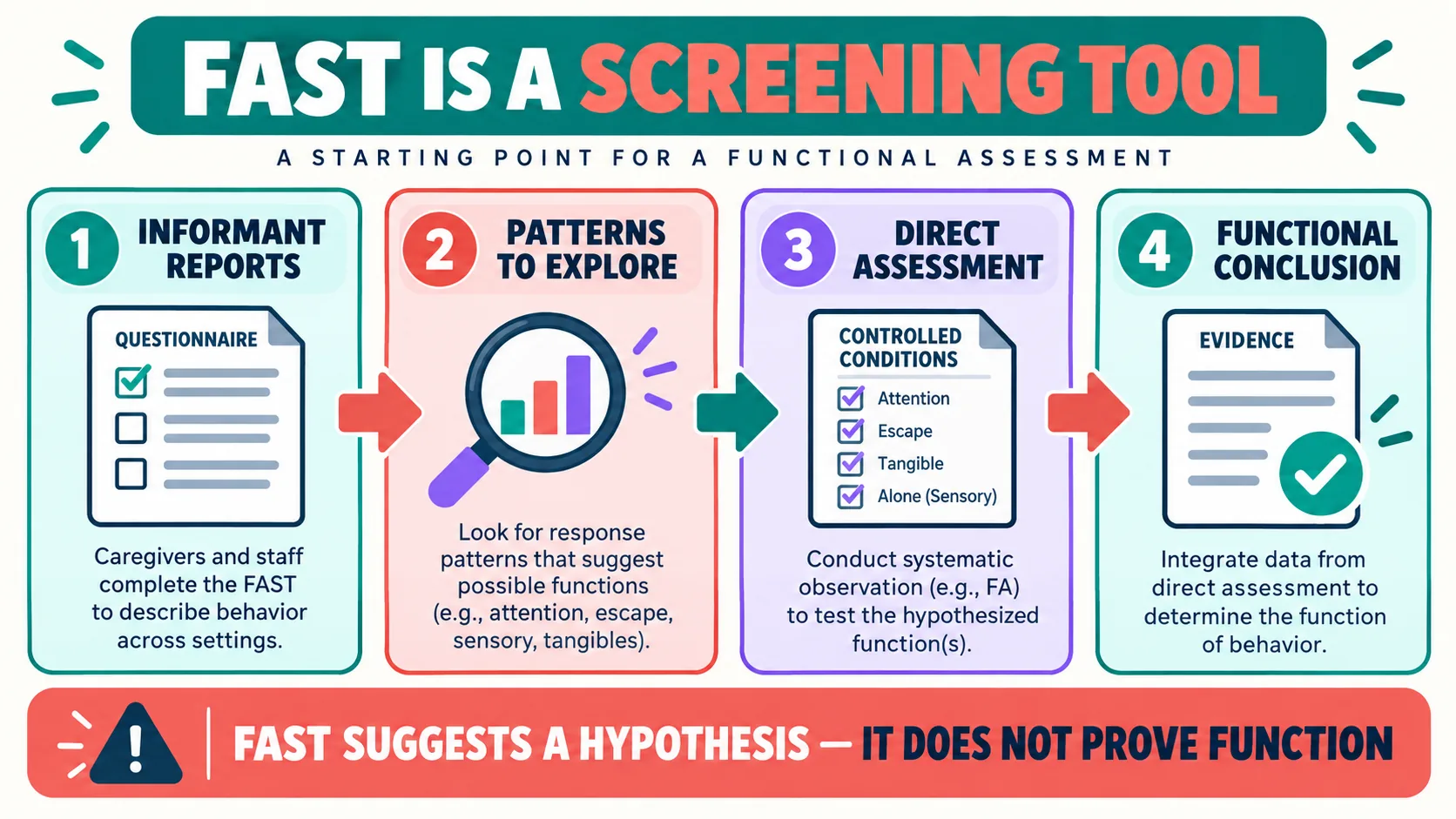
In a behavior-analysis search, “fast” is most often an acronym rather than a promise that a functional analysis can be completed quickly. The Functional Analysis Screening Tool is a structured indirect assessment. It asks an informant about events that may occur before and after problem behavior, then organizes responses into possible sources of reinforcement.
That makes FAST useful as a starting point for assessment conversations. It does not make the tool a shortened version of an experimental functional analysis. If a question describes a caregiver or staff member completing a questionnaire, think indirect assessment. If it describes arranging attention, escape, tangible, or alone conditions and measuring behavior across those conditions, think functional analysis.
What Is the Functional Analysis Screening Tool?
The original FAST research describes a 16-item questionnaire about antecedent and consequent events that may be correlated with problem behavior. Its items are organized around four possible functional categories: social-positive reinforcement, social-negative reinforcement, automatic-positive reinforcement, and automatic-negative reinforcement. In plain language, the categories ask whether behavior may relate to attention or preferred items, escape from tasks or interaction, sensory stimulation, or relief from discomfort.
The word screening is important. A screening tool helps structure information that may otherwise be incomplete or inconsistent. It can be efficient and clinically useful, but it depends on what the informant knows, remembers, and interprets. The result is therefore a hypothesis about conditions to examine—not a direct observation of every event and not a causal conclusion. What FAST can contribute: Use the points below as a quick study guide.
- a consistent set of questions for an interview;
- a way to organize reported antecedent and consequent patterns;
- a prompt to compare reports from more than one informant;
- a preliminary indication of which conditions may deserve closer assessment; and
- a study example for distinguishing indirect assessment from experimental analysis.
What FAST cannot establish alone: Use the points below as a quick study guide.
- that a reported event caused the behavior;
- that the highest score is the confirmed maintaining reinforcer;
- that a treatment should begin without additional assessment and professional judgment; or
- that a client’s behavior has one fixed function across people, settings, or time.
Why Isn’t FAST a Functional Analysis?
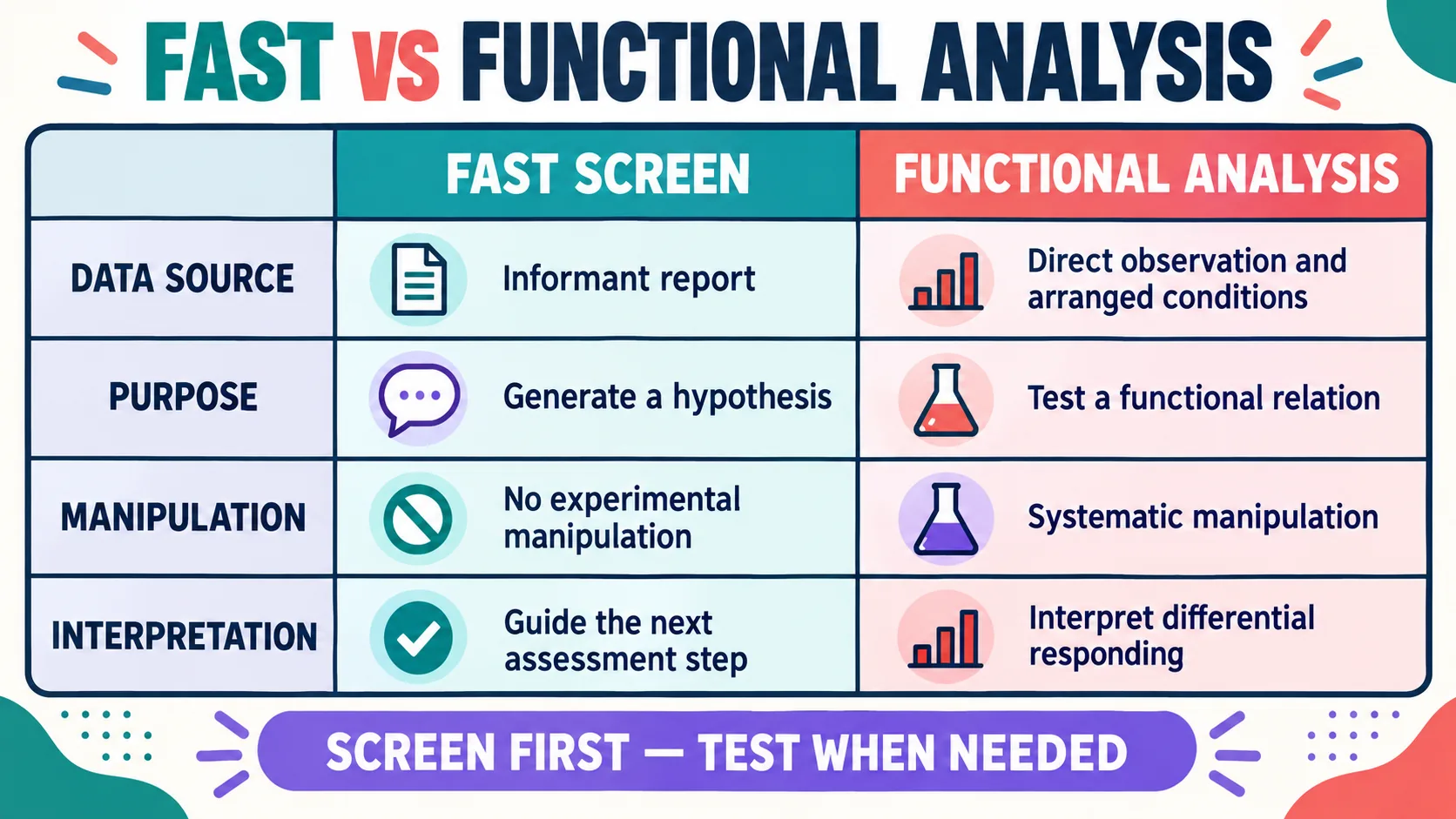
A functional analysis is defined by its experimental logic, not by the presence of the word “function.” The analyst arranges relevant conditions, measures the target behavior, and compares responding across conditions. The purpose is to evaluate whether systematic changes in an environmental variable are associated with differentiated behavior.
| Feature | FAST screen | Functional analysis |
|---|---|---|
| Data source | Informant report about behavior and context | Direct measurement during arranged conditions |
| Purpose | Generate or refine a hypothesis | Test a functional relation |
| Manipulation | No experimental manipulation is created by the questionnaire | Relevant environmental variables are systematically arranged |
| Interpretation | Guide the next assessment question | Interpret differential responding within the design and data limits |
The current BACB BCBA Test Content Outline places functional analyses within behavior assessment. That exam connection does not turn every functional-assessment tool into a functional analysis. Read the method described in the stem, then decide what kind of inference its data can support.
What Did the Original FAST Research Show?
The original study by Iwata, DeLeon, and Roscoe evaluated the FAST as an indirect assessment rather than presenting it as a replacement for experimental analysis. In one part of the study, pairs of informants completed the questionnaire for problem behaviors and the researchers examined agreement. In another part, FAST outcomes were compared with results from functional analyses.
The reported results are useful for understanding the tool’s limits. Mean item-by-item agreement was 71.5%, agreement on the highest FAST outcome was 64.8%, and the FAST outcome corresponded to the functional-analysis condition with the highest rate of problem behavior in 44 of 69 comparisons, or 63.8%. Those are study findings under the studied conditions, not an accuracy guarantee for every person, informant, setting, or behavior.
Read the original Journal of Applied Behavior Analysis study for the methods and limitations. The paper’s framing is the key exam lesson: the FAST can be helpful in a clinical interview, but the tool was not designed to supplant a functional analysis.
How Should You Interpret a FAST Result?
When an exam question gives you a FAST score or a completed questionnaire, use a disciplined sequence. Do not jump from the largest total to a treatment recommendation.
- Identify the assessment type. A questionnaire completed by an informant is indirect assessment data.
- Identify the target behavior. FAST questions should be tied to a defined behavior, not a vague label such as “acting out.”
- Read the highest category as a hypothesis. It tells you what reported contingency may deserve closer examination.
- Look for direct or experimental evidence. Ask whether observations, ABC data, or an appropriate functional analysis support or challenge the report.
- Choose the next defensible step. The best answer may be to gather more information, consult the relevant professional, or design a safe assessment—not to declare the function confirmed.
Informant disagreement does not automatically mean that one person is careless. Different people may observe different settings, response forms, establishing operations, consequences, or time periods. The disagreement is information to investigate. It may point to a context-specific pattern rather than a single universal function.
Worked BCBA-Style Example
Suppose a teacher and a parent complete a FAST for the same student’s property destruction. The teacher’s responses produce the highest total in the escape-related category, while the parent’s responses produce the highest total in the attention-related category. A study question asks what the BCBA should conclude.
The strongest answer is not “the behavior has two confirmed functions” and not “the teacher’s score is correct.” The FAST results suggest that the behavior may vary by setting or consequence. The next step is to define the behavior, review the contexts represented by each informant, collect direct information, and determine whether an assessment arrangement is appropriate and safe. A functional analysis would require systematic conditions and measurement; the two FAST forms alone do not provide that evidence.
- Good inference: reported patterns differ across informants and should guide further assessment.
- Overreach: the highest questionnaire score proves the maintaining reinforcer.
- Exam clue: the question is testing the boundary between indirect hypothesis generation and experimental demonstration.
Common FAST and Functional-Analysis Exam Traps
- Trap 1: Treating FAST as “fast functional analysis.” The acronym names a screening questionnaire in this context; it does not describe a shortened experimental design.
- Trap 2: Confusing a high score with causation. A reported correlation is not the same as a demonstrated functional relation.
- Trap 3: Calling every observation a functional analysis. Direct observation may be descriptive. Experimental analysis requires an appropriate arrangement and comparison.
- Trap 4: Assuming one function everywhere. Function can vary with setting, operation, response form, and consequence history.
- Trap 5: Using the tool as a treatment plan. Assessment information must be interpreted with client safety, ethics, context, and professional competence in view.
Frequently Asked Questions
Is FAST the same as a functional behavior assessment?: No. FAST is one indirect assessment tool that may be used within a broader functional behavior assessment process. A functional behavior assessment can draw on records, interviews, direct observation, and experimental analysis as appropriate. The tool does not define the entire assessment.
Does FAST identify the function of behavior?: It can suggest possible functional categories based on informant responses. “Suggest” is the important verb. The result should be compared with direct information and, when appropriate, an experimental functional analysis before it is treated as evidence of a functional relation.
Why would different people get different FAST results?: Informants may see the behavior under different demands, routines, relationships, and consequences. They may also describe different response forms. Divergent results should prompt context-specific investigation rather than a rushed decision about which informant is right.
What should I remember for the BCBA exam?: Remember the chain: indirect report can generate a hypothesis; direct observation can describe patterns; an appropriately designed functional analysis tests a functional relation. Match the conclusion to the method and do not claim more control than the design supports.
Bottom Line
In BCBA study language, fast functional analysis is usually a search for the Functional Analysis Screening Tool and its relationship to functional analysis. FAST is useful for organizing informant reports and selecting the next assessment question. It is not a direct test, a diagnosis, a treatment plan, or proof of behavioral function by itself.
After you can classify the method, practice reading short scenarios for the evidence they actually provide. The free BCBA mock exam can be used as an unofficial practice checkpoint for assessment and experimental-design distinctions. Review each explanation as study feedback; it is not official BACB content, a clinical protocol, or a guarantee of an exam result.
Take the Free BCBA Mock Exam
When you are ready to apply the idea, use the free practice resource below for additional feedback. Take the Free BCBA Mock Exam



