
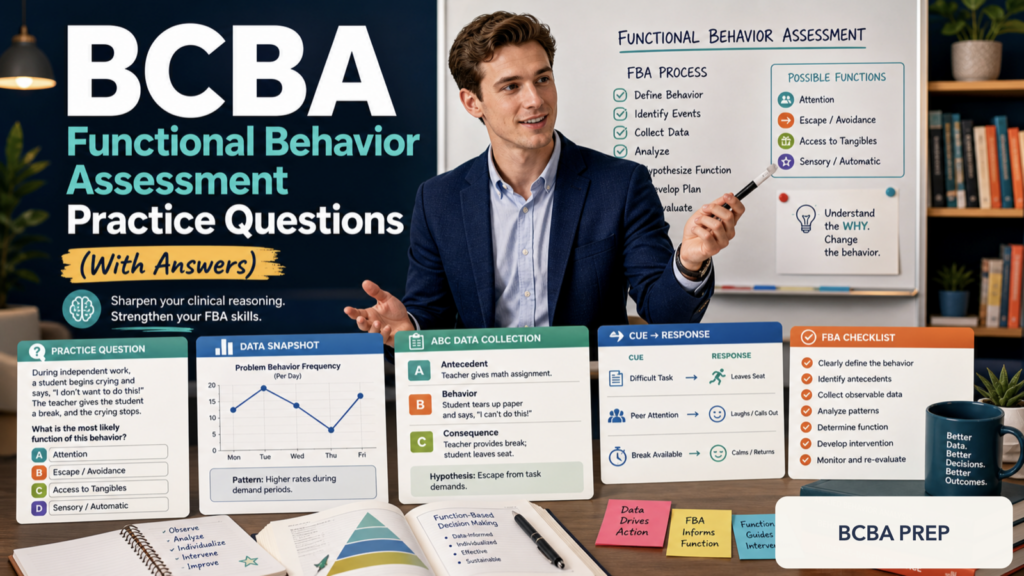
Master Functional Behavior Assessment with Realistic BCBA Practice
Sharpen your FBA knowledge with scenario-based questions designed to mirror the BCBA exam. Each question includes a detailed rationale to help you understand the reasoning behind the correct answer.
Table of Contents
- Master Functional Behavior Assessment with Realistic BCBA Practice
- BCBA Functional Behavior Assessment Practice Questions
- Common Traps to Avoid in FBA Questions
- FBA Exam Prep Checklist
- Test Your Readiness with Our Free BCBA Mock Exam
- Frequently Asked Questions About BCBA FBA Questions
- References
Test your ability to identify functions of behavior, select assessment methods, and interpret data—all critical skills for the BCBA exam.

BCBA Functional Behavior Assessment Practice Questions
Try these 5 scenario-based FBA questions and check your answers with explanations.
Question 1: Identifying Function of Behavior
Scenario: A student in a classroom frequently throws his pencil when given a difficult worksheet. After throwing the pencil, the teacher removes the worksheet and gives him a different, easier task.
Prompt: What is the most likely function of the pencil throwing behavior?
- A. Access to tangibles
- B. Escape from demand
- C. Automatic reinforcement
- D. Attention
Correct Answer: B
Why This Answer Is Correct: The behavior results in removal of the difficult worksheet, which is an aversive demand. This negative reinforcement (escape) maintains the behavior.
Why the Other Options Are Wrong:
- Access to tangibles: The student does not gain access to a preferred item; instead, a task is removed.
- Automatic reinforcement: The behavior is maintained by environmental consequences, not sensory stimulation.
- Attention: There is no indication that the teacher’s attention (e.g., reprimand) follows the behavior; the teacher removes the task.
Exam Trap: Don’t confuse escape with attention. Always look at what happens immediately after the behavior. Here, the demand is removed.
Question 2: Functional Analysis Conditions
Scenario: A behavior analyst conducts a functional analysis for self-injurious behavior (SIB). In one condition, the therapist provides a brief reprimand each time SIB occurs. In another condition, the therapist ignores the behavior. SIB occurs most during the reprimand condition.
Prompt: What function does the reprimand condition test?
- A. Escape
- B. Attention
- C. Tangible
- D. Alone/automatic
Correct Answer: B
Why This Answer Is Correct: This is a typical attention condition: the therapist delivers attention (reprimand) contingent on the behavior. High rates in this condition suggest attention maintains the behavior.
Why the Other Options Are Wrong:
- Escape: In escape conditions, the therapist removes a demand; no demand is present here.
- Tangible: Tangible conditions involve providing access to a preferred item, not attention.
- Alone/automatic: In alone conditions, the person is left alone with no consequences; here, consequences are delivered.
Exam Trap: Even though a reprimand is not positive attention, it still functions as attention (social positive reinforcement).
Question 3: Interpreting Functional Analysis Data
Scenario: A functional analysis graph shows that SIB occurs at high rates in the alone condition, but at near-zero levels in all other conditions (attention, escape, tangible).
Prompt: What is the most likely function of SIB?
- A. Social positive reinforcement (attention)
- B. Social negative reinforcement (escape)
- C. Automatic reinforcement
- D. Multiple functions
Correct Answer: C
Why This Answer Is Correct: When behavior persists in the absence of social consequences (alone condition), it is maintained by automatic reinforcement (sensory stimulation).
Why the Other Options Are Wrong:
- Attention: SIB did not occur during the attention condition, ruling out social positive reinforcement.
- Escape: SIB did not occur during the escape condition, ruling out social negative reinforcement.
- Multiple functions: Only one condition showed elevated rates, so a single function is indicated.
Exam Trap: Remember that behavior occurring in the alone condition (no social consequences) is the hallmark of automatic reinforcement.
Question 4: Selecting FBA Method
Scenario: A child engages in aggression that is dangerous. The behavior analyst has limited time and needs to identify the function quickly but safely. The child’s aggression is low frequency but high intensity.
Prompt: Which FBA method is most appropriate?
- A. Functional analysis (FA)
- B. Descriptive assessment (ABC data)
- C. Indirect assessment (interviews/rating scales)
- D. Narrative recording
Correct Answer: C
Why This Answer Is Correct: Indirect assessment (e.g., interviews, rating scales) is the least intrusive and safest method for dangerous behaviors. It gathers information without direct manipulation, making it appropriate when time is limited and safety is a concern.
Why the Other Options Are Wrong:
- Functional analysis: Involves direct manipulation of contingencies, which can be risky for dangerous behaviors and requires more time.
- Descriptive assessment: Involves direct observation but does not manipulate conditions; may be safer than FA but still requires observation time and may not capture low-frequency events.
- Narrative recording: A type of descriptive assessment; same limitations as ABC data.
Exam Trap: For dangerous behaviors, always prioritize safety. Begin with indirect methods before considering direct observation or functional analysis.
Question 5: Identifying Maintaining Variable from ABC Data
Scenario: A BCBA collects ABC data on a student’s head-banging. The data show that head-banging consistently occurs after the teacher says ‘time to clean up’ (antecedent), and the result is that the teacher stops asking the student to clean up and lets him sit alone (consequence).
Prompt: What is the likely maintaining variable for head-banging?
- A. Access to attention
- B. Escape from task demands
- C. Access to preferred items
- D. Sensory stimulation
Correct Answer: B
Why This Answer Is Correct: The antecedent is a demand (clean up), and the consequence is removal of that demand (the teacher stops asking and lets him sit alone). This is negative reinforcement through escape.
Why the Other Options Are Wrong:
- Attention: The teacher stops engaging with the student after the behavior, not providing attention.
- Access to preferred items: No preferred item is delivered; the student is allowed to sit alone.
- Sensory stimulation: The consequence is environmental (removal of demand), not internal sensory stimulation.
Exam Trap: Focus on the consequence that follows the behavior. If a demand is removed, the function is escape, even if the student is left alone.
Common Traps to Avoid in FBA Questions
Here are common mistakes test-takers make on FBA questions.
- Assuming a behavior is attention-maintained just because it is socially mediated; always consider the consequence.
- Confusing automatic reinforcement with social functions: if behavior occurs alone, it’s likely automatic.
- Thinking that ‘negative reinforcement’ always means something aversive is removed; it refers to removal of a stimulus that increases behavior.
- Believing that functional analysis is always the best choice: safety and ethics come first for dangerous behaviors.
- Overlooking the antecedent: the SD or MO helps narrow down the function.
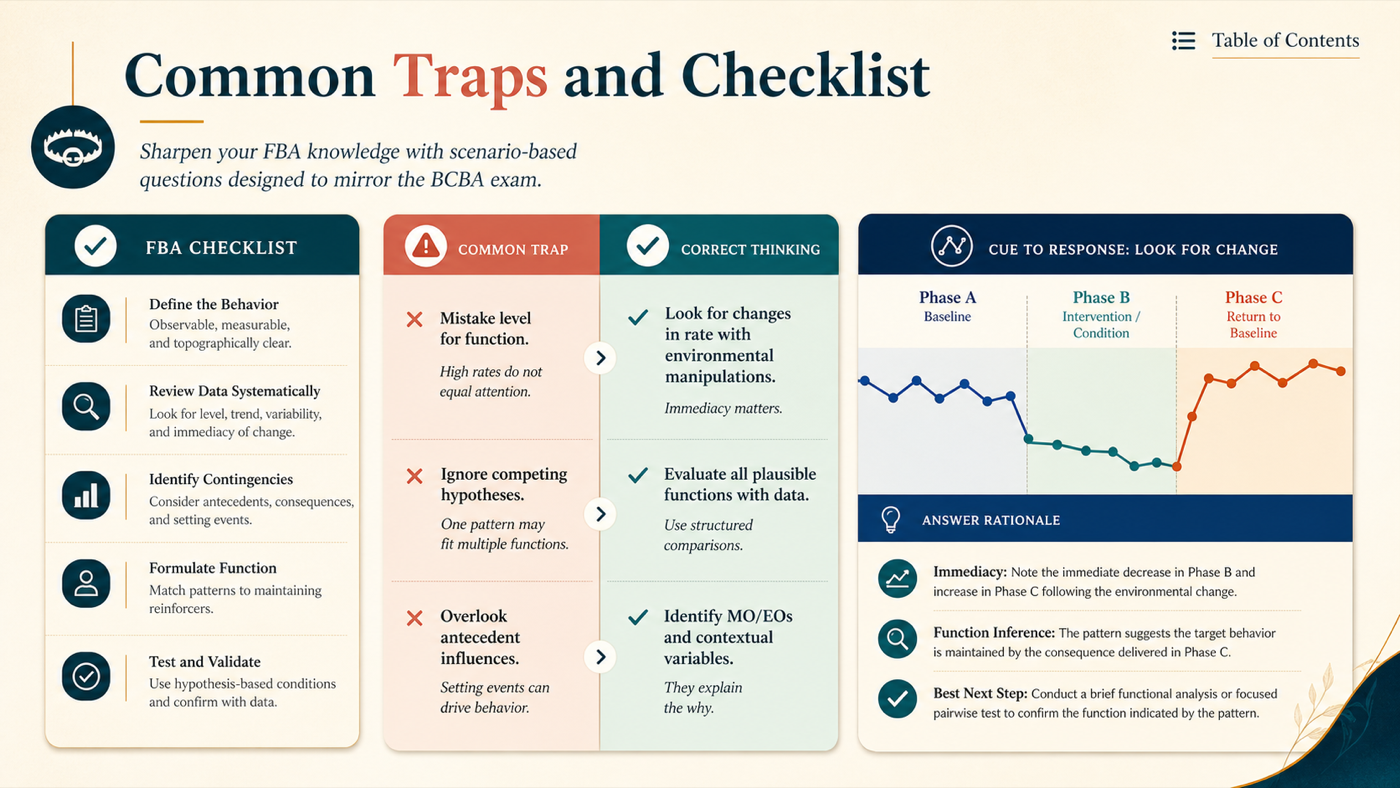
FBA Exam Prep Checklist
- Review the four functions of behavior (escape, attention, tangible, automatic).
- Practice interpreting FA graphs and ABC data.
- Know when to use indirect, descriptive, and functional analysis methods.
- Memorize the components of a functional behavior assessment (FBA).
- Take at least one full-length mock exam under timed conditions.
Test Your Readiness with Our Free BCBA Mock Exam
Ready for the real thing? Take our free BCBA mock exam featuring 150+ questions covering all BACB® test content areas, including FBA.
Take the Free BCBA Mock Exam
Get immediate scoring and detailed explanations. Start your free mock exam now!
Frequently Asked Questions About BCBA FBA Questions
Q: How many FBA questions are on the BCBA exam?
A: The BCBA exam includes approximately 15-20% of questions on assessment, which includes FBA. Exact numbers vary per test form.
Q: What is the difference between functional analysis and functional behavior assessment?
A: FBA is the overall process of identifying the function of behavior, which may include indirect, descriptive, and experimental analysis. Functional analysis is the experimental method where conditions are manipulated to determine function.
Q: Can I pass the BCBA exam without studying FBA?
A: No, FBA is a critical domain. You must understand how to identify functions, select assessment methods, and interpret data.
References
Next step for BCBA exam prep
Turn this topic into exam-day practice
Use this topic as a focused review, then test it in exam-style conditions with a free mock before deciding whether five full-length mocks are the right next step.
Start the Free BCBA Mock Exam
Continue with Five Full-Length Mocks — $99
Review the included materials and access details before ordering. No pass guarantee is implied.



