

BCBA in Australia is a time-sensitive credential question. The BACB credential, Australia’s local CBA pathway, local provider rules, and work authorization are related—but they are not the same thing. Table of Contents
Table of Contents
- What Is the Short Answer About BCBA in Australia?
- What Does BCBA Mean in Australia?
- Can You Apply for BCBA Certification in Australia?
- What Is the Local CBA Path?
- How Do BCBA and CBA Compare?
- What Changes on January 1, 2027?
- What Does BCBA Certification Not Prove?
- What Should an Australia Applicant Verify?
- Can a BCBA Work in Australia?
- How Does This Connect to BCBA Exam Preparation?
- BCBA in Australia FAQ
- Take the Free BCBA Mock Exam
What Is the Short Answer About BCBA in Australia?
BCBA in Australia can refer to a person holding the Behavior Analyst Certification Board’s graduate-level certification, but it does not automatically answer every Australian employment, registration, funding, or provider-number question. The BACB is the organization that issues the BCBA credential. Australia also has a local Certified Behaviour Analyst (CBA) pathway through the Association for Behaviour Analysis Australia (ABA Australia).
The timing matters. The BACB says it agreed to discontinue offering new BACB certifications in Australia effective January 1, 2027, while people who already hold BACB certifications in Australia can maintain them under the applicable rules. That means an applicant should not rely on a general “international BCBA” article written before the transition. Check the BACB’s International Development & Support page, the current BCBA Handbook, and the current Australian professional information before making a plan. This guide separates four questions that are often collapsed into one:
- Do you hold or qualify for a BACB certification?
- Can you pursue an Australian CBA credential or another local pathway?
- Does an employer, funder, insurer, or service system recognize your credential?
- Do you have the legal right to work and provide a particular service?
What Does BCBA Mean in Australia?
BCBA means Board Certified Behavior Analyst, a graduate-level certification issued by the BACB. The credential describes certification in behavior analysis; it is not an Australian visa, a state or territory registration, a Medicare provider number, or a universal permission to deliver every health or disability service.
In Australia, a person may use the BCBA credential as part of a professional profile, but the practical meaning depends on the role and setting. An employer may ask for a BCBA, a CBA, a university qualification, local experience, professional indemnity insurance, a police or working-with-children check, or another requirement. A funding system or private insurer can apply its own provider rules. A family may reasonably ask whether the analyst’s credential is current, who oversees the service, and which local rules apply.
Therefore, “Is BCBA recognized in Australia?” is too broad to answer with a single yes or no. A better question is: recognized by whom, for what decision, in which setting, and during which credential period? The ABA Australia FAQ states that BCBA certification alone does not allow a practitioner to obtain a Medicare provider number or a private health provider number. Treat that as an important boundary, not as a statement that a BCBA can never work in Australia.
Can You Apply for BCBA Certification in Australia?
At the time of this review, the BACB’s international page lists Australia among the countries from which it accepts certification applications, while also announcing the transition that ends new BACB certifications in Australia on January 1, 2027. The two statements must be read together. “Applications are currently accepted” does not mean the opportunity continues indefinitely, and it does not remove the ordinary education, fieldwork, application, and examination requirements.
If your plan is to apply before the transition, use the current BACB instructions rather than a course provider’s summary. The BACB’s 2027 transition guidance says that a complete application, including payment and required documents, must be received by December 31, 2026 to be reviewed under the current requirements. That deadline is not a reason to rush an incomplete application. It is a reason to check the exact document rules, fieldwork records, coursework evidence, and processing instructions early.
If you apply after the transition, do not assume that the old Australia pathway remains available. Recheck the BACB international page and the current Handbook for the rule that applies on the date you plan to apply. The source of truth is the certification body’s current rule, not a search snippet, an old university page, or a social-media post.
What Is the Local CBA Path?
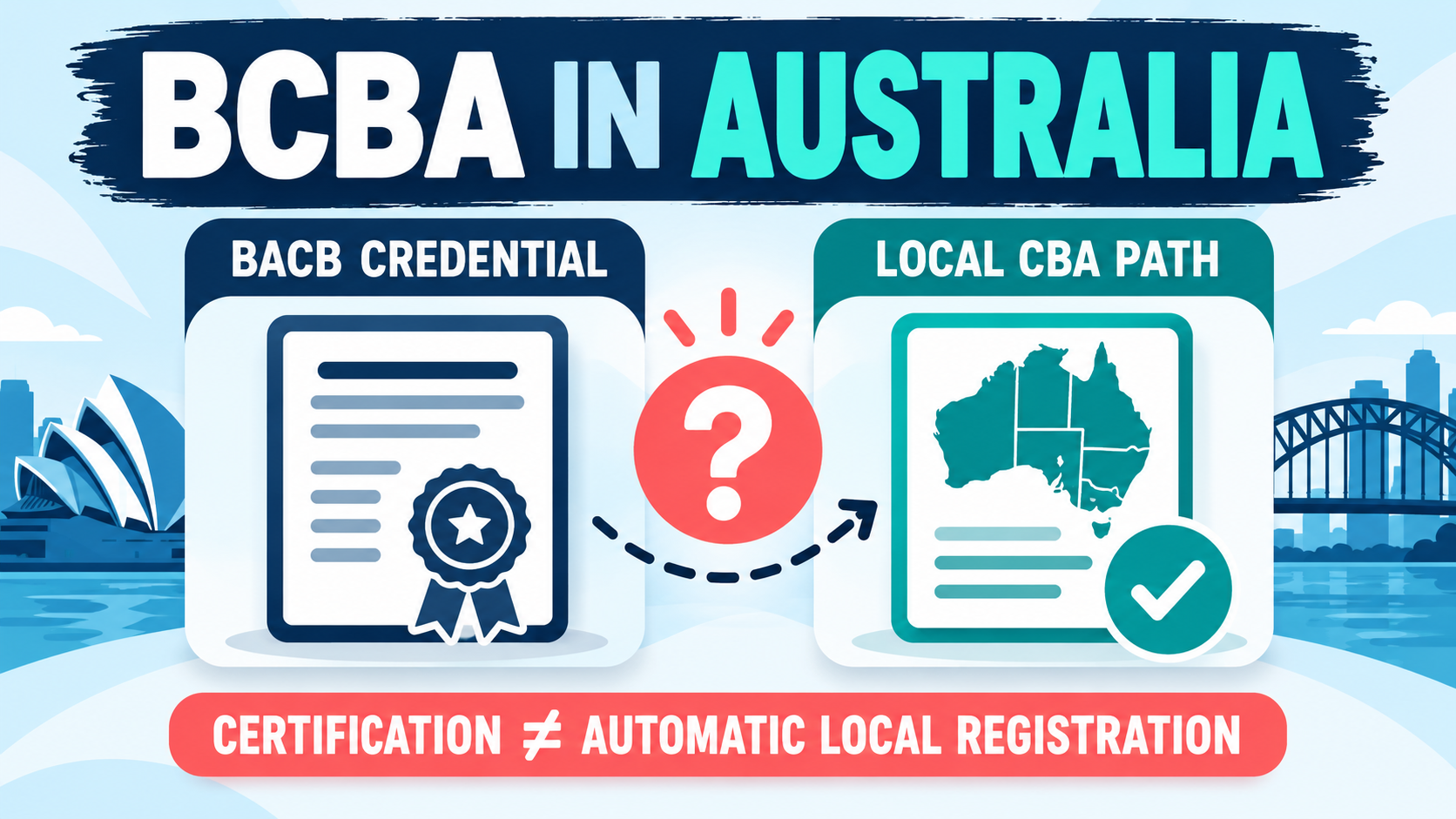
ABA Australia’s CBA pathway is a separate local credentialing route. Its current information describes a BCBA pathway for practitioners who hold a current, valid BCBA certification, are in good standing, live or work in Australia, and agree to the ABA Australia Code of Ethical Practice. The same organization also describes other application routes and publishes its own guidelines and checklist.
A CBA application is therefore not a replacement name for a BCBA application. It is a different organization, a different credential, and a different evidence set. A person can ask whether the CBA pathway is a better fit for an Australian role, whether the person’s current BCBA status is eligible for that pathway, and what documents the local organization currently requires.
Keep the distinction clear in a résumé, website bio, job application, and exam answer. Do not write “CBA” when you mean “BCBA,” and do not imply that a CBA is issued by the BACB. Use the title that the issuing organization has actually granted and check the current usage rules before adding letters after your name.
How Do BCBA and CBA Compare?
| Question | BCBA | CBA in Australia |
|---|---|---|
| Who issues it? | Behavior Analyst Certification Board. | Association for Behaviour Analysis Australia, under its current local program. |
| What does it describe? | Certification in behavior analysis under BACB requirements. | A local Australian behaviour-analyst credential under ABA Australia’s requirements. |
| Does it automatically create local authorization? | No. Check local role, provider, funding, and work rules. | No. It still does not replace every employer, legal, funding, or service-system requirement. |
| What should you verify? | Current BACB status, Handbook, international rules, and transition date. | Current CBA guidelines, pathway, good standing, location, ethics agreement, and application evidence. |
The comparison is about credential ownership and scope, not about which title is “better.” The right choice depends on the role, the client or service system, the organization’s requirements, and the current rules that apply to the applicant.
What Changes on January 1, 2027?
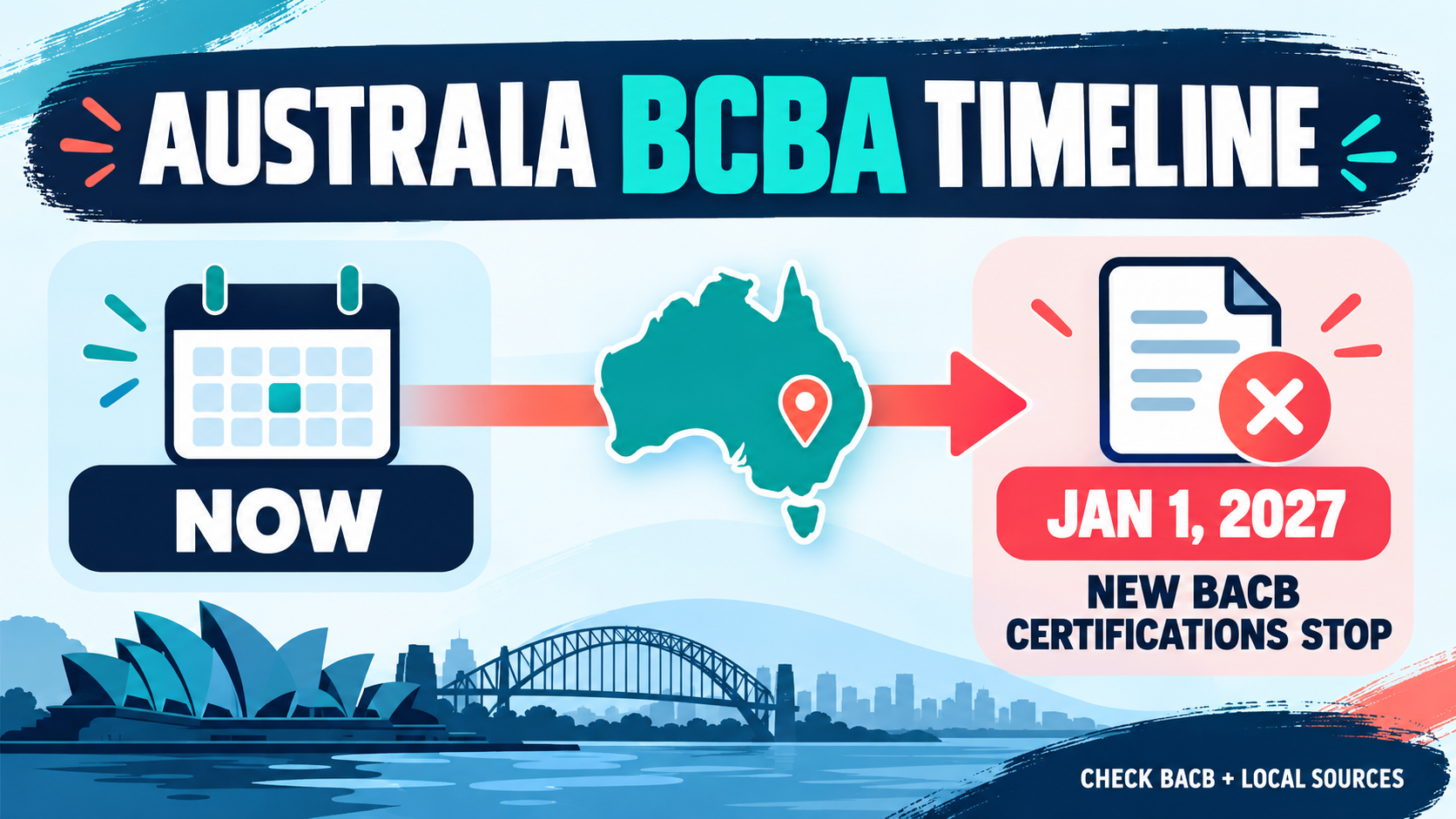
There are two different 2027 conversations. The first is the international change specific to Australia: the BACB says new BACB certifications in Australia will stop being offered on January 1, 2027. The second is the global BCBA eligibility and maintenance update that also takes effect on January 1, 2027. Do not confuse the country-specific certification availability change with the general BCBA coursework and fieldwork transition.
The BACB’s 2027 BCBA Requirements describe two future eligibility pathways and revised coursework and fieldwork expectations. The transition guide gives a side-by-side explanation of changes such as freestanding coursework and updated content areas. An Australia applicant should therefore make a dated plan:
- Confirm whether the person is applying before or after January 1, 2027.
- Confirm whether the application is complete under the rule that will govern it.
- Keep a record of coursework, fieldwork, supervision, payments, and submitted documents.
- Check whether the applicant’s Australian university, supervisor, or pathway is affected by later international changes.
- Recheck the BACB and ABA Australia pages immediately before submitting an application or accepting a role.
What Does BCBA Certification Not Prove?
A credential is evidence of meeting the issuing body’s requirements. It is not evidence that every local permission, employment condition, billing arrangement, or service-system requirement has been met.
- Not a visa: a BCBA certificate does not grant immigration or work authorization.
- Not an Australian provider number: ABA Australia specifically warns that BCBA certification alone does not create Medicare or private-health provider numbers.
- Not a universal funding credential: a payer, plan, school, employer, or disability service may set additional conditions.
- Not a substitute for local law: the role may be affected by state or territory requirements, employer policy, privacy rules, insurance, and safeguarding checks.
- Not permanent: check the BACB status and any local credential renewal or good-standing rule at the time of use.
This distinction protects applicants and families from overpromising. It also makes an exam answer stronger: identify the credential, then identify the separate legal, administrative, ethical, or organizational question instead of treating one fact as proof of everything.
What Should an Australia Applicant Verify?
Use a source-first checklist before paying for a course, moving countries, or describing a credential to an employer:
- Issuing body: Is the source the BACB, ABA Australia, an employer, a funder, or another organization?
- Status: Is the certification active, expired, pending, or subject to a transition rule?
- Date: Does the source apply before or after January 1, 2027?
- Pathway: Are you pursuing BCBA certification, the CBA pathway, a university qualification, or a different local route?
- Evidence: Can you document the degree, coursework, supervised fieldwork, examination, good standing, and any local application materials?
- Scope: What exact job, service, setting, client group, or funding system is being discussed?
- Local conditions: Does the employer or service system require checks, insurance, registration, supervision, or a provider number?
Save the URL, document title, revision date, and the question the source answers. This habit prevents a common research error: using a valid source for the wrong question. A BACB page can answer certification status while an employer or Australian organization answers role-specific eligibility.
Can a BCBA Work in Australia?
Potentially, but the answer depends on the job and the conditions attached to it. Some employers may value or require BCBA certification; others may use the CBA pathway, a local qualification, or a combination of education and experience. A job advertisement may also specify a state or territory, a population, a service model, a background check, insurance, or the right to work in Australia. Ask the prospective employer precise questions:
- Which credential or qualification is required for this exact position?
- Is the role clinical, educational, supervisory, research, administrative, or consulting?
- Who is responsible for supervision and clinical governance?
- What local checks, insurance, or provider-system requirements apply?
- Does the employer sponsor work authorization, or must the candidate already have it?
Do not infer a legal conclusion from a job title. A person can be qualified for one behavior-analytic role and still need additional permission, supervision, or credentialing for another.
How Does This Connect to BCBA Exam Preparation?
The current BCBA Test Content Outline rewards careful discrimination between facts, scope, ethics, measurement, and professional responsibilities. The Australia question is a useful practice scenario because it contains several plausible but different answers.
- If the question asks who issues the BCBA certification, answer BACB.
- If it asks whether the BCBA alone creates a Medicare provider number, answer no based on the relevant Australian source.
- If it asks what changes on January 1, 2027, identify whether it means Australian certification availability or general BCBA eligibility requirements.
- If it asks what a practitioner should do before applying, choose the current official source and verify the date and pathway.
For a focused study checkpoint after reviewing the distinctions, use the free BCBA mock exam. It is a study resource, not an official BACB product and not a substitute for current certification, immigration, employment, or local professional advice.
BCBA in Australia FAQ
Is BCBA recognized in Australia?
It can be relevant to employers and behavior-analytic work, but recognition is not one universal legal status. Confirm the exact employer, service system, credential pathway, and date. Can I apply for a BCBA while living in Australia?
The BACB’s current international page lists Australia as an authorized country while also stating that new BACB certifications in Australia will stop on January 1, 2027. Verify the current application rule and deadline before acting. Is CBA the same as BCBA?
No. CBA is a separate Australian pathway administered by ABA Australia. Do not use the titles interchangeably.
Does a BCBA automatically get a Medicare provider number?
No. ABA Australia’s FAQ specifically says BCBA certification alone does not allow a practitioner to obtain a Medicare provider number or a private health provider number.
What is the most important 2027 mistake to avoid?
Do not combine the Australia-specific end of new BACB certifications with the general BCBA eligibility transition. Read the current BACB international page, 2027 requirements, Handbook, and local Australian sources as separate checks.
Take the Free BCBA Mock Exam
If you want a low-pressure way to check your recall, use the free practice resource below. Take the Free BCBA Mock Exam



