
BCBA forensics is best understood as behavior analysis applied in a forensic, correctional, or criminal-justice context—not as a separate BACB specialty or a shortcut into criminal profiling. The work may involve measurable behavior, rehabilitation, staff performance, program evaluation, or behavior support, but it must stay inside the analyst’s competence, the referral question, applicable law, and ethical obligations.
Table of Contents
- What Does BCBA Forensics Mean?
- What Can Behavior Analysis Contribute?
- A Forensic Behavior-Analysis Workflow
- What Training and Experience Should You Verify?
- Forensic Behavior Analysis vs. Forensic Psychology vs. Profiling
- Ethics, Privacy, and Due Process
- The BCBA Exam Angle
- Common Mistakes
- BCBA Forensics FAQ
- Take the Free BCBA Mock Exam
This article is an educational overview. It is not legal advice, a promise of employment, a guide to predicting criminality, or a substitute for forensic-psychology, medical, mental-health, or legal training. “BCBA” refers to Board Certified Behavior Analyst; “ABA” refers to applied behavior analysis. Table of Contents
What Does BCBA Forensics Mean?
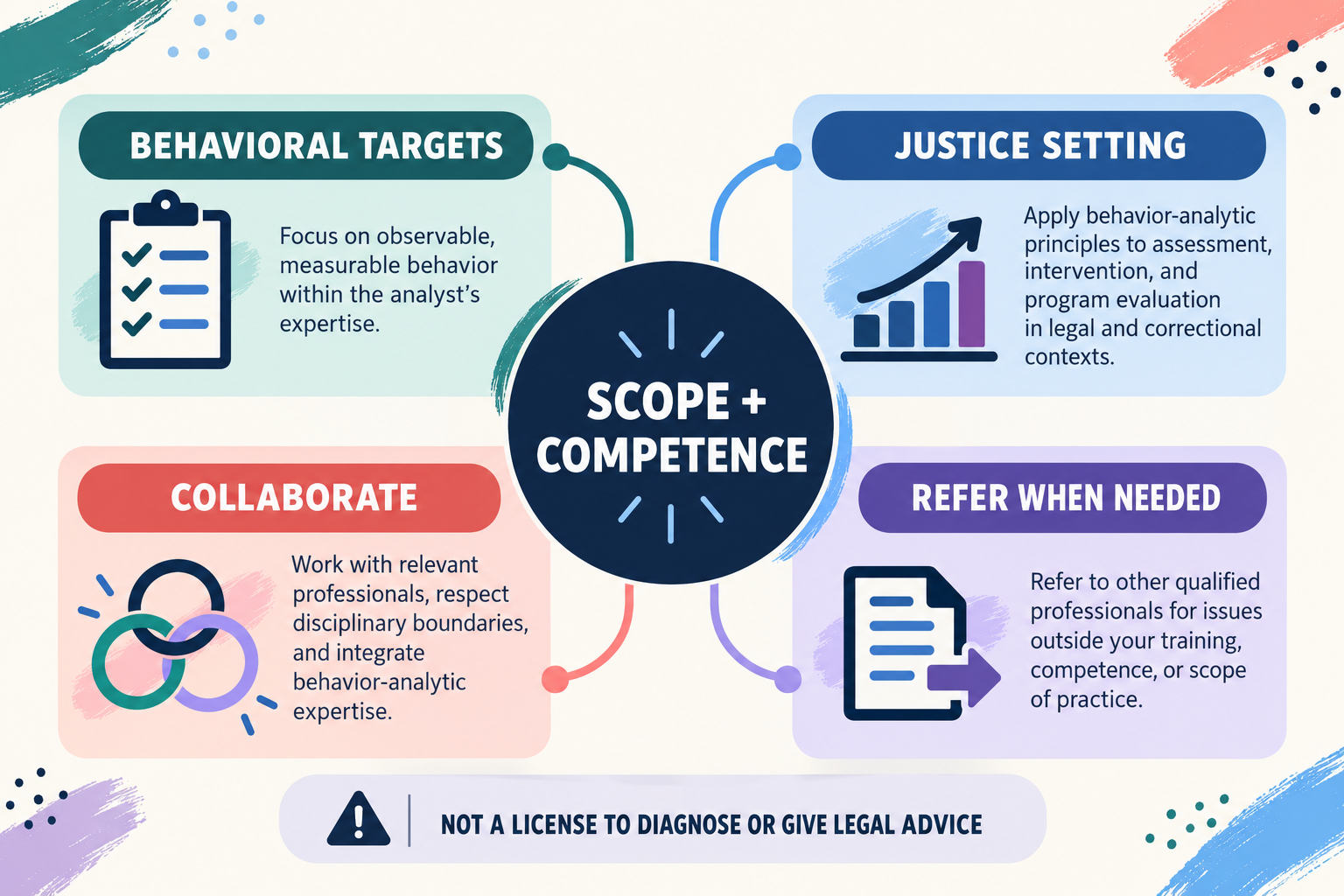
The search phrase BCBA forensics usually points to a career or practice question: can behavior-analytic skills be used in a justice-related setting, and what would that work actually involve? The short answer is that a BCBA may apply behavior analysis in a setting connected to corrections, courts, community supervision, rehabilitation, or forensic services when the work is within the person’s education, training, experience, authorization, and competence.
There is an important qualification. The BACB credential is not the same thing as a “forensic BCBA” license, a forensic-psychology license, a law-enforcement analyst designation, or an expert-witness qualification. A person may develop a forensic focus through additional education, supervised experience, consultation, and a clearly defined role, but the label itself does not create authority to diagnose, determine guilt, predict violence, conduct a legal examination, or give an opinion outside the referral question.
Also avoid confusing applied behavior analysis with the FBI’s Behavioral Analysis Unit. The FBI describes behavioral analysis as a law-enforcement resource for understanding criminal behavior and assisting investigations. That work and applied behavior analysis may both discuss behavior, but they are different professional contexts. A BCBA should describe the actual service rather than borrow a dramatic law-enforcement title.
What Can Behavior Analysis Contribute?
A 2024 review of applied behavior analysis in the criminal-justice system noted that the research base and extent of application are not simple or uniform. That is a useful caution for anyone searching for this career path: forensic behavior analysis is a developing application area, not a guarantee that every correctional or court program uses a BCBA role. Depending on the setting and referral, possible contributions may include:
- Defining and measuring behavior: translate a broad concern into observable responses, opportunities, frequency, duration, latency, accuracy, or implementation measures.
- Behavior support and rehabilitation: teach communication, self-management, coping, decision-making, or daily-living skills that matter to the person’s stated goals and setting.
- Program evaluation: examine whether a prevention, education, treatment, or reentry program is delivered as designed and whether meaningful outcomes change.
- Staff performance: define critical staff behaviors, train them with instruction, modeling, rehearsal, and feedback, and monitor fidelity without turning the evaluation into a vague character judgment.
- Environmental analysis: identify setting events, routines, prompts, consequences, and access barriers that affect behavior in a facility or community program.
These examples are not a menu that every BCBA can immediately provide. They are questions to investigate with an employer, supervisor, or interdisciplinary team. The service must be meaningful to the person or system, supported by a defensible rationale, and evaluated with data that can inform a decision.
A Forensic Behavior-Analysis Workflow
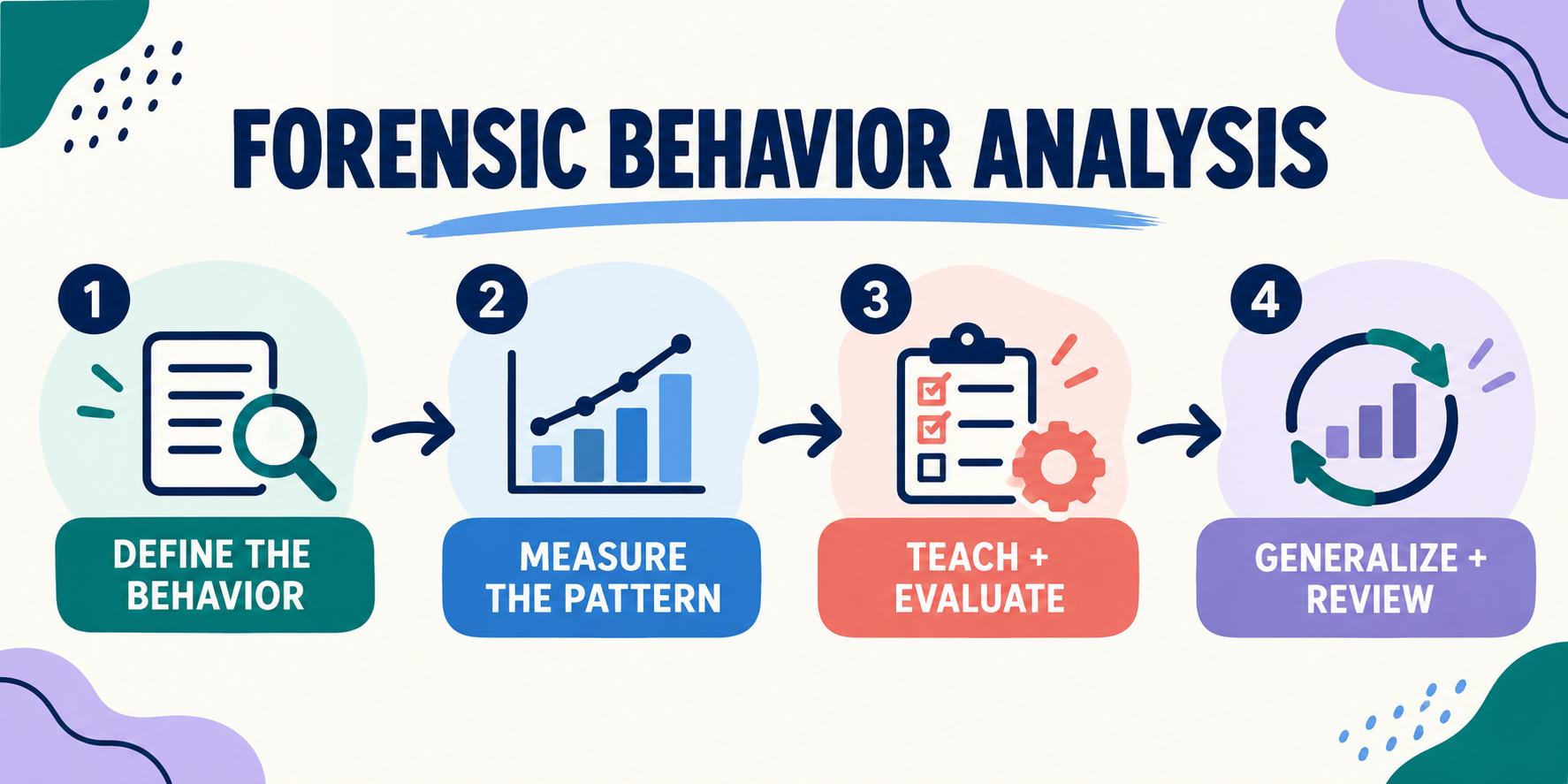
A justice setting can make it tempting to start with the institution’s label—“high risk,” “noncompliant,” “manipulative,” or “dangerous.” A behavior-analytic workflow starts somewhere more precise. What behavior is occurring? Who is affected? Under what conditions? What does the referral authorize the analyst to answer? What would count as a meaningful and safe improvement?
| Referral question | Behavior-analytic lens | Required collaboration |
|---|---|---|
| A participant misses required program steps | Define the steps, opportunities, prompts, barriers, and consequences; measure completion and latency | Program staff, the participant, case manager, and any legal or clinical decision-maker |
| Staff implementation varies across shifts | Use a task analysis, fidelity measure, observation, and feedback loop | Supervisors, staff representatives, labor or policy contacts, and the service team |
| A reentry program wants outcome evidence | Choose outcomes that are observable, meaningful, privacy-protective, and not just easy to count | Program leadership, data or evaluation staff, community partners, and participants |
| A behavior creates immediate safety concern | Follow emergency policy first, then assess antecedents, consequences, replacement skills, and risk controls | Qualified clinical, medical, security, and legal personnel as required by the setting |
The order matters. A data sheet does not turn a coercive or legally unsupported decision into a behavior-analytic service. In a forensic environment, the analyst should clarify who requested the work, who the client is, who can consent, who will receive the information, and how the person can raise a concern or decline participation when the setting permits that choice.
What Training and Experience Should You Verify?
Start with the current BACB BCBA resources. They establish the certification framework, but they do not certify a person as a forensic psychologist or tell an employer that the individual has every skill a justice setting may require. A candidate considering this niche should map additional learning to the actual role.
- Behavior analysis: measurement, assessment, functional relations, skill acquisition, behavior reduction, generalization, maintenance, supervision, and ethical decision making.
- Justice context: correctional systems, reentry, institutional routines, trauma-informed collaboration, power differences, confidentiality, and the limits of risk language.
- Legal and forensic context: evidence handling, documentation, testimony rules, discovery, due process, and the difference between an educational or clinical opinion and a legal conclusion.
- Interdisciplinary practice: communication with attorneys, judges, probation or parole teams, medical and mental-health professionals, educators, security staff, and community providers.
Ask a prospective employer or supervisor: What is the referral question? What training is required before independent work? Who reviews records? What happens when the requested opinion is outside behavior analysis? How are conflicts between institutional goals and participant welfare handled? Vague answers are a signal to slow down and seek consultation.
Forensic Behavior Analysis vs. Forensic Psychology vs. Profiling
These terms may appear together in search results, but they do not mean the same thing. The table is a high-level orientation, not a credentialing rule.
| Area | Typical focus | What a BCBA must not assume |
|---|---|---|
| Forensic behavior analysis | Observable behavior, environmental variables, teaching, support, staff performance, and program evaluation in a justice-related context | A BCBA credential alone answers every legal, clinical, or forensic question |
| Forensic psychology | Psychological assessment, treatment, consultation, or testimony as authorized by the professional’s education, license, and jurisdiction | Behavior analysis and forensic psychology are interchangeable titles |
| Criminal profiling or investigative analysis | Law-enforcement analysis of investigative information and patterns in criminal behavior | A BCBA can predict an unknown offender or claim law-enforcement authority because both fields use the word “behavior” |
When a job description combines these areas, ask for the actual duties and required credentials. “Behavioral” in a title is not enough. Read whether the role teaches behavior, evaluates a program, provides psychological care, performs a forensic assessment, or supports an investigation.
Ethics, Privacy, and Due Process
The BACB Ethics Code resources emphasize benefit, compassion, dignity, respect, integrity, and competence. Those principles become especially important when a participant has limited power, when services are connected to a legal consequence, or when an institution controls access to basic activities.
Before collecting or sharing information, document the purpose, authority, consent or assent process when applicable, privacy limits, retention plan, and audience. Separate direct observation from an allegation, a record summary from a conclusion, and a behavior description from a character judgment. Use culturally responsive and person-centered language. Do not represent a correlation as a cause, or a program outcome as proof that one person would have acted differently in an unknown future.
Safety still matters, but “safety” should not become a blank check for unnecessary restriction. If an intervention involves restraint, seclusion, punishment, medication, or other regulated action, follow the governing law and policy and involve the professionals who are authorized and trained for it. A BCBA should not accept a forensic referral simply because the institution wants a behavior label attached to a legal decision.
The BCBA Exam Angle
The BCBA exam may use an institutional, correctional, or high-stakes scenario without testing a separate “forensic BCBA” credential. The tested skill is usually the same behavior-analytic reasoning used elsewhere: define the target, select a valid measure, assess relevant environmental variables, choose an ethical intervention, evaluate outcomes, and stay within competence. For a forensic-style question, slow down at these decision points:
- Referral: What exact question is the analyst being asked to answer, and who is the client?
- Definition: Is the response observable, measurable, and separate from a legal or mentalistic label?
- Data: Does the measure support the decision, protect privacy, and capture context rather than merely institutional convenience?
- Ethics: Are dignity, assent when applicable, confidentiality, choice, risk, and conflicts being considered?
- Competence: Does the answer require legal, medical, diagnostic, or forensic-psychology authority that the behavior analyst does not have?
Use the free BCBA mock exam to practice these distinctions across assessment, measurement, ethics, intervention, and supervision questions. A niche context should make your reasoning more precise—not persuade you to choose a dramatic answer outside scope.
Common Mistakes
- Assuming “forensic” is a BACB specialty: treat it as a context or focus that requires additional competence, not an automatic designation.
- Confusing behavior analysis with profiling: observable measurement and behavior change are not the same as predicting an unknown offender.
- Accepting an undefined referral: clarify the client, question, authority, audience, records, and limits before collecting data.
- Using institutional labels as behavior definitions: replace “manipulative” or “high risk” with observable responses and relevant conditions.
- Ignoring power and privacy: a person’s participation may be constrained; explain how information is used and who can access it.
- Calling a program effective from one outcome: inspect implementation, measurement quality, generalization, maintenance, and meaningfulness.
BCBA Forensics FAQ
Is there an official forensic BCBA certification?: The BACB BCBA credential is a graduate-level behavior-analysis certification. “Forensic BCBA” is generally a description of a setting, interest, or practice focus—not proof of a separate BACB forensic credential. Verify any additional designation with the organization that issues it and check whether an employer or jurisdiction actually recognizes it.
Can a BCBA work in a prison or correctional program?: A BCBA may be able to work in a correctional or justice-related program when the role is authorized, supervised as needed, and within competence. The person should confirm the employer’s requirements, local rules, privacy procedures, safety policies, and the exact service being delivered. A BCBA credential alone does not answer those questions.
Can a BCBA be a criminal profiler?: Do not assume so. Criminal profiling and law-enforcement behavioral analysis involve different training, agency roles, methods, and authority. A behavior analyst should not market a BCBA credential as permission to predict an unknown offender or provide an investigative opinion outside the person’s training and authorization.
What should someone study for a forensic behavior-analysis career?: Build the BCBA foundation first: measurement, assessment, behavior-change procedures, ethics, supervision, and data-based decision making. Then add supervised experience and education relevant to the specific justice setting, such as correctional programming, reentry, legal processes, trauma-informed collaboration, privacy, and program evaluation. The correct mix depends on the actual job, not the title alone.
Bottom line: BCBA forensics can describe a meaningful, interdisciplinary application of behavior analysis in justice-related settings, but it is not a shortcut to criminal profiling, diagnosis, expert testimony, or legal authority. Define the referral, measure observable behavior, protect dignity and privacy, collaborate with qualified professionals, and stay within documented competence. That is the safest career interpretation and the strongest BCBA exam reasoning.
Take the Free BCBA Mock Exam
If you want a low-pressure way to check your recall, use the free practice resource below. Take the Free BCBA Mock Exam



