
If you search for BCBA in hospital roles, you may be picturing one standard job. In practice, hospital behavior-analytic roles vary widely. A BCBA might consult with an inpatient unit, support a pediatric behavioral-health program, train nurses and technicians, work in an outpatient hospital clinic, or help a medical center build a behavior-support pathway.
Table of Contents
- BCBA in Hospital: What the Role Means
- What Hospital BCBAs May Do
- Where Hospital Behavior Analysts Work
- How Hospital Work Differs from Clinic or School Work
- Scope, Licensure, and Team Boundaries
- How to Evaluate a Hospital BCBA Job
- Preparing for Hospital Work During BCBA Fieldwork
- Is a Hospital BCBA Role a Good Fit?
- Final Takeaway
- Quick Review Checklist
- Take the Free BCBA Mock Exam
The common thread is not a particular uniform or department. It is the use of behavior-analytic assessment, data, teaching, and staff collaboration inside a fast-moving healthcare system. This guide explains what hospital BCBAs may do, how the work differs from clinic or school practice, what credentials and boundaries to verify, and how to decide whether a hospital role fits your training plan.
BCBA in Hospital: What the Role Means
A BCBA in a hospital applies behavior-analytic expertise within a medical, psychiatric, rehabilitation, or pediatric care environment. The role may be embedded in a department, contracted through an ABA provider, or organized as a consultation service. The BCBA is usually asked to make behavior easier to understand and safer to support while coordinating with the professionals who manage medical, psychiatric, nursing, speech, occupational, and social-work needs.
The BACB describes the BCBA as a graduate-level certification for independent behavior-analytic practice and supervision. That credential is important, but it is not a universal hospital job description. Hospitals still define their own privileges, reporting lines, required training, and hiring criteria. State licensure or registration may also apply, especially when services are delivered as behavioral-health or healthcare treatment.
That is why “hospital BCBA” should be treated as a setting, not a guarantee of one scope of practice. Before accepting a position, ask what population you will serve, which department owns the role, what decisions you can make independently, and how your recommendations fit into the patient’s overall care plan.
What Hospital BCBAs May Do
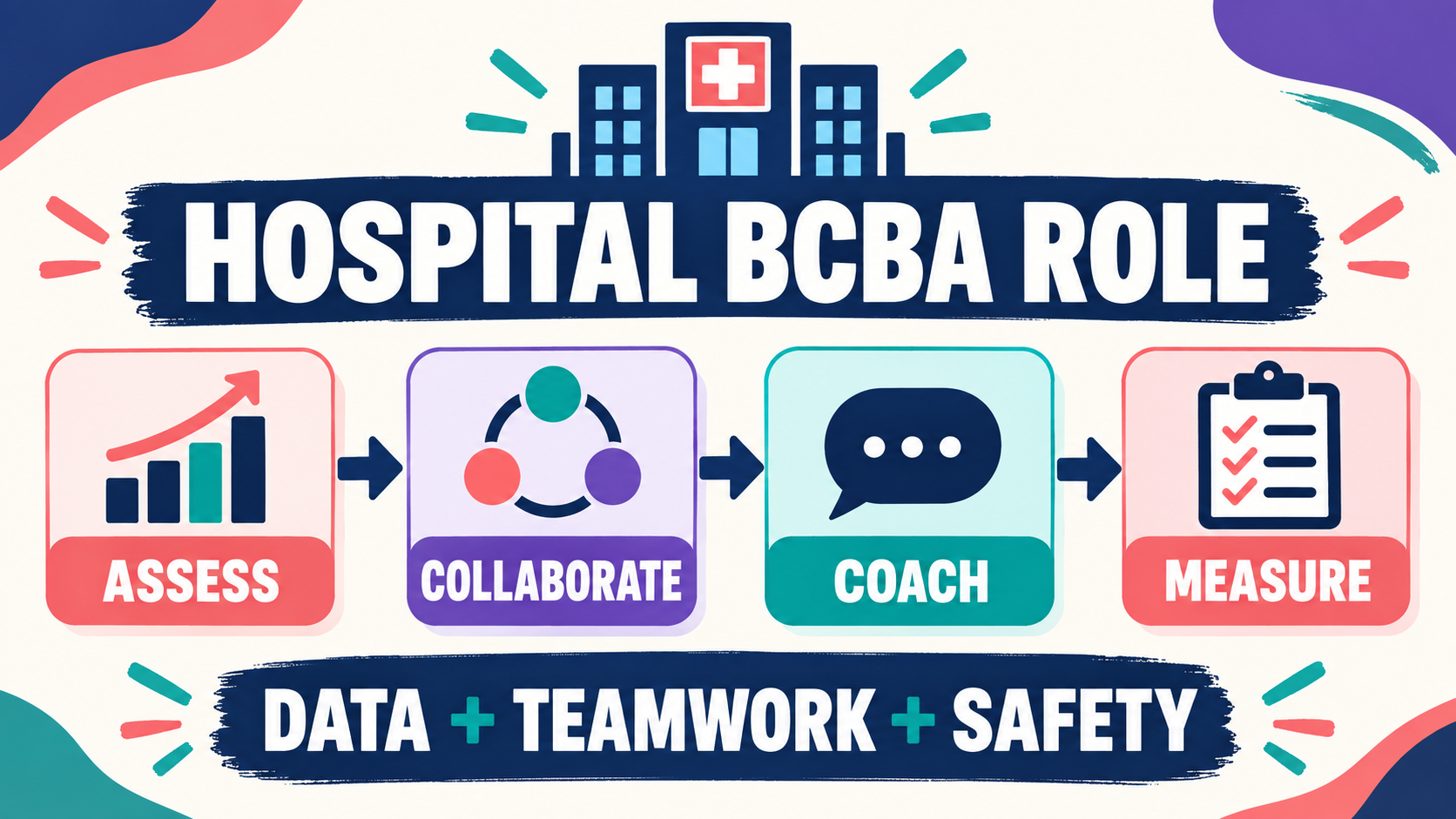
The daily work depends on the hospital’s program, but four workstreams appear often: assessment, collaboration, coaching, and measurement. A BCBA may complete some of these directly and may train other staff to carry out agreed procedures consistently.
- Assess behavior in context. The BCBA observes what happens before and after a behavior, reviews available records, interviews caregivers and staff, and identifies patterns that can guide support. In an inpatient setting, the assessment must account for pain, sleep, medication changes, communication barriers, sensory conditions, unfamiliar routines, and other variables outside a typical clinic room.
- Build practical supports. Recommendations may include communication supports, antecedent adjustments, skill-acquisition programs, reinforcement arrangements, de-escalation procedures, or a written behavior-support plan. The plan should be specific enough for different shifts to use and flexible enough to respect the patient’s needs and medical instructions.
- Collaborate across disciplines. Hospital care is team-based. A BCBA may join rounds, case conferences, handoffs, family meetings, discharge planning, or quality-improvement meetings. The goal is not to make every professional use ABA terminology. The goal is to translate behavioral observations into actions the care team can understand and implement.
- Coach and measure. Staff training, caregiver coaching, direct observation, data review, and fidelity checks help determine whether a plan is usable and whether it is helping. If the data do not show meaningful progress, the team should revisit the hypothesis, goals, procedures, or environmental conditions rather than simply asking staff to try harder.
Recent hospital examples show why the setting is distinctive. Dartmouth Health describes a behavioral unit where BCBA consultation includes tracking, organizing, and interpreting behavioral data to make treatment recommendations. A 2026 Behavior Analysis in Practice article describes a pediatric acute-care consultation model involving BCBAs, RBTs, hospital leadership, nursing, and a hospital data system. These examples do not represent every hospital, but they demonstrate that the work can extend beyond a traditional one-to-one ABA session.
Where Hospital Behavior Analysts Work
A hospital may use BCBAs in more than one service line. The job title can look similar while the workflow and patient population are very different.
| Setting | Possible BCBA contribution | What to clarify |
|---|---|---|
| Inpatient behavioral health | Behavior assessment, crisis-support planning, staff coaching, data review, and skill-building within a structured unit. | Population, crisis training, shift coverage, restraint or seclusion policies, and who leads clinical decisions. |
| Pediatric acute care | Consultation for children with autism or intellectual and developmental disabilities, staff training, caregiver support, and behavior data systems. | Medical-unit workflow, family participation, infection-control expectations, and how behavioral recommendations are coordinated with treatment. |
| Outpatient hospital clinic | Assessment, caregiver training, treatment planning, follow-up, and collaboration with developmental or behavioral-health teams. | Billable services, appointment length, payer rules, caseload, and whether the work is direct treatment or consultation. |
| Rehabilitation or neurobehavioral services | Support for behavior and skill acquisition after injury or during rehabilitation, with close interdisciplinary planning. | Required clinical experience, documentation standards, medical supervision, and the distinction between behavioral and medical recommendations. |
Some hospitals also partner with universities, residential programs, community agencies, or specialty clinics. A job post may use “hospital-based BCBA” even when most hours occur in an affiliated outpatient or community program. Read the actual schedule and reporting structure before assuming that the role is inpatient.
How Hospital Work Differs from Clinic or School Work
In a clinic or school, the BCBA often has more control over the physical environment, session timing, materials, and staff who implement the plan. A hospital is more variable. A patient may move between rooms, undergo procedures, have several different caregivers in one day, or experience a rapid change in health status. The behavior plan must be useful without becoming another burden for an already busy team.
Hospital work also makes handoffs and shared language especially important. A recommendation that works when one specialist is present may fail during the night shift unless it is documented clearly. A strong hospital BCBA learns how to reduce a plan to observable steps, communicate the rationale without jargon, and identify which parts require immediate consultation with another professional.
The data can look different too. Instead of a predictable session-by-session graph, the BCBA may use incident reports, ABC observations, treatment-integrity checks, length-of-stay information, staff measures, caregiver reports, or electronic health-record fields. Data should be interpreted cautiously because medical events, staffing, environment, and patient preference can all change at the same time.
Finally, hospital roles may involve less continuous direct therapy and more consultation, coaching, program design, and systems work. That can be rewarding if you like interdisciplinary problem-solving. It can be frustrating if you expect to control every implementation detail or if you prefer a stable caseload and familiar routine.
Scope, Licensure, and Team Boundaries
A BCBA can bring a behavior-analytic lens to a hospital team, but the BCBA credential does not replace medical, nursing, psychiatric, psychological, or rehabilitation training. A BCBA should not diagnose a medical condition, change medication, give medical clearance, or represent a behavioral recommendation as a medical order. The exact boundary depends on the practitioner’s other credentials, state law, employer policies, and the patient’s care plan.
Review the BACB Ethics Code for Behavior Analysts before working in a hospital. The code applies to BCBA applicants and certificants and emphasizes responsible practice, competence, informed consent, documentation, confidentiality, and collaboration. In a hospital, those duties meet additional rules for privacy, infection control, emergency response, incident reporting, and access to the medical record.
Licensure is another checkpoint. Some jurisdictions regulate behavior analysis separately or require a state license for specific healthcare or behavioral-health services. A hospital may also require background checks, immunizations, workplace safety training, CPR or crisis training, electronic-record training, and a formal privileging process. Ask the employer which requirements apply to the position rather than assuming that passing the BCBA exam is the only credential needed.
How to Evaluate a Hospital BCBA Job
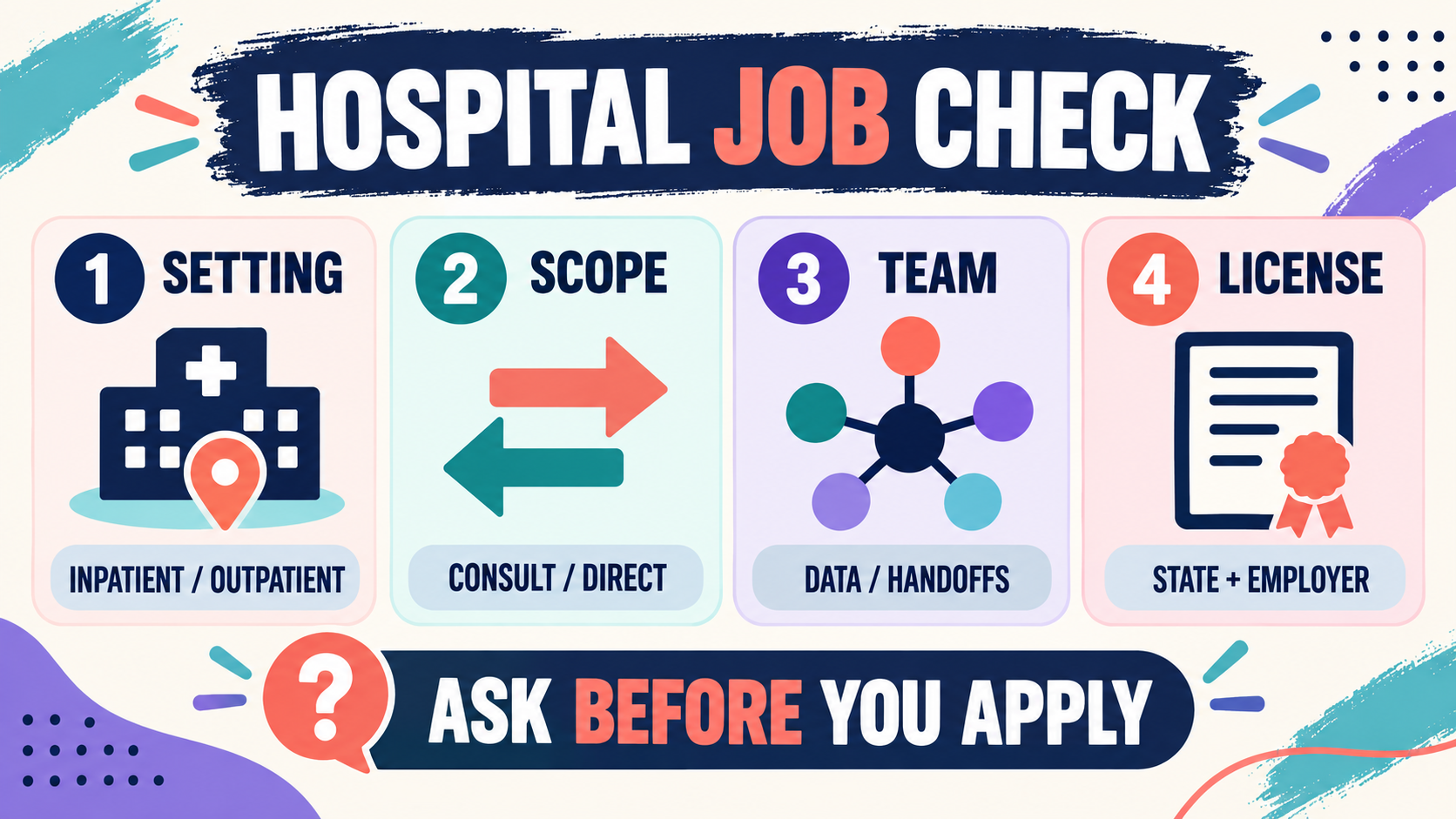
A hospital job posting may sound impressive while leaving the daily scope unclear. Use the four-part check below before you apply or accept an offer.
| Check | Questions to ask | Why it matters |
|---|---|---|
| Setting | Is the role inpatient, outpatient, consultation, rehabilitation, or a mix? Which unit receives the service? | The setting determines pace, patient contact, documentation, and the skills you need each day. |
| Scope | How much is assessment, direct work, staff training, case consultation, supervision, or quality improvement? | “BCBA” can describe very different mixes of clinical and systems responsibilities. |
| Team | Who is the clinical supervisor? How are recommendations approved, communicated, and handed off between shifts? | Clear ownership prevents the BCBA from working in isolation or giving instructions outside the role. |
| License and logistics | What state license, hospital credential, schedule, crisis training, and documentation access are required? | A position can be a poor fit if the credentialing timeline or working conditions are hidden until after hire. |
Also ask how success is measured. A thoughtful answer might include staff implementation, patient-centered goals, meaningful behavior or skill outcomes, caregiver confidence, safe transitions, or improved communication. Be cautious if the only measure is the number of billable hours or if the hospital expects the BCBA to solve every behavioral problem without protected time for assessment and team training.
Preparing for Hospital Work During BCBA Fieldwork
If hospital work interests you while you are pursuing certification, discuss the setting with your supervisor early. The current BCBA Handbook controls fieldwork requirements and documentation. It describes supervised fieldwork, concentrated supervised fieldwork, supervisor responsibilities, and activities that can help trainees develop behavior-analytic skills. A hospital placement should be evaluated for quality and compliance, not selected only because the setting sounds prestigious. Build a learning plan around skills you can demonstrate:
- Write observable operational definitions and collect reliable data in a busy environment.
- Practice interviewing staff and caregivers without assuming that a behavior has one simple cause.
- Learn to summarize behavior-analytic findings for nurses, physicians, therapists, teachers, and families.
- Participate in treatment-integrity checks, handoffs, and outcome reviews.
- Ask your supervisor how consent, assent, confidentiality, crisis response, and scope-of-practice questions are handled.
- Keep your fieldwork records separate from the hospital’s patient record and follow both BACB and employer documentation rules.
Because BACB requirements are changing during the 2026–2027 transition, save the version of the handbook and employer fieldwork guidance that apply to your plan. The BACB Recent and Upcoming Changes page should be checked alongside the current handbook. If a hospital advertises fieldwork supervision, ask whether the arrangement is designed for certification fieldwork, employment orientation, or both; those are not automatically interchangeable.
Is a Hospital BCBA Role a Good Fit?
Hospital work may suit you if you enjoy fast-changing environments, interdisciplinary communication, consultation, and translating data into practical support. It can also be a good fit if you want to work with patients across different ages or diagnoses and are comfortable learning hospital systems.
It may be less comfortable if you need a highly predictable schedule, prefer to control the entire treatment environment, or want a role centered almost entirely on extended direct ABA sessions. That is not a judgment about your ability. It is a reminder to compare the actual workflow with the kind of behavior-analytic practice you want to build.
Before applying, review the employer’s population, schedule, crisis expectations, supervision structure, licensure rules, documentation system, and team culture. During an interview, ask to shadow or speak with a current BCBA if the hospital allows it. The most useful signal is whether the organization gives the role clear authority, realistic time, qualified supervision, and a respectful place in the care team.
Final Takeaway
A BCBA in a hospital may assess behavior, design practical supports, coach staff and caregivers, analyze data, and collaborate across medical and behavioral-health disciplines. The setting is varied, and the title alone does not tell you whether the work is inpatient consultation, outpatient treatment, rehabilitation, or a systems role.
Use the current BACB handbook and ethics code as your foundation, then verify state licensure, hospital credentialing, scope, schedule, supervision, and patient population with the employer. If you are preparing for the BCBA examination, a free BCBA mock exam can help you identify weak content areas and practice timing. It is a study aid, not an official BACB product and not a guarantee of a passing score. For targeted review, use our bcba in hospital practice questions to apply the concept in exam-style scenarios.
Quick Review Checklist
Use this final checklist to turn bcba in hospital into exam-ready reasoning. The goal is not to memorize a label in isolation; it is to identify the relevant evidence and explain why the best answer fits the scenario. Key ideas to review:
- State the central definition or decision point for bcba in hospital in your own words.
- Identify the detail that makes bcba in hospital different from its closest related ABA term.
- Separate the observable facts in a scenario from assumptions that are not supported by the facts.
- Write one example and one nonexample so you can recognize the concept in a new setting.
Exam application checks:
- Ask what the question is actually requesting before comparing the answer choices.
- Mark the antecedent, response, consequence, or other evidence that supports the selected answer.
- Look for a distractor that describes a related process but does not answer the specific question.
Final self-check:
- Explain how you would verify the interpretation with clear observations or data.
- Change one detail in the scenario and decide whether your answer should change.
- Give a one-sentence rationale that a supervisor or study partner could evaluate.
Take the Free BCBA Mock Exam
If you want a low-pressure way to check your recall, use the free practice resource below. Take the Free BCBA Mock Exam



