
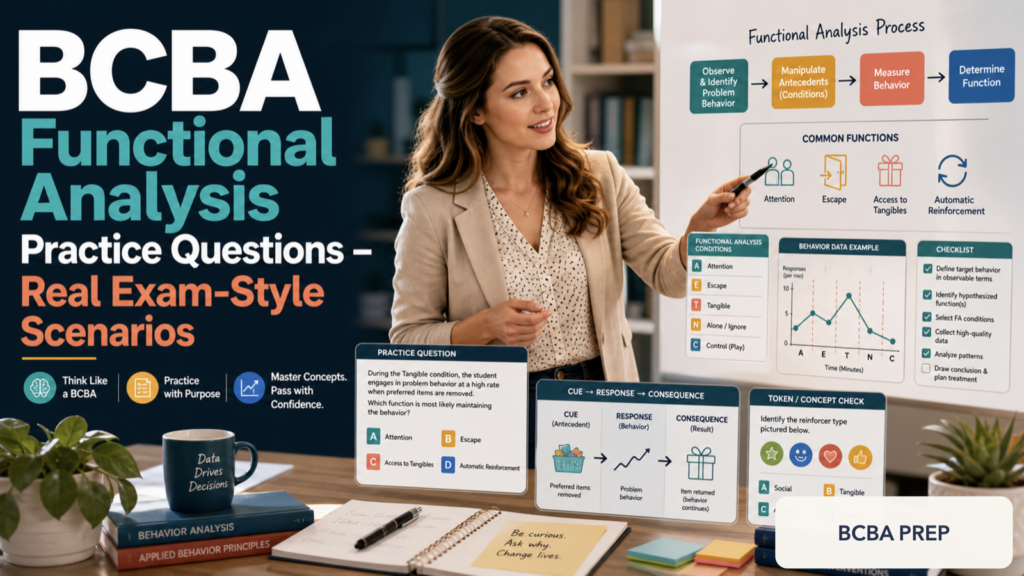
Master Functional Analysis with Exam-Style Practice
Functional analysis (FA) is one of the most critical topics on the BCBA exam. These five scenario-based questions mirror the real exam and will test your ability to identify FA conditions, interpret graphs, and choose the correct experimental designs.
Table of Contents
- Master Functional Analysis with Exam-Style Practice
- 5 Real Exam-Style Scenarios
- Common Exam Traps in Functional Analysis Questions
- FA Question Checklist for Exam Day
- Ready for More? Take Our Free BCBA Mock Exam
- Functional Analysis Practice Questions — FAQ
- References
Each question includes a detailed rationale and common exam traps. After the quiz, be sure to check our free BCBA mock exam for even more practice.

5 Real Exam-Style Scenarios
Read each scenario carefully. Select the single best answer.
Question 1:
Scenario: During a functional analysis, a therapist provides a break from demands contingent on self-injurious behavior (SIB). SIB occurs most frequently in this condition compared to the play and alone conditions.
Prompt: What function is indicated by these results?
- A. Automatic reinforcement
- B. Social positive reinforcement (access to tangibles)
- C. Social negative reinforcement (escape from demands)
- D. Social positive reinforcement (attention)
Correct Answer: C
Why This Answer Is Correct: The test condition involves contingent break (escape) from demands for SIB. Higher rates in this condition indicate that SIB is maintained by escape from demands, i.e., social negative reinforcement.
Why the Other Options Are Wrong:
- A: Automatic reinforcement would be indicated by high rates in the alone condition, not in a condition where breaks are delivered.
- B: Access to tangibles would require delivery of a preferred item, not a break from demands.
- D: Attention would require delivery of attention, not a break from demands.
Exam Trap: Watch for the specific contingency: break from demands = negative reinforcement. Do not confuse escape with attention.
Question 2:
Scenario: A functional analysis graph shows undifferentiated responding across all conditions (attention, escape, alone, play). The behavior occurs at moderate levels in all conditions.
Prompt: Which interpretation is most likely?
- A. The behavior is maintained by automatic reinforcement.
- B. The behavior is maintained by multiple control (both attention and escape).
- C. The FA results are inconclusive; further analysis is needed.
- D. The behavior is maintained by access to tangibles.
Correct Answer: C
Why This Answer Is Correct: Undifferentiated FA results (no clear separation between test and control conditions) are inconclusive. Further assessment, such as a latency-based FA or a different design, is needed to identify function.
Why the Other Options Are Wrong:
- A: Automatic reinforcement would typically show high rates in alone condition, not undifferentiated across all conditions.
- B: Multiple control might show elevated rates in multiple test conditions but still differentiate from control; undifferentiated data do not confirm multiple control.
- D: Access to tangibles would require a separate tangible condition; it cannot be inferred from these conditions.
Exam Trap: Undifferentiated FA does not mean ‘no function’; it means the FA was inconclusive. Always consider the need for further analysis.
Question 3:
Scenario: A behavior analyst conducts a functional analysis using a multi-element design. The graph shows clear separation: highest rates in the attention condition, lower in escape and alone, and lowest in play. However, the alone condition was conducted only once and shows a moderate spike.
Prompt: What is the best next step?
- A. Conclude that the behavior is maintained by automatic reinforcement because of the spike in alone.
- B. Conclude that the behavior is maintained by attention because that condition shows highest rates overall.
- C. Replicate the alone condition to confirm the spike is reliable.
- D. Discontinue the analysis and implement an attention-based intervention.
Correct Answer: C
Why This Answer Is Correct: A single data point in the alone condition is insufficient to confirm automatic reinforcement. The analyst should replicate the alone condition to see if high rates persist. Attention appears to be the primary function, but the alone spike needs verification.
Why the Other Options Are Wrong:
- A: A single spike does not confirm automatic reinforcement without replication.
- B: Although attention is likely, the spike in alone warrants further investigation to rule out automatic reinforcement.
- D: Discontinuing the analysis prematurely could lead to an incomplete or incorrect functional assessment.
Exam Trap: Multi-element designs require rapid alternation and replication. A single session in one condition does not provide enough data.
Question 4:
Scenario: A functional analysis is conducted for a child’s aggression. During the escape condition, the therapist places a demand and removes it contingent on aggression—aggression occurs. However, during the attention condition, the child also engages in aggression at similarly high levels.
Prompt: What does this pattern suggest?
- A. The functional analysis results are invalid due to poor procedural integrity.
- B. The behavior is under multiple control (escape and attention).
- C. The behavior is automatically reinforced.
- D. The functional analysis should be redesigned as a pairwise comparison.
Correct Answer: B
Why This Answer Is Correct: High rates in both the escape and attention test conditions relative to the control (play) indicate that the behavior is maintained by both social negative reinforcement (escape) and social positive reinforcement (attention). This is known as multiple control.
Why the Other Options Are Wrong:
- A: There is no indication of poor integrity; multiple functions are a plausible outcome.
- C: Automatic reinforcement would require high rates in alone; not described.
- D: A pairwise comparison could be used, but the current data already suggest multiple control; redesign may not be necessary initially.
Exam Trap: Multiple control means the behavior has more than one function. Look for elevated responding in multiple test conditions compared to the control condition.
Question 5:
Scenario: In a functional analysis, the alone condition is conducted in a room with no one else present. The behavior occurs at a steady, high rate. In the attention condition, the therapist provides a brief reprimand contingent on the behavior, and rates are moderate. In the escape condition, rates are low. The play condition shows near-zero rates.
Prompt: What is the most likely function?
- A. Social positive reinforcement (attention)
- B. Automatic reinforcement
- C. Social negative reinforcement (escape)
- D. Multiple control (attention and escape)
Correct Answer: B
Why This Answer Is Correct: High rates in the alone condition (no social consequences) and lower rates in social conditions indicate the behavior is maintained by automatic reinforcement (sensory stimulation). The moderate attention condition may represent some attenuation or carryover, but the alone condition data are definitive.
Why the Other Options Are Wrong:
- A: Attention-maintained behaviors show highest rates in attention condition, not in alone.
- C: Escape function would show highest rates in escape condition; here escape rates are low.
- D: Multiple control would show high rates in multiple test conditions; here only alone is high.
Exam Trap: Alone condition is essential for detecting automatic reinforcement. If behavior persists without social consequences, suspect automatic function.
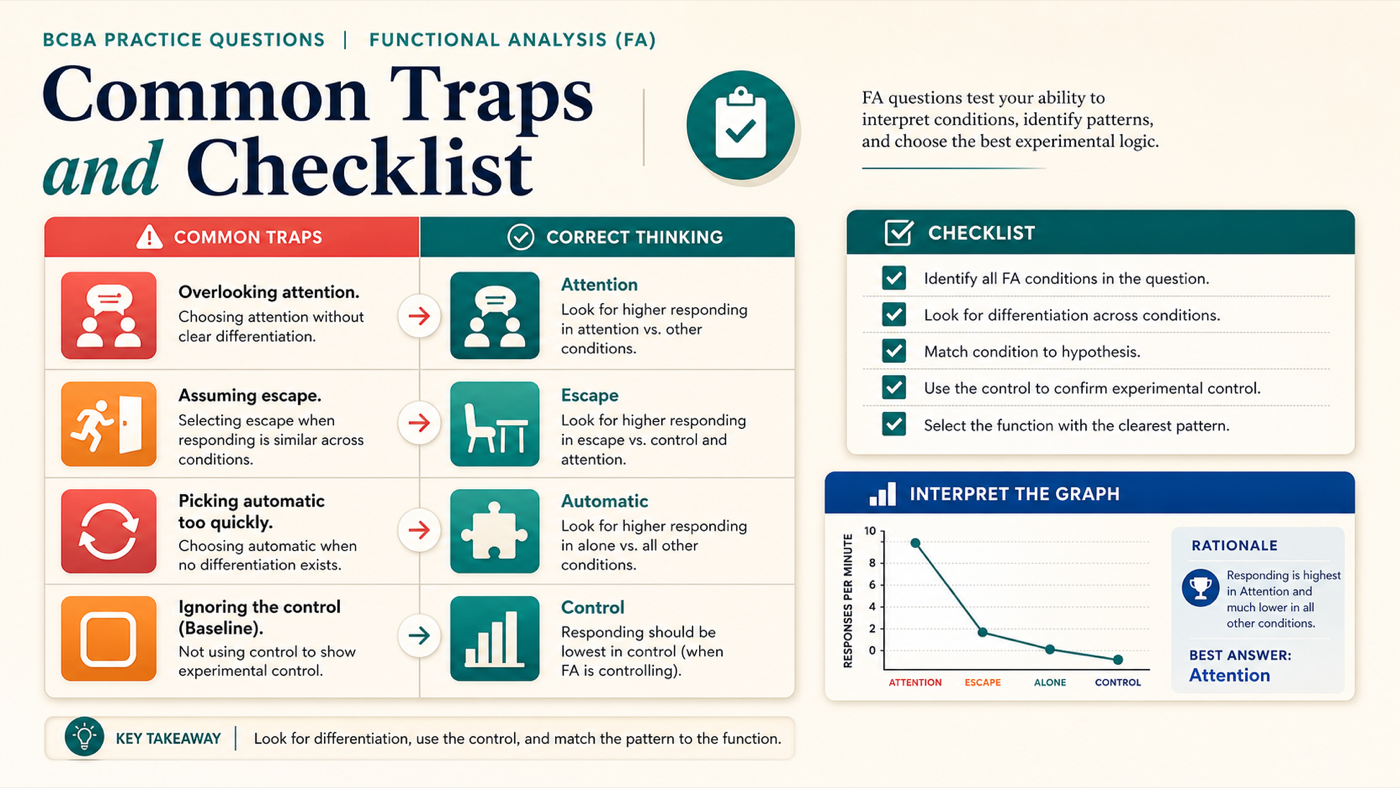
Common Exam Traps in Functional Analysis Questions
Watch out for these four common mistakes BCBA candidates make on FA questions:
- Confusing ‘alone condition’ results with automatic reinforcement — remember, high alone = automatic function ONLY if the behavior persists without any social consequences.
- Interpreting undifferentiated FA data as ‘no function’ instead of ‘inconclusive — need further analysis.’
- Overlooking multiple control when two test conditions both show elevated rates relative to control.
- Assuming a single session in a condition is sufficient — FA requires replication within design (e.g., multi-element).
FA Question Checklist for Exam Day
- Identify the contingency in each test condition (e.g., contingent attention vs. contingent break).
- Compare each test condition to the control (play) condition — not to each other.
- Look for replication of data paths in multi-element designs.
- If alone condition shows high rates, consider automatic reinforcement; if low, rule it out.
- If two test conditions are both elevated relative to control, suspect multiple control.
Ready for More? Take Our Free BCBA Mock Exam
Test your knowledge with a full-length, realistic BCBA practice exam. It includes detailed rationales and covers all BACB 6th Edition Task List items.
Take the Free BCBA Mock Exam
Access your free mock exam now and see how you score before the real test!
Functional Analysis Practice Questions — FAQ
Q: What is the difference between a functional analysis and a functional behavior assessment?
A: FA involves direct manipulation of variables to demonstrate functional relations; FBA is broader and includes indirect and descriptive methods.
Q: How many conditions are typically in a standard FA?
A: A standard FA usually includes at least three test conditions (attention, escape, alone) and one control (play).
Q: What if FA results show no differentiation?
A: This is inconclusive. Conduct further analyses such as a latency-based FA, pair wise FA, or trial-based FA.
References
Complete BCBA Exam Prep
Turn this topic into exam-day practice
Practice concepts in context with five full-length 6th Edition mock exams, two bonus practice exams, a 6th Edition study guide, and key-term flashcards—all in one $120 USD package.
Get the $120 All-in-One Prep Pack
Review everything included on the product page before ordering. No pass guarantee is implied.



