
What Is Generality in ABA?
Generality is one of the seven core dimensions of Applied Behavior Analysis as outlined by Baer, Wolf, and Risley in 1968. It refers to the extent to which a behavior change persists over time, appears in different settings, and spreads to related behaviors. In other words, generality in ABA means that the skills taught in therapy transfer to real-world contexts without additional training. Without generality, behavior change remains confined to the training environment and fails to achieve socially significant outcomes.
Table of Contents
- What Is Generality in ABA?
- Real-World ABA Examples of Generality
- Why Generality Matters for the BCBA Exam
- Quick Checklist for Programming Generality
- Final Summary
- References
Baer, Wolf, and Risley’s Core Dimension
In their seminal 1968 article, Baer, Wolf, and Risley defined applied behavior analysis as having seven dimensions, including generality. They emphasized that a behavior change is not truly meaningful if it only occurs in the training environment or under the original intervention conditions. For an intervention to be successful, the new behavior must be durable and transferable across settings, people, and time. This foundational requirement ensures that ABA interventions produce lasting improvements in clients’ lives.
The Goal of Durable and Transferable Change
Ethical and effective ABA interventions aim for lasting impact. If a child learns to request a snack in therapy but cannot do so at home, the intervention has failed to achieve generality. Programming for generality ensures that clients maintain skills after the intervention ends and can adapt them to new situations. This focus on socially significant outcomes is a hallmark of quality ABA practice. For example, teaching a child to greet peers in a clinic is not enough; the skill must generalize to the playground, classroom, and other natural settings. Behavior analysts use strategies like teaching in the natural environment, using multiple exemplars, and incorporating common stimuli to promote generality.
Real-World ABA Examples of Generality
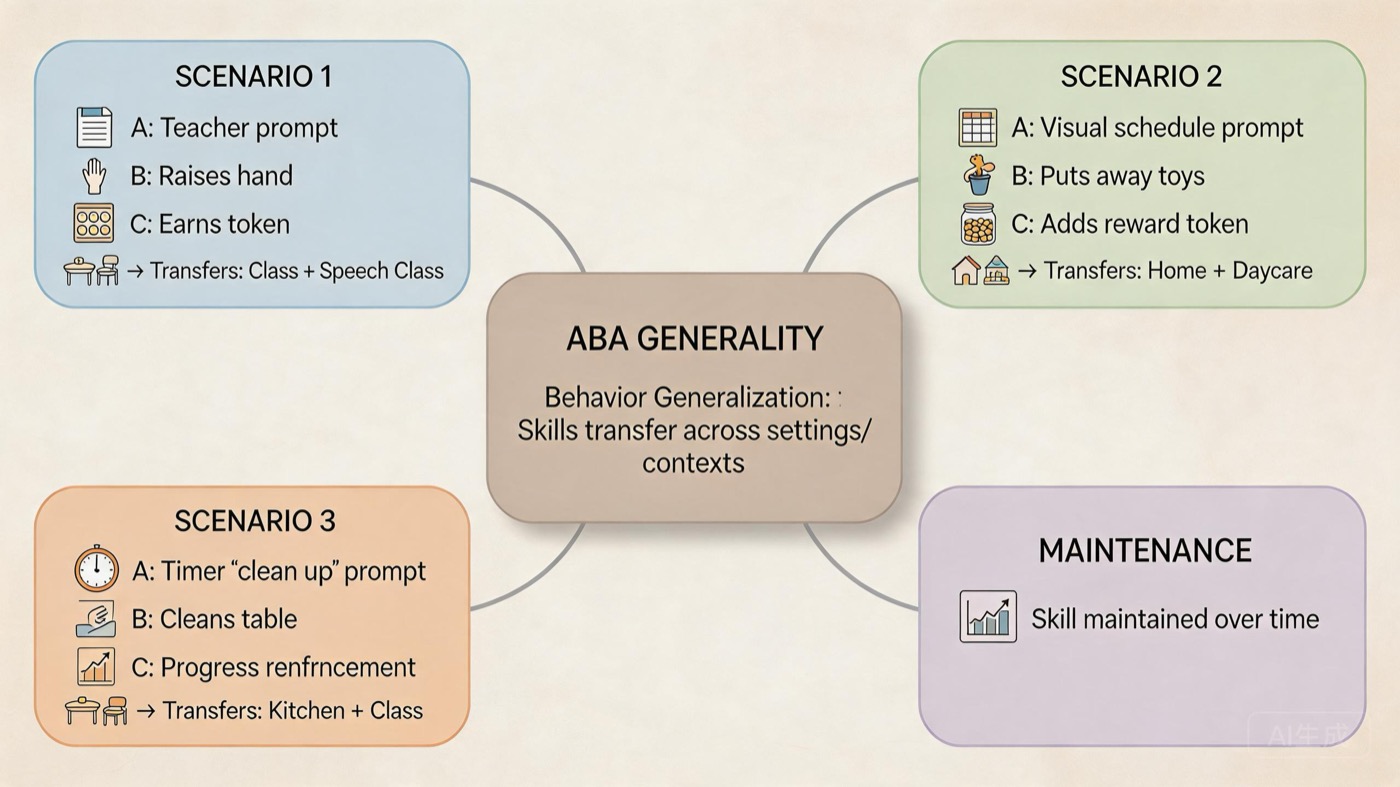
Understanding generality is easier with concrete examples. Below are three ABC (antecedent-behavior-consequence) scenarios where generality is demonstrated. Each example highlights how a behavior learned in one context transfers to another, showing the practical application of this dimension.
Example 1: Classroom to Home
ABC: A child raises his hand in class when the teacher prompts (antecedent), he raises his hand (behavior), and the teacher calls on him (consequence, attention). Generality: The child also raises his hand at home during dinner to ask for a turn to speak. Hypothesized function: attention — the behavior accesses social reinforcement across environments. This transfer occurred because the child learned that raising his hand reliably leads to attention, and the family dinner situation provided a similar antecedent (desire to speak).
Example 2: Social Skills Across Peers
ABC: A student initiates a greeting with one peer (antecedent: peer present), says “Hi” (behavior), and the peer responds positively (consequence). Generality: The student now greets multiple peers throughout the school day. Hypothesized function: social positive reinforcement — the greeting produces favorable social interactions. To ensure this generality, the teacher arranged for the student to practice with different peers, using varied greeting prompts. This multiple exemplar training helped the student learn that greeting anyone is likely to produce a friendly response.
Example 3: Food Selectivity from Clinic to Restaurant
ABC: In a clinic, a child tastes a new food after the clinician models (antecedent), the child takes a bite (behavior), and receives a preferred item (consequence). Generality: The child tries new foods when dining out with family. Hypothesized function: escape from food demands — the consequence (preferred item) might override the aversion to novel foods. Notice that the antecedent (novel food) is similar across settings, but the consequence (preferred item) is only available in the clinic. Yet the child still generalizes, possibly because tasting itself becomes reinforced by the family’s praise or reduced pressure. This example reminds us that generality can occur even without identical consequences, as long as the function is maintained.
These examples illustrate that generality is not automatic; it requires intentional programming. For instance, in the second example, the teacher actively programmed for generality by introducing multiple peers. Without such planning, the student might have only greeted the original peer.
Why Generality Matters for the BCBA Exam
The BCBA exam frequently tests your understanding of generality through scenario-based questions. You need to distinguish generality from related concepts and identify when programming for generality is missing. According to recent exam task lists (e.g., BACB 5th Edition Task List), items on generality appear under assessment and intervention sections, often requiring you to select strategies that promote generalization.
Common Exam Traps
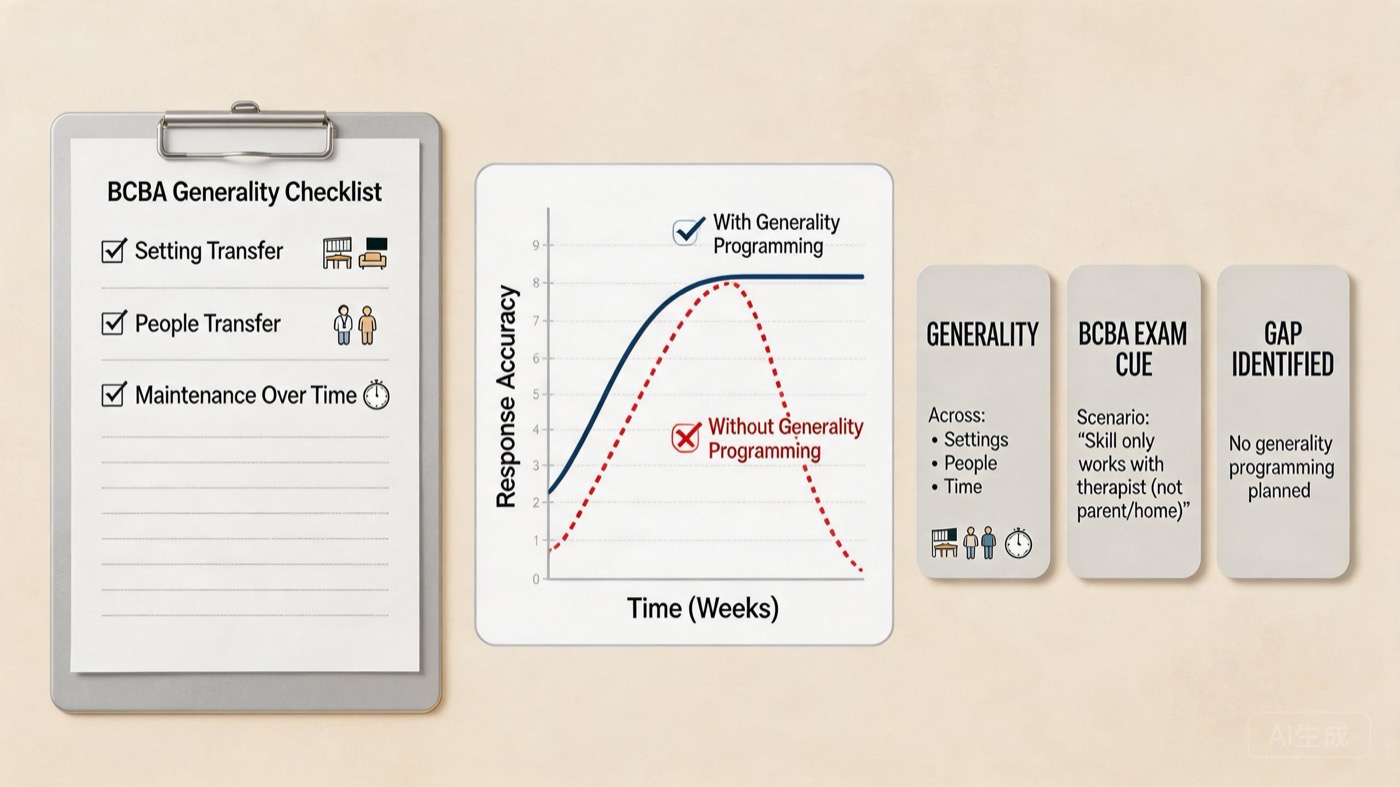
- Confusing generality with maintenance: Maintenance refers to the behavior persisting over time after the intervention. Generality includes but is broader — it involves transfer across settings, people, and behaviors. For example, if a student continues to raise his hand six months later, that is maintenance; if he also raises his hand at home, that is generality.
- Forgetting to program for generality: Many answer choices describe an effective intervention but overlook teaching in multiple environments. Without explicit programming, generality is unlikely. For instance, an answer that only mentions teaching in a clinic may be incomplete.
- Overgeneralization vs. discrimination: While generality is desired, sometimes a behavior occurs in inappropriate contexts (overgeneralization). The exam may ask you to recognize when discrimination training is needed instead. For example, a child who learns to say “excuse me” before interrupting may start saying it even when no one is speaking — that’s overgeneralization, not true generality.
How to Spot Generality Questions
Look for scenarios mentioning transfer across settings, people, or stimuli. For example, a skill taught in the clinic appears at school or with a new therapist. The correct answer will likely include strategies like teaching in natural environments, using multiple exemplars, or incorporating common stimuli. Practice question: “A BCBA teaches a student to request a break using a card. The student later requests a break verbally at home. This is an example of: a) maintenance, b) generality, c) discrimination, d) extinction.” Answer: generality, because the behavior transferred across modalities (card to verbal) and settings (clinic to home).
Quick Checklist for Programming Generality
When designing behavior intervention plans, use this checklist to ensure generality is addressed:
- Plan training in the natural environment (e.g., home, community) as early as possible.
- Involve multiple people (parents, teachers, peers) in intervention delivery.
- Use multiple stimulus exemplars (different materials, instructions) to teach the skill.
- Schedule follow-up probes across settings and over time to monitor maintenance and transfer.
- Reinforce independent use of the skill without prompts in new contexts.
- Use common stimuli (e.g., same visual cues) across training and generalization settings to bridge the gap.
Programmed generality is essential; natural contingencies often do not produce transfer. For example, a BCBA working on toilet training might first teach in the clinic bathroom with a picture schedule, then have the parent use the same schedule at home. This strategy (common stimuli) increases the likelihood of generalization.
For more on related dimensions and exam preparation, see our guide on the 7 Dimensions of ABA with Real-Life Cases.
Final Summary
Generality in ABA ensures that behavior change is meaningful and lasting. As a BCBA candidate, you must not only define it but also recognize how to program for it and identify it in exam scenarios. Master this dimension by practicing with real-world examples and studying common exam traps. Remember that generality is not automatic; it requires deliberate planning. Use the checklist above to guide your intervention designs. Good luck with your preparation!
References
- Behavior Analyst Certification Board (BACB)
- Association for Behavior Analysis International (ABAI)
- Baer, D. M., Wolf, M. M., & Risley, T. R. (1968). Some current dimensions of applied behavior analysis. Journal of Applied Behavior Analysis, 1(1), 91–97.
Complete BCBA Exam Prep
Turn this topic into exam-day practice
Practice concepts in context with five full-length 6th Edition mock exams, two bonus practice exams, a 6th Edition study guide, and key-term flashcards—all in one $120 USD package.
Get the $120 All-in-One Prep Pack
Review everything included on the product page before ordering. No pass guarantee is implied.



