

BCBA exam whiteboard strategy is most useful when it helps you solve a scenario, not when it becomes a giant memory dump. Build a small, individualized system for writing the clue, the behavior dimension, the relevant contingency, and the question number you want to revisit. Then rehearse it under time before exam day.
Table of Contents
- What Does “BCBA Exam Whiteboard” Mean?
- What Should You Put on a Practice Whiteboard?
- How Can a Whiteboard Help With a BCBA Scenario?
- How Do You Rehearse the Whiteboard Under Time?
- What Should You Verify About Exam-Day Materials?
- What Whiteboard Mistakes Waste Time?
- BCBA Exam Whiteboard Quick Checklist
- Take the Free BCBA Mock Exam
There are two different questions hidden in the phrase “BCBA exam whiteboard.” You may be asking how to use a whiteboard during mock exams, or what notes and scratch tools are allowed in the actual testing appointment. Those are not the same. The current BACB Handbook controls official examination rules, and Pearson VUE delivery details can change. Check the current instructions tied to your appointment rather than relying on a social-media tip.
This guide gives you a practical study workflow without telling you to bring personal notes, paper, a calculator, or any other prohibited item into the testing room. It also does not reproduce confidential examination content. Use the current BCBA Handbook and BACB examination-information page as the authority. Table of Contents
What Does “BCBA Exam Whiteboard” Mean?
A whiteboard is a scratch or planning surface that can help you externalize a short chain of reasoning. It is not a second textbook, an answer key, or a place to copy an entire task list. The useful question is: What information would make this particular vignette easier to discriminate?
During study, you can practice with a physical board, blank paper, a tablet, or the same electronic tool your mock platform provides. The goal is to rehearse the behavior of analyzing a question: identify the observable response, locate the consequence, define the measurement or design clue, compare the options, and record a flag if you need to return.
On the actual exam, the permitted tool may not look like the one you used at home. Some candidates report physical or electronic note surfaces, while official policies and delivery features can change. Treat candidate reports as ideas for practice—not permission. Verify the current BACB and Pearson VUE instructions that apply to your appointment.
What Should You Put on a Practice Whiteboard?
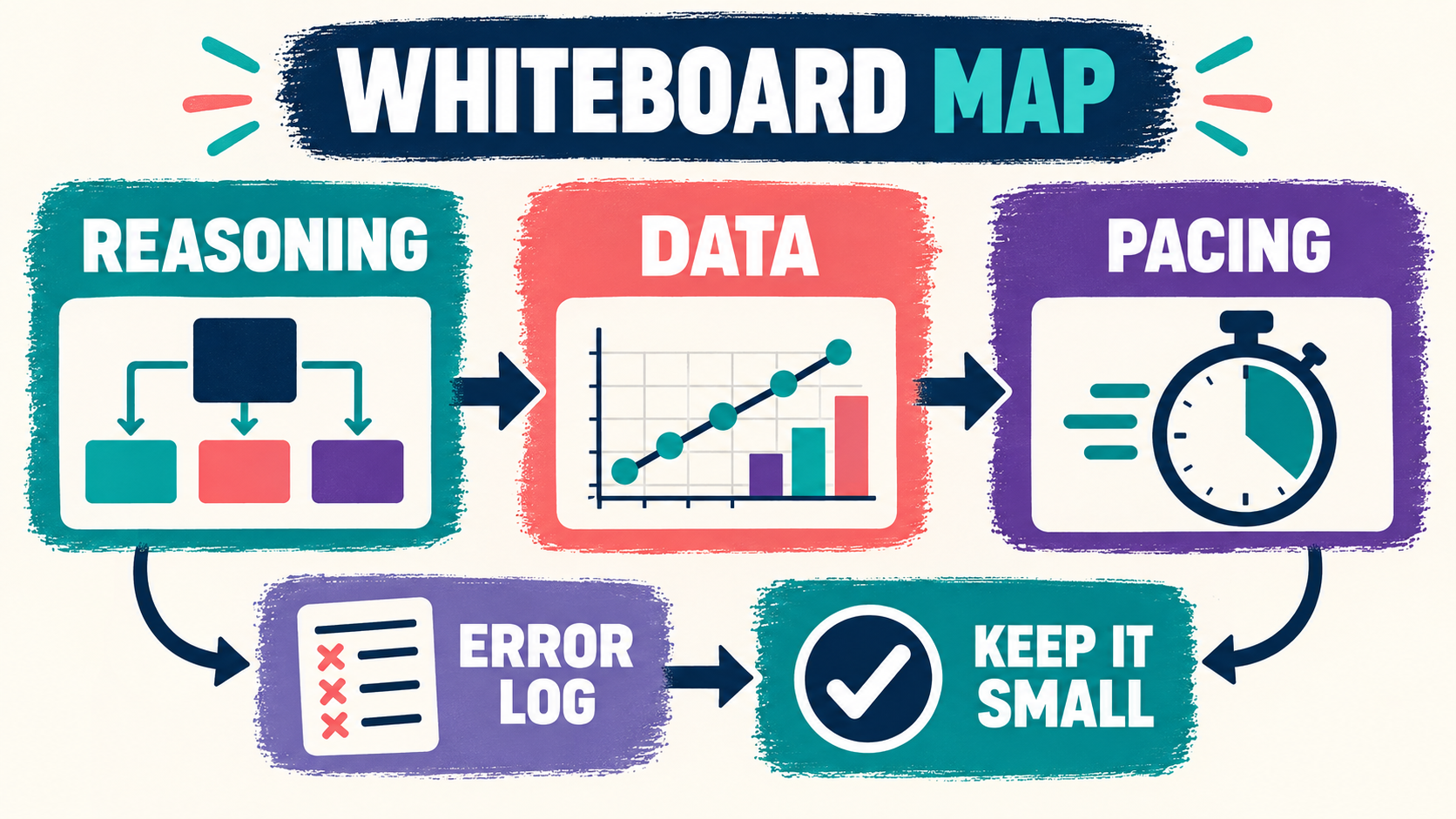
Use three small zones rather than filling the board from corner to corner. A useful layout is a reasoning zone, a data or design zone, and a pacing zone. The exact contents should come from your error log. If you never use an acronym, it does not deserve board space.
| Zone | Useful content | Stop rule |
|---|---|---|
| Reasoning | A short ABC, function, contingency, or “best first step” frame. | If copying the whole vignette is slower than rereading it, stop writing. |
| Data/design | A formula, measurement contrast, design feature, or graph clue you personally confuse. | Write only the cue that resolves a known error pattern. |
| Pacing | Question checkpoints, a flag list, or a brief reset reminder. | Do not let the board become a second task to maintain. |
Examples of compact prompts include “function before procedure,” “rate = count ÷ time,” “independent vs prompted,” “prediction–verification–replication,” and “least restrictive, client-informed next step.” These are study prompts, not substitutes for understanding. Write only what you can explain and apply.
- Use your error log: choose two or three concepts you repeatedly confuse.
- Use symbols: arrows, a small grid, or a single letter can be faster than a sentence.
- Keep the board legible: leave blank space so a new scenario can be mapped without erasing everything.
- Practice writing at your real pace: a beautiful board that takes ten minutes is not a good exam tool.
How Can a Whiteboard Help With a BCBA Scenario?
The board should reduce working-memory load while preserving the wording that matters. Use it for a short representation of the relationship in the question, not for a conclusion that the facts do not support.
- Circle the task: is the question asking for a definition, a measurement choice, a function hypothesis, an intervention, an ethical action, or a design feature?
- Write the observable behavior: avoid replacing an operational definition with a diagnosis or a vague label.
- Map the relation: note the antecedent, response, consequence, motivating operation, or comparison condition that the stem actually supplies.
- Write the decision rule: for example, “measure the critical dimension,” “assess before selecting,” or “protect confidentiality before public response.”
- Compare the options: cross out choices that skip assessment, overclaim certainty, ignore data, or jump to a more intrusive step without justification.
For a measurement item, a tiny note such as “how often / how long / how soon / whether during interval” may be more useful than copying all four answer choices. For a single-case design item, write the feature that distinguishes the designs in the stem. For an ethics item, record the client, stakeholder, public-statement, or competence boundary before thinking about a convenient solution.
Do not use the board to create a fake certainty. If the stem lacks information, write “need assessment” or “cannot conclude yet” and look for the answer that respects that limit. The best response is often the one that gathers relevant information before making a high-impact decision.
How Do You Rehearse the Whiteboard Under Time?
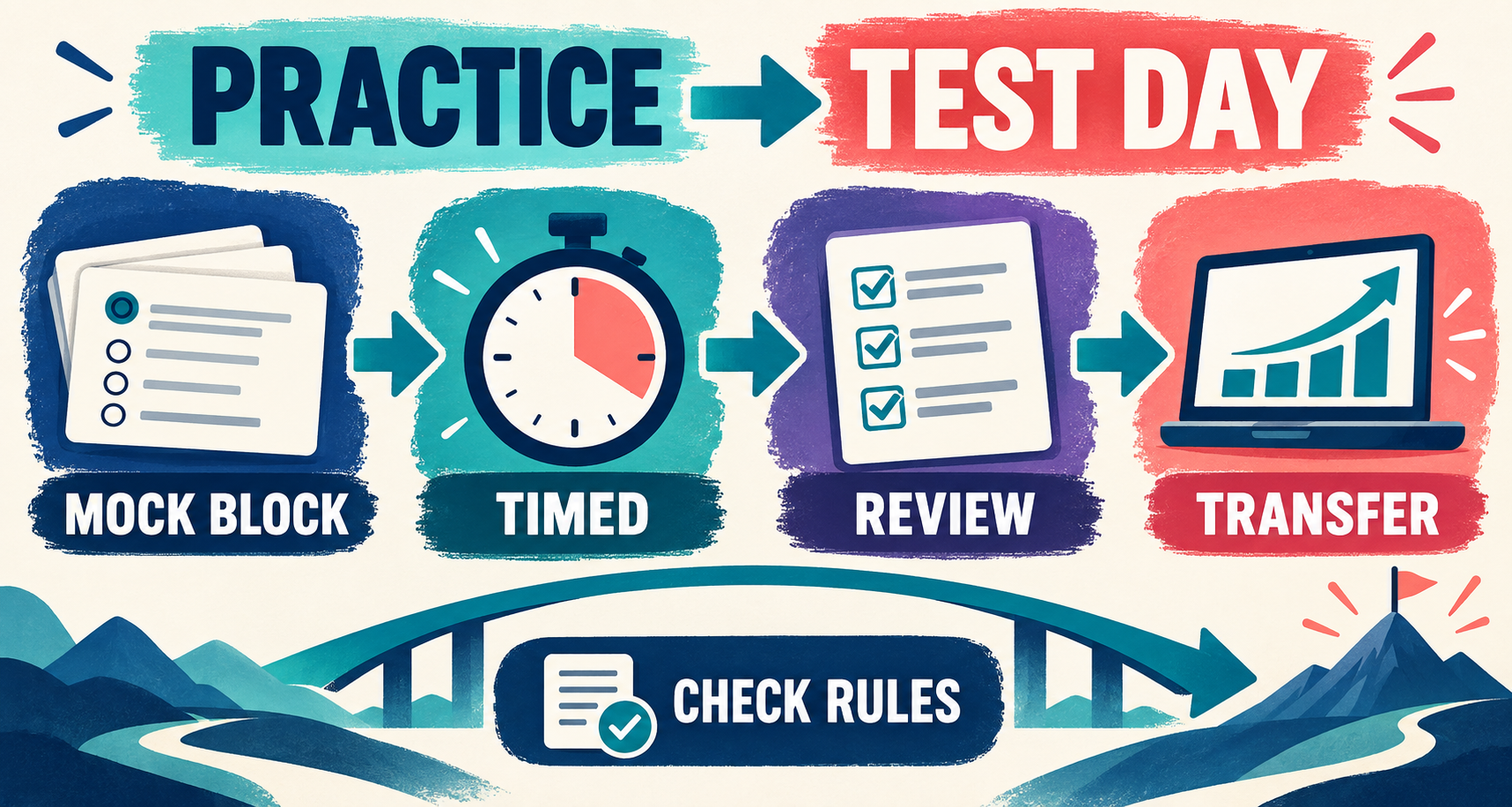
Build the whiteboard into mock-exam practice gradually. The first rehearsal is not a speed test. It is an observation: what do you write, when do you write it, and does it improve your answer or only make you feel busy?
- Run a short block: complete 10–20 questions with the same board or digital tool you plan to use.
- Mark the behavior: note whether writing clarified the question, slowed you down, or became a reassurance ritual.
- Review the error log: remove prompts you never used and add only a cue tied to a real miss.
- Run a timed mixed block: include measurement, assessment, ethics, design, intervention, and supervision questions so the board cannot be built for one topic only.
- Practice the reset: after a difficult item, clear the immediate space, take one slow breath, and return to the task being asked.
During a full-length rehearsal, track whether board use changes your pacing. If you are spending too long writing an acronym, stop and answer from your knowledge. If you are losing the structure of a complex scenario, use a tiny ABC or data sketch. The board is a tool for discrimination, not a performance requirement.
Also practice with a plain surface that resembles the restrictions you may face. Do not assume you can bring a favorite marker, printed template, personal notes, calculator, or paper into the real exam. The practice goal is portability of reasoning, not portability of materials.
What Should You Verify About Exam-Day Materials?
Read the current BACB Handbook and the instructions attached to your Pearson VUE appointment. The current Handbook lists personal items and materials that are not permitted in the examination room, including notes and scratch paper. A third-party page or a candidate’s recent post cannot override the official rule.
Testing tools can also change. A center may provide a particular writing surface or the delivery platform may include an electronic note feature, but availability, controls, and timing should be confirmed through current official instructions. Do not write notes before the exam is authorized to begin, do not photograph or remove testing materials, and do not assume a tool works like the one in your mock platform.
- Check the current BACB Handbook before the appointment.
- Read Pearson VUE’s current BACB exam page and appointment instructions.
- Follow the proctor’s directions even if an older study video says something different.
- Ask the testing provider about an accommodation rather than bringing an unapproved tool.
- Never copy, discuss, or upload confidential exam content.
This is why a good BCBA exam whiteboard article should teach a workflow, not promise a particular physical board. Your preparation should survive a change in surface, marker, interface, or room.
What Whiteboard Mistakes Waste Time?
- Memory dumping everything: writing the entire task list can consume time without helping the next question.
- Copying the stem: the screen already contains the stem; write only the relation or clue you need to hold.
- Using a universal acronym list: a prompt that helped someone else may distract you or trigger the wrong answer.
- Writing before reading the question: identify what is being asked before choosing a representation.
- Turning the board into an anxiety ritual: if writing feels mandatory on every item, practice answering without it.
- Ignoring the official rules: internet advice is not permission to bring prohibited materials or record exam content.
The strongest strategy is usually small and specific. A candidate who writes one functional relation or measurement distinction at the right moment may benefit more than a candidate who fills the whole board with definitions and then never looks at them.
BCBA Exam Whiteboard Quick Checklist
Before the next mock exam, ask:
- Which two or three recurring errors justify board space?
- Can I express each cue in a few words or a simple diagram?
- Do I know when to stop writing and reread the question?
- Can I use the same reasoning if the surface is physical, electronic, or unavailable?
- Have I checked the current BACB and Pearson VUE instructions for my appointment?
Use the free BCBA mock exam to rehearse this behavior under realistic timing. It is an independent study aid, not an official BACB product, a source of confidential exam content, or a guarantee of a passing score.
The short version is: build a small board from your own error log, use it to map the question rather than copy it, rehearse the writing decision under time, and verify official materials rules before test day. That is a safer and more transferable answer to the search for a BCBA exam whiteboard.
Take the Free BCBA Mock Exam
When you are ready to apply the idea, use the free practice resource below for additional feedback. Take the Free BCBA Mock Exam



