
A BCBA exam podcast can make review easier to fit into a commute or walk, but listening is not the same as learning. Screen the episode, pause for retrieval, verify the current source, and finish with mixed practice.
Table of Contents
- What Is a BCBA Exam Podcast Good For?
- How Should You Screen a Podcast Before Listening?
- Which Episodes Deserve Trust?
- How Do You Turn Listening Into Active Recall?
- How Should Audio Connect to the Current TCO?
- Where Do Old Task Lists Create Risk?
- How Should You Pair a Podcast With Practice Questions?
- What Does a 20-Minute Audio Study Routine Look Like?
- What Should a BCBA Podcast Checklist Include?
- Which Official Resources Should You Start With?
- BCBA Exam Podcast FAQ
Audio is useful when your eyes and hands are busy, yet the BCBA examination tests decisions, discriminations, data interpretation, ethics, and application. The best podcast routine therefore treats an episode as a prompt for active study—not as proof that a candidate knows the material. This guide shows how to use audio without drifting into outdated task lists or passive repetition. Table of Contents
What Is a BCBA Exam Podcast Good For?
A BCBA exam podcast is best for orientation, explanation, retrieval prompts, and review between focused study blocks. It can introduce a concept, model how an expert distinguishes similar terms, or remind you to revisit a domain. It is not a substitute for your training, the current BCBA Test Content Outline, the Ethics Code, supervised preparation, or practice that requires you to choose and defend an answer.
Audio can help when you need flexible exposure, but the medium can hide uncertainty. A listener may recognize a familiar phrase while being unable to define it, apply it to a new scenario, or identify why a distractor is wrong. Build a pause into every episode so you must produce an answer before hearing the explanation.
- Use audio to preview: identify the topic and write two questions before pressing play.
- Use audio to retrieve: pause after a definition and explain it without looking at notes.
- Use audio to compare: ask how the idea differs from a close term in the current TCO.
- Use audio to schedule: create a small review habit that leads into reading and practice.
How Should You Screen a Podcast Before Listening?
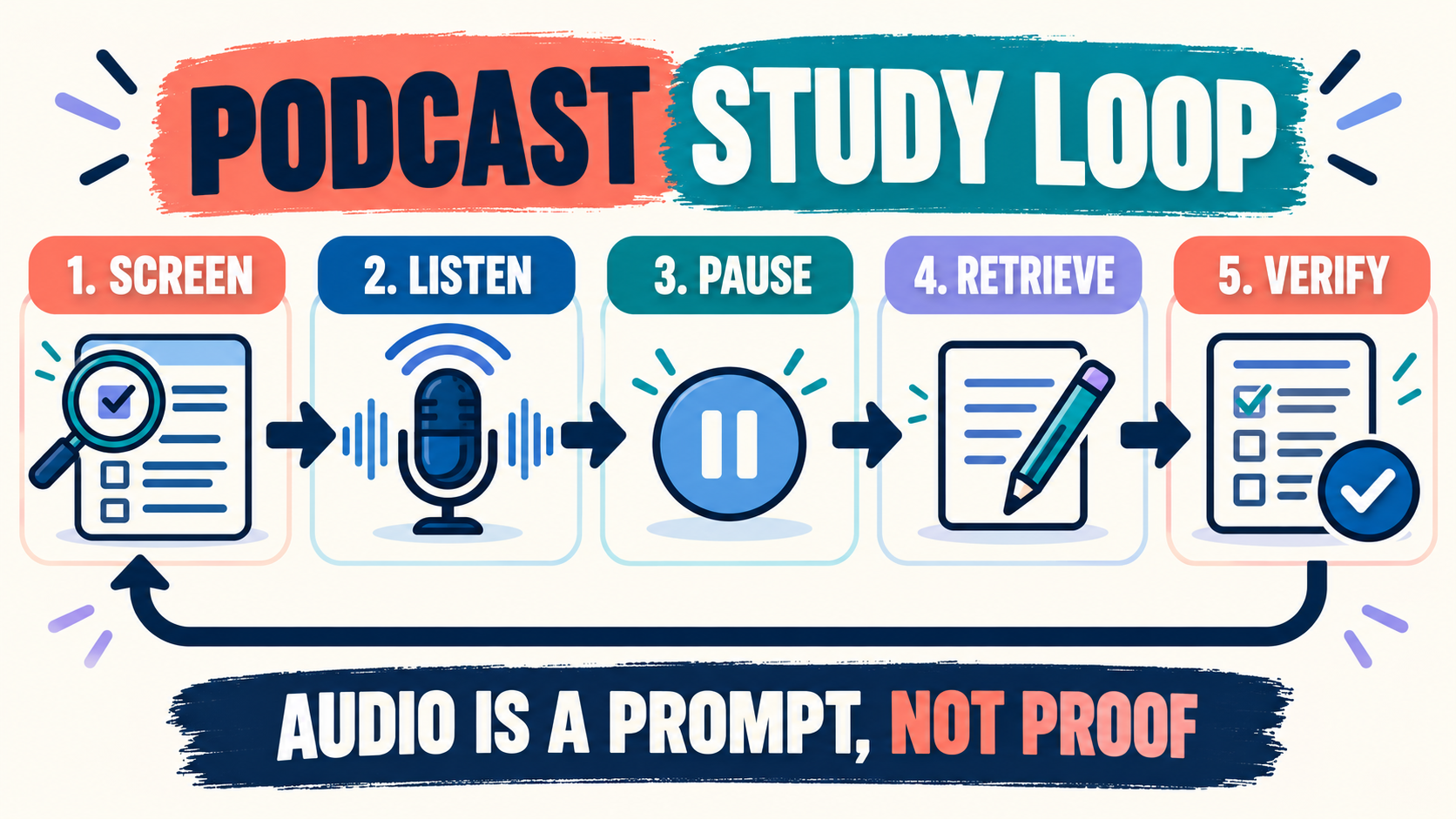
Screen the episode before you invest study time. Look for the edition or outline it follows, the publication or update date, the host’s qualifications, links to primary sources, and a clear distinction between education and credentialing advice. A show that says it covers the “task list” without naming the edition may be using language that no longer matches the current exam.
Also check the episode’s intended job. A BACB news or certification episode may explain policy context, while a commercial show may teach a concept or promote a course. Neither is automatically bad, but you should not use a marketing claim as an eligibility rule or treat an old episode as current merely because it ranks well.
Which Episodes Deserve Trust?
Prefer episodes that show their sources and make their boundaries visible. The BACB’s official Inside the BACB podcast page includes certification and professional topics, and it also identifies when an older episode may be outdated. That warning is useful: a date label is not decoration when requirements, handbooks, and test outlines change.
| Signal | Why it matters | Your action |
|---|---|---|
| Edition named | The episode tells you which outline or task list it uses. | Compare it with the current BACB TCO before making a study map. |
| Source links | Claims can be checked instead of accepted on authority. | Open the primary source and save the version or access date. |
| Answer reasoning | Good teaching explains why similar choices differ. | Pause and state the distractor rule in your own words. |
| Clear update note | Certification and exam information can age quickly. | Replace or annotate an episode when the official rule changes. |
Be especially careful with older podcasts that describe the fifth-edition task list. They may still explain foundational behavior analysis well, but their domain labels, examples, and study sequence should not silently become your current exam blueprint. Use them for concepts only after checking what changed.
How Do You Turn Listening Into Active Recall?
Active recall means producing information from memory before seeing or hearing the answer. During an episode, pause after each substantial idea and answer one question aloud or in writing. For a concept episode, define the term, give an example, give a nonexample, and name the feature that would change the decision. For a policy episode, write the official source you must verify.
- Before listening: write the domain, task, and one uncertainty you want the episode to address.
- During listening: pause after explanations and reconstruct the rule without replaying the sentence.
- After listening: write one new scenario and decide whether the same answer still fits.
- Next day: retrieve the idea without audio, then check the source and your notes.
Do not confuse a comfortable listening experience with fluency. If you can follow the host but cannot generate an answer from a blank page, keep the episode in the “exposure” column of your study log. Move it to “learned” only after you can transfer the idea to a new scenario and explain the boundary.
How Should Audio Connect to the Current TCO?
The current BCBA exam uses the 6th-edition Test Content Outline. Treat the official BCBA TCO as the map and a podcast as one learning aid. For every episode, record the domain or task it supports, the terms it explains, and the type of question it might help you answer. If you cannot map the episode, its value may be general orientation rather than exam preparation.
A podcast also tends to overrepresent memorable concepts. A host may spend a full episode on one interesting distinction even though your own diagnostic shows a different domain needs attention. Let your error log determine the next episode, not the order in a playlist. The outline tells you the boundary; your practice data tells you the priority.
Where Do Old Task Lists Create Risk?
Search results can surface useful older audio beside current shows. The risk is not that every old explanation is worthless. The risk is that a candidate copies old labels, old domain boundaries, or old eligibility advice without checking the current source. The BACB’s podcast page itself distinguishes current information from episodes that may be outdated, which is a reminder to verify rather than assume. Keep three notes when an episode discusses a changing topic:
- What the episode says: quote or paraphrase the study claim without treating it as a rule.
- What the official source says: record the current BACB page, handbook, or TCO you checked.
- What applies to you: separate exam content from eligibility, application, fieldwork, and appointment questions.
If your certification timeline crosses the 2027 transition, read the current requirements and transition resources directly. An audio summary can help you know what to investigate, but it should not decide which pathway or form applies to your record.
How Should You Pair a Podcast With Practice Questions?
Use a short practice set after listening, not another hour of audio. Choose questions from more than one domain when the goal is transfer. For each missed item, classify the error: definition, application, data interpretation, ethics, reading, or stamina. Then return to the episode only if it addresses the identified gap; otherwise choose a reading, worked example, supervisor discussion, or current official source. Try this sequence for BCBA exam podcast practice questions:
- Listen to one focused segment and pause before the answer or summary.
- Write a new vignette using the same concept but different facts.
- Answer a mixed question without replaying the episode.
- Explain why the best option fits and why the distractors do not.
- Record the next action in your error log.
What Does a 20-Minute Audio Study Routine Look Like?
A short routine can be enough when it leads to active work. Spend two minutes screening the source and naming the target. Listen for eight minutes, pausing at least twice to retrieve. Use five minutes to answer or write a scenario without the audio. Finish with five minutes of verification: open the current TCO or official page, correct your notes, and schedule the next review.
Keep audio away from tasks that demand clinical judgment or private information. Do not listen to a sensitive case discussion in a public place, record a client, or share protected information in a study group. A flexible routine should still protect confidentiality and professional boundaries.
What Should a BCBA Podcast Checklist Include?
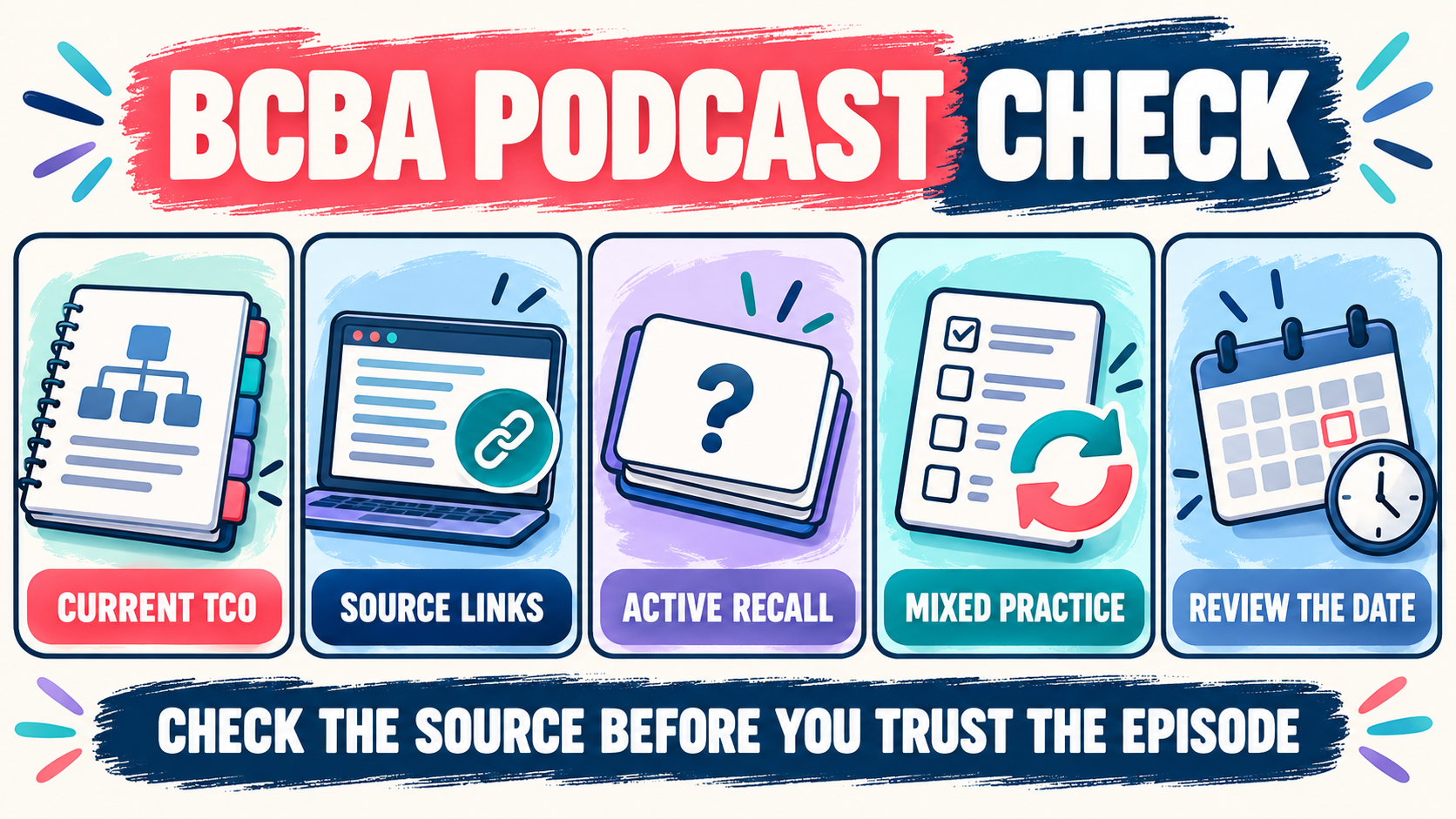
The checklist above turns a podcast recommendation into a source-and-study audit. Before you add an episode to a serious preparation plan, confirm the current outline, locate the source links, test yourself with active recall, mix the concept into practice, and review the date. If one of these steps is missing, label the episode as optional exposure rather than a core study source.
- Current TCO: can you identify the edition or outline the episode uses?
- Source links: can you open a primary BACB page for changing facts?
- Active recall: can you explain the concept without replaying the audio?
- Mixed practice: can you apply the idea when the scenario and domain change?
- Review the date: will you recheck the episode if the handbook, TCO, or requirements change?
Which Official Resources Should You Start With?
Begin with the BACB’s Examination Information, current BCBA Handbook, TCO, Ethics Code, and transition materials. The official Inside the BACB podcast is useful for hearing the organization explain selected certification and professional topics, but still check the linked source for the rule that affects your application or appointment.
For a low-pressure diagnostic, Take the Free BCBA Mock Exam after the listening-and-recall cycle. Treat the score as evidence about what to review next, not as certification evidence. The strongest combination is audio for flexible exposure, reading for precision, practice for application, and feedback for the next decision.
BCBA Exam Podcast FAQ
Can a podcast replace a BCBA study guide?: No. A podcast can explain or prompt review, but it cannot replace the current TCO, official requirements, training materials, practice, and feedback. Use it as one component in a deliberate study system.
Are old BCBA exam podcasts still useful?: They may be useful for foundational concepts, but first check the edition, date, and topic. Do not use an old episode as current eligibility or exam-version guidance without comparing it with official BACB sources.
How long should a BCBA exam podcast study session be?: There is no required length. A focused 20-minute cycle can work when it includes pauses, retrieval, source verification, and practice. Longer listening without producing answers may create familiarity without durable learning.
Should I listen to a podcast before or after practice questions?: Use it before practice to preview a topic or after practice to repair a specific gap. Let your error log decide. If the issue is reading or data interpretation, replaying a conceptual episode may not solve it.
Bottom line: A BCBA exam podcast is most valuable when it changes what you do next: screen the source, listen with a question, pause to retrieve, verify the current rule, practice a new scenario, and review the error.



