

If you search for BCBA fellowship, you may be looking for a structured way to complete supervised fieldwork while working in an ABA organization. A fellowship can provide supervision, mentorship, training, and access to clinical experience, but the word is not a single BACB credential or a universal program format.
Table of Contents
- BCBA Fellowship: What It Is and What It Is Not
- What a BCBA Fellowship May Include
- Fellowship, Internship, Supervision, and Mentorship
- What to Verify Before Joining a Fellowship
- Paid Fieldwork, Employment, and Compensation
- The 2026–2027 BACB Checkpoint
- Questions to Ask Before You Accept
- Red Flags in a Fellowship Offer
- Who Benefits Most from a Fellowship?
- Final Takeaway
- Quick Review Checklist
- Take the Free BCBA Mock Exam
Some fellowships are paid employment pathways for RBTs or behavior technicians. Others are fieldwork-support programs for students who already have a placement. A few combine exam preparation, leadership development, and a staged promotion plan. This guide explains how the models differ, what to verify before joining, and how to tell whether a fellowship will actually support your BCBA certification plan.
BCBA Fellowship: What It Is and What It Is Not
A BCBA fellowship is usually a structured employment or training arrangement designed to help a person build the experience, supervision, and professional skills needed on the path to board certification. The organization may pair a trainee with one or more BCBAs, create a fieldwork plan, schedule case-review meetings, offer unrestricted activities, and provide feedback as the trainee develops.
The key word is usually. The BACB sets certification and fieldwork requirements; it does not turn every program labeled “fellowship” into an approved route. The BACB BCBA resource page directs candidates to the current handbook, fieldwork checklist, supervision contract, and documentation resources. A fellowship is a provider’s way of organizing support around those requirements. It is not a replacement for the handbook, your qualifying degree and coursework, or the BCBA examination.
That distinction protects you from a common misunderstanding: joining a fellowship does not automatically make every hour count. Hours must meet the fieldwork rules in effect for your application, be supervised and documented correctly, and include activities that help you develop the competencies expected of a behavior analyst. Your supervisor remains responsible for determining whether activities are appropriate, but you should understand the plan before you start.
What a BCBA Fellowship May Include
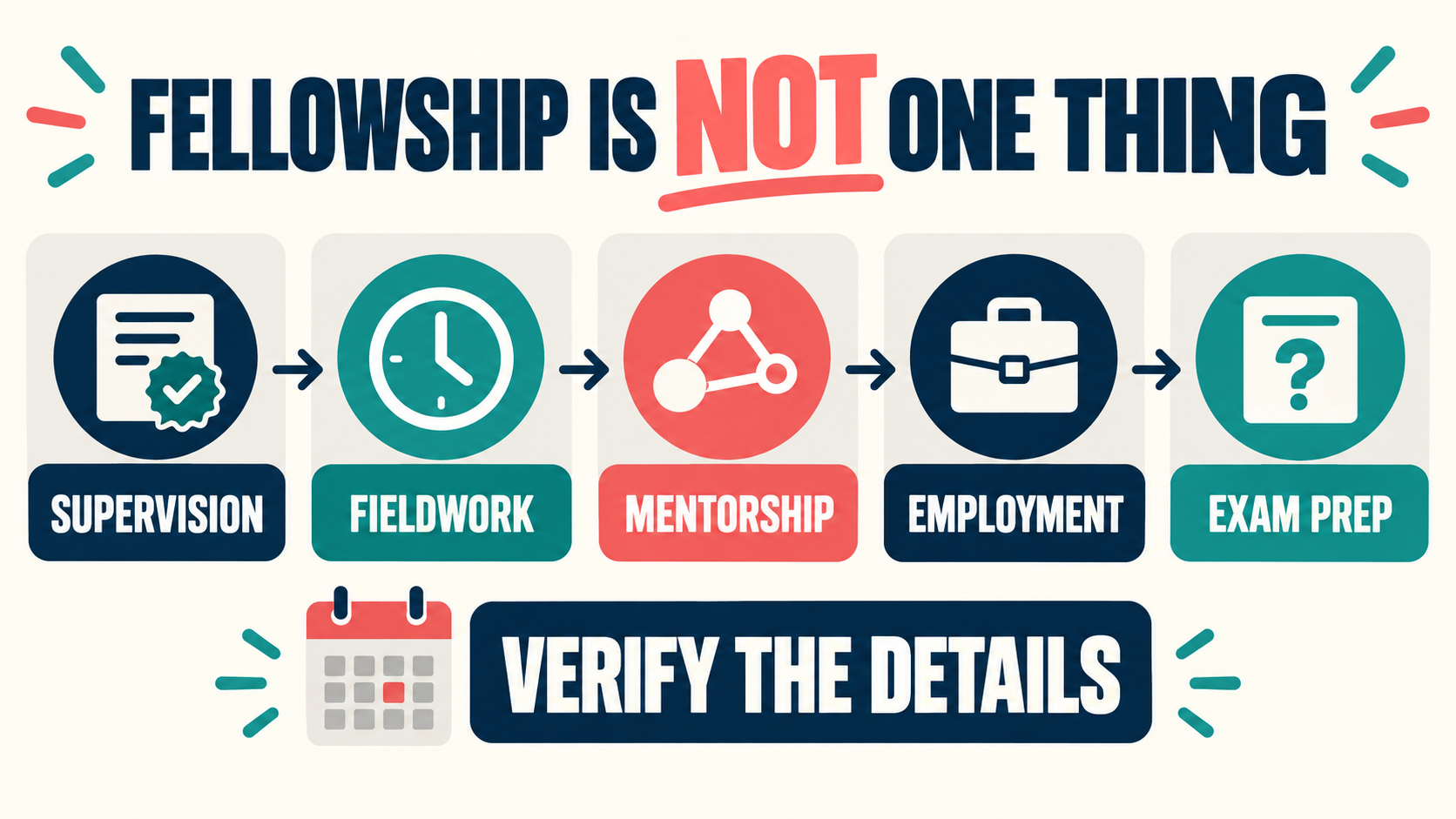
Programs use different combinations of support. One provider may focus on fieldwork hours and supervision; another may build a multi-stage career ladder; another may offer mentoring and exam preparation while leaving part of the fieldwork arrangement to the trainee.
- Fieldwork supervision. A qualified BCBA supervises the trainee’s work, observes practice, reviews data and decisions, and provides feedback tied to fieldwork requirements. Ask which supervisor is responsible for signatures and documentation.
- Unrestricted activities. A strong program creates opportunities beyond direct implementation, such as data analysis, assessment support, program writing, caregiver training, staff training, treatment-integrity review, and team consultation. “We have clients” is not the same as “we have a plan for qualifying unrestricted work.”
- Mentorship. Mentoring can include career conversations, study planning, modeling professional communication, and advice about cases. Mentorship is valuable, but it is not automatically the same as BACB fieldwork supervision. Find out which meetings are formal supervision and which are optional support.
- Employment and training. Some fellowships hire the trainee as an RBT or behavior technician and provide paid restricted work, training, and a route toward higher-level responsibilities. Others are available only to existing employees enrolled in an ABA program. Read the employment terms separately from the fieldwork terms.
- Exam preparation. Programs may include study groups, practice questions, content reviews, or a planned examination timeline. Those resources can help, but an employer’s practice test is not the BACB exam and cannot replace eligibility approval.
Current fellowship pages illustrate the range. CARD describes a no-cost fieldwork fellowship with supervision, unrestricted activities, and mentorship for employees. Helping Hands Family describes a structured program tied to employment and an ABA graduate program. Hopebridge describes paid work and opportunities to develop skills outside direct therapy. These pages are examples of program models, not universal standards or endorsements.
Fellowship, Internship, Supervision, and Mentorship
These terms overlap in everyday conversation, but they answer different questions. An internship usually describes a temporary learning placement connected to school or professional experience. A fellowship often describes a more structured post-coursework or employment pathway with staged responsibilities, supervision, and professional development. Either one can be useful, and neither label proves that the hours meet BACB requirements.
Supervision is the formal relationship and documentation process that determines whether a trainee’s work can count toward certification fieldwork. Mentorship is broader guidance that can improve judgment, confidence, communication, and career planning. A mentor may be an excellent resource without being the responsible fieldwork supervisor. Your agreement should make that difference explicit.
| Term | Usually describes | What you still need to verify |
|---|---|---|
| Fellowship | A structured training, employment, and professional-development pathway. | Fieldwork eligibility, supervisor, qualifying activities, pay, schedule, and exit terms. |
| Internship | A temporary placement for learning or practical experience, often connected to a school. | Whether the placement is formal BACB fieldwork, how hours are documented, and who supervises. |
| Supervision | The formal review, observation, feedback, and documentation required for fieldwork. | Supervisor qualifications, contract, monthly requirements, observation, and verification forms. |
| Mentorship | Broader professional guidance, modeling, encouragement, and career advice. | Whether any mentoring activity is also documented as formal supervision or fieldwork. |
What to Verify Before Joining a Fellowship
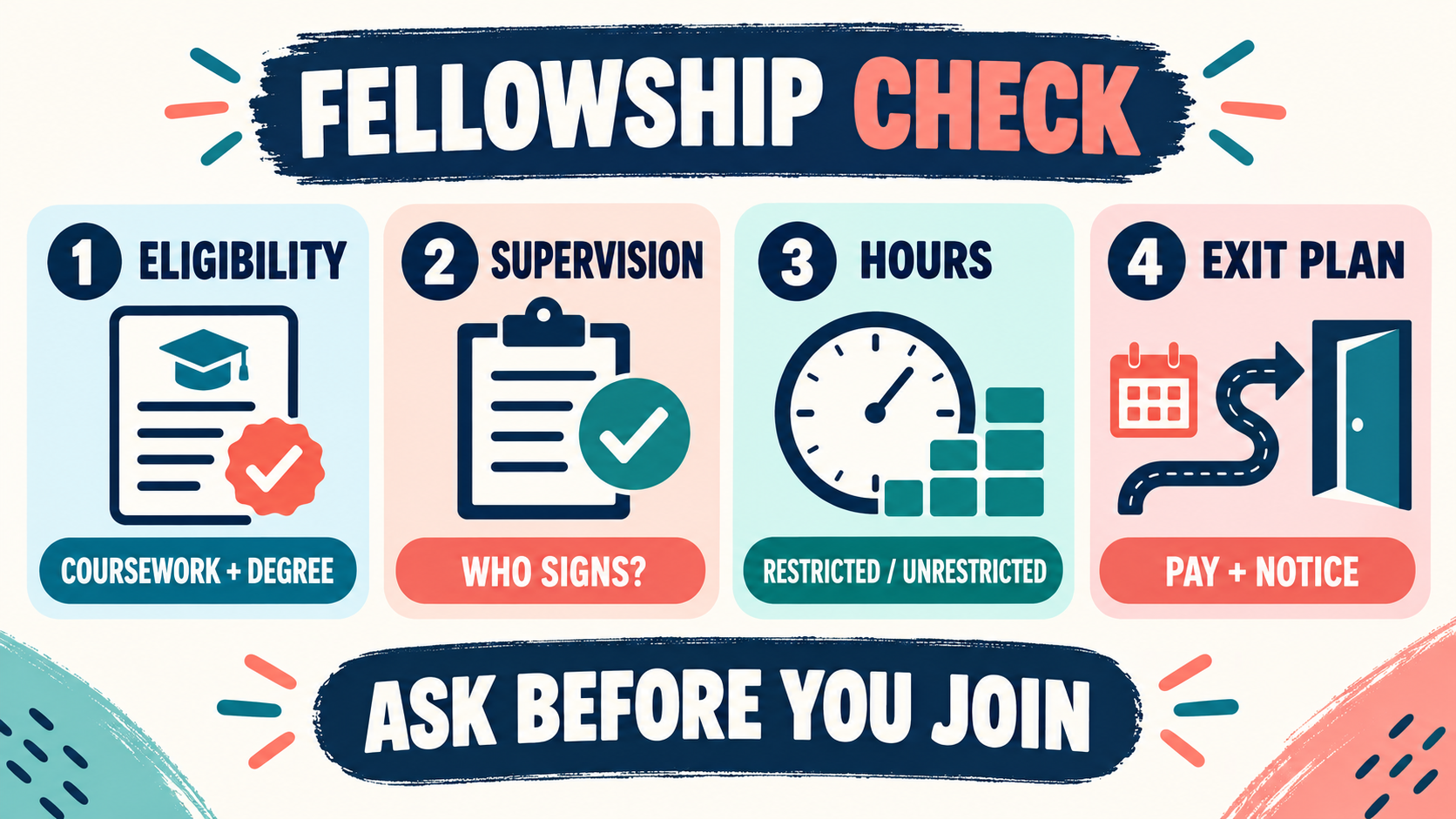
Before you accept a fellowship, ask for a written plan. You should be able to see how your education, job duties, supervision, fieldwork, and exam timeline fit together.
- Eligibility. Confirm that you are enrolled in or have completed the degree and behavior-analytic coursework required for your intended pathway. Ask whether the program accepts trainees at your current stage or expects a completed master’s degree.
- Supervisor. Identify the responsible supervisor by name and credential. Ask whether the supervisor is active and in good standing, meets the current BACB requirements, has completed required supervision training, and will actually observe and review your work.
- Activities. Request examples of restricted and unrestricted activities. A useful plan should explain how you will practice assessment, data interpretation, program development, caregiver or staff training, ethical decision-making, and collaboration rather than assigning only repetitive direct implementation.
- Documentation. Ask who maintains monthly records, when you receive copies, how supervision contracts are signed, and what happens if a supervisor leaves. Keep your own contemporaneous records; do not rely on a verbal promise that the company will reconstruct hours later.
- Schedule. Find out how many hours you can realistically work each month, how supervision fits into the schedule, whether meetings are paid, and whether the program expects you to work outside paid time. The fastest advertised timeline may not be realistic for your caseload, coursework, or life.
- Exit plan. Ask what happens when you finish fieldwork, leave the company, fail to meet a monthly minimum, or decide the placement is not a fit. Clarify notice periods, repayment clauses, noncompete language, and access to your records before signing.
Paid Fieldwork, Employment, and Compensation
Some fellowships advertise paid restricted hours, paid training, paid supervision time, or a salary ladder. Others offer supervision at no separate charge but require employment, a minimum schedule, or a commitment to stay. Compensation is important, but it should not be the only comparison point.
Ask exactly what is paid: direct client hours, team meetings, supervision meetings, study groups, report writing, travel, cancellations, and unrestricted projects may be treated differently. A high hourly rate can be less valuable if the program provides little unrestricted experience or if supervision occurs outside the paid schedule. Conversely, a lower starting rate may be reasonable if the program provides protected mentorship and a clear, documented development path. Compare the total package, not a single advertised number.
Also check whether the fellowship is an employee role, an independent-contractor arrangement, or an unpaid placement. That distinction affects taxes, benefits, scheduling, workers’ compensation, and who controls the work. If the program requires you to pay for supervision, ask what services are included, who signs the documentation, and whether the supervisor has a conflict of interest. Put the answer in writing.
The 2026–2027 BACB Checkpoint
Fieldwork plans need a date check. The BACB supervision page explains the responsibilities of people supervising future behavior analysts and points candidates to the applicable handbook. The current handbook contains detailed rules for fieldwork, supervision, observations, qualifying activities, contracts, and verification.
The BACB Recent and Upcoming Changes page also matters because requirements change during the 2026–2027 transition. The updated 2027 BCBA Handbook describes the eligibility rules that apply to candidates planning under the new framework. Do not assume that an old fellowship brochure, an outdated VCS reference, or a social-media promise explains the rules for your application date.
Ask the fellowship how it will handle changes if your fieldwork spans the transition. Which handbook version is being used? How will the supervisor document observations and monthly requirements? If the organization gives you a different answer from the BACB handbook, pause and resolve the conflict before you rely on the hours.
Questions to Ask Before You Accept
Use these questions in an interview or written information request:
- Is this fellowship available to employees only, or can outside trainees participate?
- Which parts of the program are formal BACB fieldwork supervision, and which are mentorship or exam preparation?
- Who signs my supervision contract and monthly or final fieldwork verification documents?
- How are unrestricted hours created when the clinic is busy or the caseload changes?
- How often will I receive direct observation, individual supervision, group supervision, and written feedback?
- Are supervision meetings, documentation, training, and case preparation paid?
- What happens to my records and fieldwork hours if I resign or the supervisor changes?
- What are the minimum schedule, performance expectations, and any repayment or stay requirements?
- What is the organization’s plan for the BACB requirements that apply to my application date?
Good programs should welcome these questions. A clear answer is not a guarantee that the fellowship is right for you, but an evasive answer is useful information before you commit.
Red Flags in a Fellowship Offer
Slow down when a program promises that you will become a BCBA simply by joining, guarantees a passing score, or uses “approved hours” without naming the current documentation process. Other warning signs include no written supervision contract, no named supervisor, vague claims about unlimited unrestricted hours, pressure to work unpaid time, and a requirement to sign forms you cannot review.
Be careful with a program that counts every RBT task as BCBA fieldwork, treats mentorship conversations as automatic supervision, or cannot explain how patient privacy and ethical concerns are handled. A fellowship should help you develop competence, not ask you to perform duties beyond your training or credential.
Who Benefits Most from a Fellowship?
A fellowship may be a strong fit if you want a structured work-and-study path, learn well through feedback, need help finding qualifying experience, and are comfortable working within one organization’s clinical model. It can be especially useful for an RBT or behavior technician who wants a clearer route from direct implementation toward assessment, data review, caregiver training, and program development.
It may be less suitable if you need complete control over your schedule, already have a compliant fieldwork plan, or do not want employment conditions tied to supervision. In that case, an independent fieldwork arrangement or university-supported placement may give you more flexibility. The best choice is the arrangement that supports your learning goals and produces documentation you can defend.
Final Takeaway
A BCBA fellowship can combine employment, supervised fieldwork, mentorship, unrestricted activities, and exam preparation, but the label alone proves none of those pieces. Compare the responsible supervisor, written contract, activities, documentation, compensation, schedule, transition plan, and exit terms before you join.
Use the current BACB handbook and supervision resources as your source of truth. Once your fieldwork plan is documented, a free BCBA mock exam can help you identify content gaps and practice pacing. It is a study aid, not an official BACB product and not a guarantee of a passing score.
Quick Review Checklist
Use this final checklist to turn bcba fellowship into exam-ready reasoning. The goal is not to memorize a label in isolation; it is to identify the relevant evidence and explain why the best answer fits the scenario. Key ideas to review:
- State the central definition or decision point for bcba fellowship in your own words.
- Identify the detail that makes bcba fellowship different from its closest related ABA term.
- Separate the observable facts in a scenario from assumptions that are not supported by the facts.
- Write one example and one nonexample so you can recognize the concept in a new setting.
Exam application checks:
- Ask what the question is actually requesting before comparing the answer choices.
- Mark the antecedent, response, consequence, or other evidence that supports the selected answer.
- Look for a distractor that describes a related process but does not answer the specific question.
Final self-check:
- Explain how you would verify the interpretation with clear observations or data.
- Change one detail in the scenario and decide whether your answer should change.
- Give a one-sentence rationale that a supervisor or study partner could evaluate.
Take the Free BCBA Mock Exam
If you want a low-pressure way to check your recall, use the free practice resource below. Take the Free BCBA Mock Exam



