

BCBA director usually describes a leadership job in an ABA organization, not a separate BACB certification. The role may combine clinical oversight, staff development, quality systems, family communication, and operational decisions, but the exact authority depends on the employer, state, payer, and written job description. A strong candidate therefore evaluates the work behind the title instead of assuming that “director” automatically means more clinical independence.
Table of Contents
- What Does BCBA Director Mean?
- What Does a BCBA Director Do?
- BCBA Credential, Director Title, and Accountability
- How to Evaluate BCBA Director Readiness
- Questions to Ask Before Accepting the Role
- Caseload, Quality, and Operational Tradeoffs
- Supervision, Delegation, and Escalation
- Ethics and Conflicts of Interest
- A Practical Transition Plan
- The BCBA Exam and Director-Level Thinking
- BCBA Director FAQ
- Take the Free BCBA Mock Exam
This guide is educational and not a legal, licensing, payer, or employment determination. Use the current BACB Handbook, Ethics Code, state rules, payer requirements, and employer policies for decisions that affect certification or client care. Table of Contents
What Does BCBA Director Mean?
A BCBA director is typically a Board Certified Behavior Analyst who holds an organizational leadership position. Some employers use clinical director, center director, regional director, or director of clinical services for similar work. Other employers use the same title for very different jobs: one may involve a small caseload and quality review, while another may be mostly recruiting, scheduling, budgets, and business development.
The important distinction is that BCBA is a professional certification, while director is an employer-defined job title. The BACB’s current BCBA materials explain the credential, certification pathway, and responsibilities of BCBAs; they do not create one universal “BCBA director” scope of practice. A director can have significant organizational authority without having permission to ignore clinical, ethical, licensing, or payer rules.
Before comparing opportunities, translate the title into decisions: Who can you supervise? Who signs clinical documents? Which cases can you accept or discharge? What happens when utilization targets conflict with clinical judgment? How much time is protected for quality work? The answers matter more than the title on the email signature.
What Does a BCBA Director Do?
The exact job varies, but a director-level BCBA often coordinates several connected systems:
- Clinical quality: review assessments, treatment plans, progress reports, data displays, safety procedures, and discharge decisions for accuracy and fit.
- Team leadership: coach BCBAs, behavior technicians, assistant analysts, and support staff through clear expectations, observation, feedback, and follow-up.
- Case escalation: create a path for risk concerns, stalled progress, caregiver disagreement, scope questions, incidents, and requests for additional expertise.
- Operations: coordinate staffing, scheduling, documentation deadlines, utilization, referral intake, and communication with administrative teams.
- Family and stakeholder communication: explain clinical decisions in plain language and address concerns without promising outcomes that the data cannot support.
- Professional development: build onboarding, competency checks, staff training, supervision routines, and a culture in which people can report mistakes early.
These categories are not interchangeable. A director who approves clinical documents needs enough protected review time and relevant competence. A director who manages operations needs a clear handoff so business decisions do not quietly become treatment decisions. A job description that lists every responsibility but protects none of the time is a warning sign.
BCBA Credential, Director Title, and Accountability
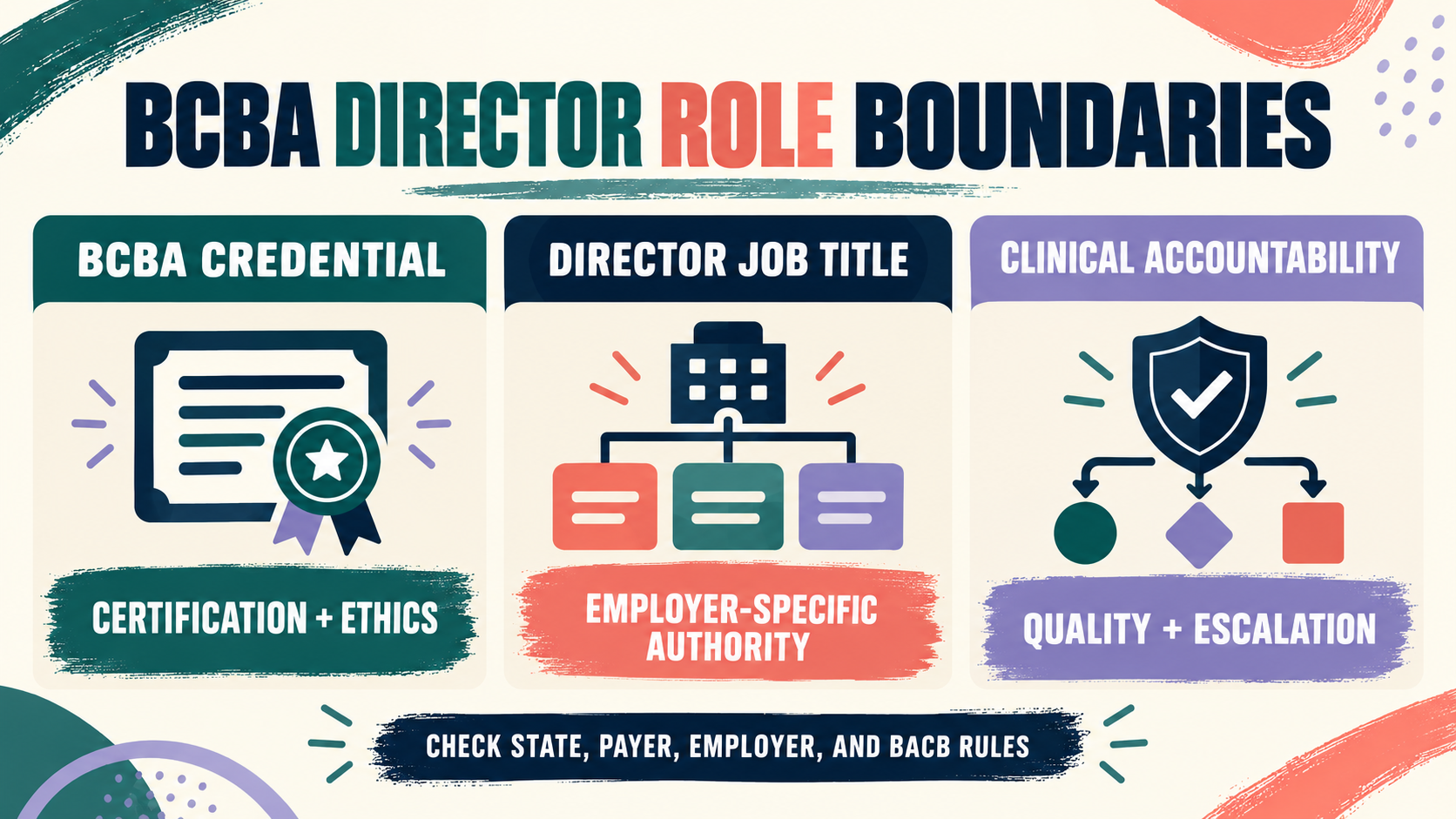
The current BACB BCBA resource describes BCBAs as graduate-level practitioners who may provide behavior-analytic services independently and supervise the work of others who implement those services. The Ethics Code resources apply to BCBA certificants and applicants. A director title adds organizational responsibility; it does not erase those professional duties.
| Layer | What it describes | What to verify |
|---|---|---|
| BCBA credential | Certification, professional competence, ethical duties, and the applicable BACB requirements. | Current certification status, state licensure or registration, competence for the service, and current official rules. |
| Director job title | An employer’s organizational label for leadership, management, or clinical oversight. | Decision rights, reporting line, budget authority, hiring power, and whether the role is clinical, operational, or mixed. |
| Clinical accountability | Responsibility for safe, competent, documented, and individualized behavior-analytic services. | Who owns the case, who reviews decisions, how concerns escalate, and what happens when targets conflict with client welfare. |
Think of the three layers as related but separate. An employer cannot solve a credential or licensure problem by changing someone’s title. A BCBA cannot use certification as a reason to make decisions outside the authority granted by a state, payer, facility, or employment agreement. A director’s responsibility is often to make those boundaries visible to the whole team.
How to Evaluate BCBA Director Readiness
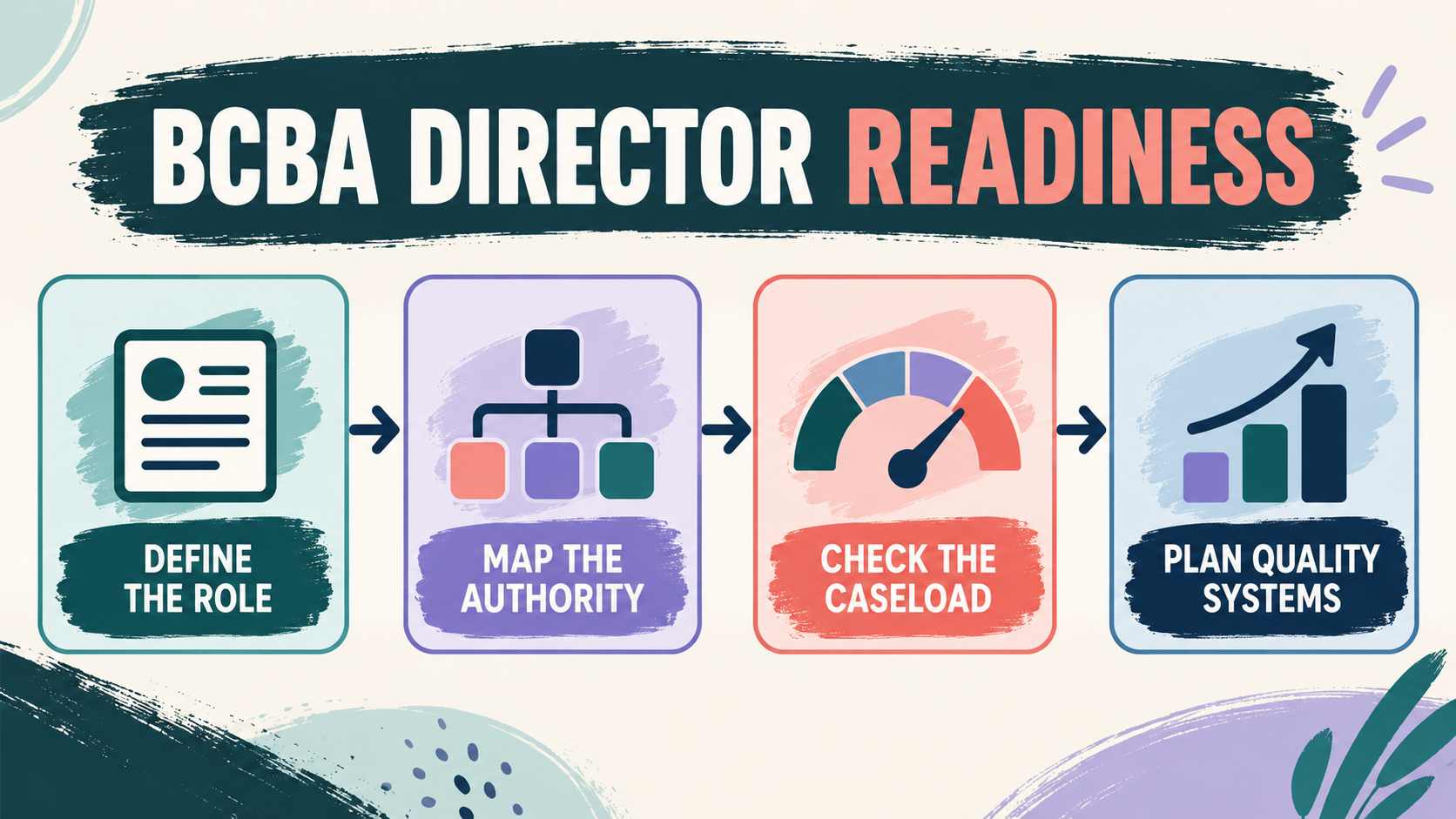
Readiness is more than years since certification. It includes judgment, communication, systems thinking, and the ability to make decisions under pressure without losing the individual client’s goals. Use the following sequence when preparing for a promotion or comparing a role.
- Define the role: list the population, setting, service model, direct-service expectations, leadership scope, and decisions the director actually owns.
- Map the authority: identify who can approve treatment plans, assign cases, stop a risky service, approve staff competency, change schedules, and escalate a concern to an executive or external professional.
- Check the caseload: calculate direct hours, supervision, document review, meetings, travel, on-call work, incident response, and protected administrative time. A title is not a workload plan.
- Plan quality systems: choose a small set of measures such as timely reviews, fidelity checks, staff competency, caregiver communication, data-based plan changes, and resolution of open risks.
For each step, create one piece of evidence. That might be a sample review checklist, a de-identified case-presentation rubric, a staff-training plan, a communication protocol, or a dashboard that shows whether work is completed. Evidence helps you discuss readiness without reducing leadership to confidence or personality.
Questions to Ask Before Accepting the Role
Ask for written answers before accepting a BCBA director offer. A thoughtful employer should be able to explain the following:
- How many BCBAs, BCaBAs, RBTs, clients, locations, and disciplines are in the scope?
- What percentage of the week is protected for clinical review, supervision, staff development, and administrative work?
- Does the director carry a full caseload, a reduced caseload, an on-call assignment, or a changing volume tied to hiring?
- Who has final authority when a payer request, productivity target, or referral promise conflicts with clinical judgment?
- Which state licenses, payer rules, accreditation standards, or facility policies apply?
- What incident, safety, complaint, and ethics-reporting process is already in place?
- How are performance expectations measured, and which metrics are quality indicators rather than simple billable-hour counts?
- What training, consultation, and transition support will be available during the first 30, 60, and 90 days?
Pay attention to the answer that is not written down. If the organization expects you to be responsible for every clinical outcome but gives you no authority to change staffing, documentation, training, or unsafe workflow, clarify the mismatch before accepting the job.
Caseload, Quality, and Operational Tradeoffs
One of the most useful BCBA director conversations is about capacity. A director may still provide direct services, but the leadership workload can be invisible: reviewing plans, coaching staff, responding to families, managing incidents, attending operations meetings, and fixing documentation systems all consume time.
| Work area | Useful evidence | Risk when ignored |
|---|---|---|
| Clinical review | Sampling schedule, feedback log, and documented plan revisions. | Approvals become rushed, inconsistent, or disconnected from data. |
| Staff competence | Observation, rehearsal, feedback, and follow-up records. | A training attendance sheet is mistaken for demonstrated competence. |
| Family partnership | Plain-language goals, response pathway, and documented preferences. | Concerns surface late or are treated as customer-service problems only. |
| Operations | Capacity plan, deadlines, escalation rules, and ownership map. | The director becomes the hidden bottleneck for every decision. |
Good metrics help a director see where a system needs support. Bad metrics reward speed while hiding errors. Review both outcomes and process: client progress, safety, assent or choice, documentation quality, staff competence, timeliness, and whether people can raise a concern without retaliation.
Supervision, Delegation, and Escalation
The BACB’s supervision, assessment, training, and oversight resource distinguishes supervision of future behavior analysts, ongoing supervision, assessment, and training roles. If a BCBA director supervises trainees, BCaBAs, or RBTs, the director must check the requirements that apply to that relationship. A director title alone does not prove that every supervision responsibility is satisfied. Use a written responsibility map:
- Who is the formal supervisor or clinical owner?
- What can be delegated, and what must be personally reviewed or signed?
- How will a supervisee receive observation, feedback, modeling, rehearsal, and follow-up?
- What triggers a second opinion, safety escalation, referral, or pause in service?
- How are disagreements documented and resolved?
The current BACB materials also describe an 8-hour supervision training requirement for certain supervisors before they provide qualifying supervision. Check the handbook and current BACB pages rather than relying on an old job description or a colleague’s memory.
Ethics and Conflicts of Interest
Directors often sit at the intersection of clinical, financial, and personnel interests. That makes conflict management a core skill. A director should be able to say when a referral is outside competence, when a caseload is unsafe, when a documentation deadline needs renegotiation, or when an employee’s performance issue requires a process separate from the client’s care.
Common warning signs include pressure to keep a case open solely for revenue, asking staff to copy notes, discouraging a reportable concern, treating assent or caregiver disagreement as noncompliance, or promising a clinical outcome because a referral source expects it. The solution is not a private workaround. Use the organization’s reporting path, document the decision, consult the appropriate professional, and follow the current Ethics Code and jurisdictional requirements.
Protect privacy in leadership meetings. Share the minimum necessary information, use de-identified examples when possible, and confirm who is authorized to access records. A director’s broad organizational role does not mean every manager or business partner should see every clinical detail.
A Practical Transition Plan
If you are moving from staff BCBA to director, plan the first 90 days around listening and visibility rather than immediate redesign. In the first month, learn the service model, meet staff and families as appropriate, map deadlines, review incident and quality processes, and identify urgent risks. In the second month, choose one or two measurable workflow improvements, clarify escalation ownership, and practice feedback conversations. In the third month, review outcome data with the team, revise the plan, and set a sustainable cadence for quality review.
Keep a boundary between “what I would do on my own caseload” and “what the system needs.” Leadership decisions should be explainable to the team, consistent with policy, and open to review. The best director is not the person who answers every question instantly; it is the person who makes good decisions easier for other people to make.
The BCBA Exam and Director-Level Thinking
For a BCBA candidate or early-career analyst, a director scenario is useful practice because it combines technical judgment with ethics, supervision, measurement, and systems thinking. Ask yourself: What is the observable problem? What data are missing? Who owns the decision? Which answer protects the client, respects scope, and can actually be implemented?
When using a practice question, do not select an answer merely because it sounds like leadership. Look for the option that defines the target, checks the relevant data, involves the right stakeholders, follows the chain of responsibility, and includes a way to evaluate the result. The free BCBA mock exam can give you a baseline for this reasoning. It is exam practice, not BACB supervision, licensure advice, or a guarantee of certification.
BCBA Director FAQ
Is BCBA director a separate certification?: No. BCBA is a certification; director is an employer-defined position. The scope, authority, licensure, supervision duties, and performance expectations must be verified in the actual role and current rules.
What is the difference between a BCBA director and a clinical director?: Often the titles overlap, but neither phrase has one universal scope. Compare the job’s clinical authority, direct-service expectations, staffing responsibility, quality duties, reporting line, and state or payer requirements instead of relying on the title.
Does a director have to be a BCBA?: Some employers or jurisdictions require a BCBA or another specified professional; others use director for an operational role. Check the written position description, applicable state and payer rules, and who is responsible for clinical decisions. Do not assume the title settles the question.
How can I prepare for a BCBA director interview?: Prepare examples that show data-based decision-making, staff coaching, ethical escalation, family communication, quality improvement, and workload planning. Ask how authority, caseload, metrics, supervision, and incident response are defined. A strong interview is a two-way fit check.
Bottom line: A BCBA director role can be a meaningful next step when the title, authority, clinical accountability, workload, and support system line up. Read the job description as a decision map, verify current BACB and jurisdictional rules, protect time for quality work, and use measurable evidence to build trust.
Take the Free BCBA Mock Exam
If you want a low-pressure way to check your recall, use the free practice resource below. Take the Free BCBA Mock Exam



