

BCBA credits is an ambiguous search. It may refer to university credit hours, BACB coursework content hours, continuing education units (CEUs), or supervised fieldwork hours. These numbers can appear in the same program brochure, but they do not perform the same job in a certification file.
Table of Contents
- What Do BCBA Credits Usually Mean?
- Why Are There Four Different Numbers?
- How Do College Credits Relate to Classroom Hours?
- What Are BCBA Coursework Content Hours?
- Are BCBA Credits the Same as CEUs?
- Do Fieldwork Hours Count as Credits?
- How Should You Compare a Program’s Numbers?
- What Changes for BCBA Credits in 2027?
- How Do You Audit Your Own Credit Records?
- What Should You Ask a BCBA Program?
- How Can Credit Confusion Become Exam Practice?
- BCBA Credits FAQ
This guide gives you a practical way to sort the numbers before you enroll, apply, renew, or transfer coursework. It is educational, not a certification determination, transcript evaluation, admission decision, or legal opinion. For a deadline or eligibility question, use the current BACB handbook and ask the program or BACB to confirm the record that applies to you. Table of Contents
What Do BCBA Credits Usually Mean?
When someone types bcba credits, they may be asking “How many university credits are in this certificate?” They may instead mean “How many BACB coursework hours do I need?” A practicing BCBA may be asking about CEUs for recertification, while a trainee may be counting supervised fieldwork hours. The right answer depends on which record the question is trying to complete.
The current BCBA Handbook uses separate requirements for degree and coursework, supervised fieldwork, and continuing education. A program’s headline such as “21 credits” can be useful for understanding its schedule, but it is not by itself proof that every course satisfies the BACB content requirements or that the hours are fieldwork.
Why Are There Four Different Numbers?
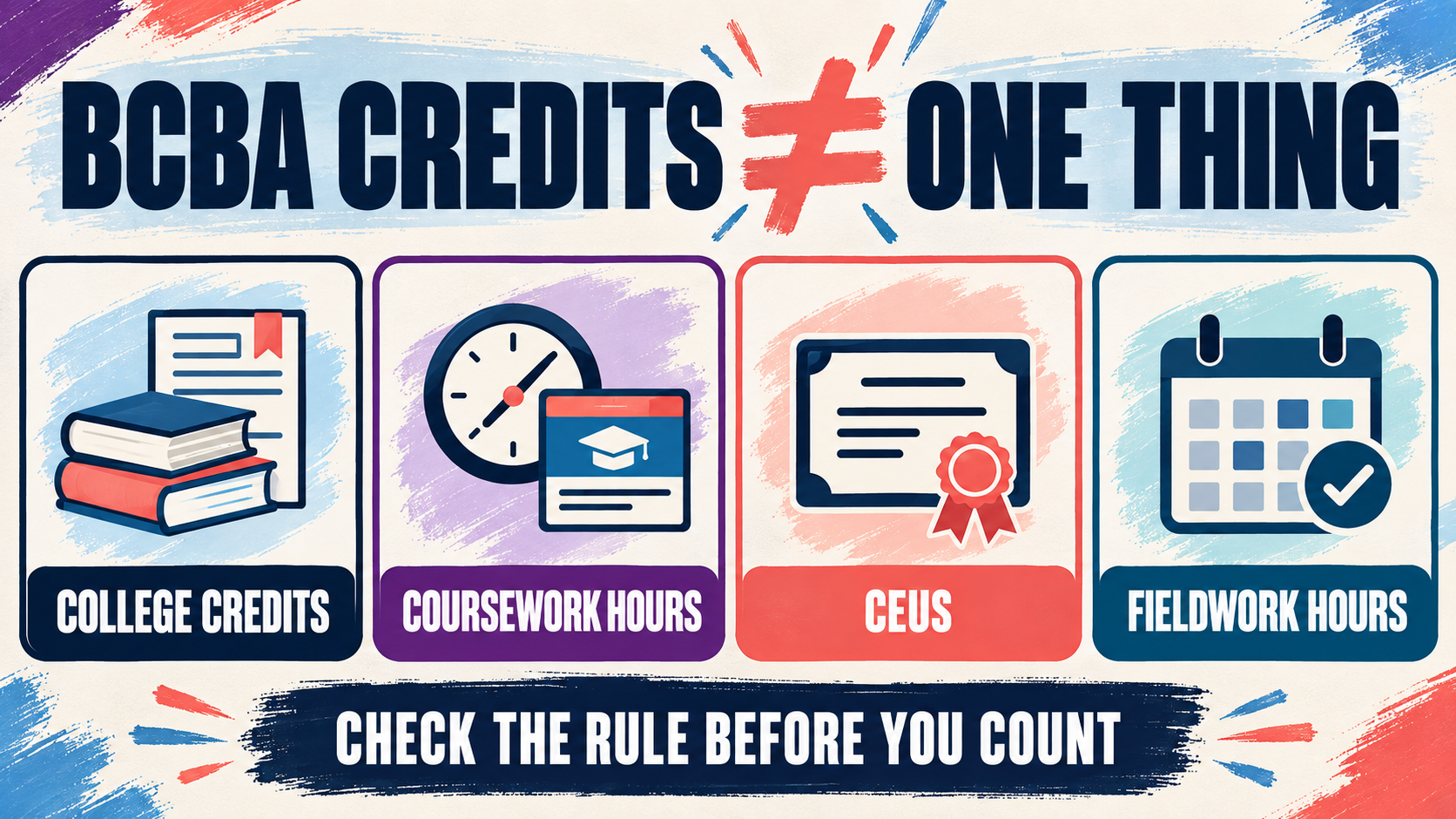
Think of the numbers as four labels attached to four different systems:
- College credits: the academic unit your university uses for enrollment, tuition, graduation, and transcript records.
- Coursework content hours: the amount of qualifying behavior-analytic instruction mapped to the BACB content areas for an eligibility pathway.
- CEUs: continuing education units used by an active certificant during a recertification cycle.
- Fieldwork hours: supervised applied experience documented through the applicable fieldwork forms and supervision structure.
| Number on a page | What it measures | Typical proof | Do not assume |
|---|---|---|---|
| College credits | Academic enrollment and course load. | Official transcript and catalog. | Every credit is a qualifying BCBA content hour. |
| Content hours | Behavior-analytic instruction in required content areas. | Transcript, syllabus, program attestation, and current BACB mapping. | A course title alone proves coverage. |
| CEUs | Continuing education during a two-year maintenance cycle. | ACE certificate, university documentation, or BACB portal record. | A CEU replaces initial certification coursework. |
| Fieldwork hours | Supervised applied experience in behavior analysis. | Supervision contract, monthly forms, logs, and final verification. | A paid ABA job automatically supplies qualifying hours. |
How Do College Credits Relate to Classroom Hours?
The BACB uses a conversion for instructional requirements that can be applied globally: one semester credit hour represents 15 hours of classroom instruction, and one quarter credit hour represents 10 hours. That conversion helps translate different university calendars into a common instructional language. It does not turn every minute in a course into qualifying behavior-analytic content.
For example, a three-semester-credit course may represent 45 classroom hours under that convention. The next question is what those hours actually teach. If the course is partly general education, clinical practice, or a broad survey, the program may not be able to count the entire course toward a specific BACB content area. Ask for the syllabus, content-hour breakdown, and the person responsible for the current attestation.
Also separate a credit from a grade. A transcript can show that you earned academic credit, while a pathway rule may additionally require a passing grade, a particular level of study, a qualifying institution, a time window, or a designated program contact. Those details are why a credit total is a starting point, not the final answer.
What Are BCBA Coursework Content Hours?
For the current Pathway 2 structure described in the June 2026 BCBA Handbook, qualifying graduate-level behavior-analytic coursework totals 315 content hours across the listed areas. The handbook also requires academic credit, a passing grade, a qualifying institution, a designated Pathway 2 Program Contact, and official documentation. The specific content areas include ethics and professionalism, philosophical underpinnings and concepts, measurement and experimental design, behavior assessment, behavior-change procedures, and personnel supervision and management.
That is why two programs can both advertise “21 credits” while still requiring a closer comparison. One may put the hours into freestanding courses that map cleanly to the requirement. Another may use different course titles, combine topics, or include credits that support the larger degree but are not part of the qualifying sequence. The program must explain the mapping; do not reverse-engineer eligibility from a marketing number.
The current handbook says official transcripts are used to demonstrate degree and coursework. If you transferred schools, keep every relevant transcript. If a program’s verification contact or attestation is part of your pathway, confirm that status before assuming the course sequence is complete.
Are BCBA Credits the Same as CEUs?
No. CEUs belong to certification maintenance after initial certification. The current handbook says a BCBA must obtain 32 CEUs in each two-year recertification cycle, including 4 ethics CEUs and 3 supervision CEUs when the certificant supervises. CEUs must be earned inside the cycle to which they are applied; extra units do not simply roll forward to the next cycle.
The BACB’s CEU table uses learning activities, teaching, and scholarship. For learning, the handbook states that 50 minutes of learning equals 1 CEU, and it allows qualifying didactic graduate courses to be documented with syllabi and transcripts. That does not mean a university’s credit label automatically equals a CEU. The activity, provider or institution, passing result, documentation, and category all matter.
- Use the current BACB handbook to identify the maintenance cycle and category you need.
- Check the ACE Provider Verification Registry when the activity is offered as an ACE event.
- Save the certificate, syllabus, transcript, completion date, and any category designation before entering the activity.
- Do not treat initial certification coursework, fieldwork, and renewal CEUs as interchangeable buckets.
Do Fieldwork Hours Count as Credits?
Fieldwork hours are applied experience, not university credits. Under the current BCBA Handbook, candidates generally complete either 2,000 hours of Supervised Fieldwork or 1,500 hours of Concentrated Supervised Fieldwork, with the applicable monthly supervision, observation, and activity requirements. At least 60% of total fieldwork hours must be unrestricted under the current structure.
The 2027 summary keeps the 2,000/1,500 hour choices but changes several supervision details, including a 7.5% supervision figure for concentrated fieldwork and a monthly maximum of 160 hours. The hours still require the correct supervisor, documentation, forms, and applied activities. An employer may call a position “fieldwork,” but the supervisor and candidate remain responsible for determining whether the records meet the applicable requirements. Do not convert fieldwork into college credits for a résumé or program comparison. Instead, record the month, fieldwork type, total hours, supervised hours, observations, unrestricted activities, supervisor, and signed verification forms.
How Should You Compare a Program’s Numbers?
Use the program’s number only after you know what the number labels. A good comparison asks whether the program is describing a full graduate degree, a post-master’s certificate, a Pathway 2 coursework sequence, a practicum, a CE activity, or an optional fieldwork class. The answer changes what the credits can do for you.
| Program statement | Follow-up question | Record to request |
|---|---|---|
| “21 credits for BCBA eligibility” | Which pathway, content areas, dates, and program contact apply? | Current course map, syllabi, transcript plan, and attestation process. |
| “Three credits of practicum” | Is this academic credit, fieldwork, or both under documented rules? | Catalog description, supervision contract, and monthly verification process. |
| “Earn CEUs through graduate study” | What passing result, minutes, category, and documentation are accepted? | Syllabus, transcript, completion date, and category instructions. |
What Changes for BCBA Credits in 2027?
The BACB’s 2027 BCBA Requirements keep the total Pathway 2 content at 315 hours but reorganize the content into new freestanding-course requirements. The transition resource lists changes such as standalone Basic Principles, Theory and Philosophy, Research Methods, two freestanding courses for Behavior Assessment and Intervention, a 45-hour freestanding Organizational Behavior Management course, and a freestanding Ethics course.
If your application is on or after January 1, 2027, do not ask only, “How many credits did I complete?” Ask whether the courses meet the 2027 content descriptions and standalone-course rules. The transition guidance says applicants who do not meet the current requirements before the effective date must meet the new requirements. Your advisor, program contact, and the current BACB documents should review the timeline together.
One more distinction matters: the 2027 change affects certification eligibility and maintenance; it does not turn CEUs into initial coursework or fieldwork hours into academic credit. Keep the systems separate even when a program uses one learning platform for all of them.
How Do You Audit Your Own Credit Records?
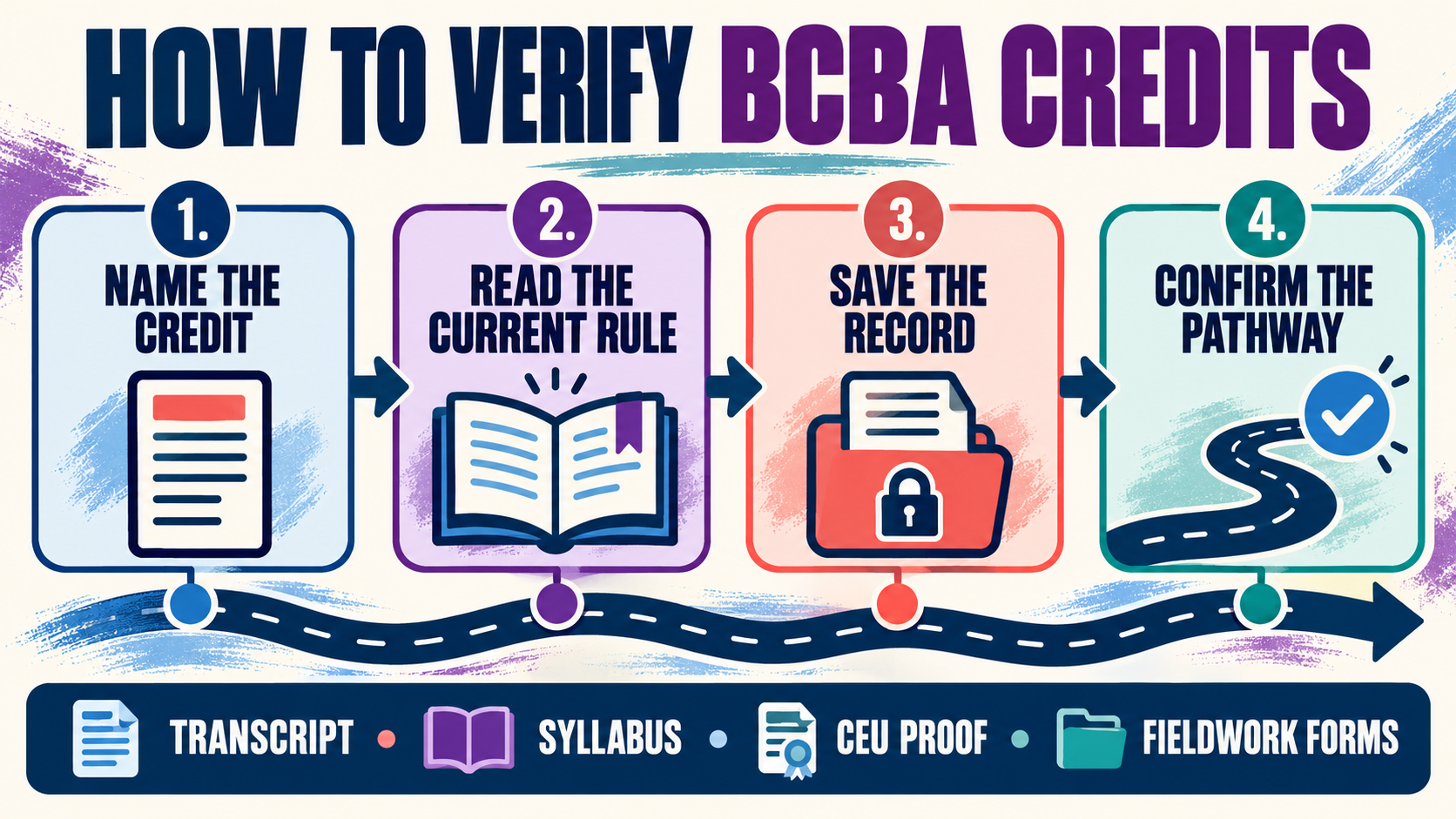
Before you apply or renew, build a small evidence table instead of relying on memory. The goal is to make each number answerable: what is it, which rule uses it, and which document proves it?
- Name the credit: label each item as college credit, content hour, CEU, or fieldwork hour.
- Read the current rule: note the handbook version, pathway, certification cycle, or application date.
- Save the record: keep transcripts, syllabi, certificates, contracts, logs, forms, and written program responses.
- Confirm the pathway: ask the program contact or BACB what remains missing before you commit to another course or hour.
- Highlight every course title that contains more than one content area.
- Mark whether the course is graduate level and whether the grade meets the stated threshold.
- Record the date range in case the pathway has a recency window.
- Keep a separate CEU log for the current recertification cycle.
- Keep fieldwork records separate from academic and CEU records.
What Should You Ask a BCBA Program?
Send specific questions rather than asking whether a program is “BACB approved.” That phrase can hide several different claims. Ask who is making the claim, which pathway it refers to, and what the program can document at the time you apply.
- Is this number semester credits, quarter credits, classroom hours, BACB content hours, or fieldwork hours?
- Which current BACB pathway does the sequence support, and who completes the required attestation?
- Which courses are freestanding under the 2027 content descriptions?
- What transcript, syllabus, grade, transfer, and recency records will I need?
- Does the practicum include qualifying fieldwork documentation, or is it only academic credit?
- If I stop after the certificate, what requirement remains for the degree, fieldwork, application, and exam?
How Can Credit Confusion Become Exam Practice?
Credit questions are useful BCBA exam practice because they require you to define the measurement before interpreting it. A number without its unit is an incomplete stimulus. Ask what was measured, under which rule, with what record, and for what decision. That habit transfers to data interpretation, ethics, supervision, and certification scenarios.
Take the Free BCBA Mock Exam to practice separating a requirement from a helpful preparation step. You can also use bcba credits practice questions as a short review prompt: identify the unit, identify the governing document, and reject an answer that silently swaps CEUs for coursework or fieldwork.
BCBA Credits FAQ
How many credits do I need to become a BCBA?: There is no single universal credit number that answers the question. The applicable pathway requires a qualifying degree, behavior-analytic coursework or an accredited/recognized program, supervised fieldwork, and the examination. Program credit totals must be translated into the current BACB content and documentation rules.
Is one college credit equal to one BACB content hour?: No. The BACB uses an instructional conversion of 15 classroom hours per semester credit and 10 per quarter credit for the stated global convention, but qualifying content also depends on what the course teaches and which pathway rules apply.
Are BCBA credits the same as CEUs?: No. CEUs maintain an existing BCBA certification during a two-year cycle. University coursework may sometimes be documented as a CE learning activity, but a college credit, a qualifying initial-certification course, and a CEU are not automatically interchangeable.
Can my fieldwork hours be counted as credits?: Not simply because they were completed at an employer or university. Fieldwork is supervised applied experience documented under the applicable fieldwork requirements. Academic credit may accompany a practicum, but the program and supervisor must explain whether the same activity meets each separate rule.
Do the 2027 changes alter the total coursework hours?: The BACB’s current 2027 summary keeps Pathway 2 at 315 total content hours while changing the required course structure and content allocation. Check the transition resource and current handbook for your application date; do not rely on a program’s old credit chart alone.
Bottom line: Treat “BCBA credits” as a question that needs a unit before it needs a number. Label the credit, read the current rule, save the proof, and confirm the pathway before paying for another course or counting another hour.



