

What Is a Discriminative Stimulus? Definition and Function
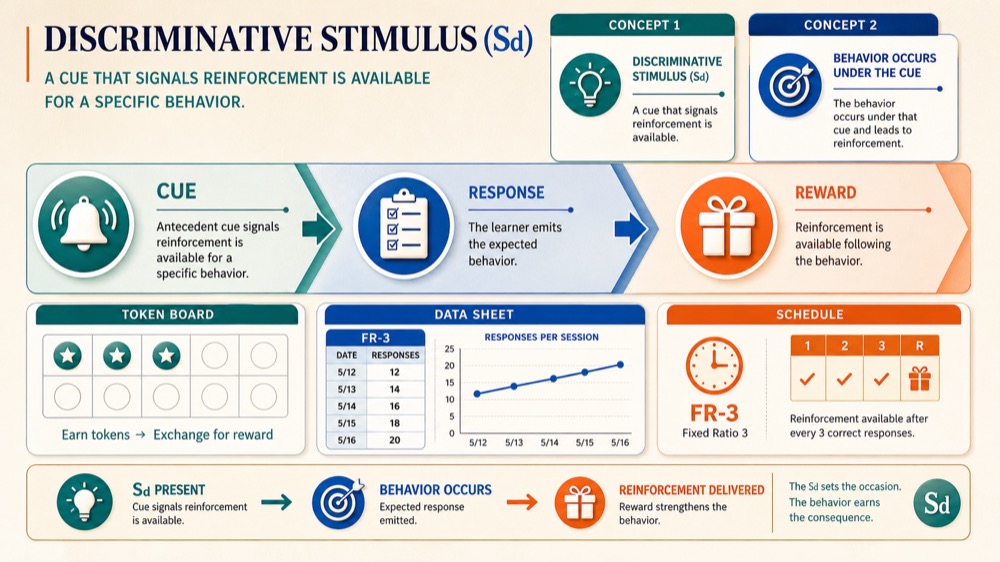
A discriminative stimulus (Sd) is an antecedent stimulus that signals the availability of reinforcement for a particular behavior. In simpler terms, it tells the learner that if they perform a specific behavior right now, a reinforcer is likely to follow. The concept is central to understanding stimulus control, where a behavior occurs more often in the presence of an Sd and less often in its absence.
Table of Contents
- What Is a Discriminative Stimulus? Definition and Function
- ABC Analysis: Worked Examples of Discriminative Stimuli
- Discriminative Stimulus vs. Prompts: Key Differences for the Exam
- Common Exam Traps and How to Avoid Them
- Quick Checklist: Discriminative Stimulus for Exam Review
- Summary: Why Discriminative Stimuli Matter in ABA
- References
For the BCBA exam, you need to know that an Sd does not cause a behavior; it merely sets the occasion for it. The behavior is maintained by the reinforcement history in that context. When an Sd is present, the behavior is more likely to occur because it has been reinforced in the past under similar conditions. Conversely, an S-delta (SΔ) signals that reinforcement is not available for that behavior, so the behavior is less likely to occur.
Key Components of a Discriminative Stimulus: There are three essential elements to a discriminative stimulus relationship: the antecedent (Sd), the behavior, and the consequence (reinforcer). These form the three-term contingency (ABC). Stimulus class refers to a group of stimuli that share a common function – for example, different teachers asking a question can all function as Sds for raising a hand if that behavior has been reinforced in their presence.
How Discriminative Stimuli Differ from Motivating Operations: Many BCBA candidates confuse discriminative stimuli with motivating operations (MOs). The key difference is function: an Sd signals that reinforcement is available if a behavior occurs, while an MO alters the value of that reinforcement and the frequency of behaviors that have produced it in the past. For example, food deprivation (an MO) makes food more valuable, but a food item on the table (an Sd) signals that eating will produce reinforcement. Both can occur together, but they are distinct concepts tested on the exam.
ABC Analysis: Worked Examples of Discriminative Stimuli
To really understand how discriminative stimuli function, it helps to break down real-world scenarios using the ABC contingency (Antecedent-Behavior-Consequence). Each example below identifies the Sd, the behavior, and the consequence maintaining it, along with the hypothesized function.
Example 1: Raising Hand in Class: Use the points below as a quick study guide.
- Antecedent (Sd): Teacher asks the class a question and looks at students.
- Behavior: Student raises hand.
- Consequence: Teacher calls on the student and provides attention.
- Function: Access to attention. The teacher’s question is the Sd that signals hand-raising will be reinforced.
Example 2: Stop Sign While Driving: Use the points below as a quick study guide.
- Antecedent (Sd): Red stop sign at an intersection.
- Behavior: Driver presses the brake pedal.
- Consequence: Avoiding a traffic ticket and safe driving.
- Function: Escape/avoidance of a fine. The stop sign is an Sd that signals braking will be reinforced by avoiding a punishment.
Example 3: Client Requesting a Break: Use the points below as a quick study guide.
- Antecedent (Sd): Therapist presents a difficult task and says, ‘Do you need a break?’
- Behavior: Client says, ‘Break please.’
- Consequence: Therapist provides a short break from the task.
- Function: Escape from a demand. The therapist’s question is the Sd that signals requesting a break will result in a break.
These examples illustrate that the same behavior can have different Sds depending on the context. On the BCBA exam, you will be asked to identify the Sd in a vignette. Always look for the stimulus that directly precedes the behavior and has a history of reinforcement for that behavior.
Discriminative Stimulus vs. Prompts: Key Differences for the Exam
A common exam trap is confusing a discriminative stimulus with a prompt. Both are antecedents, but they serve different purposes. An Sd is a naturally occurring or established stimulus that signals reinforcement availability. A prompt is an added stimulus (verbal, gestural, physical) that helps the learner engage in the correct behavior but is not the final Sd.
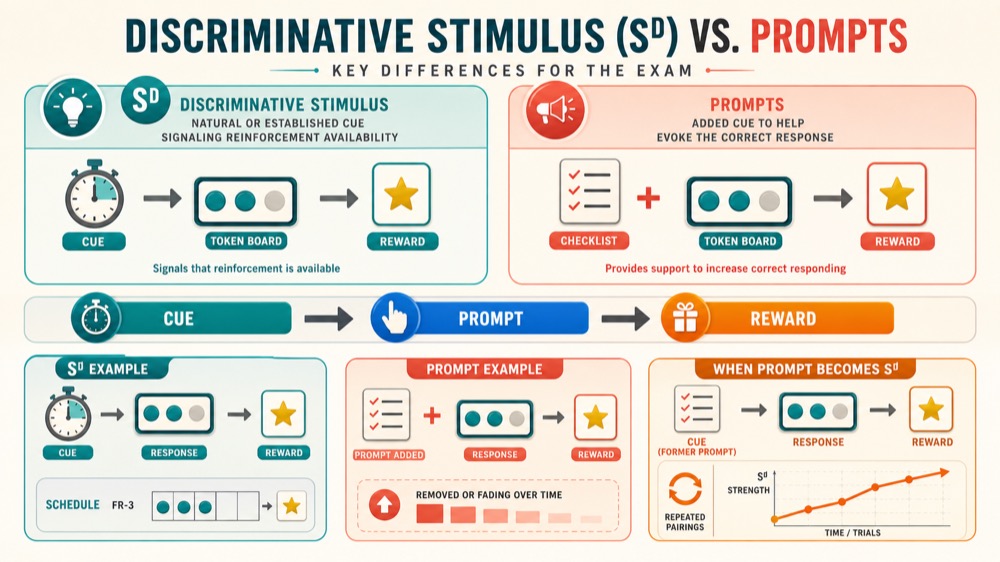
When a Prompt Becomes an Sd: If a prompt is consistently present when reinforcement occurs, it may become a discriminative stimulus itself. This can lead to prompt dependency, where the learner waits for the prompt instead of responding to the natural Sd. To prevent this, behavior analysts use transfer of stimulus control procedures (e.g., prompt fading, prompt delay) to shift control from the prompt to the natural Sd. For example, if a therapist always points to a picture before the client requests it, the point may become an Sd. Fading the point ensures the picture alone gains stimulus control.
Common Exam Traps and How to Avoid Them
Here are two frequent misconceptions that appear on the BCBA exam. Knowing these will save you points.
Trap 1: Confusing Sd with a Reinforcer: Remember: an Sd is an antecedent, while a reinforcer is a consequence. A test question might describe a stimulus that signals reinforcement is available and ask whether it is an Sd or a reinforcer. If the stimulus occurs before the behavior and signals that reinforcement is coming, it is an Sd. If it occurs after the behavior and increases future behavior, it is a reinforcer.
Trap 2: Overlooking the S-delta: In discrimination training, the S-delta is the stimulus in whose presence the behavior is not reinforced. Exam scenarios may present multiple stimuli and ask which one is the Sd. For instance, if a child requests a toy when a parent is present (Sd) but not when a grandparent is present (S-delta), the parent is the Sd for requesting. Always identify which stimulus has a history of reinforcement for that behavior.
Quick Checklist: Discriminative Stimulus for Exam Review
Use this checklist to reinforce your understanding and catch any gaps before test day.
- Identify the Sd: Can you spot the antecedent that signals reinforcement?
- Distinguish from MO: Is the stimulus altering the value of a reinforcer or just signaling its availability?
- Differentiate from prompts: Is the stimulus naturally occurring or added?
- Recall the three-term contingency: Can you map the ABC for an Sd relationship?
- Understand S-delta: What stimulus signals that reinforcement is not available?
- Apply to practice scenarios: Work through sample vignettes from free BCBA mock exam questions to build fluency.
Summary: Why Discriminative Stimuli Matter in ABA
Discriminative stimuli are the foundation of stimulus control, which underlies every behavior intervention plan. They allow individuals to differentiate between situations where a behavior will be effective and where it will not. As a BCBA, you will use discrimination training to teach new skills, transfer stimulus control from prompts to natural cues, and reduce problem behaviors by altering antecedent conditions. Mastering the concept of Sd will not only help you pass the exam but also make you a more effective practitioner. For more depth, explore the discriminative stimulus Sd BCBA exam guide and our BCBA exam prep guide for comprehensive study resources.
How to Study discriminative stimulus for BCBA-Style Questions
When you review discriminative stimulus, do not stop at the definition. The exam usually tests whether you can apply the concept inside a short scenario, separate it from similar terms, and choose the most behaviorally precise answer. A strong study routine should connect the term to observable behavior, environmental context, measurement, and likely consequences.
- Define the response: identify exactly what the learner or client does, not just the broad skill area.
- Find the context: note the antecedent, setting, materials, people, or condition that makes the concept relevant.
- Check the consequence: ask what changes after the response and whether that change supports the answer choice.
- Compare close terms: write one sentence explaining why the best answer is not a related but different ABA concept.
For practice, turn each example into a quick discrimination exercise. Ask, “What would make this answer wrong?” and then change one detail in the scenario. This builds flexible exam reasoning instead of memorizing a single phrase.



