

When someone searches bat cage ABA, they may mean two completely different things. Most literal results point to a bat, batting cage, animal enclosure, or sports facility. In some ABA study materials, however, BAT-CAGE is used as a memory aid for the seven dimensions of applied behavior analysis.
Table of Contents
- Bat Cage ABA: The Short Answer
- Map BAT-CAGE to the Seven Dimensions
- Turn Each Dimension Into a Scenario Question
- Avoid Mnemonic Traps
- Use a 10-Minute Exam Drill
- Frequently Asked Questions
- Sources for Further Study
- Quick Review Checklist
- Take the Free BCBA Mock Exam
This page targets the ABA-study meaning only. It is a mnemonic guide, not a literal bat-cage resource and not an official BACB acronym. If your course uses a different order or wording, follow the current course materials and the BACB’s current resources. The existing seven-dimensions exam guide and its support pages remain read-only references; this new URL does not replace or modify them. The goal is not to memorize letters without understanding. Use each dimension as a question that helps you evaluate an ABA example, research description, intervention, or exam answer.
Bat Cage ABA: The Short Answer
In an ABA exam context, BAT-CAGE is commonly used to remember seven dimensions associated with applied behavior analysis:
- B — Behavioral
- A — Applied
- T — Technological
- C — Conceptually systematic
- A — Analytic
- G — Generality
- E — Effective
Different instructors may rearrange the order to match the classic literature or use a different memory aid. The acronym is not the authority. The dimensions are useful because they prompt questions about the behavior being studied, the social importance of the target, the relation between intervention and outcome, the replicability of the procedure, the connection to behavioral principles, the size and durability of change, and whether the change matters in real life.
Map BAT-CAGE to the Seven Dimensions

Use the map as a retrieval cue, then verify the definition in your course materials. The short prompts below are designed for study, not as a substitute for the original sources or the current BCBA exam content outline.
| Letter | Dimension | Study prompt |
|---|---|---|
| B | Behavioral | Is the target response observable and measured rather than inferred from a label? |
| A | Applied | Does the target matter to the person or the people responsible for the setting? |
| T | Technological | Could a trained reader follow the written procedure with reasonable consistency? |
| C | Conceptually systematic | Can the procedure be explained using behavioral principles rather than unexplained steps? |
| A | Analytic | Does the evidence support a functional relation between the intervention and behavior change? |
| G | Generality | Does the change last, transfer across contexts, or spread to meaningful related behavior? |
| E | Effective | Is the amount of change large enough to make a practical difference? |
Two dimensions are easy to confuse. Analytic asks whether the evidence demonstrates a functional relation, while effective asks whether the change is meaningful enough. A graph can show a relation with a small change, and a large change can still be difficult to interpret if the design or measurement does not support the conclusion.
Turn Each Dimension Into a Scenario Question
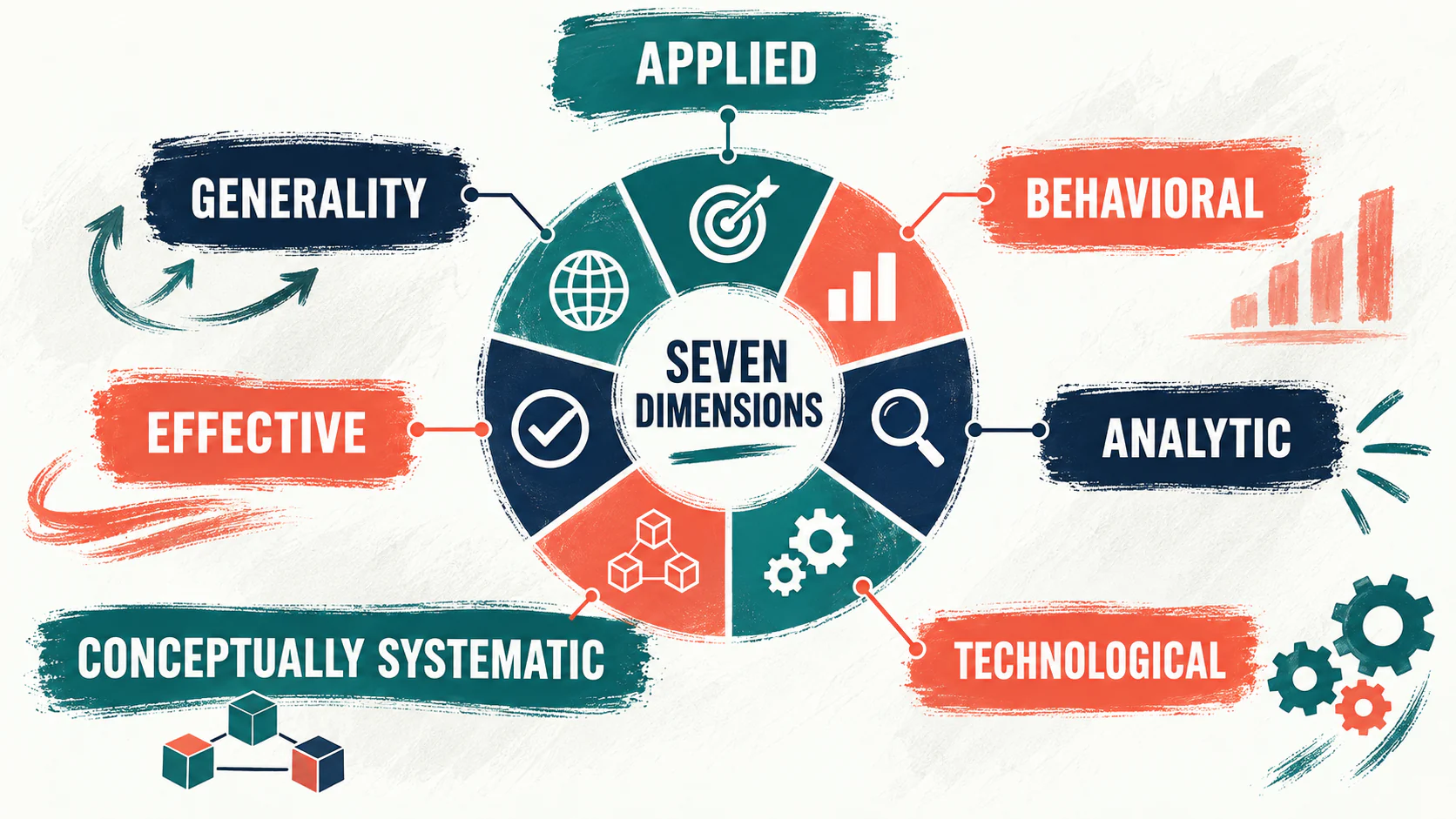
The seven-dimension wheel works best when you apply it to a short scenario. Read the scenario once for the target and context, then ask one BAT-CAGE question at a time.
- Behavioral: replace a vague phrase such as “improved attention” with an observable response and a scoring rule. Ask what an observer would see, hear, or count.
- Applied: ask whose daily life changes if the target improves. A technically interesting response is not automatically socially important.
- Technological: look for enough detail to reproduce the procedure: materials, timing, prompts, consequences, and decision rules. “Used ABA techniques” is not a procedure.
- Conceptually systematic: connect the steps to concepts such as reinforcement, prompting, stimulus control, shaping, or motivating operations when the scenario supports that explanation.
- Analytic: inspect the design, baseline, comparison, replication, and data pattern. A change after intervention is not automatically proof that the intervention caused it.
- Generality: look for maintenance over time, generalization across people or settings, or spread to related responses. One successful training session is not enough.
- Effective: ask whether the magnitude of change is meaningful to the person and the setting, not just statistically or visually noticeable.
For an exam question, you rarely need to force every dimension into the same answer. Find the dimension that matches the wording. If the question highlights a procedure that cannot be repeated, technological is likely relevant. If it highlights transfer to home after clinic training, generality is the stronger clue. If it asks whether the change is important enough to matter, effective or applied may be the issue depending on the answer choices.
Avoid Mnemonic Traps
| Trap | Better response | Why it matters |
|---|---|---|
| Treating BAT-CAGE as official BACB terminology | Use it as a memory aid and verify current course and BACB language. | Mnemonics can vary; the concept is more important than the letters. |
| Confusing applied with effective | Applied asks whether the target is socially important; effective asks whether the change is meaningful. | A meaningful target can have an ineffective intervention, and vice versa. |
| Confusing technological with conceptually systematic | Technological is replicable description; conceptually systematic is principled explanation. | A detailed recipe can still lack a clear behavioral rationale. |
| Calling one post-test change analytic | Inspect the design and evidence for a functional relation. | Time, maturation, measurement, or context changes can be alternative explanations. |
Use a 10-Minute Exam Drill
Write a short, fictional intervention scenario and complete this drill:
- Underline the observable target and write one measurement definition.
- State why the target matters to the person or setting.
- Circle the procedure details another trained implementer would need.
- Name the behavioral principle that explains the key step.
- Identify the evidence that would support a functional relation.
- Add one maintenance or generalization probe and one practical-effect question.
Then remove the letters and answer the scenario in plain language. If you can explain the dimensions without saying BAT-CAGE, you are studying the concepts rather than depending on the mnemonic. For more mixed scenario practice, the Free BCBA Mock Exam can help you find whether your weak point is measurement, dimensions, design, or ethics. It is a study diagnostic, not an official BACB exam.
Frequently Asked Questions
What does bat cage ABA mean?: In some ABA study materials, BAT-CAGE is a mnemonic for Behavioral, Applied, Technological, Conceptually systematic, Analytic, Generality, and Effective. The exact query is ambiguous, however; many search results for “bat cage” have nothing to do with ABA.
Is BAT-CAGE an official BACB acronym?: No. Treat it as a study aid, not as an official BACB rule, credential, or required wording. Check the current BACB materials and your instructor’s terminology when the order or labels differ.
What are the seven dimensions of ABA?: The commonly taught dimensions are applied, behavioral, analytic, technological, conceptually systematic, effective, and generality. Different study resources may present the order differently. The important task is to understand what each dimension asks about an ABA intervention or analysis.
Which BAT-CAGE letter is about generalization?: G is the memory cue for generality. In study questions, look for maintenance over time, transfer across people or settings, or spread to related behavior. One successful training context does not prove generality.
Sources for Further Study
Use the current BCBA Handbook, BCBA resource hub, and BACB Ethics Codes for official context. Historical training materials may explain the BAT-CAGE mnemonic, but they are not a substitute for current BACB requirements. Recheck your course’s assigned source and the current exam content outline before relying on any memory aid.
Quick Review Checklist
Use this final checklist to turn bat cage aba into exam-ready reasoning. The goal is not to memorize a label in isolation; it is to identify the relevant evidence and explain why the best answer fits the scenario. Key ideas to review:
- State the central definition or decision point for bat cage aba in your own words.
- Identify the detail that makes bat cage aba different from its closest related ABA term.
- Separate the observable facts in a scenario from assumptions that are not supported by the facts.
- Write one example and one nonexample so you can recognize the concept in a new setting.
Exam application checks:
- Ask what the question is actually requesting before comparing the answer choices.
- Mark the antecedent, response, consequence, or other evidence that supports the selected answer.
- Look for a distractor that describes a related process but does not answer the specific question.
Final self-check:
- Explain how you would verify the interpretation with clear observations or data.
- Change one detail in the scenario and decide whether your answer should change.
- Give a one-sentence rationale that a supervisor or study partner could evaluate.
Take the Free BCBA Mock Exam
When you are ready to apply the idea, use the free practice resource below for additional feedback. Take the Free BCBA Mock Exam



