
ABA caregiver education is the process of helping a caregiver understand and use an agreed skill or support in daily life. It is more than handing over a worksheet and more respectful than expecting a family to become a clinician. Good education has a clear learning target, practice, feedback, access support, and a plan for deciding what to do with observations.
Table of Contents
- ABA Caregiver Education: The Short Answer
- Separate Education, Training, Coaching, and Treatment
- Build a Caregiver Learning Target
- Use Instruction, Modeling, Rehearsal, and Feedback
- Adapt for Language, Access, and Consent
- Use Data Feedback Without Making Caregivers the Clinician
- Plan Home Generalization
- Provider-Fit Questions and BCBA Exam Traps
- Frequently Asked Questions
- Sources for Further Study
- Quick Review Checklist
- Take the Free BCBA Mock Exam
This guide focuses on the education workflow: define one practical caregiver target, use instruction and modeling, rehearse the step, give feedback, make the data understandable, and plan generalization at home. The existing ABA parent-training reference, BST caregiver-coaching guide, and BST exam guide remain read-only references. This new page does not replace or change them.
Terminology varies among providers and payers. A real education plan must respect consent, culture, language, accessibility, privacy, caregiver capacity, supervision, and current state or payer requirements. The framework below is educational guidance, not a universal home protocol or billing instruction.
ABA Caregiver Education: The Short Answer
Caregiver education should answer a practical question: “What does this caregiver want or need to be able to do more confidently in the real routine?” The answer might involve recognizing a communication response, arranging a predictable transition, delivering reinforcement as agreed, recording a short observation, or knowing when to contact the supervising clinician. It should not begin with a long list of terminology that never reaches the family’s daily life. A useful education target is:
- Observable: a coach can see or hear whether the caregiver performed the step.
- Relevant: it connects to a meaningful routine, safety need, communication goal, or family priority.
- Feasible: the materials, time, language, technology, and setting are realistic.
- Supported: the caregiver can ask questions, practice, receive feedback, and decline or adapt a step.
- Reviewable: the team has a simple way to decide whether the education helped and what support is next.
Separate Education, Training, Coaching, and Treatment
People use these words differently, so ask what the provider means rather than assuming the label tells you the service. The distinctions below are a planning aid, not a universal payer definition.
| Term | Primary learning question | Boundary to clarify |
|---|---|---|
| Education | What does the caregiver understand and feel ready to try? | Information alone does not prove independent implementation. |
| Training | Can the caregiver perform a defined step to an agreed criterion? | The step must be individualized, consent-based, and supervised appropriately. |
| Coaching | What support helps the caregiver use the skill in the natural routine? | Coaching should not shift clinical responsibility or risk decisions to the caregiver. |
| Direct treatment | What intervention is delivered directly to change the learner’s behavior or skill? | A caregiver may participate without being the direct-treatment provider. |
Build a Caregiver Learning Target
Start with one routine and one skill. For example, a provider and caregiver might define the target as: “During the evening transition, the caregiver will present the visual choice, wait the agreed interval, prompt the taught communication response, and record whether the response occurred.” That is easier to teach and review than “implement ABA at home.”
| Planning field | Example question | Access check |
|---|---|---|
| Routine | When and where would this skill make the biggest practical difference? | Is the routine predictable enough to practice without creating extra burden? |
| Caregiver response | What exact action should the caregiver try, and what counts as a completed step? | Are instructions available in the caregiver’s preferred language and format? |
| Support | What prompt, model, visual, translation, or technology makes practice possible? | Can the family access the material, and can they request a different support? |
| Review | What observation or conversation tells the team to maintain, adapt, or pause? | Is the review short enough to happen without turning family life into paperwork? |
Use Instruction, Modeling, Rehearsal, and Feedback
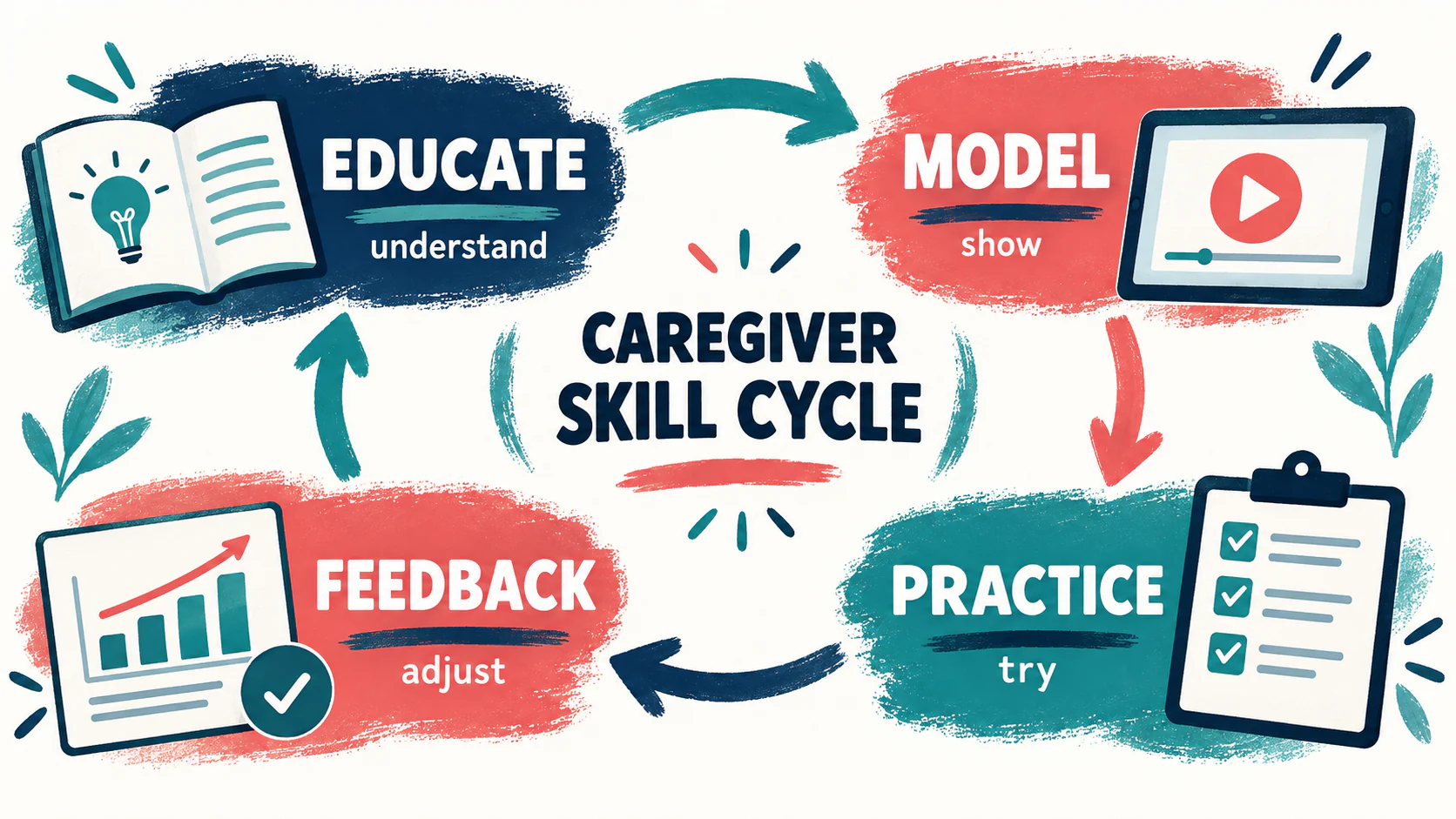
Behavior skills training, often summarized as instruction, modeling, rehearsal, and feedback, is a useful structure for teaching a defined caregiver skill. It is a teaching sequence, not a script that must be delivered identically in every family.
- Instruction: explain the purpose and steps in plain language. Ask the caregiver to describe the step back or identify what they want clarified.
- Modeling: demonstrate the step in the relevant routine, using the materials and language the caregiver can actually access.
- Rehearsal: let the caregiver practice, first in a low-pressure simulation when useful and then in the natural routine if they consent.
- Feedback: identify what worked, give one or two specific adjustments, and provide another opportunity to practice. Feedback should be collaborative, not humiliating.
Set the criterion with the caregiver and supervising clinician. A caregiver may be able to perform a step in a quiet role-play but need more support during a rushed bedtime routine. That difference is information about generalization and feasibility, not a reason to shame the caregiver or declare the family noncompliant.
Adapt for Language, Access, and Consent
Education is only accessible when the family can understand, practice, and use it. Ask about preferred language, literacy, hearing or vision access, cultural routines, scheduling, technology, transportation, and who the caregiver wants involved. Use qualified interpretation or translation processes when needed; do not rely on a child to interpret clinical information.
Explain what participation involves and what information will be recorded or shared. A caregiver can ask for a pause, a different teaching format, or a smaller step. The clinical team still holds responsibility for assessment, supervision, safety decisions, and updating the plan. Education should increase the caregiver’s choices and confidence, not transfer professional risk without support.
Use Data Feedback Without Making Caregivers the Clinician
Data feedback should be useful enough to guide a conversation and simple enough to fit the routine. The caregiver might record whether a communication response occurred, how long a transition took, or which support was used. The BCBA or supervising clinician should define the measure, explain what it means, check its quality, and combine it with other relevant information.
| Feedback question | Keep visible | Do not imply |
|---|---|---|
| What changed? | The same simple measure, context, time window, and major support changes. | One home observation proves the full intervention caused the change. |
| Was the step feasible? | Time, materials, caregiver comfort, competing demands, and barriers. | A missed opportunity is a character flaw or refusal to help. |
| What is next? | Maintain, simplify, model again, change the measure, or discuss the plan in supervision. | The caregiver must independently change a clinical plan without supervision. |
Plan Home Generalization
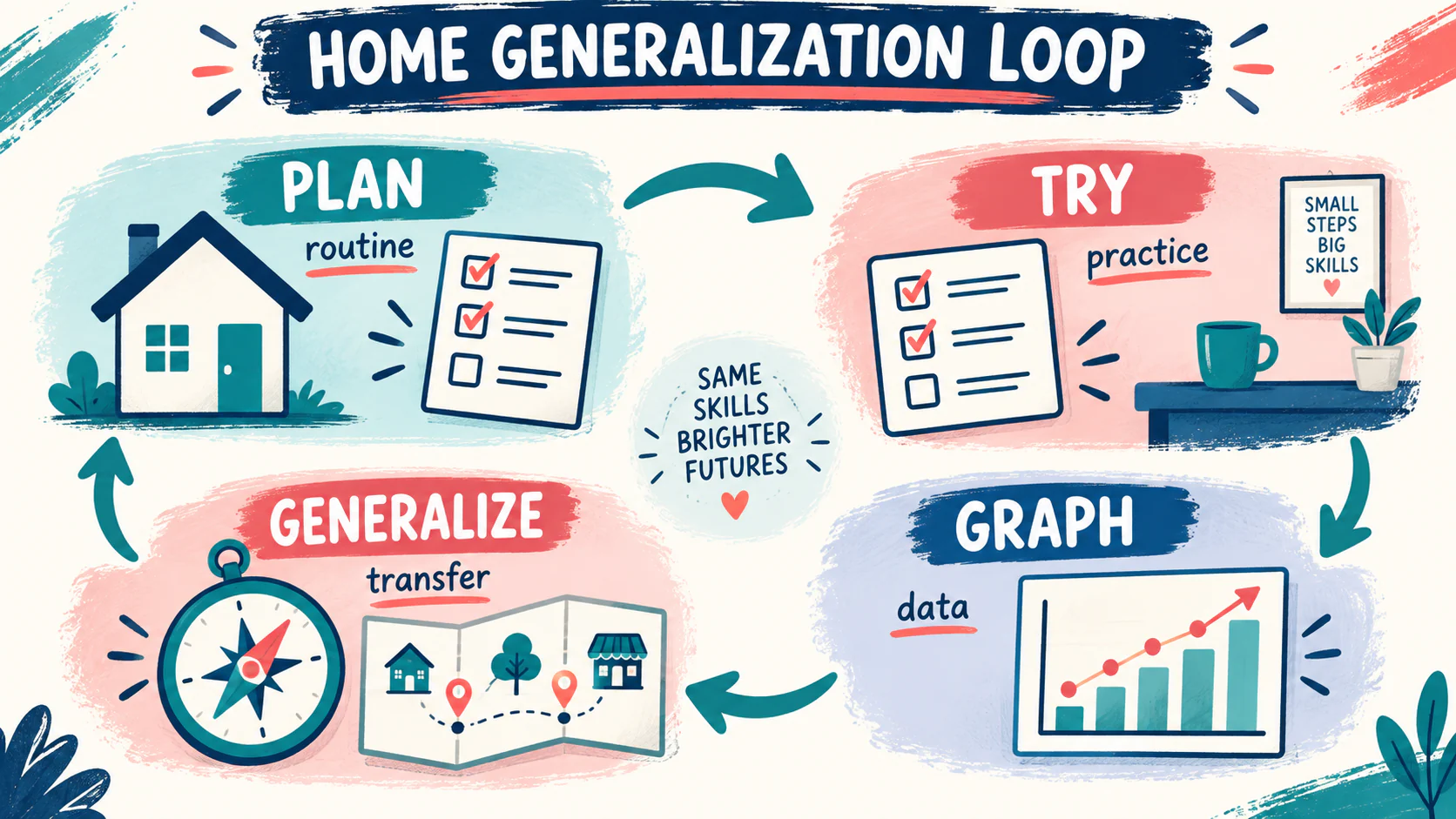
Generalization should be designed, not assumed. A skill practiced in a clinic may require different materials, language, timing, reinforcement, and prompts at home. Select one meaningful transfer context at a time. Ask what should remain the same, what must be adapted, and how the caregiver will know when to use the skill without waiting for a professional to be present.
- Plan: choose the routine, response, support, and brief measure.
- Try: practice with the caregiver’s actual materials and preferred communication style.
- Graph or summarize: review a small sample with the same definitions and note barriers or context changes.
- Generalize: vary the people, setting, time, or materials gradually when the skill is safe and stable, then check maintenance.
Home generalization is not a demand that every caregiver reproduce a clinic protocol. It is a collaborative test of whether the skill or support is useful in the environment where the family needs it. If the plan increases stress, risk, or conflict, pause and bring that information to the supervising clinician.
Provider-Fit Questions and BCBA Exam Traps
Before choosing a provider or study resource, ask:
- What caregiver skill or outcome are we teaching, and how will we know it is useful?
- How will instruction, modeling, practice, and feedback be adapted for language and accessibility?
- What data will the caregiver collect, how much time will it take, and who interprets it?
- How can the caregiver ask questions, request a pause, or report a safety concern?
- How will the team plan generalization without treating one home trial as proof of success?
For BCBA exam study, common traps include confusing information delivery with skill acquisition, treating caregiver participation as automatic consent, assigning a clinical decision to an untrained caregiver, and assuming that a strategy generalizes because it worked in one setting. The Free BCBA Mock Exam can help you practice separating BST steps, data interpretation, generalization, and ethics boundaries. It is a study diagnostic, not a substitute for supervision or a guarantee of certification.
Frequently Asked Questions
What is ABA caregiver education?: It is a structured, accessible process for helping a caregiver understand and use an agreed support or skill in daily life. It can include explanation, modeling, practice, feedback, data discussion, and generalization planning, with the exact service label varying by provider or payer.
Is caregiver education the same as parent training?: They may overlap, and providers may use the terms differently. Caregiver education emphasizes learning and access; parent training often emphasizes performing defined procedures or supporting goals. Ask what the service includes, how participation is measured, and who retains clinical responsibility.
Does a caregiver have to collect data?: Not automatically. A supervising clinician should explain the purpose, burden, privacy, and format of any data request, then adapt it to the family’s capacity and consent. Caregiver observations can be valuable without turning the caregiver into the sole data collector or clinical decision-maker.
How does BST support ABA caregiver education?: BST provides a useful teaching sequence: instruction, modeling, rehearsal, and feedback. It should be individualized, respectful, accessible, and practiced in the routines where the caregiver will use the skill. It does not eliminate the need for assessment, supervision, or safety procedures.
Sources for Further Study
For current professional boundaries, review the BACB Ethics Codes, BCBA Handbook, and BCBA resource hub. For a secondary family-facing explanation, compare the ABA Resource Center parent-training article and ABA Navigator guide. Recheck current local, organizational, payer, privacy, and supervision requirements before applying any education plan.
Quick Review Checklist
Use this final checklist to turn aba caregiver education into exam-ready reasoning. The goal is not to memorize a label in isolation; it is to identify the relevant evidence and explain why the best answer fits the scenario. Key ideas to review:
- State the central definition or decision point for aba caregiver education in your own words.
- Identify the detail that makes aba caregiver education different from its closest related ABA term.
- Separate the observable facts in a scenario from assumptions that are not supported by the facts.
- Write one example and one nonexample so you can recognize the concept in a new setting.
Exam application checks:
- Ask what the question is actually requesting before comparing the answer choices.
- Mark the antecedent, response, consequence, or other evidence that supports the selected answer.
- Look for a distractor that describes a related process but does not answer the specific question.
Final self-check:
- Explain how you would verify the interpretation with clear observations or data.
- Change one detail in the scenario and decide whether your answer should change.
- Give a one-sentence rationale that a supervisor or study partner could evaluate.
Take the Free BCBA Mock Exam
When you are ready to apply the idea, use the free practice resource below for additional feedback. Take the Free BCBA Mock Exam



