
If you are searching for BACB transcripts, the practical question is not simply “Do I have a transcript?” It is whether the Behavior Analyst Certification Board can treat the records you submit as official evidence for your degree and qualifying coursework. A transcript is one part of an application file. It must match the pathway you are using, cover every relevant institution, and reach the BACB through an accepted delivery method.
Table of Contents
- What Are BACB Transcripts?
- Official vs. Unofficial Transcripts
- Which Schools and Records Should You Include?
- How an Official Transcript Gets to the BACB
- How Do Transcripts Fit the 2027 BCBA Pathways?
- BACB Transcript Review Checklist
- Common BACB Transcript Submission Mistakes
- BACB Transcript FAQ
- Take the Free BCBA Mock Exam
This guide is written for BCBA applicants planning around the current rules and the January 1, 2027 transition. Requirements can change, and the BACB BCBA application resources and current handbook should control your final submission. Use this page to organize the evidence before you pay, submit, or ask a school to send a record.
What Are BACB Transcripts?
BACB transcripts are official academic records used to verify information such as a qualifying degree, completed behavior-analytic coursework, course grades, and the institution that awarded or delivered the relevant education. “Official” describes how the record reaches the BACB, not just how professional the PDF looks. A screenshot from a student portal, a scan of an opened envelope, or a file forwarded by the applicant may not carry the same evidentiary status as a sealed paper transcript or an electronic transcript sent directly by the institution.
The transcript does not replace every other requirement. Depending on your eligibility pathway and timing, the application may also require a coursework attestation, fieldwork verification forms, a degree record, examination information, or other supplemental documents. The transcript answers an education-evidence question: what school granted the degree or qualifying courses, and what does the institution’s official record show?
- Credential evidence: the record should identify the institution and the degree information relevant to your pathway.
- Coursework evidence: the record should show the qualifying behavior-analytic courses you are relying on, when applicable.
- Identity matching: names and dates should be consistent with the application, or the difference should be explained through the BACB’s accepted process.
- Source integrity: the institution, not the applicant forwarding a file, should be the source of an electronic official transcript.
Official vs. Unofficial Transcripts
An unofficial transcript can be useful for your own audit. It can help you list courses, check grades, spot a missing degree conferral, and compare records from multiple schools. It should not automatically be treated as the document that satisfies the BACB’s submission rule. The BACB Handbook defines official transcripts by the delivery route: an institution may send an electronic transcript directly, or the original paper record may be mailed in a sealed, unopened envelope.
That distinction matters because a forwarded electronic transcript can lose its official chain of custody. Before ordering anything, ask the registrar which electronic service they use, what recipient address the BACB currently publishes, whether the transcript can include the degree conferral date, and whether the order will be sent directly rather than released to you first. Keep the order confirmation for your records, but do not assume your copy is the official copy the BACB will review.
Which Schools and Records Should You Include?
Build the transcript inventory from your eligibility evidence, not from memory. Start with the institution that awarded the qualifying degree. Then add every other institution where you completed coursework that you are using to meet the behavior-analytic coursework requirement. If you transferred courses, completed a post-master’s sequence, or used more than one school, the BACB may need records from each relevant institution. A single transcript that mentions transfer credit may not show the original course detail the reviewer needs.
Pathway 1 and Pathway 2 can create different document questions. Under Pathway 1, the program and degree’s accreditation or recognition status are central, but the application still needs official education evidence. Under Pathway 2, the coursework record is paired with the applicable coursework attestation. If your degree came from one university and your behavior-analytic courses came from another, treat those as separate evidence sources and ask both institutions for the correct official record.
| Record question | What to verify | Why it matters |
|---|---|---|
| Degree school | Institution name, degree, conferral or completion information | Connects the academic record to the eligibility pathway |
| Coursework school | Every qualifying course and final grade that the institution records | Supports the coursework evidence reviewed by the BACB |
| Transfer history | Whether another institution granted the original credit | Prevents a transcript gap when the receiving school shows only transfer hours |
| Name consistency | Legal name and any required supporting explanation | Reduces identity-matching delays during document review |
How an Official Transcript Gets to the BACB
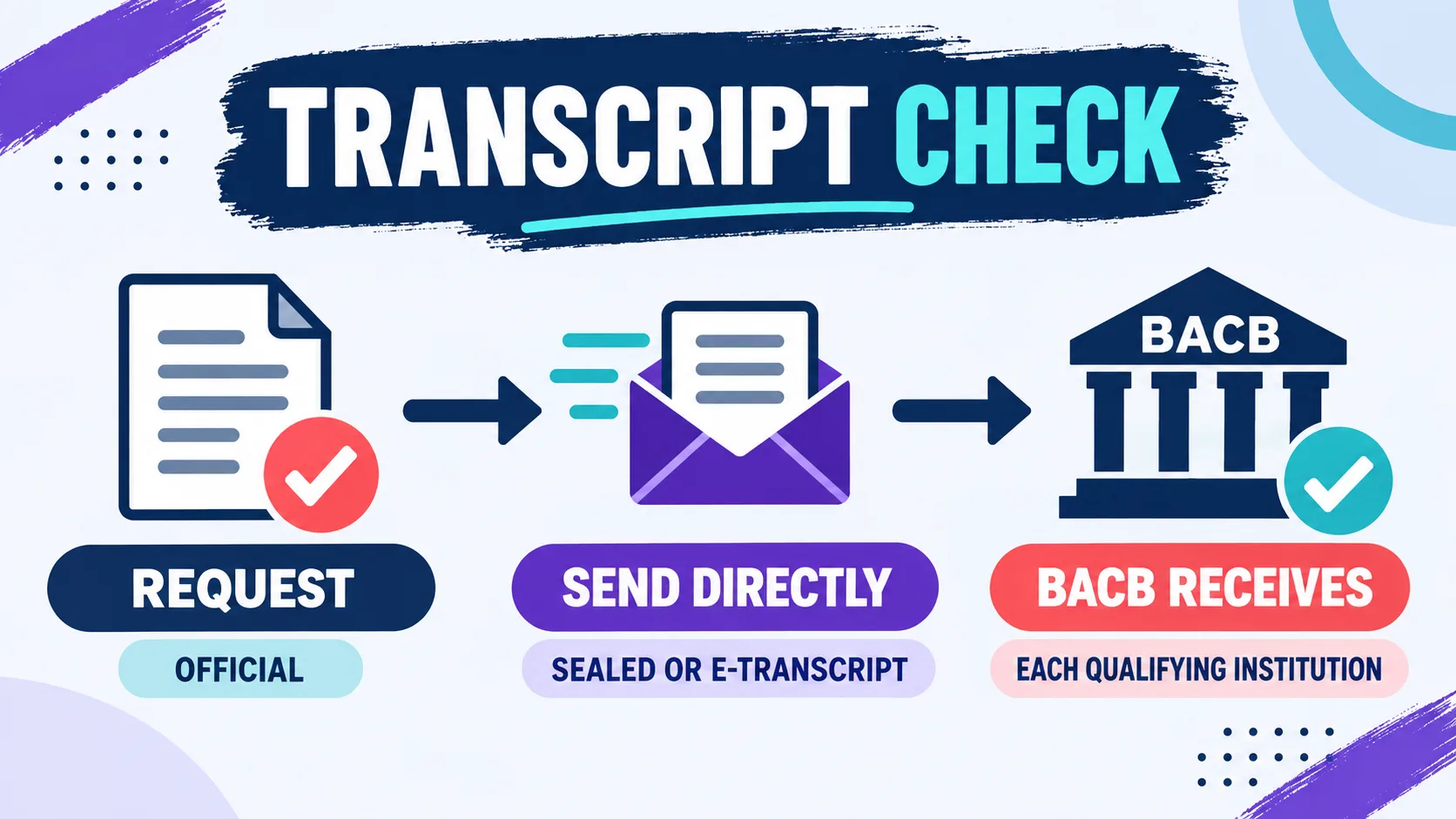
The safest workflow is a direct-delivery workflow. First, compare the current BACB Handbook and application page with your pathway. Second, make a school-by-school list. Third, order the official records using the registrar’s direct electronic service or the BACB’s current sealed-mail instructions. Fourth, confirm that each institution sent the record and that the application system can match it to your file. Do not rely on an old address copied from a forum post or a university page; the receiving instructions belong to the BACB and may be updated.
- Identify the application pathway and the version of the requirements that applies to your submission date.
- List the degree institution, every qualifying coursework institution, and any transfer-credit institution.
- Check the legal name, degree conferral information, course titles, grades, and dates on your personal audit copy.
- Ask each registrar to send the official transcript directly through an accepted electronic service or in a sealed, unopened envelope.
- Save order receipts and delivery confirmations without opening or forwarding the official record.
- Compare the BACB account or application status with the registrar’s confirmation and follow up through the official contact route if a document is not matched.
The official BACB blog explains a common pattern: if the degree and qualifying coursework came from different schools, the applicant should expect to provide records from both. If one school granted both the degree and the qualifying coursework, one record may cover both facts only if it actually displays the required information. The point is completeness, not the number of envelopes.
How Do Transcripts Fit the 2027 BCBA Pathways?
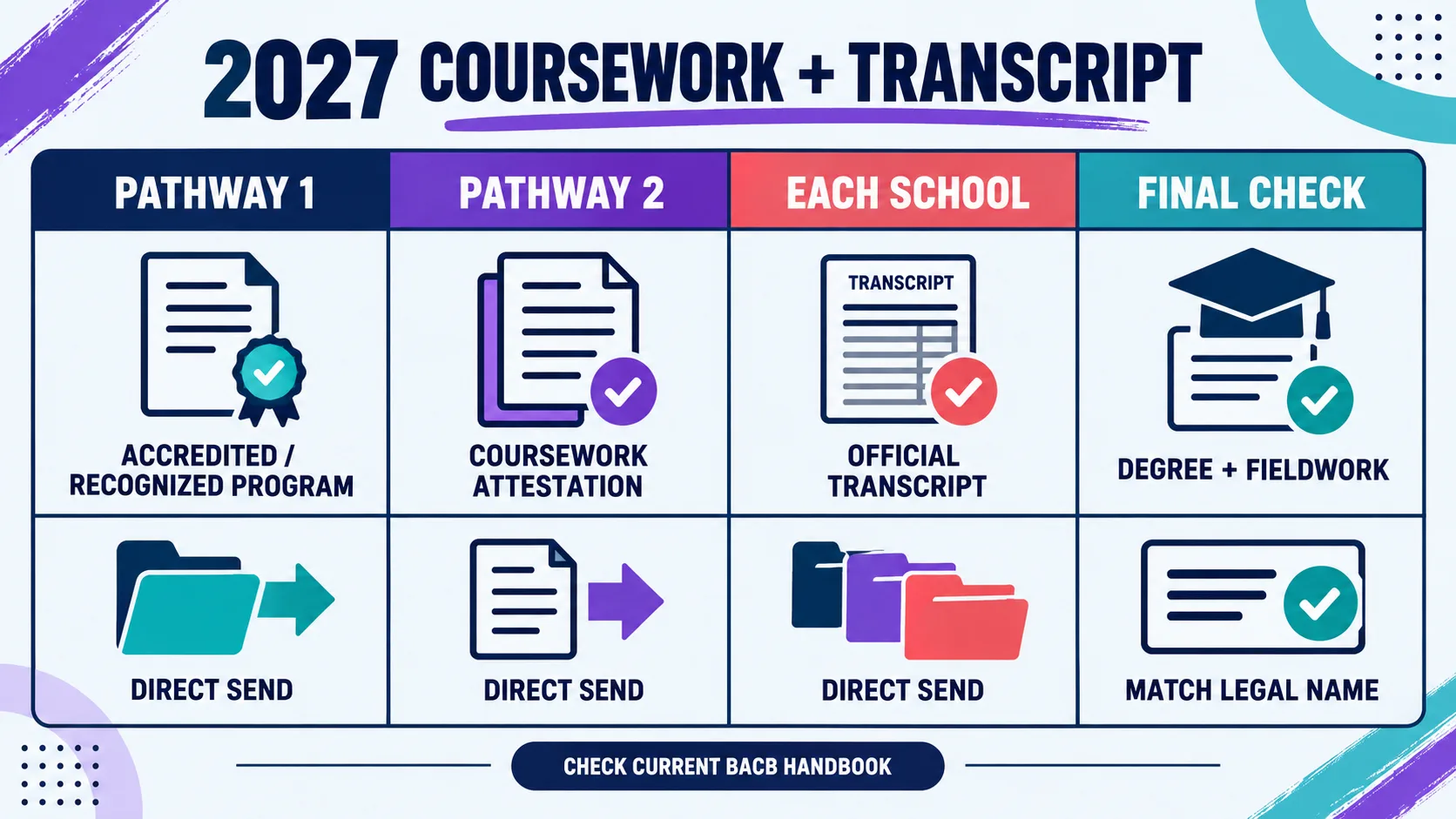
The BACB’s 2027 BCBA Requirements describe two eligibility pathways beginning January 1, 2027. Pathway 1 uses a qualifying accredited or recognized program. Pathway 2 combines a qualifying master’s degree, behavior-analytic coursework, supervised fieldwork, and the examination, with the education evidence supported by the applicable coursework-attestation process. In either pathway, a transcript is evidence; it is not the entire pathway.
For Pathway 2 applicants, the current BACB university guidance says that the designated Pathway 2 Program Contact reviews coursework and submits an attestation when appropriate. The applicant still requests official transcripts from each institution where qualifying coursework was completed. This is why a transcript and an attestation should be tracked as separate checklist items. One document does not silently replace the other.
Timing is especially important in late 2026. The BACB’s transition notice says that a complete application, including payment and required documents, must be received by December 31, 2026 to be reviewed under the current 2022 requirements. Applications after the transition must be checked against the 2027 requirements and the current handbook. If your transcript order, attestation, fieldwork form, or application is still pending, verify the applicable deadline directly with the BACB rather than assuming that an order date equals a received date.
BACB Transcript Review Checklist
Use this checklist before submitting. It is designed to catch document gaps, not to determine whether your coursework qualifies in a formal BACB review.
- My legal name in the application matches the name on each record, or I have a plan for the discrepancy.
- I identified the institution that awarded my qualifying degree.
- I identified every institution where I completed coursework I am using for eligibility.
- I checked whether transfer credit requires an additional original transcript.
- The degree conferral or completion information is visible where required.
- The transcript lists the course titles, grades, and dates I am relying on.
- Each electronic transcript will be sent directly by the institution.
- Any mailed transcript will remain sealed and unopened.
- I tracked the coursework attestation separately if my pathway requires one.
- I checked the current BACB Handbook and application-processing page immediately before submission.
If a transcript does not show the detail you expected, do not edit it, annotate it, or combine it with screenshots to create a substitute record. Ask the registrar whether a corrected official transcript or a separate official document is available, then ask the BACB how that document should be submitted. The reviewer—not a blog post or an admissions representative—decides whether the evidence satisfies the certification application.
Common BACB Transcript Submission Mistakes
The first mistake is sending a beautiful PDF yourself and assuming that “official” is a visual quality. The second is sending the degree transcript but forgetting the separate institution that supplied qualifying coursework. The third is confusing a school’s internal coursework confirmation with the BACB’s required attestation. The fourth is using a 2025 or 2026 checklist after the 2027 rules apply without verifying the transition.
- Forwarding an electronic transcript: ask the institution to send it directly.
- Opening a sealed envelope: once opened, the paper record may no longer be treated as official.
- Relying on transfer hours alone: find out whether the original institution’s course detail is needed.
- Using a portal screenshot: keep it for your own audit, not as a replacement for an official record.
- Combining transcript and attestation: track each requirement separately and confirm the correct version.
- Waiting until the deadline: allow registrar processing and BACB review time; an order receipt does not prove the BACB received a complete application.
These are administrative safeguards, not promises of approval. The BACB notes that it cannot determine whether a specific degree or coursework meets the requirements outside of its formal review. Your task is to submit a complete, traceable, current evidence package and to keep a record of what you sent.
BACB Transcript FAQ
Do I need transcripts from more than one school?: Possibly. If your degree and qualifying behavior-analytic coursework came from different institutions, plan to obtain an official record from each relevant school. Transfer credit is another reason to ask whether the original institution’s course record is needed.
Can I send an unofficial transcript first?: An unofficial copy can help you audit your courses, but it should not be assumed to satisfy the official-document requirement. Follow the BACB’s current direct electronic or sealed-paper instructions for the application record.
Does a transcript replace the Pathway 2 coursework attestation?: No. For a Pathway 2 application, treat the official transcript and the applicable attestation as separate evidence items. The transcript shows the academic record; the attestation is completed through the designated coursework process.
What should I do if the 2027 transition affects my application?: Check the BACB’s transition guidance, the current handbook, and the 2027 requirements against the date your complete application will be received. If any document is uncertain, contact the BACB through its current official channel before relying on a deadline assumption.
After your document plan is clear, use the free BCBA mock exam to keep your exam preparation moving while registrars and application reviewers handle the evidence side. A clean transcript package reduces administrative friction; it does not replace studying the BCBA Test Content Outline.
Take the Free BCBA Mock Exam
If you want a low-pressure way to check your recall, use the free practice resource below. Take the Free BCBA Mock Exam



