
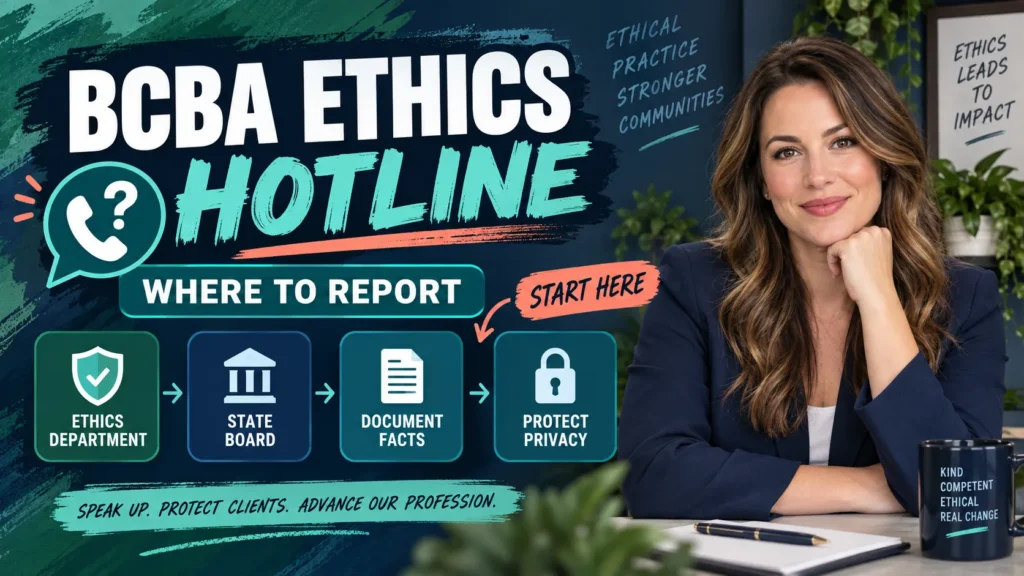
Short answer: If you search for a BCBA ethics hotline, you are usually looking for the right place to report a possible ethics concern or ask what to do next. The BACB’s published process is not a general hotline for legal or ethics advice. Instead, the Behavior Analyst Certification Board directs people to its Ethics Department reporting routes, while state licensing boards, employers, emergency services, and law enforcement may have authority over other situations.
Table of Contents
- What does “BCBA ethics hotline” actually mean?
- Where should a BCBA ethics concern go first?
- Which reporting route fits the situation?
- How do you report an alleged violation to the BACB?
- What is the difference between reporting someone, self-reporting, and public documentation?
- What can the BACB do, and what can it not do?
- How should you document and protect privacy?
- How should BCBA candidates study this topic?
- What mistakes should you avoid?
- BCBA ethics hotline FAQ
- Take the Free BCBA Mock Exam
Start by identifying three facts: who is involved, what happened, and which organization has jurisdiction. A BCBA, BCaBA, BCBA-D, or applicant may fall within BACB ethics processes. A company, a state license, an immediate safety emergency, or a non-certificant may require a different route. The current BACB Reporting to the Ethics Department page should control the final submission decision. Table of Contents
What does “BCBA ethics hotline” actually mean?
The phrase is a search shortcut, not the name of a BACB credential, an Ethics Code standard, or a promise of real-time professional advice. Someone may use it when they need to report a possible violation, understand whether an incident belongs with the BACB, locate a state disciplinary agency, or find immediate safety help.
The BACB’s ethics pages explain that the Ethics Department focuses on consumer protection, disseminates ethics information, and processes notices of alleged violations. The board also states that it cannot provide legal or ethics advice. That boundary matters: a submission is not a request for the BACB to decide your personal legal strategy, diagnose a clinical dispute, or tell you whether a provider is violating a rule before reviewing the relevant facts.
The BACB certifies people rather than companies. If the concern is about a company, you may need to contact the organization, a payer, a state regulator, or another agency with authority. If the concern involves the conduct of a BACB certificant who owns or works at that company, the individual’s conduct may still be reportable to the BACB. Jurisdiction is the first decision, not an afterthought.
Where should a BCBA ethics concern go first?
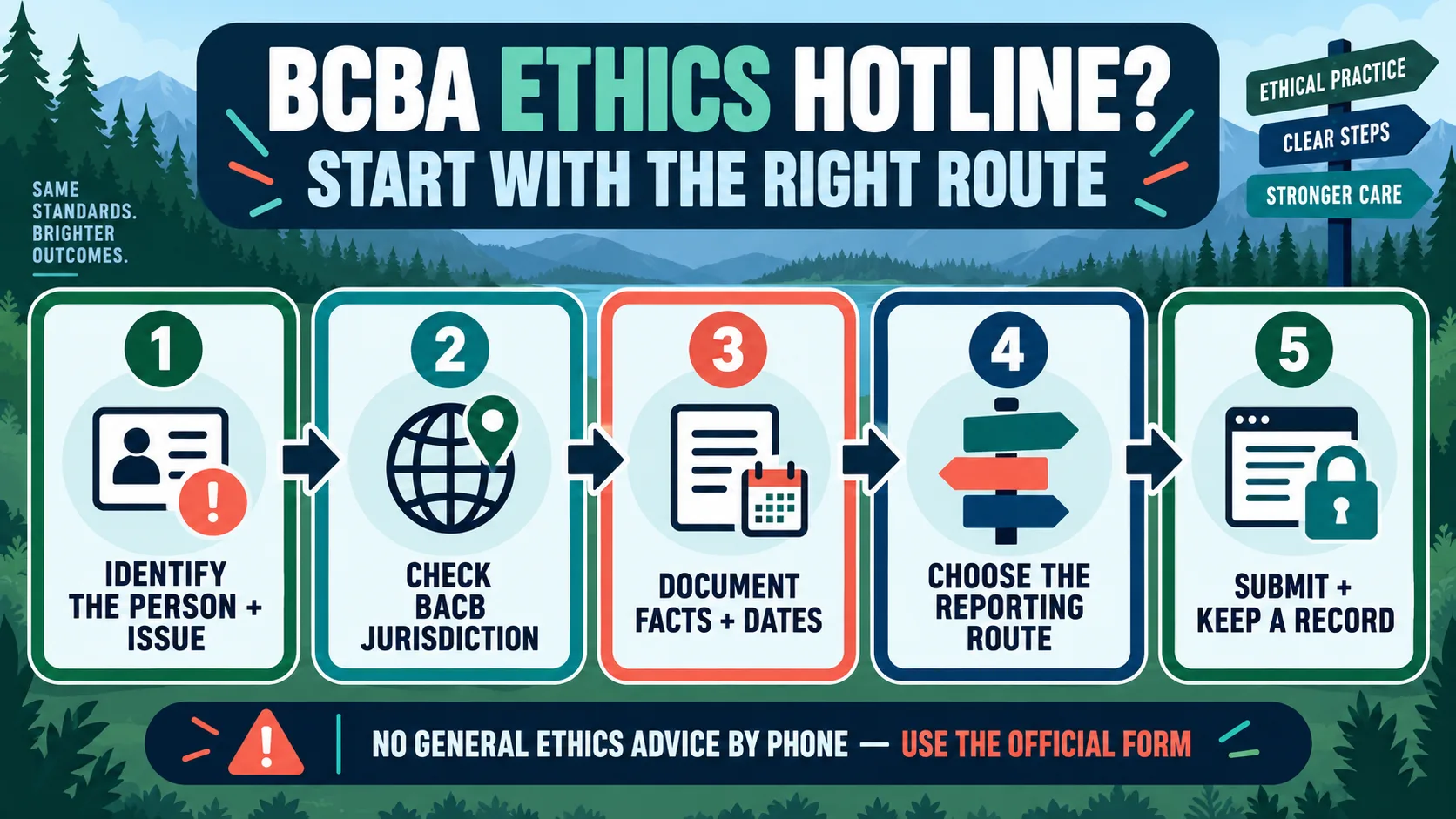
Use this routing sequence before searching for a phone number:
- Is anyone in immediate danger? If there is an urgent threat, suspected crime, or need for emergency protection, contact the appropriate local emergency or law-enforcement authority. A professional certification board is not an emergency response service.
- Is the issue tied to state-regulated practice? If the person is licensed or the concern involves a state practice rule, contact the state licensing or regulatory board. A BACB report may not replace a state complaint.
- Is the issue an internal workplace matter? Use the employer’s reporting, supervision, compliance, or safety process when the organization needs to address schedules, supervision, retaliation, policy, or immediate workplace action.
- Is the subject a BACB applicant or certificant? Review the BACB Ethics Department reporting options for an alleged violation, self-report, or publicly available documentation.
- Can you describe facts and provide relevant records? Organize dates, people, actions, and documents before submitting. Redact personally identifiable information that is not needed for the review.
This sequence does not decide the merits of a complaint. It helps you send a concern to an authority that can actually act on the type of problem described. If more than one authority may have jurisdiction, document what you submitted and follow each organization’s instructions rather than assuming one report automatically reaches every agency.
Which reporting route fits the situation?
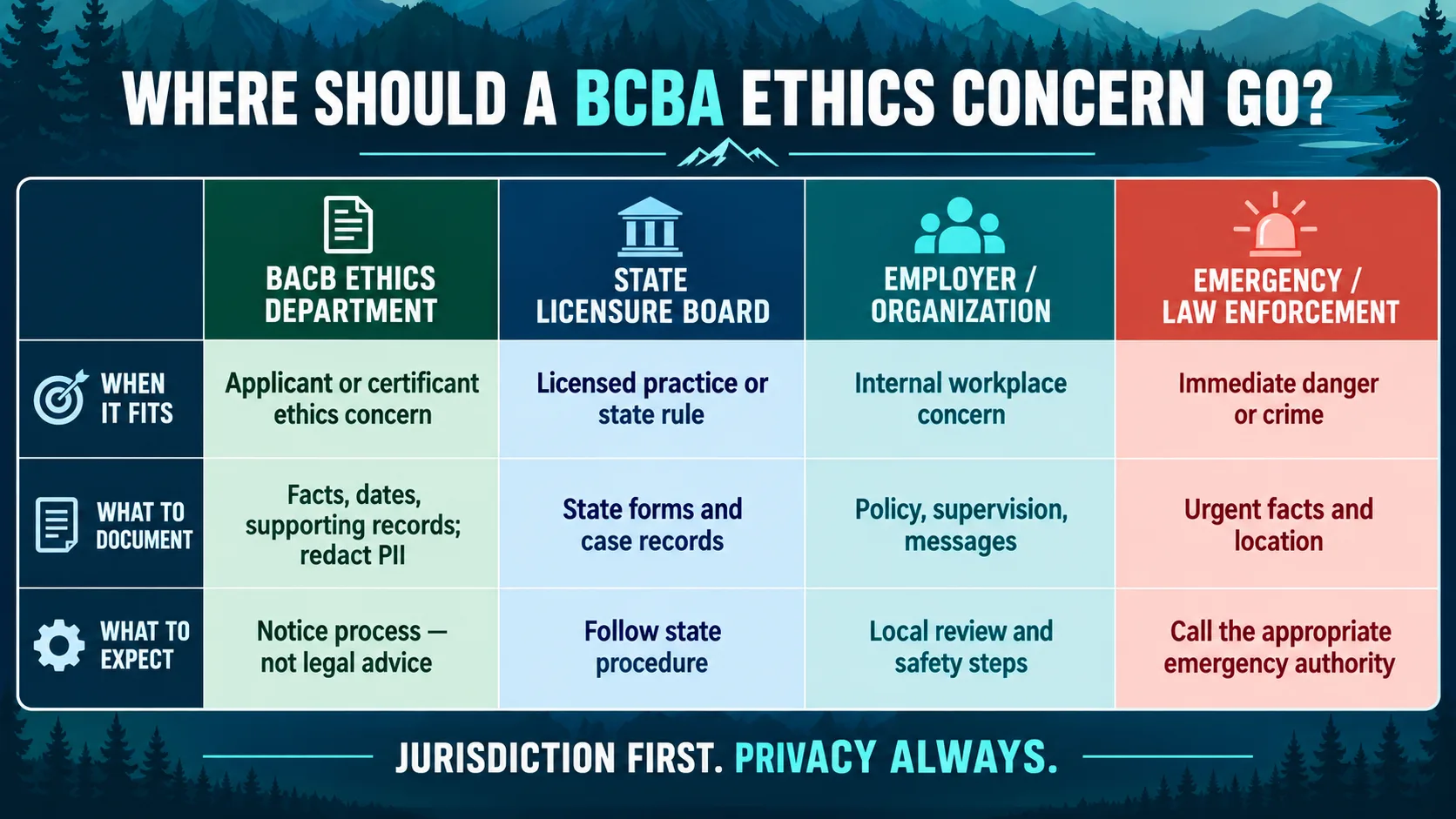
The comparison below is a study and routing aid. It does not replace the instructions on the relevant agency’s current form.
| Route | When it fits | What to document | What to expect |
|---|---|---|---|
| BACB Ethics Department | A BACB applicant or certificant may have violated an ethics requirement, or public documentation identifies a possible violation | Facts, dates, relevant records, subject details, and redacted supporting documents | A notice process governed by BACB procedures; not legal or ethics advice |
| State licensure board | The concern involves a state license, regulated practice, or state disciplinary rule | The state form, license information, dates, and records required by that agency | The state agency’s procedure and deadlines; a BACB report may not replace it |
| Employer or organization | The immediate issue concerns internal supervision, workplace conduct, policy, staffing, or safety | Policy references, supervision records, messages, dates, and requested safety action | Local review, corrective action, or escalation under the organization’s process |
| Emergency or law enforcement | Immediate danger, suspected crime, abuse, or another urgent public-safety concern | Urgent facts, location, people involved, and any evidence requested by the authority | The emergency or investigative process; do not wait for a certification-board response |
How do you report an alleged violation to the BACB?
When the BACB is the relevant authority, begin with its Reporting to the Ethics Department page. The page separates reports involving certificants or applicants, self-reporting, publicly available documentation, and infringement or misuse. Select the path that matches the subject and evidence rather than choosing a form because its title sounds familiar.
- Name the subject and status. Confirm whether the person is a BCBA, BCaBA, BCBA-D, RBT, applicant, or not within BACB certification jurisdiction. The public Certificant Registry can help you verify a certification record.
- Describe what happened. Use observable facts, dates, locations, and direct quotations only when you can support them. Separate what you personally observed from what someone else told you.
- Connect facts to the concern. You may identify a relevant Ethics Code standard if you know it, but do not force a citation or turn a disagreement into a violation without explaining the behavior and context.
- Prepare supporting records. The BACB says the needed documentation depends on the allegation. Relevant materials may include messages, training or feedback records, intervention documents, court records, or third-party findings.
- Redact private information. Remove unnecessary client, consumer, employee, and contact information. Keep a private original only when you are authorized to retain it, and submit the minimum relevant version.
- Submit through the official process. Save the confirmation, case identifier, date, and copy of what you submitted. Do not assume that calling a general contact number creates a formal notice.
- Respond to follow-up requests. A report may require additional information. Use the BACB’s responding-to-requests channel for an active matter instead of sending the same material to an unrelated inbox.
The BACB explains that, when a notice is accepted, the notice and supporting documentation may be shared with the subject, who receives an opportunity to respond. That is why a report should be factual, relevant, and privacy-conscious. A serious concern deserves careful documentation, not exaggeration.
What is the difference between reporting someone, self-reporting, and public documentation?
The reporting method changes what you submit and what follow-up you can expect:
- Reporting an alleged violation by another person: use this when a BACB applicant or certificant may have violated an applicable ethics requirement. Follow the current form and documentation instructions.
- Self-reporting: use the BACB’s self-reporting process when you are the applicant or certificant who needs to report a qualifying event. The BACB’s self-reporting page lists categories and directs the reporter to the appropriate statement and form.
- Reporting publicly available documentation: use the specific public-document route when the alleged violation is supported by material that anyone can access without an account, payment, or private invitation. The BACB states that this route is anonymous, so you should not expect status updates through it.
- Infringement or misuse: use the relevant BACB form for misrepresentation of certification or misuse of BACB information. Do not use that form as a substitute for reporting an ethics violation by a certificant.
RBT-related questions can have an additional supervisor or requirements-coordinator route. Read the reporting guidance for the specific credential and situation. “BCBA ethics hotline” is too broad to tell you which form applies.
What can the BACB do, and what can it not do?
The BACB can receive reports within its jurisdiction and process them under its ethics and code-enforcement procedures. It can also publish certain disciplinary actions and provide instructions for responding to an active request. Those functions are different from serving as a crisis line, attorney, state licensing board, employer investigator, or clinical consultant.
- The BACB does not certify companies, so a company-only complaint may need another authority.
- The BACB cannot provide legal or ethics advice, even when a person asks for a yes-or-no answer.
- A BACB report does not automatically file a state licensing complaint, payer complaint, or law-enforcement report.
- An online form is not a substitute for emergency services when a person faces immediate danger.
- A report is not proof that a violation occurred; the allegation and response must be reviewed through the applicable process.
For active matters, the BACB Responding to Requests page is more relevant than repeatedly submitting a new report. For a general non-ethics question, use the current BACB Contact Us page, while remembering that the board’s published boundary on legal and ethics advice still applies.
How should you document and protect privacy?
Good documentation is concise, chronological, and tied to the routing decision. A useful report file might contain:
- a one-sentence description of the concern;
- the subject’s name, credential, or application status when known;
- a dated timeline of what you observed or received;
- the exact policy, form, or communication that matters;
- a list of supporting files with a short explanation of relevance;
- a redacted copy that removes unnecessary personally identifiable information;
- a record of where and when the concern was submitted.
Avoid collecting extra client data just because it might make a story feel persuasive. Protect confidentiality, follow your workplace and state requirements, and use the submission instructions for file type and size. If you need legal advice, contact a licensed attorney in your jurisdiction; if you need immediate safety help, contact the appropriate emergency authority.
How should BCBA candidates study this topic?
For the BCBA exam, do not memorize “call the hotline” as a universal answer. Instead, practice a jurisdiction-and-evidence decision:
- Identify whether the stem describes a BACB applicant/certificant, a state licensee, a company, or an emergency.
- Separate an ethical concern from a legal question, clinical disagreement, workplace grievance, and immediate safety problem.
- Choose the narrowest authority that can act and the correct reporting route.
- Preserve relevant facts, protect privacy, and avoid claiming a violation before the evidence is reviewed.
Read the current BACB Ethics Codes page and the current BCBA Test Content Outline together. The outline tells you how to frame exam study; the live BACB pages tell you how current reporting and enforcement processes work. For independent practice, the free BCBA mock exam can help you rehearse scenario discrimination. It is a study resource, not an official BACB hotline, form, or exam.
What mistakes should you avoid?
- Searching only for a phone number: start with the official reporting route and jurisdiction.
- Sending a company complaint to the BACB: identify the individual conduct and the agency that regulates the organization.
- Using the wrong form: distinguish an alleged violation, self-report, public documentation, and infringement or misuse.
- Assuming anonymity: do not treat an ordinary report as anonymous unless the official route says it is.
- Including unredacted client information: submit relevant evidence with unnecessary personal information removed.
- Asking the BACB for legal advice: use a licensed attorney for legal questions and a qualified professional for clinical consultation.
- Waiting during an emergency: call the appropriate emergency authority when immediate safety is at stake.
- Submitting a second report instead of responding: use the active-case response channel when the BACB requests more information.
Bottom line: There is no single “BCBA ethics hotline” that replaces jurisdiction and documentation. Start with the BACB Ethics Department when the concern involves a BACB applicant or certificant, use the state board for state-regulated practice, use the employer for internal action, and use emergency or law-enforcement channels for immediate danger or crime. Then submit the official form with concise facts and protected records.
BCBA ethics hotline FAQ
Does the BACB have a BCBA ethics hotline? The BACB publishes Ethics Department reporting routes and contact processes, but it states that it cannot provide legal or ethics advice. Use the current reporting page rather than expecting a general advice hotline.
Where do I report a BCBA ethics violation? Start with the BACB Reporting to the Ethics Department page when the subject is a BACB applicant or certificant and the concern falls within BACB jurisdiction. A state board or another authority may also be appropriate.
Can I report a company to the BACB? The BACB says it certifies people, not companies. If the concern is about the conduct of a BACB certificant who owns or works at a company, identify that person and review the current BACB reporting guidance; a company-only issue may belong with another agency. Is a public-document ethics report anonymous? The BACB’s public-document reporting page says that route is anonymous and that the notifier cannot request an update. Check the current form before submitting.
What evidence should I send? Follow the current form’s instructions. Relevant evidence may include dated messages, feedback or training records, intervention documents, court or third-party findings, and other records tied to the allegation. Redact unnecessary personally identifiable information.
Can the BACB tell me whether my provider violated ethics? The BACB says it cannot provide ethics or legal advice. You can review the Ethics Code and reporting guidance, seek qualified advice, and use the appropriate authority for the facts and jurisdiction. Sources and further reading: Review the BACB Ethics landing page, Reporting to the Ethics Department, public-document reporting, self-reporting, Ethics Codes, and Contact Us. Official BACB instructions control if a third-party summary differs.
Take the Free BCBA Mock Exam
When you are ready to apply the idea, use the free practice resource below for additional feedback. Take the Free BCBA Mock Exam



