

Short answer: If you need an example of variable ratio schedule in everyday life, look for a response being reinforced after an unpredictable number of responses. The number of actions changes from one reinforcer to the next, while the consequence still depends on responding. A slot-machine pull is the classic example, but a planned mystery-reward system or a bonus after a varying number of referrals can illustrate the same logic.
Table of Contents
- What is a variable ratio schedule?
- What is an example of variable ratio schedule in everyday life?
- How can you test whether an example is really variable ratio?
- How is variable ratio different from the other schedules?
- What response pattern does variable ratio usually produce?
- How should you solve a BCBA exam question?
- What ethical cautions matter in applied settings?
- What are the common mistakes?
- How should you study this concept?
- Variable ratio schedule FAQ
- Take the Free BCBA Mock Exam
The key distinction is ratio versus interval. Ratio means you count responses. Interval means you track time. “The reward comes at an uncertain time” is not enough to identify a variable ratio schedule. For a BCBA exam question, ask what must happen before reinforcement can occur, whether that requirement changes, and what consequence follows the response. Table of Contents
What is a variable ratio schedule?
A variable ratio (VR) schedule delivers reinforcement after a changing number of responses. The requirement may average to a value, such as VR 5, but the learner does not know whether the next reinforcer will follow the first response, the fourth response, the seventh response, or another response. The important relation is between the count of responses and the consequence.
“Variable” does not mean random in every possible sense, and it does not mean that reinforcement is unrelated to behavior. A good scenario still describes a consequence that follows the response under a programmed or naturally occurring contingency. If the event happens after an unpredictable amount of time regardless of what the person does, that is closer to a variable interval schedule. If reinforcement follows exactly every tenth response, it is fixed ratio.
The current BACB task-list hub links to the 6th Edition BCBA Test Content Outline, which is the appropriate source for the current exam framework. The schedule label itself comes from behavior-analytic principles; the exam task is to apply the contingency accurately rather than memorize a catchy example.
What is an example of variable ratio schedule in everyday life?
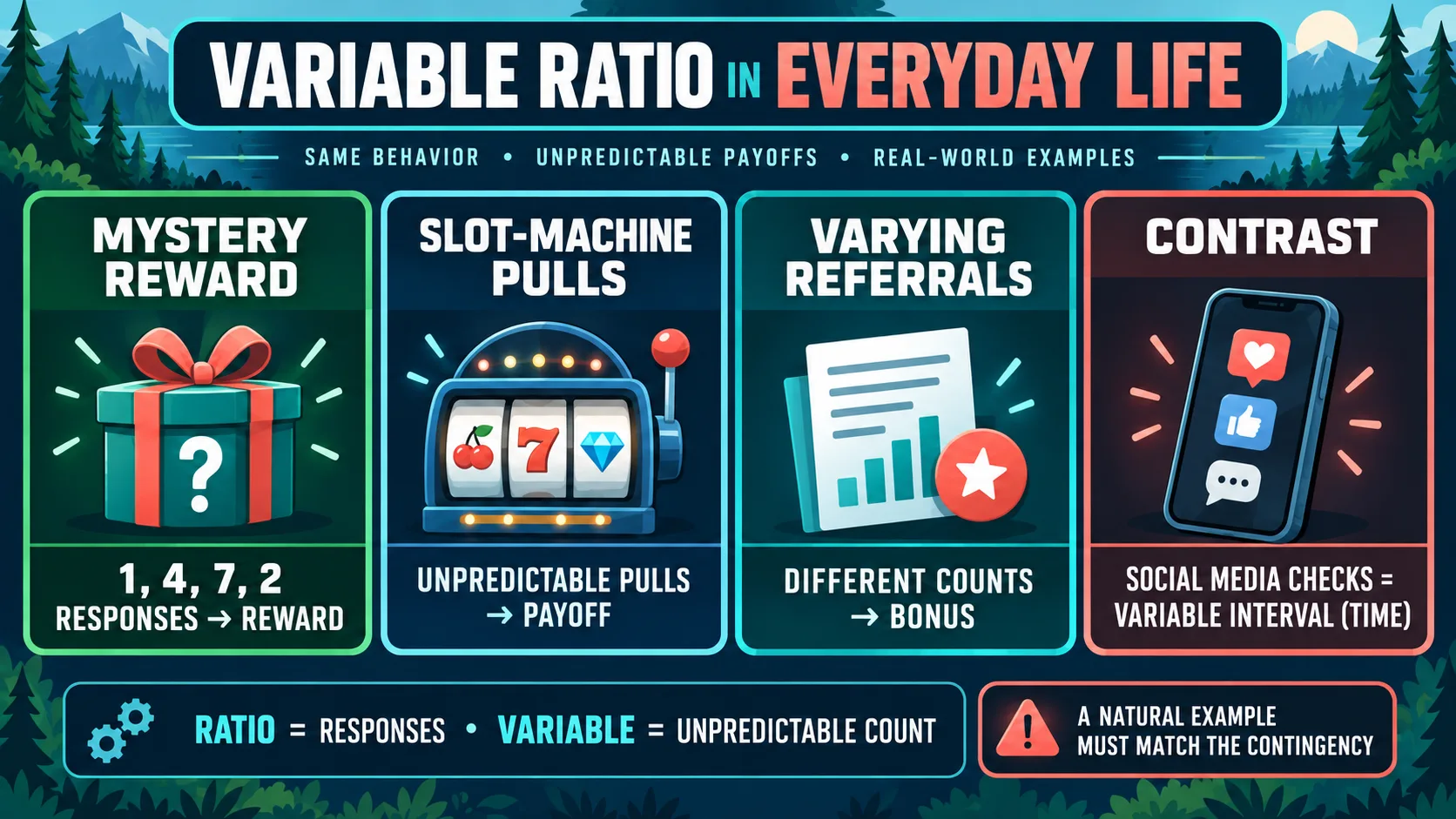
The cleanest everyday examples have three parts: a repeated response, a changing response requirement, and a reinforcer delivered after the requirement is met. These examples illustrate the logic; they do not mean that every naturally occurring reward system is a formally programmed VR schedule.
- Slot-machine pulls: each pull is a response, and a payoff can occur after an unpredictable number of pulls. This is the classic teaching example. It is also a gambling example, not a recommendation; gambling can create financial and health risks.
- A programmed mystery-reward system: a learner earns a reward after a varying number of completed, defined responses—for example, after 1, 4, 7, and 2 correct responses across opportunities. The count changes, and the reward is contingent on responding.
- A varying-referral bonus: if a program explicitly awards a bonus after an unpredictable number of successful referrals, the referral response count—not simply the passing of Friday or the arrival of a calendar date—controls access to the bonus.
- Some game reward systems: a game may award an item after a varying number of eligible actions. To classify it as VR, confirm that the reward depends on the number of responses, not merely on a timer, a daily reset, or a random event independent of responding.
Be careful with examples such as fishing, job applications, or social-media engagement. They may feel unpredictable, but a naturally uncertain outcome is not automatically a formal reinforcement schedule. Ask whether the response produces the consequence under a definable relation. If the only fact is “you never know when something good will happen,” the example is incomplete.
How can you test whether an example is really variable ratio?
Use the four-question test below. It prevents the common mistake of calling every occasional reward variable ratio:
- What is the response? Name an observable action, such as a pull, completed referral, correct response, or eligible game action.
- What is the reinforcer? Identify the consequence that follows the response and changes the future likelihood of responding. A preferred event is not automatically a reinforcer.
- Is the requirement based on responses or time? If you must count actions, you are in the ratio family. If the clock controls access, you are in the interval family.
- Does the response requirement vary? If the requirement is always 10 responses, it is fixed ratio. If it changes across reinforcers, it may be variable ratio.
Consider a concrete example: a study app gives a badge after 3, 6, 2, and 8 completed practice items, with the sequence arranged in advance but not shown to the learner. The response is completing an item, the badge is the programmed consequence, the requirement is response-based, and the number changes. That is a defensible VR example. If the app gives a badge every day at 8:00 p.m. regardless of study responses, the schedule is time-based instead.
How is variable ratio different from the other schedules?
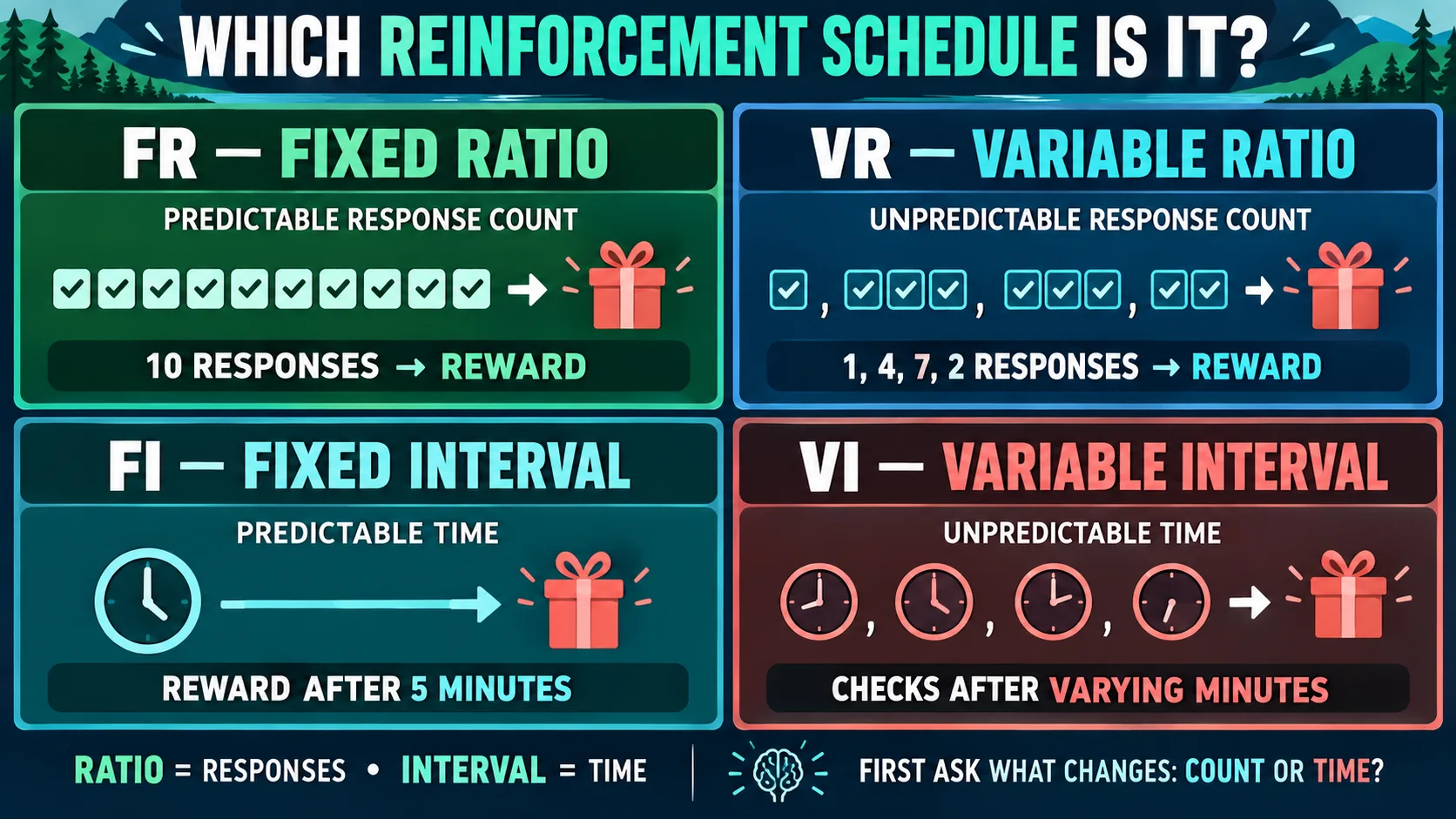
Start with the two axes: ratio versus interval, then fixed versus variable. The first asks whether the requirement is based on responses or time. The second asks whether that requirement stays predictable or changes.
| Schedule | Requirement | Example pattern | Exam question |
|---|---|---|---|
| FR Fixed ratio | A predictable number of responses | Reward after exactly 10 completed responses | Can the learner predict the response count? |
| VR Variable ratio | An unpredictable number of responses | Reward after 1, 4, 7, and 2 responses | Does the response count change across reinforcers? |
| FI Fixed interval | A predictable amount of time | The first response after every 5-minute period | Does the clock set a predictable interval? |
| VI Variable interval | An unpredictable amount of time | The first response after changing time intervals | Is time, not response count, the variable? |
The table describes the contingency, not a promise about a person’s exact response rate. A real learner’s history, motivation, reinforcer value, instructions, and effort can change performance. Use the schedule label to organize the scenario, then read the data and context instead of jumping from “VR” to an absolute prediction.
What response pattern does variable ratio usually produce?
Textbooks commonly associate VR schedules with high and steady responding and relatively small postreinforcement pauses. The response pattern makes sense: the next reinforcer cannot be predicted from a clock or a fixed response count, so pausing for a known amount of time does not provide the same advantage as it can under some fixed schedules. However, the schedule does not force one identical graph in every person or setting.
Applied research also uses variable-ratio schedules when thinning reinforcement after a skill has been acquired, with the goal of supporting maintenance. A recent article in Behavior Analysis in Practice describes the distinction between continuous reinforcement for acquisition and intermittent schedules, including VR schedules, for maintenance in classroom contexts. The practical point is not “make reinforcement unpredictable everywhere.” It is to match the programmed schedule to the learner, skill, treatment plan, and data.
- High responding: the behavior may occur at a relatively high rate when the reinforcer is valuable and the effort is acceptable.
- Steady responding: the absence of a predictable response requirement can reduce the long pause associated with some fixed-ratio patterns.
- Persistence: intermittent reinforcement can make behavior continue when reinforcement is temporarily absent, but persistence is not the same as treatment success.
- Individual variation: motivation, delay, reinforcer quality, instructions, and prior schedule history can alter the pattern.
How should you solve a BCBA exam question?
Use the sequence response → requirement → consequence → predictability:
- Underline the action that must occur.
- Circle whether the stem gives a number of responses or an amount of time.
- Ask whether the requirement is constant or changes.
- Identify what follows the response and whether it functions as reinforcement in the scenario.
- Reject the answer that uses uncertainty alone without naming the count-or-time relation.
Mini-example: A learner earns a token after completing 2, then 5, then 3 appropriate requests; the sequence is not shown. The correct classification is variable ratio because the consequence follows responses and the response requirement changes. If the learner receives a token for the first appropriate request after 10 minutes, regardless of how many requests occurred during those 10 minutes, the relevant schedule is interval rather than ratio.
Another common stem says that a person checks a phone because a message may arrive at any time. That is not automatically VR. If the phone check is the response and the message appears after changing amounts of time, it resembles a variable-interval arrangement. The exam answer depends on the programmed or described contingency, not on how tempting or unpredictable the activity sounds.
What ethical cautions matter in applied settings?
A variable ratio schedule is a technical arrangement, not a permission slip to make a client work indefinitely for an uncertain reward. In applied behavior analysis, the professional should define the target response, select meaningful goals, consider client preferences and context, monitor outcomes, and use the least risky effective plan consistent with current requirements. An unpredictable schedule that is confusing, coercive, or unrelated to the learner’s goals is not made appropriate by the label “VR.”
- Explain the contingency in a way the learner and relevant stakeholders can understand.
- Use an individualized reinforcer assessment rather than assuming that a reward is valuable.
- Track response effort, delay, errors, frustration, and meaningful outcomes.
- Thin or change reinforcement based on data and the written plan, not convenience.
- Review whether the schedule supports maintenance and generalization rather than dependence on an artificial reward.
For study purposes, connect schedule classification to the current BACB outline and ethics expectations. For practice purposes, never turn an exam example into an unsupervised clinical protocol.
What are the common mistakes?
- Calling every random reward VR: confirm that the number of responses, not just the outcome, controls access.
- Confusing ratio and interval: ratio counts behavior; interval measures time.
- Confusing variable and fixed: a reward after exactly 10 responses is FR, not VR.
- Calling phone checking VR: uncertain message timing usually raises an interval question.
- Assuming the label guarantees a graph: response patterns depend on the learner and the contingency.
- Using gambling as advice: it is a classic teaching example, not a safe or recommended intervention.
- Skipping the consequence: a preferred event is not automatically a reinforcer without an effect on future behavior.
How should you study this concept?
Make a four-column error log: response, requirement, consequence, and schedule. Write one example and one near-miss for each schedule. The near-miss matters because BCBA questions often use a scenario that sounds unpredictable but is actually time-based, or a scenario that includes a response but keeps the response requirement fixed.
Then practice in mixed sets. Do not complete twenty VR flashcards in a row and mistake familiarity for discrimination. Mix FR, VR, FI, and VI examples; explain why each alternative is wrong; and revisit any item in which you named the schedule before identifying the contingency. The free BCBA mock exam for example of variable ratio schedule in everyday life practice can provide independent practice after you have reviewed the current BACB task-list resources. It is not an official BACB exam and does not guarantee a passing result.
Bottom line: The best example of a variable ratio schedule in everyday life is one in which a response is reinforced after a changing number of responses. Count the action, identify the consequence, check whether the count varies, and compare the scenario with interval schedules before choosing an answer.
Variable ratio schedule FAQ
What is the simplest example of a variable ratio schedule? A slot-machine pull is the classic example because a payoff can follow an unpredictable number of pulls. Use it as a teaching example, not as a recommendation to gamble. Is a variable ratio schedule based on time? No. Ratio schedules are based on the number of responses. Variable ratio means that the response requirement changes; variable interval means that the time requirement changes. Is a reward after 10 responses variable ratio? No. If reinforcement follows exactly 10 responses each time, the schedule is fixed ratio. It becomes variable ratio when the required count changes across reinforcers.
Are social-media checks a variable ratio example? Usually not. If a message or update becomes available after changing amounts of time and checking is the response, the example is more consistent with variable interval. Read the exact contingency in the scenario.
Why is a mystery-reward task useful for studying VR? It makes the response count visible. If the learner completes a defined response and earns the reward after changing counts such as 1, 4, 7, and 2, the count-or-time distinction is easier to test.
Does VR always produce high, steady behavior? It is commonly associated with high and steady responding, but the exact pattern depends on motivation, effort, instructions, history, reinforcer value, and context. Describe the typical pattern without treating it as a guarantee.
Sources and further reading: Review the BACB task-list resources, the OpenStax operant-conditioning schedule comparison, and the applied research discussion in Behavior Analysis in Practice. These sources provide educational context; use current BACB materials and qualified supervision for professional decisions.
Take the Free BCBA Mock Exam
When you are ready to apply the idea, use the free practice resource below for additional feedback. Take the Free BCBA Mock Exam



