
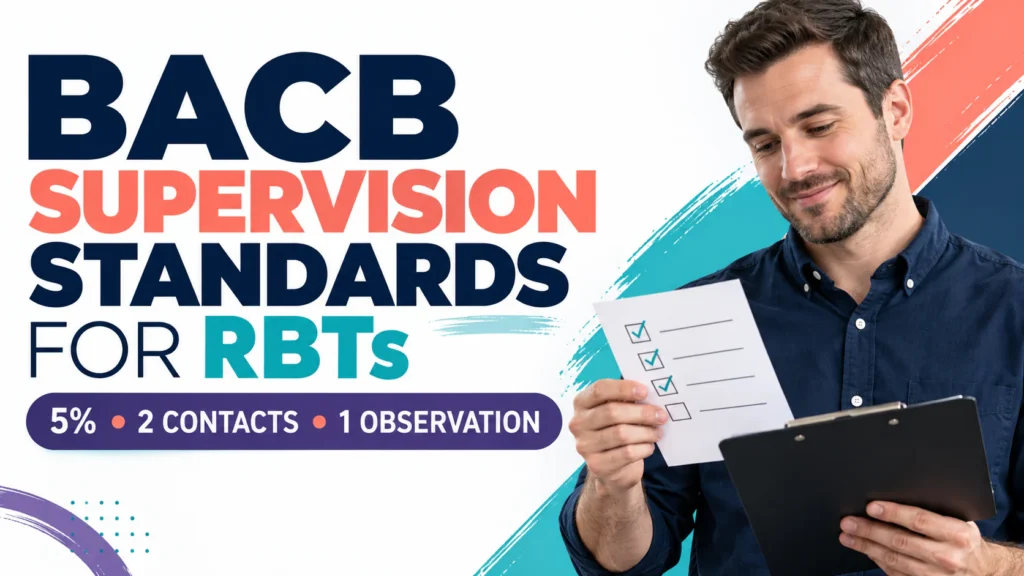
If you are searching for BACB supervision standards for RBTs, start with the current RBT Handbook rather than an old checklist or a general employer summary. The core ongoing-supervision minimums are a plan for at least 5% of the hours you spend providing behavior-analytic services each calendar month, at least two face-to-face real-time contacts each month, and an observation of you providing services during at least one of those meetings.
Table of Contents
- BACB Supervision Standards for RBTs: The Short Answer
- What the Monthly Standard Means in Practice
- RBT Supervisor vs. RBT Requirements Coordinator
- What Counts as Real-Time Supervision?
- Documentation, Portal Records, and Audit Readiness
- Do Not Confuse RBT Supervision With BCBA Fieldwork
- A Monthly RBT Supervision Audit Checklist
- For BCBA Candidates and Providers
- Quick Review Checklist
- Take the Free BCBA Mock Exam
Those numbers are only the beginning. The current rules also address individual versus small-group meetings, client-specific oversight, BACB portal records, documentation retention, the difference between an RBT Supervisor and an RBT Requirements Coordinator, and what changes when you work for more than one organization.
This guide translates the current BACB resources into a study and compliance checklist. It is educational information, not individualized certification, employment, legal, or clinical advice. When a rule affects your credential or a client’s services, verify the current handbook, your BACB portal, and the responsible supervisor.
BACB Supervision Standards for RBTs: The Short Answer
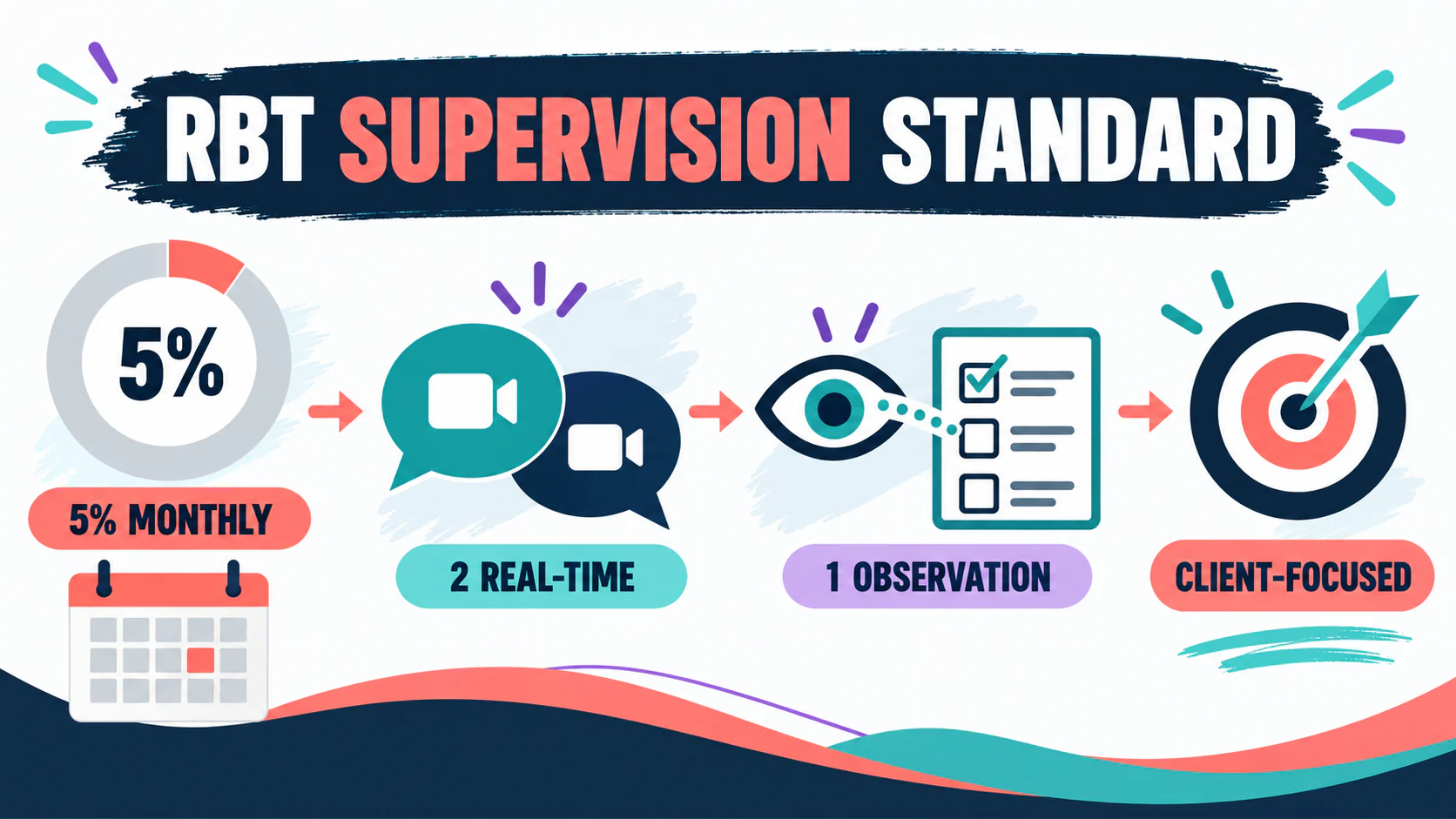
The current BACB RBT Handbook sets the ongoing-supervision minimum at 5% of the hours spent providing behavior-analytic services each calendar month. Supervision must include at least two face-to-face, real-time contacts per month. Your supervisor must observe you providing services in at least one monthly meeting. At least one of the two sessions must be individual; the other may be a small-group meeting with 2–10 RBTs who share similar experiences. Several boundaries matter:
- The 5% calculation applies separately at each organization where you provide behavior-analytic services. You cannot provide 3% at one organization and 2% at another and treat the total as 5% for both.
- A phone call, email exchange, or passive video feed by itself is not the same as a face-to-face, real-time supervision contact.
- Ongoing RBT supervision is client focused. It is separate from professional-development requirements, so one event should not be counted twice.
- Supervisors need enough client-specific knowledge to inform the clinical direction of your work, not just a generic understanding of the job title.
For a current version check, use the BACB RBT Handbook and the BACB’s RBT supervision resource page. A blog post or training slide can help you find a topic, but the handbook and current BACB portal instructions control your actual certification responsibilities.
What the Monthly Standard Means in Practice
Suppose an RBT provides 80 hours of behavior-analytic services at one organization during a calendar month. Five percent of 80 is 4 hours, so the supervision plan must provide at least 4 hours of supervision for that organization’s service hours. The percentage is not a suggestion to average across several months, and it is not satisfied by a single end-of-month conversation if the required contact, observation, and individual-session conditions are missing.
| Standard to track | Current BACB boundary | Useful proof |
|---|---|---|
| Service-hour percentage | At least 5% of behavior-analytic service hours in each calendar month, calculated separately for each organization. | Monthly service-hour log, calculation, and supervisor review. |
| Real-time contacts | At least two face-to-face, real-time contacts per month; phone or email alone is not enough. | Dates, duration, format, participants, and topics for both meetings. |
| Direct observation | The supervisor observes the RBT providing services during at least one monthly meeting. | Observation date, client/service context, feedback, and follow-up action. |
| Individual session | At least one of the two monthly supervision sessions must be individual. | A record showing no other RBTs or trainees were present in that session. |
| Small-group option | The other meeting may be interactive small-group supervision with 2–10 RBTs who share similar experiences. | Roster, interactive agenda, shared experience, and supervisor feedback. |
For remote supervision, the BACB Handbook allows web cameras, videoconferencing, or similar methods instead of physical presence when applicable laws are followed. The critical distinction is real-time interaction and feedback. A recording or a camera that is simply left on does not automatically create a qualifying supervision meeting.
RBT Supervisor vs. RBT Requirements Coordinator
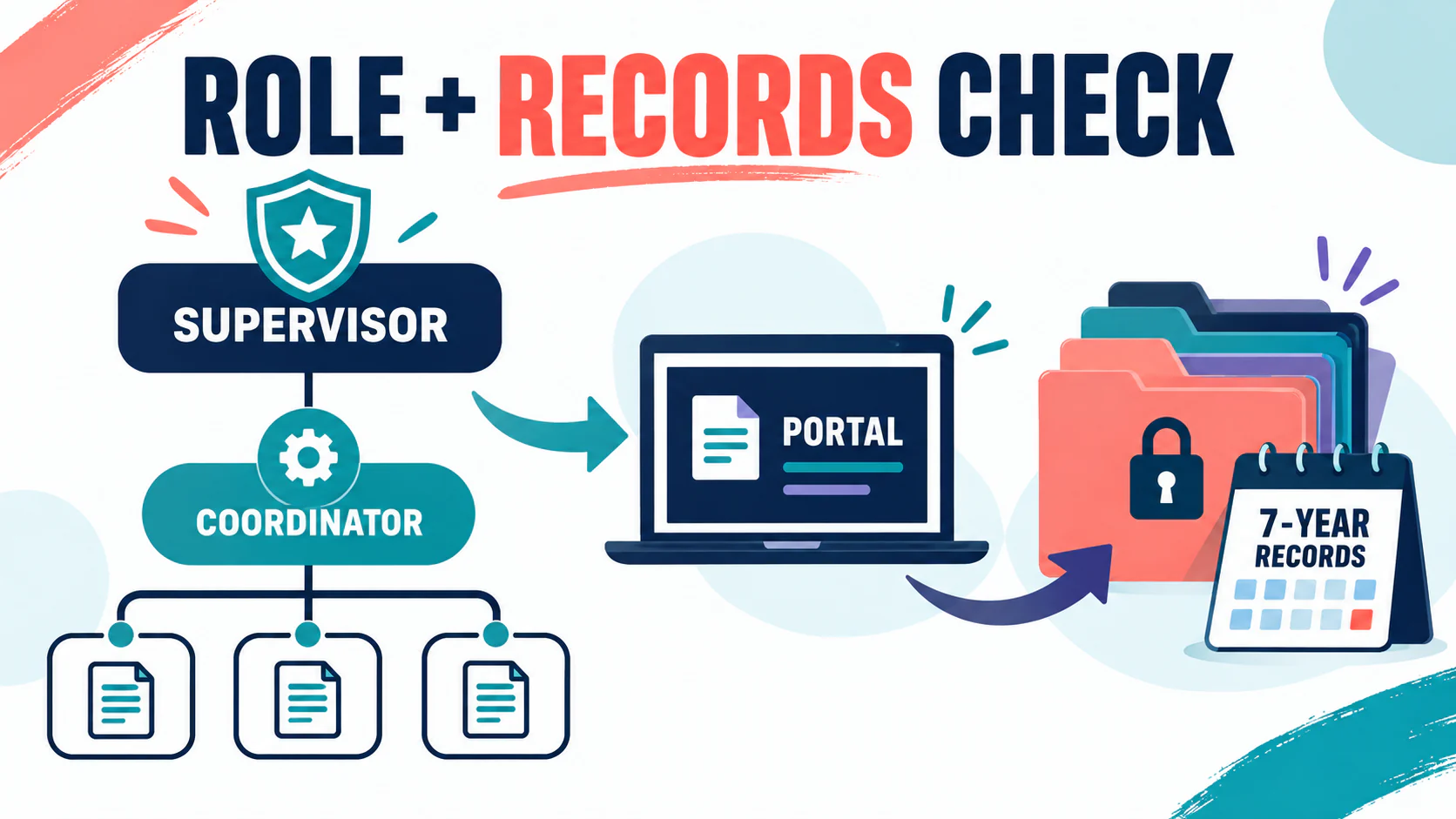
The organization’s structure determines who carries which administrative responsibility. The two roles can overlap, but they are not interchangeable labels. A supervisor is responsible for the services provided under that supervisor’s supervision. A Requirements Coordinator manages the organization-level system when multiple supervisors are involved.
| Role | Main responsibility | RBT should verify |
|---|---|---|
| RBT Supervisor | Provides supervision and is responsible for the services the RBT provides under that supervisor’s supervision. | The person’s qualification, 8-hour supervision training, client-specific knowledge, and portal listing when required. |
| RBT Requirements Coordinator | Coordinates the organization’s supervision system and ensures that the RBTs and supervisors meet the requirements. | Who is the coordinator for that organization, how supervisors share details, and where records are stored. |
| Multiple supervisors | Supervisors at one organization collaborate; they do not each need to recreate the entire system independently when a coordinator structure applies. | Which person observes, who receives the meeting details, and who confirms the monthly percentage. |
| Different organizations | Requirements are met independently at each organization where the RBT provides behavior-analytic services. | A separate monthly calculation and supervision plan for every organization. |
If a supervisor or coordinator changes, the BACB Handbook says the change must be reflected in the BACB portal when the supervisory relationship ends. Ask who is responsible for updating the record and check the Certificant Registry or portal when appropriate. Do not assume that an employer’s internal schedule automatically updates the BACB record.
What Counts as Real-Time Supervision?
Supervision is more than receiving instructions. The BACB describes activities such as setting performance expectations, observing, using behavioral skills training, providing performance feedback, modeling technical and ethical behavior, reviewing written materials, evaluating service effects, and evaluating the effects of supervision itself. A useful meeting connects those activities to the RBT’s actual clients and work.
For an individual session, the supervisor and RBT should be able to identify the client or service context, the skill or procedure being discussed, the performance observed, the feedback given, and the action to take next. For a small-group session, the meeting should be interactive and the participants should share similar experiences; simply watching a lecture with a large audience is not the same structure.
Remember that direct observation is required in at least one of the monthly meetings, but more observation may be appropriate when client needs, performance concerns, or training priorities call for it. The minimum is a compliance floor, not a recommended ceiling.
Documentation, Portal Records, and Audit Readiness
Keep records that allow another person to reconstruct what happened. At a minimum, the current handbook and BACB checklist point toward service dates and hours, supervision dates and duration, the meeting format, the participants, the supervision topics or activities, the observation, feedback, and any follow-up. The supervisor and RBT should know where the records live and how they can be accessed later.
BACB materials state that supervision documentation should be maintained for up to seven years and be available for an audit, including for former RBTs. Use a secure organization-approved system, protect client information, and do not place identifying clinical information in a public study spreadsheet. A calendar invitation proves that a meeting was scheduled; it does not by itself prove that the required supervision occurred.
The BACB supervision checklist for RBT Supervisors and Requirements Coordinators is useful for setting up a system. It is a checklist, not a substitute for the current handbook. Record the version date you used, because forms and portal procedures can change.
Do Not Confuse RBT Supervision With BCBA Fieldwork
An RBT may later pursue BCBA or BCaBA certification, but the ongoing RBT supervision rules and supervised-fieldwork rules are different. The BACB’s FAQ compares them: both may use a 5% figure in certain pathways, but the number of real-time contacts, observation expectations, individual supervision, documentation, and activity mix are not interchangeable.
| Question | Ongoing RBT supervision | BCBA/BCaBA supervised fieldwork |
|---|---|---|
| Purpose | Maintain safe, supervised RBT service delivery and certification requirements. | Build the competencies and documented experience required for a future credential. |
| Monthly structure | At least 5%, two real-time contacts, and one observation under the RBT rules. | Different contact and documentation requirements under the BCBA or BCaBA handbook. |
| Activities | Client-focused supervision of RBT work and performance. | Restricted and unrestricted fieldwork activities that develop future analyst skills. |
| Documentation | Ongoing-supervision records and audit-ready retention. | Fieldwork summaries and forms required by the applicable certification pathway. |
Some RBT service hours may count toward supervised fieldwork in the right circumstances, but that decision needs a qualified supervisor and the fieldwork rules. Do not copy an RBT supervision log into a BCBA fieldwork file and assume the requirements match. The BACB’s RBT-to-BCBA/BCaBA FAQ is the safer starting point for that transition question.
A Monthly RBT Supervision Audit Checklist
At the end of each month, an RBT and supervisor can use this sequence to find gaps before an audit or renewal deadline:
- Separate organizations: list each organization where behavior-analytic services were provided and calculate the 5% minimum separately.
- Confirm contacts: verify two face-to-face, real-time meetings occurred, including at least one individual meeting.
- Confirm observation: identify which meeting included observation of service delivery and record the feedback.
- Check the structure: confirm the supervisor, coordinator, client-specific responsibility, and BACB portal listing are current.
- Save the record: store dates, duration, format, participants, topics, service hours, calculations, and follow-up in the approved system.
- Escalate early: if a requirement was missed, notify the responsible supervisor or coordinator promptly and ask for the current BACB process rather than quietly changing a record.
If you are unsure whether a meeting or observation qualifies, document what actually happened and ask the responsible supervisor or BACB for guidance. Never backdate a record or label a passive recording as real-time supervision.
For BCBA Candidates and Providers
For exam study, turn each rule into a scenario: Which organization’s hours count? Was the contact real-time? Was one session individual? Who is responsible when a coordinator structure exists? Was the RBT observed with a client? These questions test role boundaries and application, not just memorization of “5%.”
For broader site context, the existing BACB supervision standards guide remains a read-only companion. After you review supervision, ethics, documentation, and fieldwork concepts, the Free BCBA Mock Exam can provide a separate practice diagnostic. It cannot replace the BACB Handbook or determine whether a supervision record meets current requirements.
How much supervision does an RBT need each month?: The current RBT Handbook states a minimum of 5% of the hours spent providing behavior-analytic services each calendar month, plus at least two face-to-face, real-time contacts and an observation of service delivery during at least one monthly meeting.
Can RBT supervision be done by phone or email?: Phone or email alone does not satisfy the face-to-face, real-time contact requirement. Videoconferencing or a similar method may be possible when it provides real-time interaction and complies with applicable laws; passive video monitoring alone may not count.
What is the difference between an RBT Supervisor and a Requirements Coordinator?: An RBT Supervisor provides supervision and is responsible for services under that supervisor’s supervision. A Requirements Coordinator coordinates the organization’s system when multiple supervisors are involved and ensures requirements are met. One person may serve in both roles, but the responsibilities should be identified clearly.
Can RBT supervision count as BCBA fieldwork?: Some RBT activities may count toward supervised fieldwork in the right circumstances, but ongoing RBT supervision and BCBA/BCaBA fieldwork have different requirements and documentation. Review the applicable BACB handbook with a qualified supervisor before counting hours.
Quick Review Checklist
Use this final checklist to turn bacb supervision standards for rbts into exam-ready reasoning. The goal is not to memorize a label in isolation; it is to identify the relevant evidence and explain why the best answer fits the scenario. Key ideas to review:
- State the central definition or decision point for bacb supervision standards for rbts in your own words.
- Identify the detail that makes bacb supervision standards for rbts different from its closest related ABA term.
- Separate the observable facts in a scenario from assumptions that are not supported by the facts.
- Write one example and one nonexample so you can recognize the concept in a new setting.
Exam application checks:
- Ask what the question is actually requesting before comparing the answer choices.
- Mark the antecedent, response, consequence, or other evidence that supports the selected answer.
- Look for a distractor that describes a related process but does not answer the specific question.
Final self-check:
- Explain how you would verify the interpretation with clear observations or data.
- Change one detail in the scenario and decide whether your answer should change.
- Give a one-sentence rationale that a supervisor or study partner could evaluate.
Take the Free BCBA Mock Exam
When you are ready to apply the idea, use the free practice resource below for additional feedback. Take the Free BCBA Mock Exam



