

When someone searches for an ABA terms PDF, they usually want a compact reference they can download, print, or review between practice sets. The useful question is not simply whether a file contains many definitions. It is whether the file is current, mapped to the right BCBA exam scope, precise about similar terms, and easy to turn into applied practice.
Table of Contents
- ABA Terms PDF: What It Can and Cannot Do
- Five Checks Before You Trust a Study PDF
- Term Clusters That Match the Current BCBA TCO
- Why Relationships Matter More Than Isolated Definitions
- Turn a PDF Into Retrieval Practice
- Build a Version-Controlled Study Stack
- Quick Review Checklist
- Take the Free BCBA Mock Exam
The official BACB BCBA Test Content Outline, 6th edition is the scope boundary. It is an exam outline, not a vendor glossary. A third-party PDF can summarize terms, but it should not replace the TCO, the current BCBA Handbook, or careful practice with scenarios.
This guide shows how to evaluate an ABA terminology PDF and use it as one layer in a study system. It does not label any unofficial PDF as BACB-approved, and it does not promise that downloading a study file will produce a passing score.
ABA Terms PDF: What It Can and Cannot Do
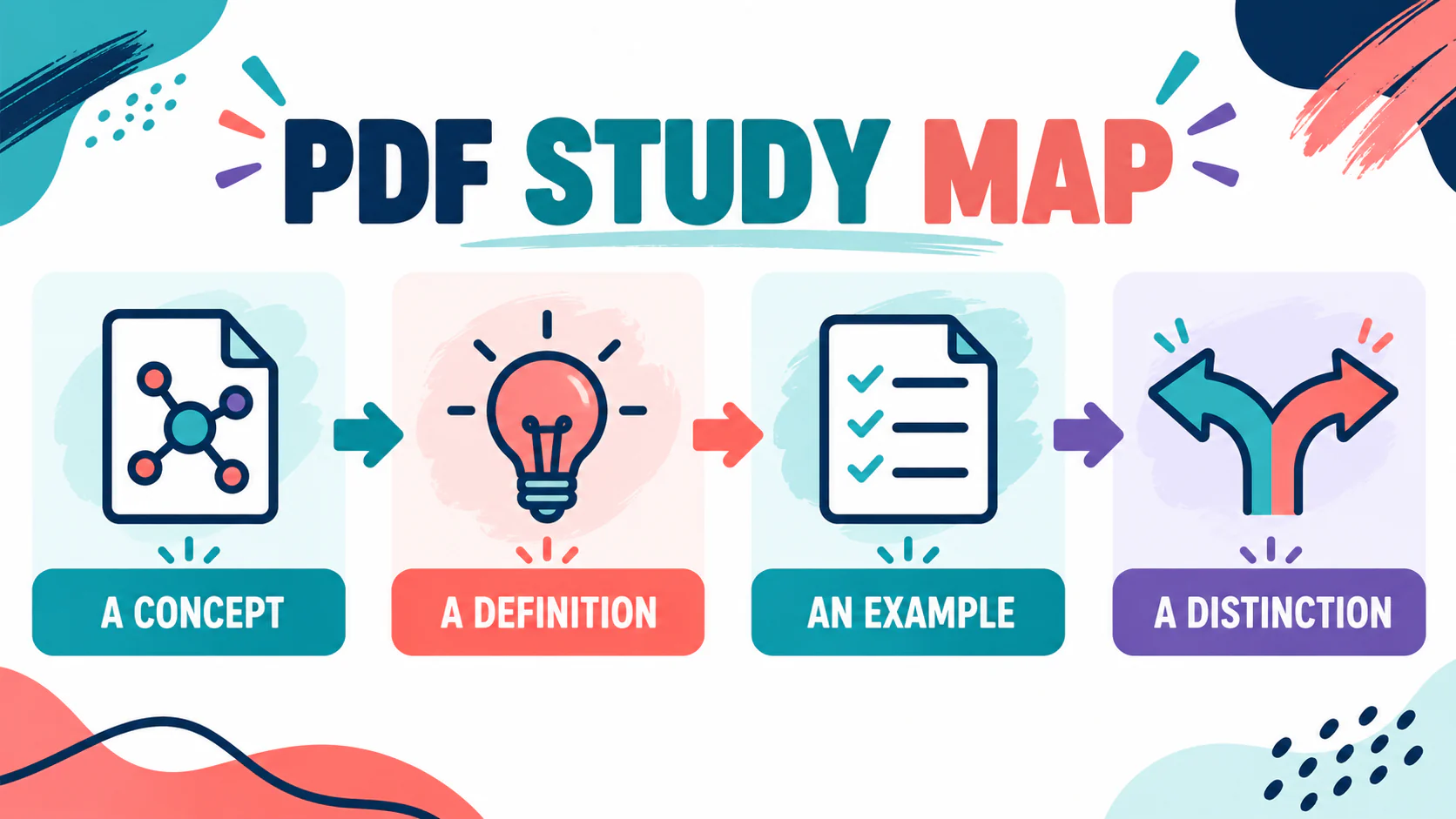
A good ABA terms PDF is a review tool. It can help you refresh a definition, compare related concepts, find a short example, and mark a term for another practice round. It cannot prove that the explanation is current, cover every task in the TCO, or tell you which answer is best in a new vignette without application practice. Use the sources in layers:
- Official scope: the BACB 6th Edition TCO tells you which domains and tasks are in the examination framework.
- Official requirements: the current BCBA Handbook controls certification and maintenance rules; a glossary does not.
- Study reference: an ABA terms PDF compresses language for review, but its author and date should be visible.
- Application practice: questions, examples, and error review test whether you can use the term when the wording changes.
The distinction prevents a common study mistake: treating a memorized sentence as if it were the complete concept. On the BCBA exam, a term may be tested through an antecedent, consequence, data pattern, ethical boundary, or intervention decision rather than through a direct “define this” question.
Five Checks Before You Trust a Study PDF
Before saving a PDF to your study folder, audit its metadata and teaching design. You do not need a long document if it is precise, current, and connected to the TCO. You do need enough information to recognize a concept in context.
| Check | What to look for | Red flag |
|---|---|---|
| Version and date | A visible edition, update date, author or publisher, and a note about the TCO it uses. | “Latest” appears in the file name but no edition or update date is shown. |
| Scope map | Terms are organized across the nine TCO domains or clearly labeled as supplemental. | A long alphabetical list gives no indication of what is in or out of exam scope. |
| Definition quality | Each entry states the functional idea in plain language and preserves important conditions. | Circular definitions, vague synonyms, or a sentence copied without context. |
| Contrast and example | The PDF separates close terms and gives a brief applied example or nonexample. | Every term has a definition but no reason it differs from its nearest distractor. |
| Study usability | Searchable text, readable headings, page numbers, accessible contrast, and a way to mark weak terms. | Scanned pages with no text layer, broken links, tiny type, or no navigation. |
A PDF can pass four checks and still need a correction. When you find a questionable definition, compare it with the official TCO and a reliable behavior-analysis text, mark the uncertainty, and ask a qualified instructor or supervisor. Do not silently memorize a statement because it is formatted professionally.
Term Clusters That Match the Current BCBA TCO
The TCO organizes 104 tasks into nine domains. A useful ABA terms PDF does not need to reproduce every task, but it should help you connect terms to the domains where they are applied. Start with clusters instead of trying to memorize an unstructured alphabetized glossary.
- Concepts and principles: reinforcement and punishment, positive and negative contingencies, extinction, motivating operations, stimulus control, schedules, verbal operants, rule-governed and contingency-shaped behavior, generalization, and maintenance.
- Measurement and data: frequency, rate, duration, latency, interresponse time, continuous and discontinuous measurement, time sampling, IOA, validity, reliability, graphs, and procedural integrity.
- Assessment: preference assessment, descriptive assessment, functional analysis, operational definition, indirect versus direct information, and assessment-based decision making.
- Behavior change: differential reinforcement, prompting and fading, shaping, chaining, token systems, time-based procedures, punishment, generalization, maintenance, and unwanted effects.
- Ethics and supervision: confidentiality, competence, cultural responsiveness, multiple relationships, informed collaboration, feedback, performance management, and scope boundaries.
These clusters are a study map, not a substitute for the full outline. The current TCO lists the task language and relative exam distribution; use it to spot omissions. For example, a PDF that contains many basic definitions but no measurement, experimental design, ethics, assessment, or supervision terms is not a complete BCBA review reference.
Why Relationships Matter More Than Isolated Definitions
Many exam errors happen between neighboring concepts. A definition is stronger when it answers four questions: What changes? When does it happen? What is the function or outcome? What term is it not?
| Cluster | Question to ask while studying | Application cue |
|---|---|---|
| Positive vs. negative | Was a stimulus added or removed, and did the behavior increase or decrease? | Classify the contingency from what changed after the behavior, not from whether the event sounded good or bad. |
| MO vs. stimulus control | Did the variable change the value of a consequence or signal its availability? | Look at the relation between the antecedent and the likely reinforcer. |
| Descriptive assessment vs. functional analysis | Were variables merely observed or systematically arranged? | Identify whether the design supports a functional hypothesis or only a descriptive pattern. |
| Reliability vs. validity | Are measurements consistent, accurate, or both? | A measure can be consistent without measuring the intended dimension well. |
Add one contrast line to every PDF entry. For example, write “negative reinforcement is not punishment” and then create a tiny scenario that shows the difference. This turns a glossary page into a discrimination exercise, which is closer to the reasoning required by exam questions.
Turn a PDF Into Retrieval Practice
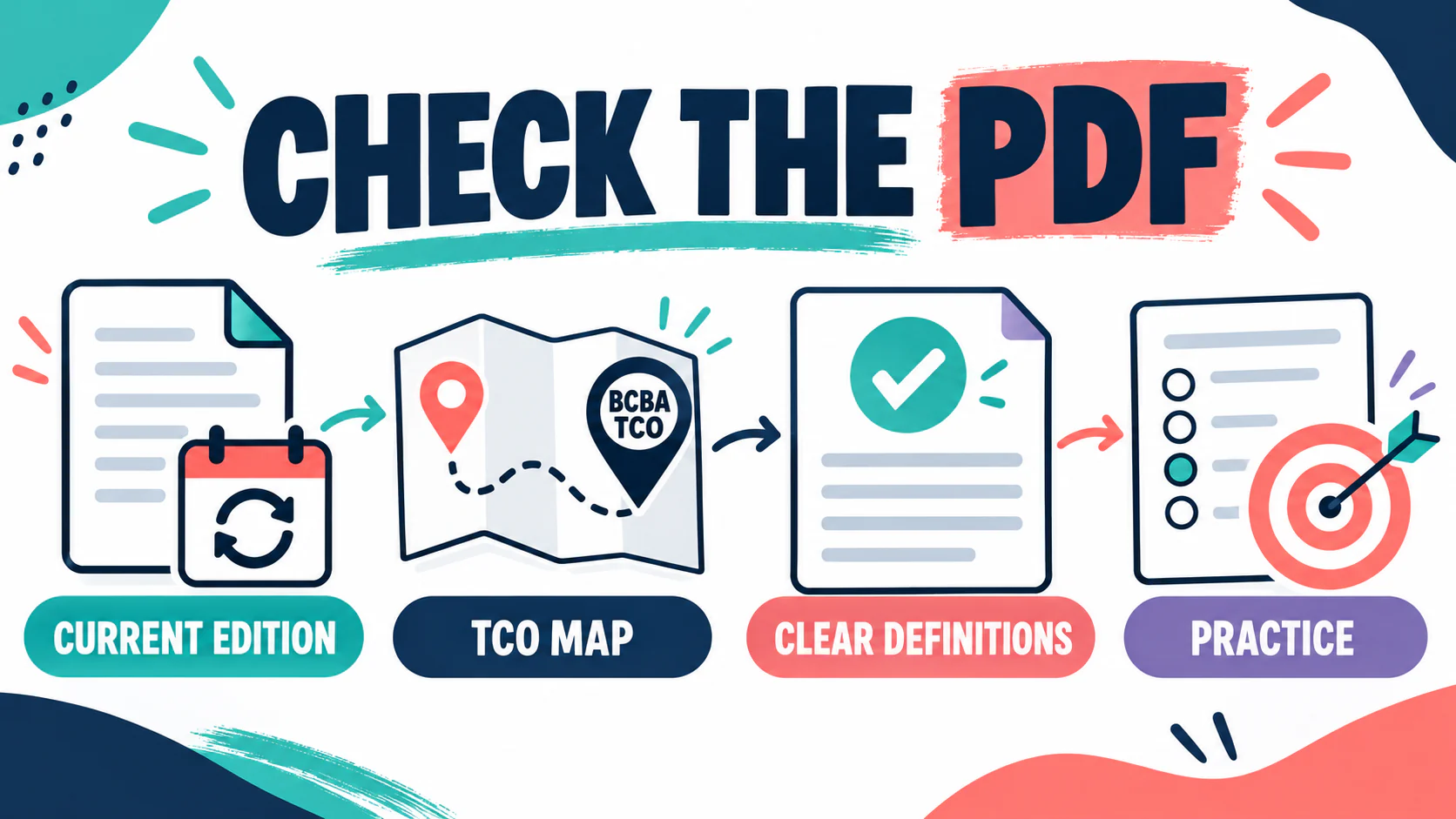
Do not read an ABA terms PDF from the first page to the last page and call that studying. Use a short retrieval loop:
- Preview: choose one cluster and write the terms you can recall before opening the PDF.
- Check: compare your definition, boundary, example, and nearest contrast with the reference.
- Apply: write a one- or two-sentence vignette that would make the term the best answer.
- Discriminate: write why one tempting related term is wrong in that vignette.
- Revisit: place the term into a spaced review queue and retest it without looking.
For measurement terms, add a small data example. For assessment terms, identify what information was observed or arranged. For ethics and supervision terms, name the responsibility, affected person, and next step. For behavior-change terms, specify the contingency and how you would evaluate effects. The extra sentence is what prevents passive familiarity from feeling like mastery.
Build a Version-Controlled Study Stack
Keep the study materials separate by function. A practical stack can include the current TCO for scope, the current BACB Handbook for certification rules, a dated ABA terms PDF for quick review, a source-backed concept guide for deeper explanations, and practice questions for retrieval. Label every file with its update date and replace it when the underlying BACB source changes.
The existing BCBA 6th Edition Quick Study Guide can be used as a read-only companion when you want a downloadable review layer. The site’s existing ABA terms guide and ABA terminology guide can provide longer explanations. This new page does not replace or modify those resources; it gives you a way to audit and use them.
Before test day, check that your PDF still points to the same TCO edition, that links open, and that the file has not collapsed a term into an inaccurate shortcut. Then use the Free BCBA Mock Exam as a separate diagnostic: let the errors tell you which term relationships need another pass. It is practice, not a guarantee of certification.
Is there an official BACB ABA terms PDF?: The BACB publishes official exam and certification resources, including the BCBA 6th Edition Test Content Outline and the BCBA Handbook. Those documents define scope and requirements; do not assume that an unofficial glossary PDF is BACB-approved unless BACB explicitly identifies it as such.
What should an ABA terms PDF include?: Look for a visible date and edition, TCO mapping, precise definitions, close-term contrasts, applied examples, and readable, searchable formatting. The best files also help you mark weak terms and connect them to practice questions.
Should I study terms alphabetically?: Alphabetical review can help you locate a term, but cluster review is usually stronger for exam preparation. Group related concepts, add a contrast line, and practice the decision rule that separates the terms in a vignette.
Can an ABA terms PDF replace practice questions?: No. A PDF supports recall and quick review; practice questions test discrimination and application. Use both, and recheck any questionable explanation against the current BACB sources or a qualified instructor.
Quick Review Checklist
Use this final checklist to turn aba terms pdf into exam-ready reasoning. The goal is not to memorize a label in isolation; it is to identify the relevant evidence and explain why the best answer fits the scenario. Key ideas to review:
- State the central definition or decision point for aba terms pdf in your own words.
- Identify the detail that makes aba terms pdf different from its closest related ABA term.
- Separate the observable facts in a scenario from assumptions that are not supported by the facts.
- Write one example and one nonexample so you can recognize the concept in a new setting.
Exam application checks:
- Ask what the question is actually requesting before comparing the answer choices.
- Mark the antecedent, response, consequence, or other evidence that supports the selected answer.
- Look for a distractor that describes a related process but does not answer the specific question.
Final self-check:
- Explain how you would verify the interpretation with clear observations or data.
- Change one detail in the scenario and decide whether your answer should change.
- Give a one-sentence rationale that a supervisor or study partner could evaluate.
Take the Free BCBA Mock Exam
When you are ready to apply the idea, use the free practice resource below for additional feedback. Take the Free BCBA Mock Exam



