

A practical BCBA fieldwork-log guide for deciding whether an activity is restricted or unrestricted before you count it. If you are searching for BACB restricted vs unrestricted hours, the most useful answer is not just a two-column definition. The difficult part is deciding what an activity is doing in context, recording the reason clearly, and checking your running totals before a borderline entry becomes a fieldwork problem.
Table of Contents
- What BACB Restricted vs Unrestricted Hours Mean
- Why Context Can Change the Category
- A Six-Step Classification Check
- How the 60/40 Fieldwork Math Works
- How to Build a Defensible Log
- Common Logging Mistakes
- Frequently Asked Questions
- Quick Review Checklist
- Take the Free BCBA Mock Exam
The BACB describes restricted activities as the delivery of therapeutic or instructional procedures directly to clients. Unrestricted activities are activities that best represent the work of a behavior analyst who develops, evaluates, and oversees programs or systems. For BCBA fieldwork, the current handbook says that at least 60% of total fieldwork hours must be unrestricted, while restricted activities may account for no more than 40%. The percentage is evaluated across the applicable accumulated fieldwork total, not by guessing from the title of one task.
Short answer: classify the activity by its purpose and context, not by whether you were physically in a session. Direct implementation of a therapeutic or instructional procedure is usually restricted. Assessment, analysis, program development, caregiver or staff training, and other analyst-level work are usually unrestricted. When the same-looking action could fit either category, document the purpose and ask your supervisor before counting it.
What BACB Restricted vs Unrestricted Hours Mean
Restricted and unrestricted are fieldwork categories, not a ranking of valuable versus unimportant work. Both categories can involve real clients and behavior-analytic services. The distinction is whether the activity mainly delivers a therapeutic or instructional procedure, or whether it develops the assessment, analysis, programming, training, and oversight skills expected from a BCBA.
The official BCBA Handbook lists acceptable activity examples and explains that only behavior-analytic activities related to a client may count. The BACB supervised-fieldwork FAQ adds an important warning: whether an activity is restricted or unrestricted depends on context.
| Category | What the activity is doing | Typical examples |
|---|---|---|
| Restricted | Delivers a therapeutic or instructional procedure directly to a client. | Implementing a skill-acquisition program, running teaching trials, or carrying out a behavior-reduction procedure as written. |
| Unrestricted | Builds the assessment, analysis, programming, training, and oversight skills most representative of BCBA work. | Conducting a behavior-analytic assessment, analyzing client data, writing a program, or training caregivers on a behavior-analytic plan. |
| Not automatically countable | Is administrative, academic, non-behavior-analytic, or disconnected from a real client’s services. | Generic billing, unrelated meetings, course homework, non-behavior-analytic training, or role-play that is not client related. |
This classification is separate from whether your employer calls a shift “direct care,” whether you were paid hourly, or whether the activity happened in a clinic. Those facts may help describe the setting, but they do not answer the fieldwork question by themselves.
Why Context Can Change the Category
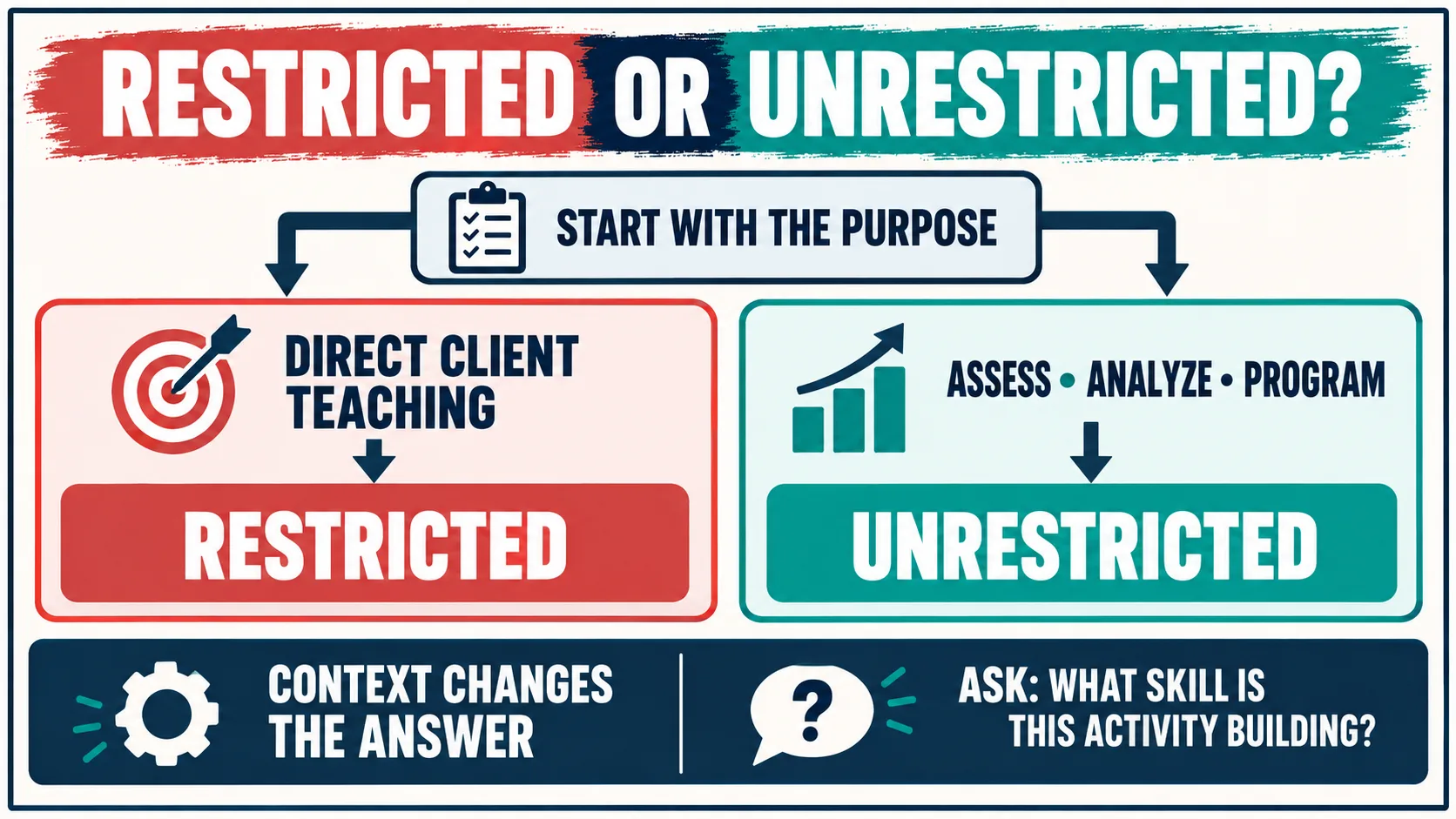
The phrase “data collection” illustrates why a label-only system fails. If you collect frequency data solely while implementing a client’s treatment procedure, the activity may be restricted. If you design or conduct data collection as part of a functional assessment to identify future programming needs, the same broad action may be unrestricted. The purpose, decision being supported, and level of analyst responsibility matter. Use three questions when a task feels borderline:
- What decision does this activity support? Is it helping you deliver an existing procedure, or helping you assess, analyze, design, evaluate, or improve a behavior-analytic program?
- What was your role? Were you following a plan, or were you making a supervised analyst-level contribution that your supervisor can review?
- What evidence would show the purpose? Can the note identify the client, behavior-analytic goal, data or decision, and supervisor review?
A task can also contain more than one component. For example, a caregiver meeting may include direct rehearsal of a program, feedback about implementation, review of graphs, and planning for generalization. Do not automatically assign the entire block to one category if the work genuinely contained distinct activities. Break the entry into meaningful segments where your documentation and supervisor’s system allow it.
A Six-Step Classification Check
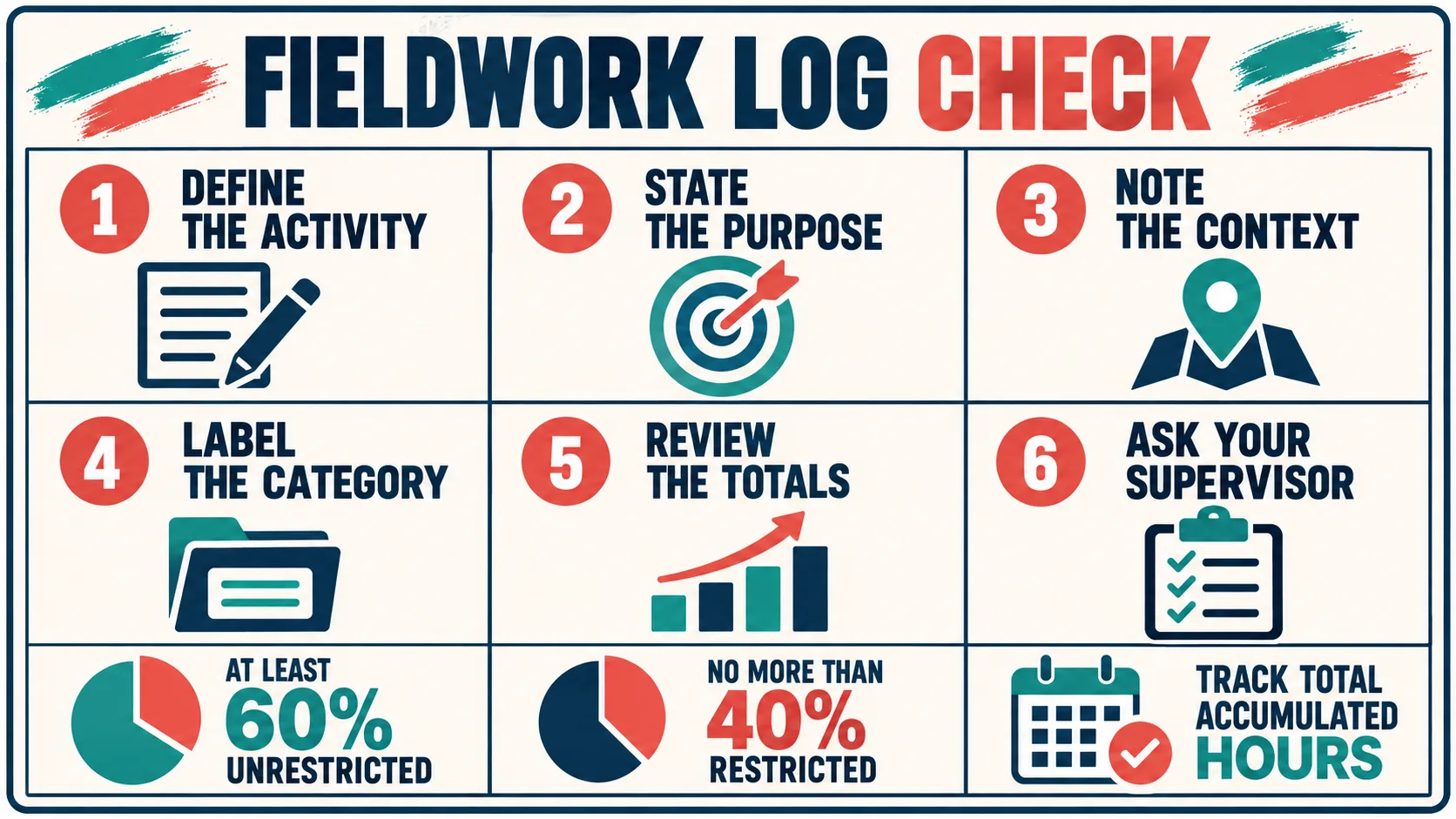
Before adding hours to a tracker, use the following sequence. It creates a repeatable record and gives your supervisor a specific question instead of a vague request to “approve these hours.”
- Define the activity. Write what you actually did, not a generic job title. “Collected data” is weaker than “collected ABC data during an assessment observation to test the current hypothesis.”
- State the purpose. Identify the clinical or learning decision the activity supported. A direct procedure and a program-evaluation task may occur during the same visit but have different purposes.
- Note the context. Record the client, setting, target, program, and whether you were implementing, assessing, analyzing, designing, or training.
- Label the provisional category. Mark restricted, unrestricted, or “needs supervisor review.” A provisional label is safer than silently counting an uncertain entry.
- Review the running totals. Add the entry to your accumulated restricted and unrestricted totals. Do not judge the ratio from one week or one calendar month alone.
- Ask your supervisor. Send the exact activity description and your reason. The supervisor is responsible for determining whether the activity meets the requirements and supports your professional goals.
| Borderline situation | What to examine | Better log question |
|---|---|---|
| Data collection during a session | Was the data collected only as part of direct treatment, or to evaluate an assessment or programming decision? | What decision did the data make possible? |
| Caregiver or staff training | Did you teach a behavior-analytic program and provide feedback, or simply supervise routine implementation? | What skill was taught, rehearsed, or evaluated? |
| Program writing or revision | Was the work tied to a real client and based on behavior-analytic assessment or data? | Which client-specific evidence informed the revision? |
| Team meeting | Did the meeting contain substantive behavior-analytic assessment, analysis, programming, or training? | Which behavior-analytic decision or product came from the meeting? |
How the 60/40 Fieldwork Math Works
For the BCBA fieldwork rule described in the current handbook, unrestricted activities must make up at least 60% of the total applicable fieldwork hours. Restricted activities may make up no more than 40%, and there is no separate minimum restricted-hour target. The key word is total: the requirement is not a demand to hit an identical percentage every calendar month.
| Illustration | Unrestricted minimum | Restricted maximum |
|---|---|---|
| 2,000 total hours | At least 1,200 hours | No more than 800 hours |
| 1,500 total hours | At least 900 hours | No more than 600 hours |
| Your actual pathway | Apply the percentage to the requirements that govern your pathway and certification period. | Do not use an illustration as a substitute for the current handbook. |
For example, a trainee might have a restricted-heavy early period and later complete more assessment and program-design work. That pattern is not automatically a problem if the accumulated total satisfies the applicable rule and every entry is eligible, documented, and supervisor-reviewed. Conversely, a high unrestricted percentage cannot rescue hours that were not behavior-analytic, client-related, or otherwise acceptable.
If you combine fieldwork types or follow a pathway with different total-hour requirements, read the relevant handbook section instead of applying the examples above mechanically. The BACB’s Fieldwork: Getting It Right article also emphasizes that both categories must be behavior-analytic and related to client services.
How to Build a Defensible Log
A good fieldwork log lets another qualified person reconstruct the activity without guessing. Use one row per meaningful activity, or follow the form your supervisor requires. Keep the wording specific enough to explain the category, but do not include unnecessary identifying information in a file that does not need it.
| Log field | What to write | Quality check |
|---|---|---|
| Date and duration | Date, start/end or duration, and the applicable supervisory period. | Does the duration match the source record and monthly total? |
| Activity and purpose | A concrete action plus the behavior-analytic decision it supported. | Could a reviewer understand why the activity was done? |
| Category and rationale | Restricted, unrestricted, or pending review, with a brief reason. | Does the rationale match the current handbook examples? |
| Supervisor review | Review date, initials or required approval, and any correction requested. | Can you show that a supervisor reviewed the entry? |
Keep a running summary that separates unrestricted, restricted, total eligible, and unresolved hours. Also save the handbook version or official page you used when a rule was unclear. This does not turn your spreadsheet into an official BACB determination; it simply makes your question and evidence easier to review.
For a broader comparison of examples, see the site’s restricted-versus-unrestricted hours guide. For monthly tracking, the BCBA supervision tracking guide can support the record-keeping workflow. This page’s narrower job is the classification decision before an entry is counted.
Common Logging Mistakes
- Classifying by location: being in a clinic, classroom, or home does not automatically make an activity restricted or unrestricted.
- Classifying by job title: “BT,” “case manager,” or “trainee” does not determine the category; the actual behavior-analytic task and context do.
- Counting every meeting: a meeting counts only when its content and purpose meet the applicable behavior-analytic fieldwork requirements.
- Using a monthly shortcut: the 60/40 rule is not a reason to reject an otherwise eligible month or to ignore a deficit in the accumulated total.
- Relying on a template without review: a prefilled category can be wrong when the context changes. Ask the supervisor about unusual cases.
- Leaving corrections undocumented: if a supervisor reclassifies an entry, keep the revised description and date instead of silently changing the number.
The BACB cannot decide every activity from a generic description because the trainee’s goals, setting, client needs, and supervision structure matter. A clean escalation question is: “Here is what I did, why I did it, what client or program evidence I used, and what product or decision resulted. Which category should this entry use, and what should I change in the documentation?”
Frequently Asked Questions
What is the difference between restricted and unrestricted BCBA hours?: Restricted hours involve delivering therapeutic or instructional procedures directly to clients. Unrestricted hours are analyst-level activities such as assessment, analysis, program development, caregiver or staff training, and evaluation. The final classification depends on the activity’s purpose and context.
Is data collection restricted or unrestricted?: It can be either. Data collection performed solely as part of a client’s treatment procedure may be restricted. Data collection designed or conducted for a functional assessment or programming decision may be unrestricted. Describe the purpose and ask your supervisor when the context is not obvious.
Do I need 60% unrestricted hours every month?: Not necessarily. The current BCBA Handbook describes the unrestricted requirement across the total accumulated fieldwork hours, rather than requiring the same percentage in every calendar month. You still need to follow the applicable supervisory-period and total-hour rules for your fieldwork type.
Can restricted hours count toward BCBA fieldwork?: Eligible restricted activities can count, but they cannot exceed the applicable maximum. There is no reason to create restricted hours simply to fill a quota; the more important goal is to obtain the unrestricted experience required for future BCBA practice and document every eligible activity correctly.
Who decides whether an activity counts?: Your supervisor should review whether an activity meets the current requirements, aligns with your professional goals, and is supported by adequate documentation. The BACB supervision resources point trainees and supervisors back to the relevant handbook sections.
How can I use this topic for BCBA exam study?: Practice the reasoning, not just the percentages: identify the purpose, classify the context, calculate the running total, and choose the missing supervision question. After your fieldwork-log review, try the Free BCBA Mock Exam to rehearse scenario-based measurement, supervision, and ethics decisions. A practice result is study feedback, not an official fieldwork determination.
Final takeaway: do not count a fieldwork entry from a job label or a familiar activity name. Describe the purpose, examine the context, record the evidence, review the accumulated totals, and ask your supervisor about anything that could reasonably fit more than one category.
Quick Review Checklist
Use this final checklist to turn bacb restricted vs unrestricted hours into exam-ready reasoning. The goal is not to memorize a label in isolation; it is to identify the relevant evidence and explain why the best answer fits the scenario. Key ideas to review:
- State the central definition or decision point for bacb restricted vs unrestricted hours in your own words.
- Identify the detail that makes bacb restricted vs unrestricted hours different from its closest related ABA term.
- Separate the observable facts in a scenario from assumptions that are not supported by the facts.
- Write one example and one nonexample so you can recognize the concept in a new setting.
Exam application checks:
- Ask what the question is actually requesting before comparing the answer choices.
- Mark the antecedent, response, consequence, or other evidence that supports the selected answer.
- Look for a distractor that describes a related process but does not answer the specific question.
Final self-check:
- Explain how you would verify the interpretation with clear observations or data.
- Change one detail in the scenario and decide whether your answer should change.
- Give a one-sentence rationale that a supervisor or study partner could evaluate.
Take the Free BCBA Mock Exam
When you are ready to apply the idea, use the free practice resource below for additional feedback. Take the Free BCBA Mock Exam



